This Amazon SWOT analysis identifies the scale of its retail and seller ecosystem, fulfillment capabilities, and AWS as major strengths, while a cost-intensive infrastructure and the complexity of operating many businesses at global scale are key weaknesses. The strongest growth paths are AWS and artificial intelligence, seller and advertising services, and better international execution. The most material threats are intense competition, regulation and litigation, trade and labor volatility, cybersecurity, and service disruption.
This is an editorial SWOT analysis based primarily on Amazon's fiscal 2025 disclosures. Amazon does not publish these four SWOT categories, so the classifications and opportunity judgments below are analytical interpretations rather than company forecasts.

What Is the SWOT Analysis
A SWOT analysis separates internal conditions from external conditions. Strengths and weaknesses describe capabilities or constraints inside the company. Opportunities and threats describe changes outside the company that could improve or weaken its position. That distinction matters: for example, AWS is an existing strength, while future demand for AI infrastructure is an opportunity whose size and timing remain uncertain.
Each point should be tied to dated evidence and a decision. The evidence window here is Amazon's fiscal year ended December 31, 2025. Financial and risk statements come from Amazon's 2025 Annual Report, which contains its Form 10-K filed with the SEC in February 2026. Where the filing describes a risk, this article treats it as a disclosed exposure, not proof that the adverse event will occur.

An Overview of Amazon
Amazon reports three operating segments: North America, International, and Amazon Web Services (AWS). It serves consumers through online and physical stores, enables third-party sellers to sell and fulfill orders, provides cloud services through AWS, offers advertising and subscriptions, manufactures devices, and produces media content. This breadth is strategically important because Amazon competes across retail, logistics, cloud computing, advertising, devices, entertainment, grocery, and healthcare rather than in a single market.
In fiscal 2025, Amazon reported consolidated net sales of $716.9 billion, up 12% year over year. North America generated $426.3 billion, International $161.9 billion, and AWS $128.7 billion. AWS grew 20%, International grew 13%, and North America grew 10%. These figures show both the scale of the stores business and the increasing importance of services, but they do not make every business equally profitable or eliminate execution risk.
For complementary views, the Amazon business model explains how its revenue engines fit together, while the Amazon value chain analysis maps the activities that create and deliver value. This page stays focused on Amazon's strategic position rather than repeating those two topics.

Amazon Company SWOT Analysis
The following SWOT uses the 2025 filing as its factual base. A useful reading is not simply to count items in each quadrant, but to test whether a strength can offset a threat and whether an opportunity justifies the cost and risk required to pursue it.

Try for Free
Strengths of Amazon Company
A broad, connected customer ecosystem. Amazon serves consumers, sellers, developers, enterprises, content creators, and advertisers. Product sales are reinforced by service revenue from third-party seller fees, AWS, advertising, Prime memberships, and digital subscriptions. The combination gives Amazon several ways to deepen customer relationships and spread investments across multiple offerings.
Selection, convenience, and fulfillment capability. Amazon identifies selection, price, convenience, and fast, reliable fulfillment as central competitive factors. It fulfills orders through North American and international networks, supplemented by co-sourced and outsourced arrangements in some countries. That operating reach is difficult to reproduce quickly, even though it is expensive to maintain.
A large and growing cloud platform. AWS generated $128.7 billion in 2025 sales and grew 20% year over year. Its services span compute, storage, databases, analytics, AI, and machine learning. AWS therefore provides Amazon with enterprise relationships and technical capabilities beyond consumer retail.
A culture oriented toward invention and long-term investment. Amazon states that customer obsession, invention, operational excellence, and long-term thinking guide the company. Its continuing investment in technology and infrastructure supports retail, cloud services, and AI initiatives, creating a platform for new products when execution is disciplined.
Weaknesses of Amazon Company
A heavy cost and capital burden. Amazon reported $102.7 billion in shipping costs in 2025, alongside $109.1 billion of fulfillment expense and $108.5 billion of technology and infrastructure expense. These categories support important strengths, but they also make returns sensitive to utilization, productivity, energy, transport, and infrastructure costs.
Operational complexity. Amazon must coordinate inventory, sellers, fulfillment centers, shipping partners, data centers, customer service, devices, media, advertising, and regulated services across many jurisdictions. The company itself warns that rapid global expansion can strain personnel, systems, financial resources, and internal controls.
Dependence on consistent execution across third parties and networks. Product availability and customer experience depend partly on sellers, suppliers, carriers, and technology providers. Poor inventory forecasts, inadequate staffing, supplier constraints, or delivery disruption can raise costs and damage trust even when the underlying demand remains strong.
Large investment can pressure near-term cash generation. Amazon expects technology and infrastructure spending to rise as it adds capacity and employees for AI and machine learning. Those investments may support long-term growth, but the filing explicitly notes that they can reduce short-term free cash flow and may not always produce the intended benefits.
Opportunities for Amazon Company
Monetize growing demand for cloud and AI services. AWS's 20% sales growth in 2025 and Amazon's stated intention to continue investing in AI indicate a credible expansion path. The opportunity is to convert infrastructure and model investment into durable customer usage; the uncertainty is whether revenue, capacity utilization, and pricing will justify the spending.
Increase the contribution of services around the retail ecosystem. Seller services, advertising, subscriptions, and fulfillment services extend beyond Amazon's own inventory. In 2025, growth in North America and International reflected, among other factors, sales by third-party sellers, advertising, and subscriptions. Expanding these services can deepen the ecosystem, provided Amazon maintains seller and customer trust.
Improve international scale and efficiency. International sales grew 13% in 2025 and represented 23% of consolidated revenue. Further growth can come from better selection, logistics, and local service adoption, but it should be evaluated market by market because currency, regulation, trade rules, and local competition can change the return profile.
Apply shared capabilities across businesses. Fulfillment, data, cloud infrastructure, and AI can support several Amazon offerings. The strategic opportunity is not diversification for its own sake; it is reuse of an existing capability where Amazon can define a customer problem, measure adoption, and set a clear threshold for continued investment.
Threats of Amazon Company
Intense competition across several industries. Amazon's filing describes competition from physical, e-commerce, and omnichannel retailers; logistics and e-commerce service providers; cloud and AI companies; advertising platforms; device makers; grocery businesses; and healthcare providers. Price competition and better-funded entrants can increase investment needs or weaken growth.
Regulatory and legal exposure. Amazon is subject to evolving rules covering competition, consumer protection, privacy, data, employment, AI, advertising, healthcare, and other activities. The FTC's Amazon e-commerce case page records antitrust allegations by the agency and state partners. Those claims should be described as allegations unless and until a court establishes otherwise.
Trade, supply, labor, and currency volatility. Tariff changes, geopolitical events, supplier constraints, fuel and transport costs, labor availability, and foreign exchange movements can affect demand, costs, and international results. These risks are more specific and decision-useful than treating any single past crisis as a permanent threat.
Cybersecurity and service availability. Amazon processes large volumes of sensitive data and depends on always-available stores, services, and infrastructure. Data loss, security incidents, or system interruptions could reduce sales, create regulatory exposure, and damage customer and seller confidence.
For a separate review of political, economic, social, technological, legal, and environmental forces, see the Amazon PESTLE analysis. It complements this threat section but should not replace company-specific evidence.
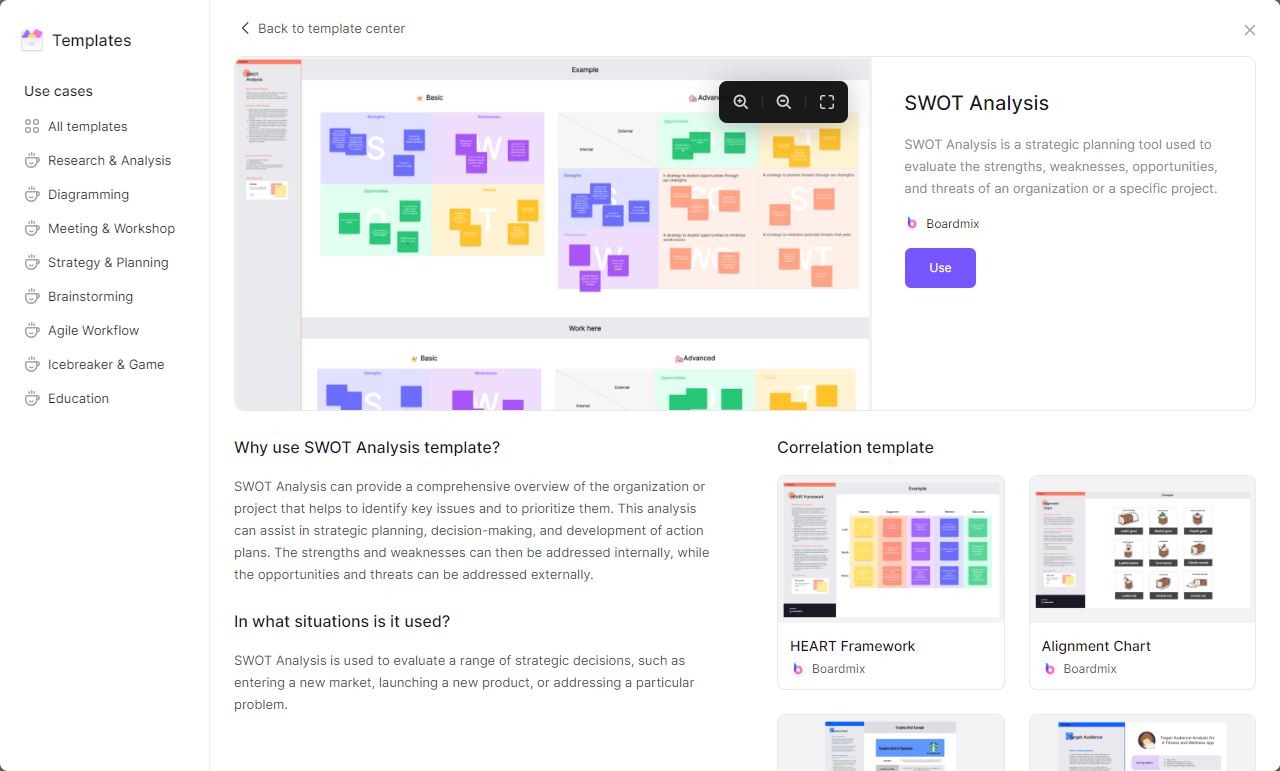
Key Takeaway: SWOT Analysis Template & Tool
Amazon's strongest position comes from the interaction of its customer ecosystem, fulfillment network, and AWS. The same model creates a trade-off: scale and technical investment support growth, while also increasing cost, execution, and regulatory exposure. The practical question is therefore not whether Amazon has more strengths than weaknesses, but which investments can produce returns that exceed their infrastructure and compliance burden.
To keep the analysis useful, attach a source date, an owner, and a measurable signal to each item. For example, track AWS growth and capacity utilization for the AI opportunity, fulfillment cost and delivery performance for the logistics strength, and case status or rule changes for regulatory threats. Revisit the matrix when new annual or quarterly filings change those signals.
You can organize the evidence in a SWOT analysis template and compare the structure with these business SWOT analysis examples. Keep each statement concise, distinguish reported facts from interpretation, and link every time-sensitive claim to its source.