INTERNAL · HELPFUL
Strengths
- Regular customers offer a starting audience for testing demand.
- Experienced cooks can build a short, familiar lunch menu.
What can we build on?


Online Collaborative Whiteboard

Boardmix Developer Platform

AI tools for diagrams, writing, and ideas

UI/UX Tool, Figma Alternative

AI PPT Maker, Gamma Alternative
Run workshops, plan projects, and work with colleagues on a shared whiteboard.
Explore collaborative workBOARDMIX · AI SWOT ANALYSIS
Turn a business idea, product, or career decision into an editable SWOT analysis. Generate a first draft with AI, then build a stronger strategy together on one online whiteboard.
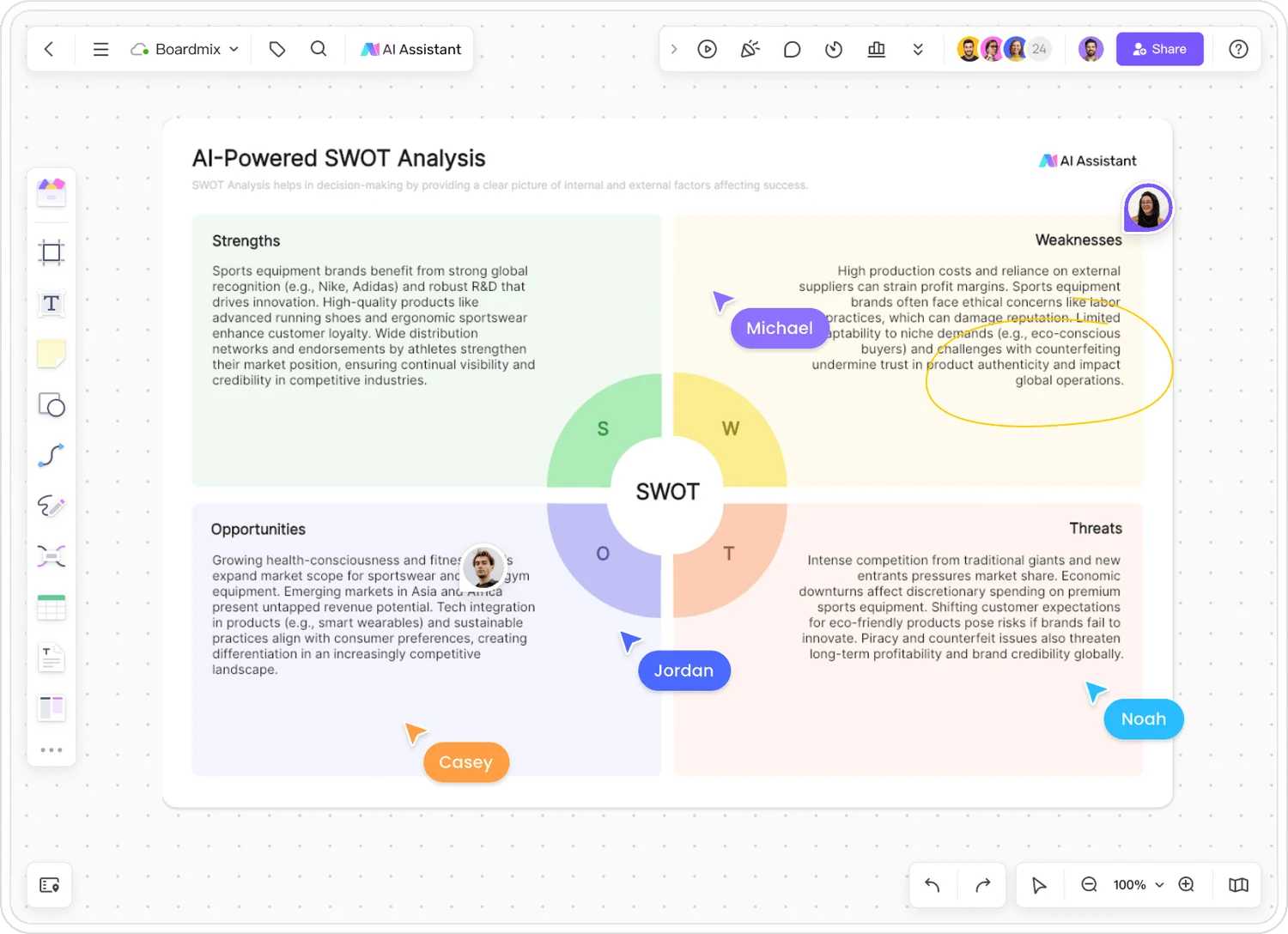
MORE THAN FOUR BOXES
A SWOT analysis separates internal strengths and weaknesses from external opportunities and threats. Boardmix helps you draft that structure with AI, then adds the space to discuss it: notes, research, diagrams, and your next plan stay together on an online collaborative whiteboard.
FROM A QUESTION TO A USEFUL MATRIX
Illustrative scenario: a neighborhood café is deciding whether to offer weekday lunch pickup for nearby offices. A focused question produces a more useful discussion than “analyze my business.”
“Create a SWOT analysis for a neighborhood café considering office lunch pickup. We have regular customers and experienced cooks, but a small kitchen and no preorder system. Nearby offices are potential customers; chains compete on price and ingredient costs vary. Separate internal from external factors. Flag assumptions instead of inventing market data.”
What can we build on?
What needs to change?
Which demand assumptions should we test?
What could make this difficult?
Use the café’s cooking strengths to explore office demand, while limiting pressure on the kitchen. Compare preparation time, customer feedback, and actual costs before committing to a wider launch.
A CLEAR STARTING POINT
Give the AI a decision to help you explore—not just a company name.
Include the business or project, target audience, objective, and constraints. Add known facts about capabilities, customers, and competitors.
Submit the prompt to Boardmix AI. Use the four SWOT categories as a starting structure; add missing context and remove irrelevant suggestions.
Ask teammates to add examples and question assumptions. Keep internal factors separate from external conditions, and put supporting notes beside the matrix.
Match a strength to an opportunity, or address a weakness that makes a threat more serious. Capture the selected action alongside the analysis.
AI TO GET YOU STARTED
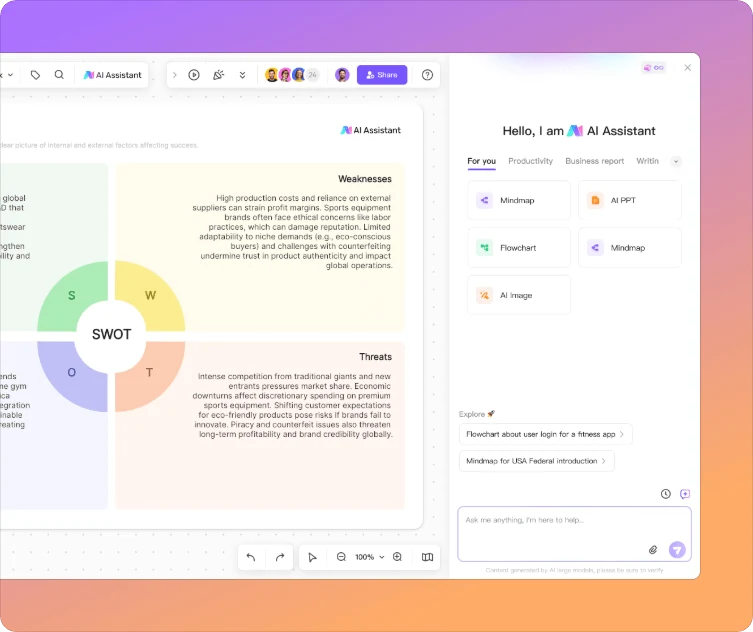
Turn your brief into an AI-generated SWOT analysis, then make it your own. Replace broad claims such as “strong brand” with specific strengths your team can explain. Expand useful points and remove those that do not fit the decision.
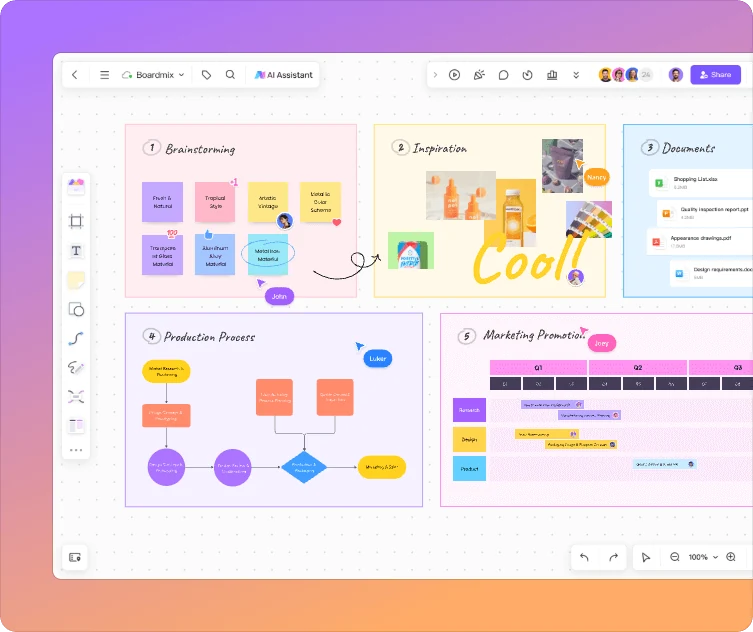
ROOM FOR THE WHOLE PICTURE
A four-box summary should not become a dead-end slide. Put customer notes, competitor observations, a business model, and a roadmap beside your SWOT analysis so the team can trace how an insight becomes a priority.
A SHARED VIEW, NOT A SOLO REPORT
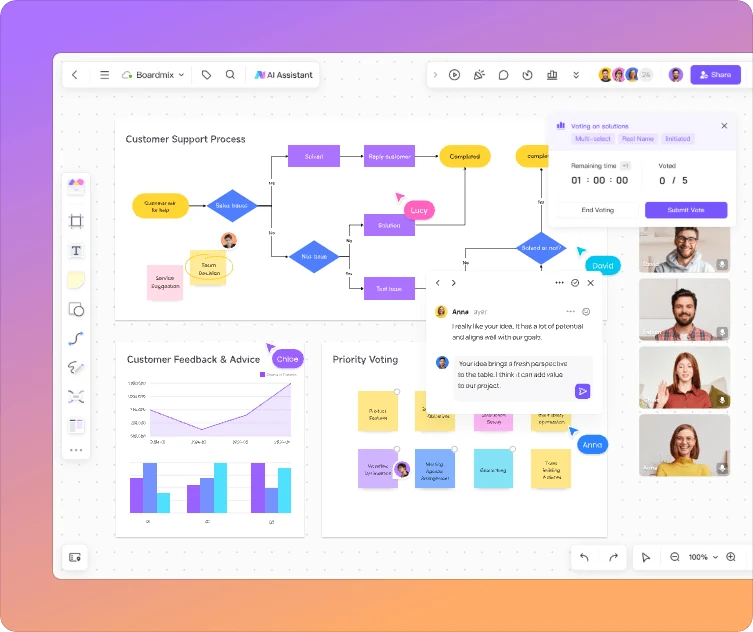
Sales, product, operations, and leadership see different parts of the same business. Invite them to work on the shared whiteboard, add comments, and refine the analysis in real time or return to it after the meeting.
START WITH A RELEVANT EXAMPLE
Explore these editable Boardmix examples for structure and inspiration. Adapt their assumptions to your own situation, or start with a SWOT analysis template.
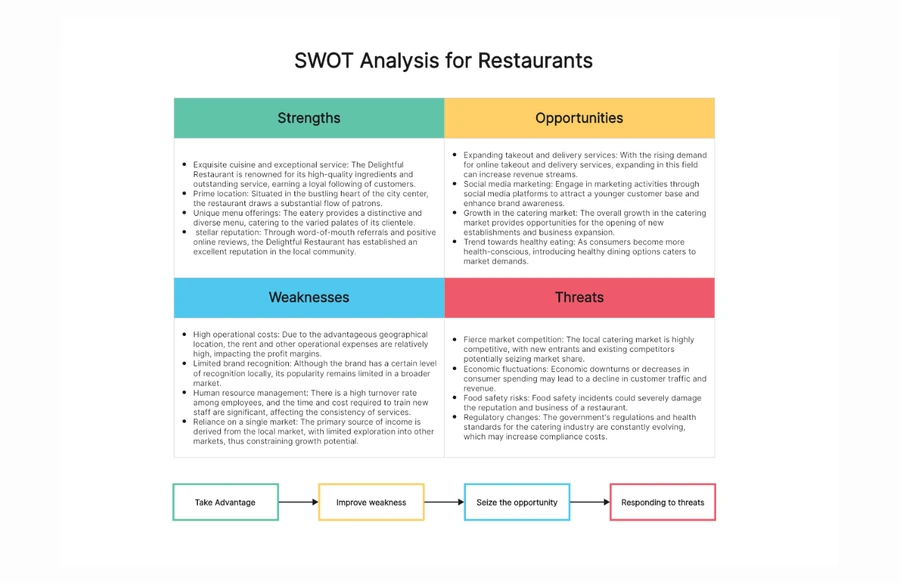
Consider menu strengths, capacity, local demand, and competition.
Explore example ↗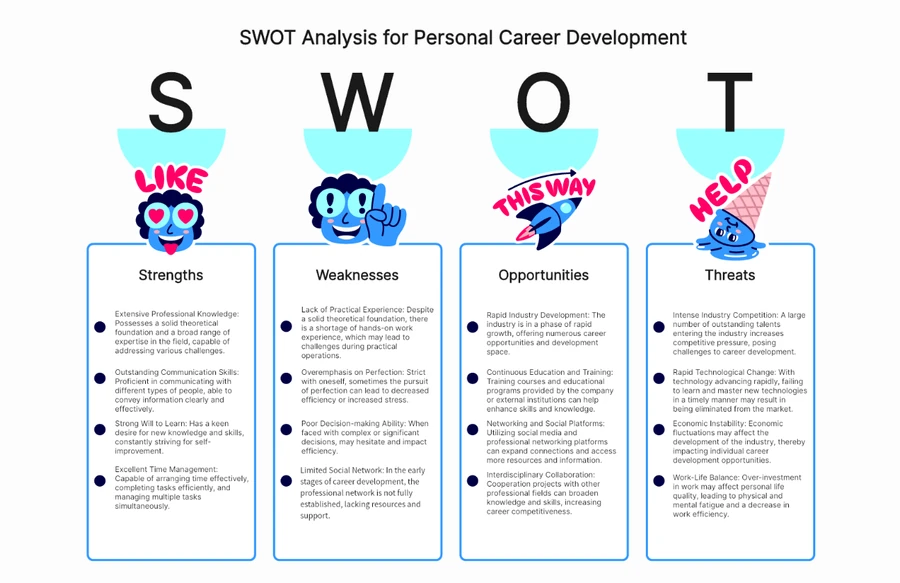
Compare your experience and skill gaps with career opportunities.
Explore example ↗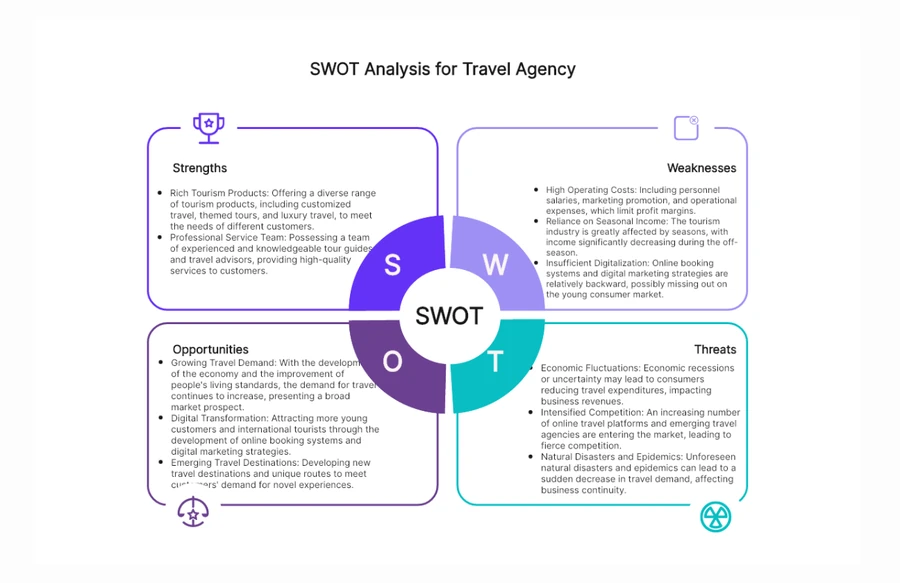
Explore service advantages, seasonal demand, and market pressures.
Explore example ↗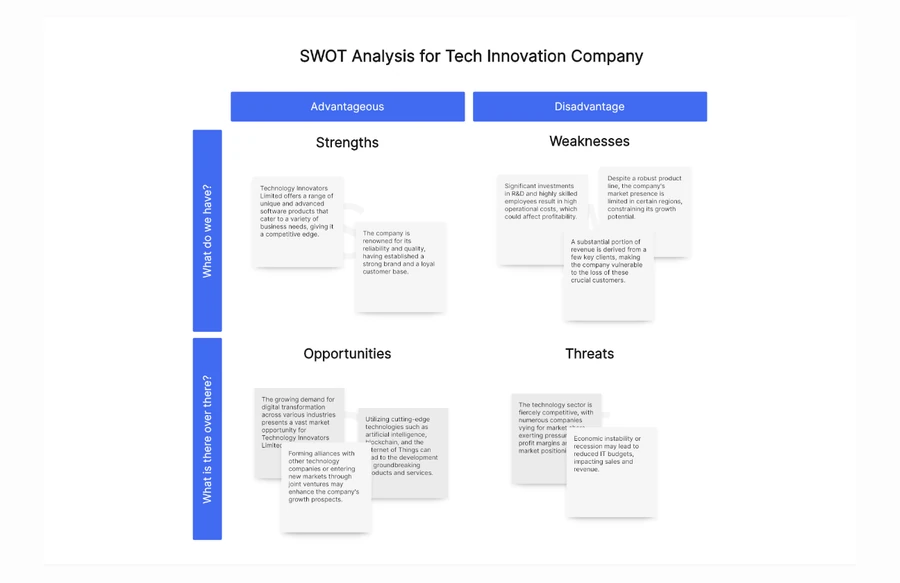
Examine product capabilities, market openings, and competitive risks.
Explore example ↗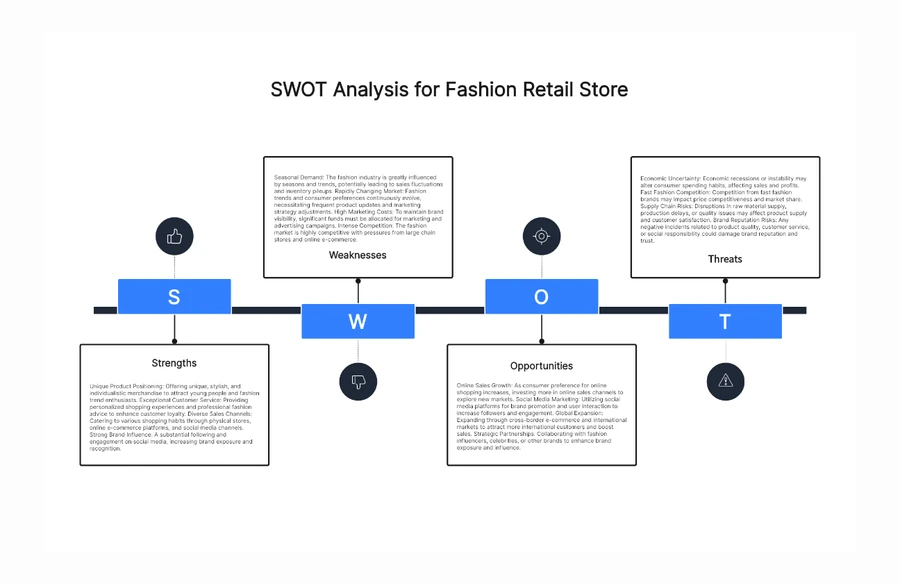
Connect assortment and store strengths with changing shopping habits.
Explore example ↗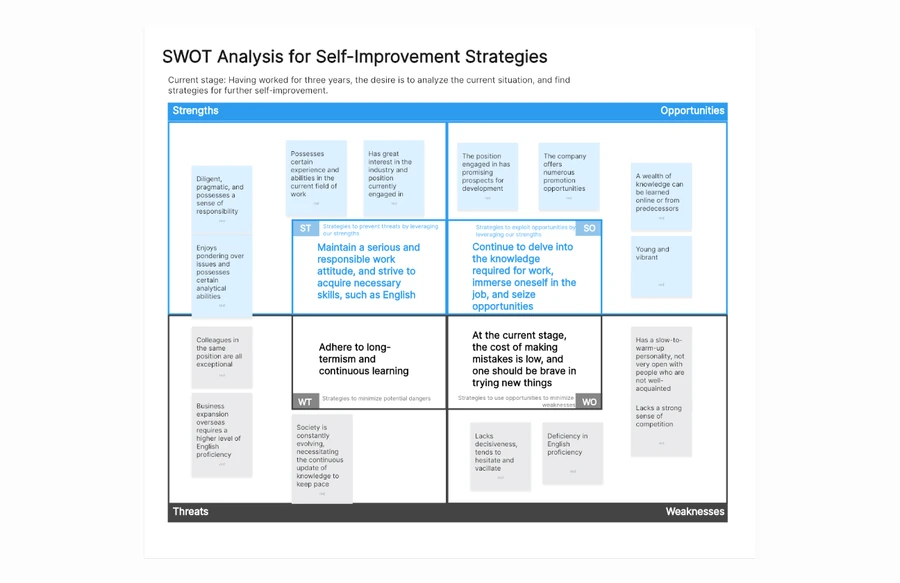
Turn strengths, habits, and external constraints into a focused plan.
Explore example ↗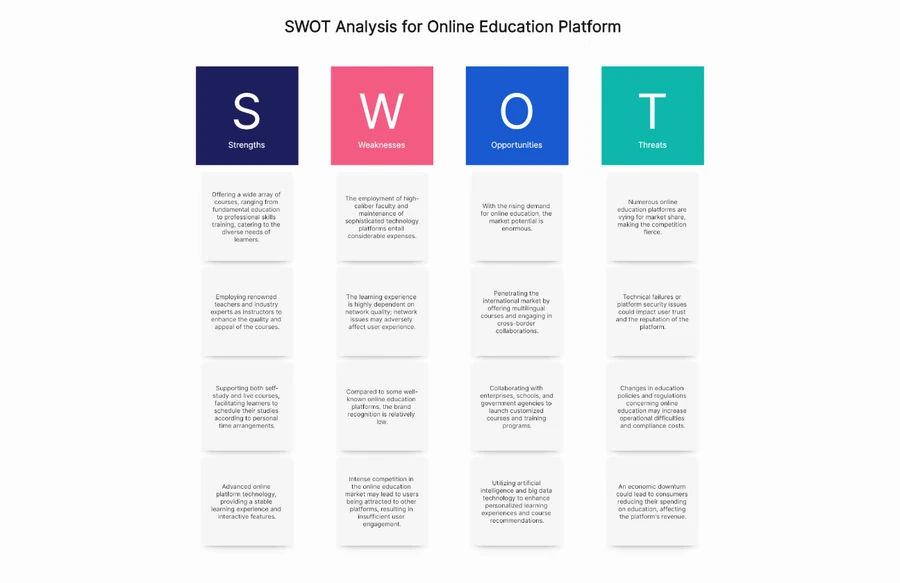
Consider learning content, delivery capabilities, and learner demand.
Explore example ↗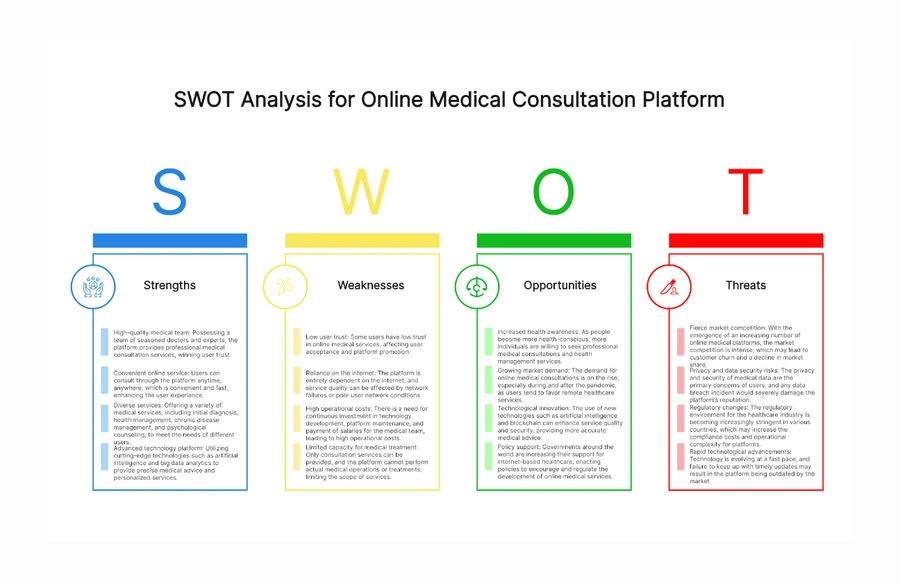
Explore service operations, access, and business risks—not clinical decisions.
Explore example ↗YOUR QUESTIONS, ANSWERED
Understand the output, improve your prompt, and choose a useful next step.
It uses your description to draft strengths, weaknesses, opportunities, and threats for a business, product, project, or personal decision. In Boardmix, you can develop that draft on an editable visual whiteboard and review it with your team.
State what you are analyzing, the decision or goal, the audience or market, and the facts you already know. Include constraints and competitor context when relevant. A short, specific brief is more useful than a company name alone.
Strengths and weaknesses are internal factors, such as skills, resources, or operating capacity. Opportunities and threats come from outside, such as changing customer needs or new competitors. For example, a small kitchen is a weakness; a competing restaurant’s price promotion is a threat.
Yes. Describe your career or development goal, relevant experience, skills you want to build, and external constraints. Use the result to identify options and priorities, then refine it with your own judgment or feedback from a mentor.
No. A generated SWOT is a draft, not independent market research. Confirm claims about demand, competitors, costs, and regulations with appropriate sources. Add your own evidence and remove assumptions that do not apply.
Yes. Boardmix supports shared whiteboards, real-time collaboration, and comments. Keep the SWOT beside supporting notes and your chosen actions so teammates can review the reasoning, not just the final four boxes.
Boardmix offers a free plan. AI usage is subject to your account’s available credits and current plan limits; it is not an unlimited free service. See Boardmix pricing for the current allowance and options.
FROM FIRST DRAFT TO SHARED DIRECTION
Describe the situation. Explore the four perspectives. Build the next plan with your team.