Firm infrastructure
Coordinate planning, finance, legal responsibilities, and quality policies. Keep business priorities and standards consistent across departments.


Online Collaborative Whiteboard

Boardmix Developer Platform

AI tools for diagrams, writing, and ideas

UI/UX Tool, Figma Alternative

AI PPT Maker, Gamma Alternative
Run workshops, plan projects, and work with colleagues on a shared whiteboard.
Explore collaborative workBOARDMIX · AI VALUE CHAINS
Turn your business description into an editable value chain. Map primary and support activities, connect the work behind customer value, and refine the analysis together on one whiteboard.
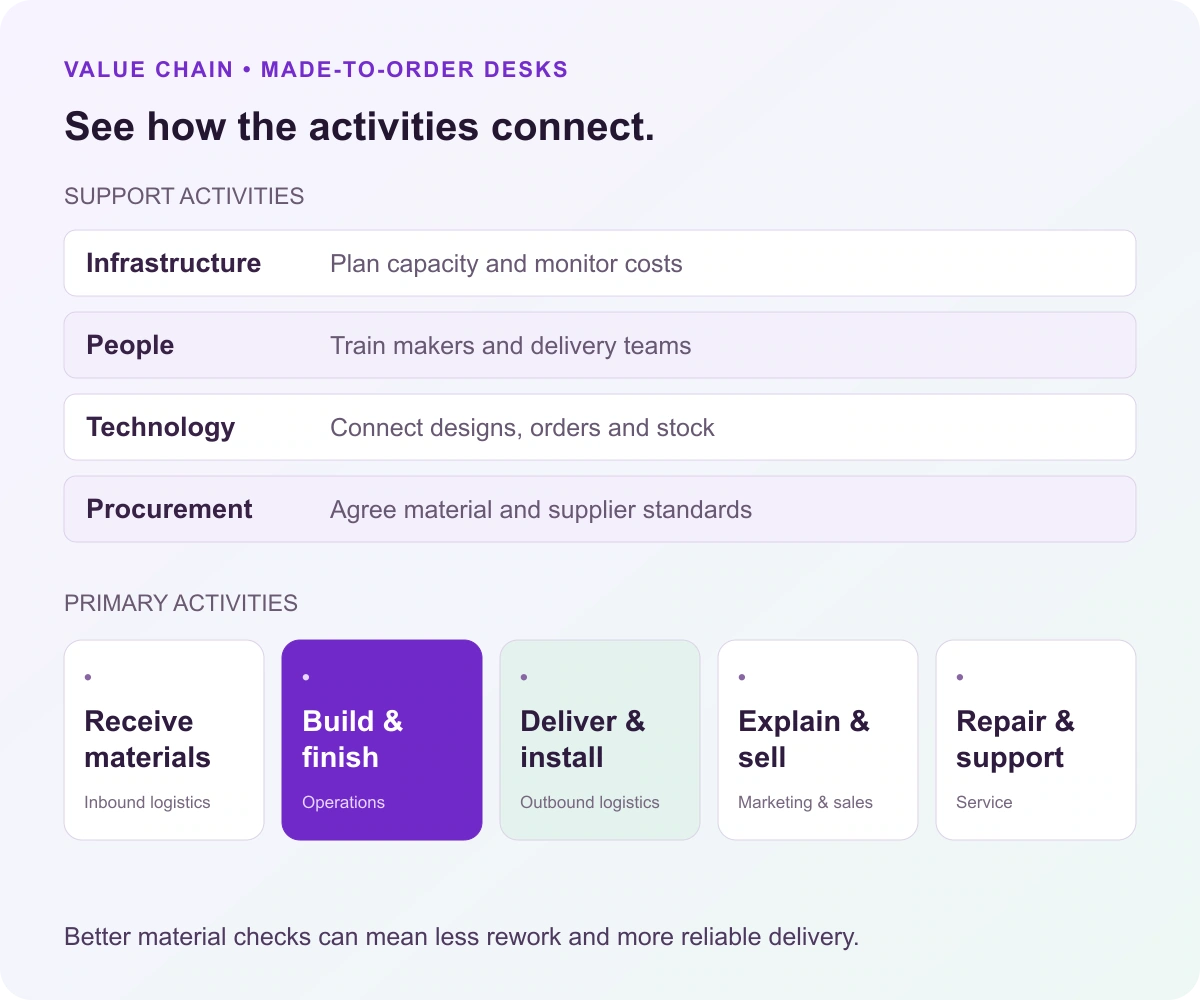
A complete value chain example
In this illustrative business, customers configure a desk online; the company builds, delivers, and supports it. Explore all nine activities—not just production—and the connections between them.
Capabilities that enable the whole business
Coordinate planning, finance, legal responsibilities, and quality policies. Keep business priorities and standards consistent across departments.
Recruit and train the people who sell, build, deliver, and support desks. Develop skills in reading specifications, handling materials, and recognizing defects.
Improve desk designs, cutting methods, finishing processes, and order information. Technology includes practical know-how and process improvement, not only software.
Select suppliers and purchase timber, hardware, tools, software, and transport services. Sourcing and buying are distinct from receiving and storing materials.
How the business creates, delivers, and maintains customer value
Inspect incoming timber and hardware, record unsuitable pieces, and store materials for the workshop. Catch material problems before they become finished-desk problems.
Confirm specifications, cut and assemble components, apply the finish, and inspect the desk. Track adjustments and rework rather than treating every delay as a scheduling issue.
Protect the finished desk, match it to the order, arrange delivery, and provide handling instructions. The product should arrive in the condition promised.
Explain dimensions, materials, finishes, and delivery expectations. Clear choices help align customer expectations with what the workshop is asked to build.
Help with assembly, resolve damage reports, and supply replacement parts. Recurring questions can reveal improvements to instructions, design, packing, or production.
These are activity categories, not a fixed sequence: selling a custom desk may happen before manufacturing it.
Look beyond individual costs
Inconsistent materials may require extra finishing, delay delivery, and increase service requests. Rushed packing can add another problem. A lower purchase price alone does not show whether the whole value chain improves.
Compare a stricter material specification with the downstream work it might prevent. Place receiving records, production notes, delivery reports, and customer messages beside the affected activities. Separate observed problems from possible explanations.
Prefer to build the structure yourself? Start with a value chain template.
From business context to a working model
Use the input above. Include the offer, customers, delivery model, and issue to explore. A desk manufacturer with repeat finishing work gives more direction than “furniture industry.”
Continue through the AI creation flow to get a draft. Replace generic labels with actual work, distinguish procurement from inbound logistics, and add missing activities.
Invite colleagues to edit and comment in Boardmix. Connect related activities and supporting notes. Keep a process map nearby when an activity needs closer examination.
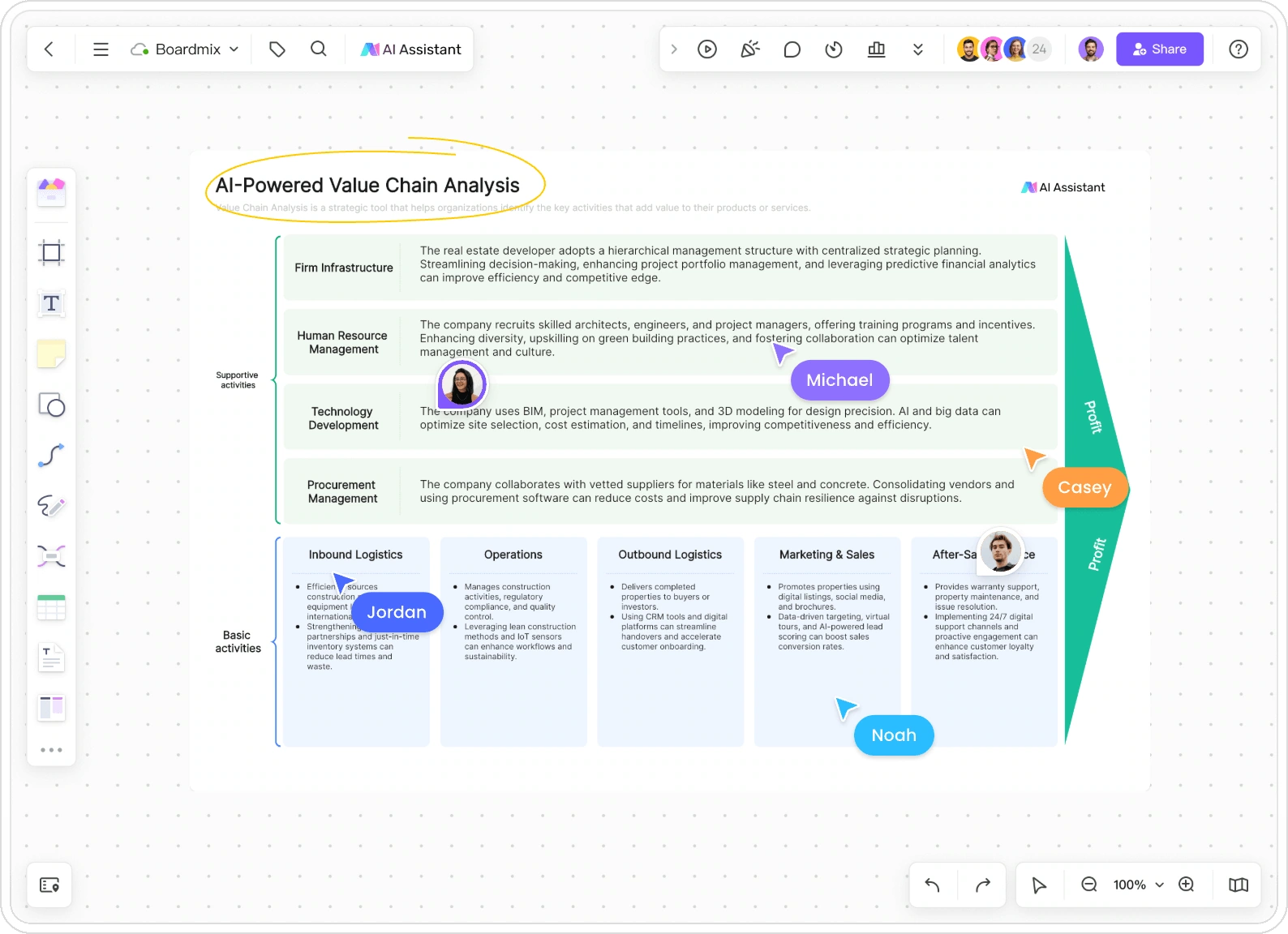
New to the framework? Learn how to organize and interpret a value chain diagram.
Better context, a more useful starting point
Choose a starting point, then adapt the details to the work you want to understand.
Create a Porter value chain for a business making desks to order and selling online. Customers choose sizes and finishes. Include five primary and four support activities. Focus on how material quality, rework, packaging, delivery, and replacement parts connect. Do not invent costs or performance results.
Map the value chain of an online retailer selling reusable kitchen products purchased from suppliers. We hold stock, pack orders, use delivery partners, and handle returns. Distinguish procurement from receiving and storage. Explore how product information, order accuracy, and returns handling affect customers.
Create a Porter value chain for a bookkeeping service serving independent retailers. Adapt the activities to receiving client records, producing accounts, delivering reports, winning customers, and supporting questions. Include training, technology, procurement, and management. Do not add physical warehouses or manufacturing stages.
More than a generated diagram
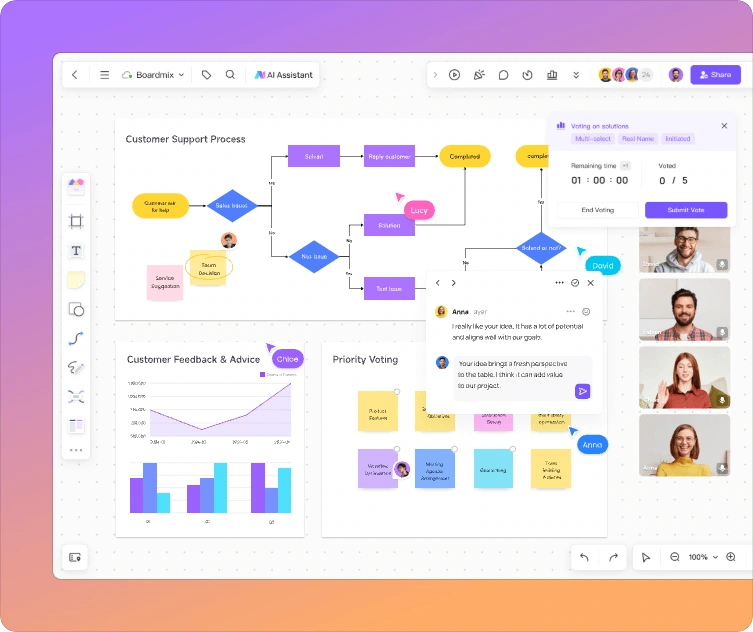
Purchasing may see a favorable price while production sees more rejects. Put both observations beside the affected activities rather than merging them into an unsupported conclusion.
Add notes, source links, and related diagrams beside the model. Colleagues can see what prompted a proposed change without searching a separate presentation.
Place the current and proposed models side by side. Discuss how fewer material options could simplify production while changing the customization customers value. Edit and comment in the same whiteboard.
Explore different business contexts
Browse community models for structural ideas, then replace their assumptions with information about your business.
Sporting goods and retail
View example →Coffee and customer service
View example →Consumer technology
View example →Furniture retail and delivery
View example →Restaurant operations
View example →Food and beverages
View example →Telecommunications
View example →Online retail
View example →AI helps structure a first draft. It does not know your actual costs, operating problems, or customer priorities unless you provide them. Add that information to the editable model and discuss the relationships with your team.
A value chain examines how business activities contribute to customer value, cost, and differentiation. A supply chain focuses on how inputs and outputs move through suppliers, operations, and delivery partners. The views overlap but answer different questions.
Describe the business, its customers, what it provides, and how it delivers it. Add a specific question, such as reducing rework or improving after-sales support. Include relevant constraints without unnecessary confidential details.
Boardmix offers a Free plan for getting started with the whiteboard. AI access and credits depend on your account and plan. See Boardmix pricing for current AI options.
Yes. Teammates can edit and comment on the shared Boardmix model. Invite colleagues from purchasing, operations, sales, and service so the analysis reflects how the business actually works.
The example uses Porter's five primary and four support categories to examine important activities and their connections. Harvard Business School explains the strategic perspective; Cambridge's guide describes the activity categories.
Start with your business
Turn the first draft into a shared view of the activities that matter to your customers.
Generate my value chain