Specific
Improve the first reply to incoming weekday support tickets, rather than every part of customer service at once.


Online Collaborative Whiteboard

Boardmix Developer Platform

AI tools for diagrams, writing, and ideas

UI/UX Tool, Figma Alternative

AI PPT Maker, Gamma Alternative
Run workshops, plan projects, and work with colleagues on a shared whiteboard.
Explore collaborative workBOARDMIX · SMART GOAL SETTING
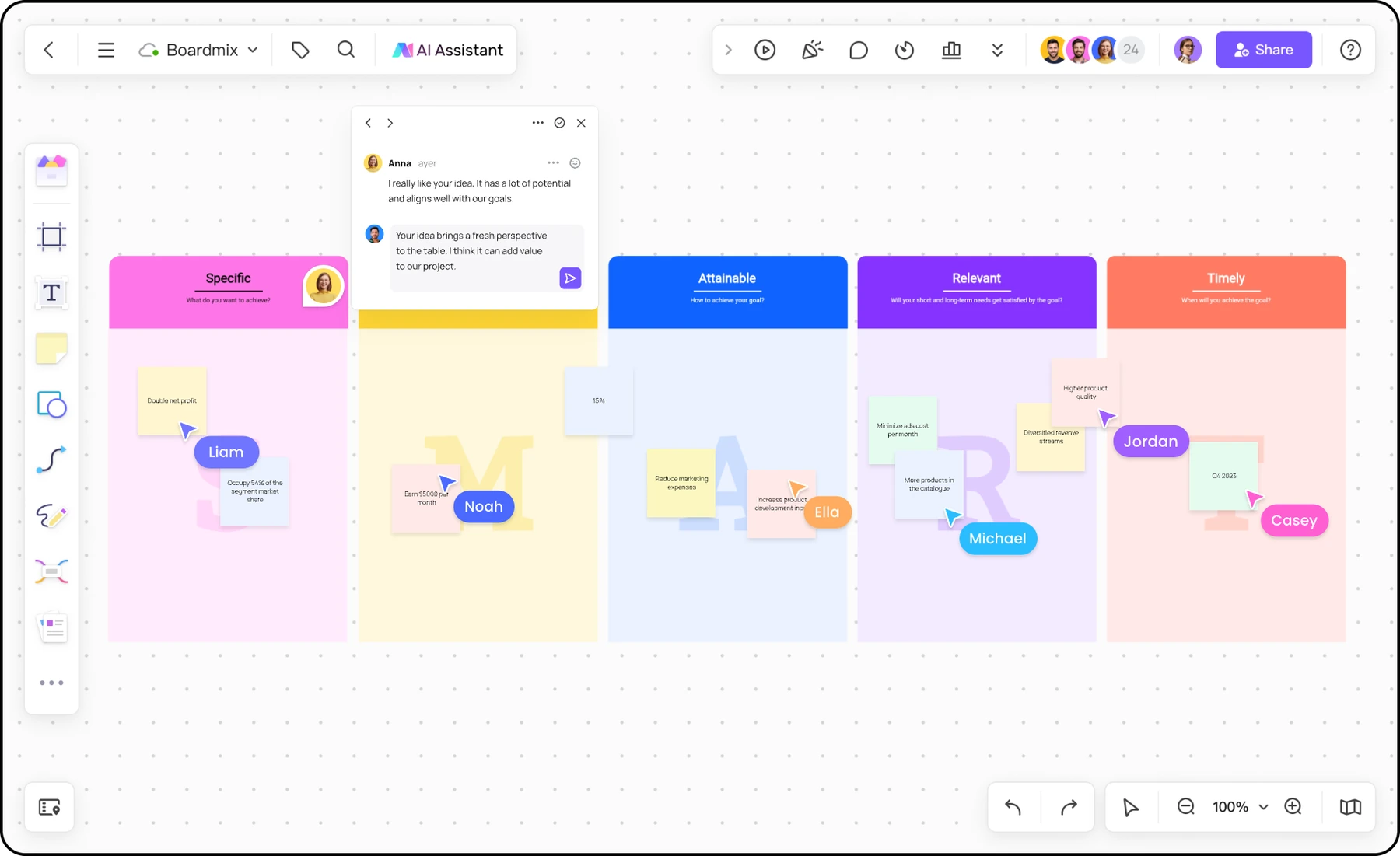
Turn a broad ambition into a goal your team can act on. Define the outcome, agree how to measure it, and keep the plan, discussions, and progress together on a visual board.
FROM INTENTION TO A WORKABLE GOAL
SMART means Specific, Measurable, Achievable, Relevant, and Time-bound. Use the five questions to sharpen a goal, then give it an owner and a practical plan.
“Improve customer support.”
Illustrative team planning exampleThe support lead owns the goal. The team will test a rotating triage role and a shared response guide, then review the results each week.
Improve the first reply to incoming weekday support tickets, rather than every part of customer service at once.
Track median first-response time against the eight-hour baseline. Use the same business hours and ticket scope throughout.
Check that the team can cover triage and maintain the guide before committing to the four-hour target.
Help customers get useful support sooner. Keep the reopen rate visible so speed does not replace response quality.
Evaluate the goal at the end of week eight, with weekly reviews to spot problems and adjust the work.
For this example, count only the team's defined support hours. Compare the same ticket categories and let the seven-day reopen window finish before evaluating each cohort.
START WITH A RELEVANT STRUCTURE
A sales target, a learning goal, and a system rollout need different measures. Explore these existing Boardmix examples, then replace their sample targets and dates with your own.
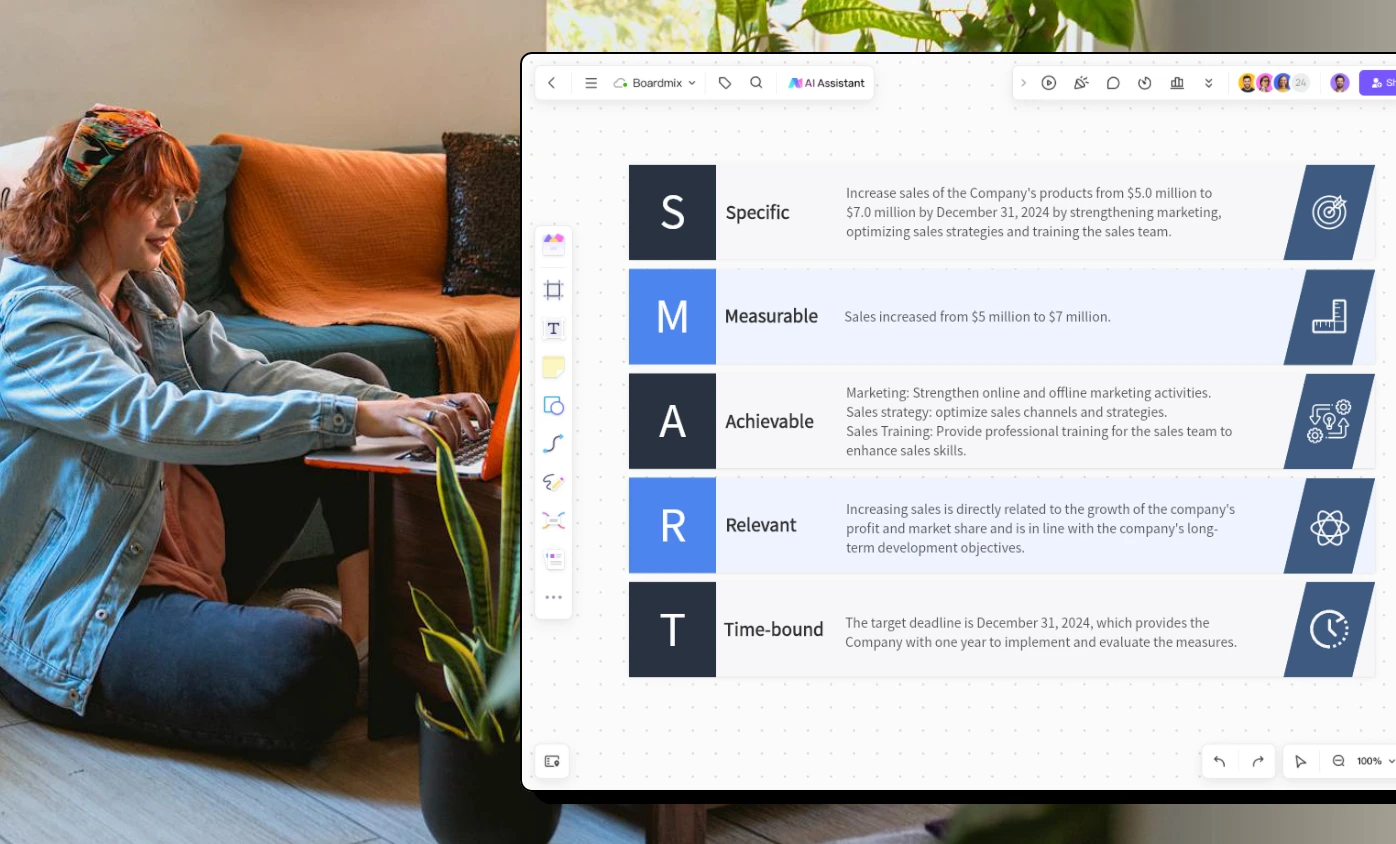
Define the sales measure, the starting point, and the period. Keep the activities that support the target separate from the result itself.
View sales growth template →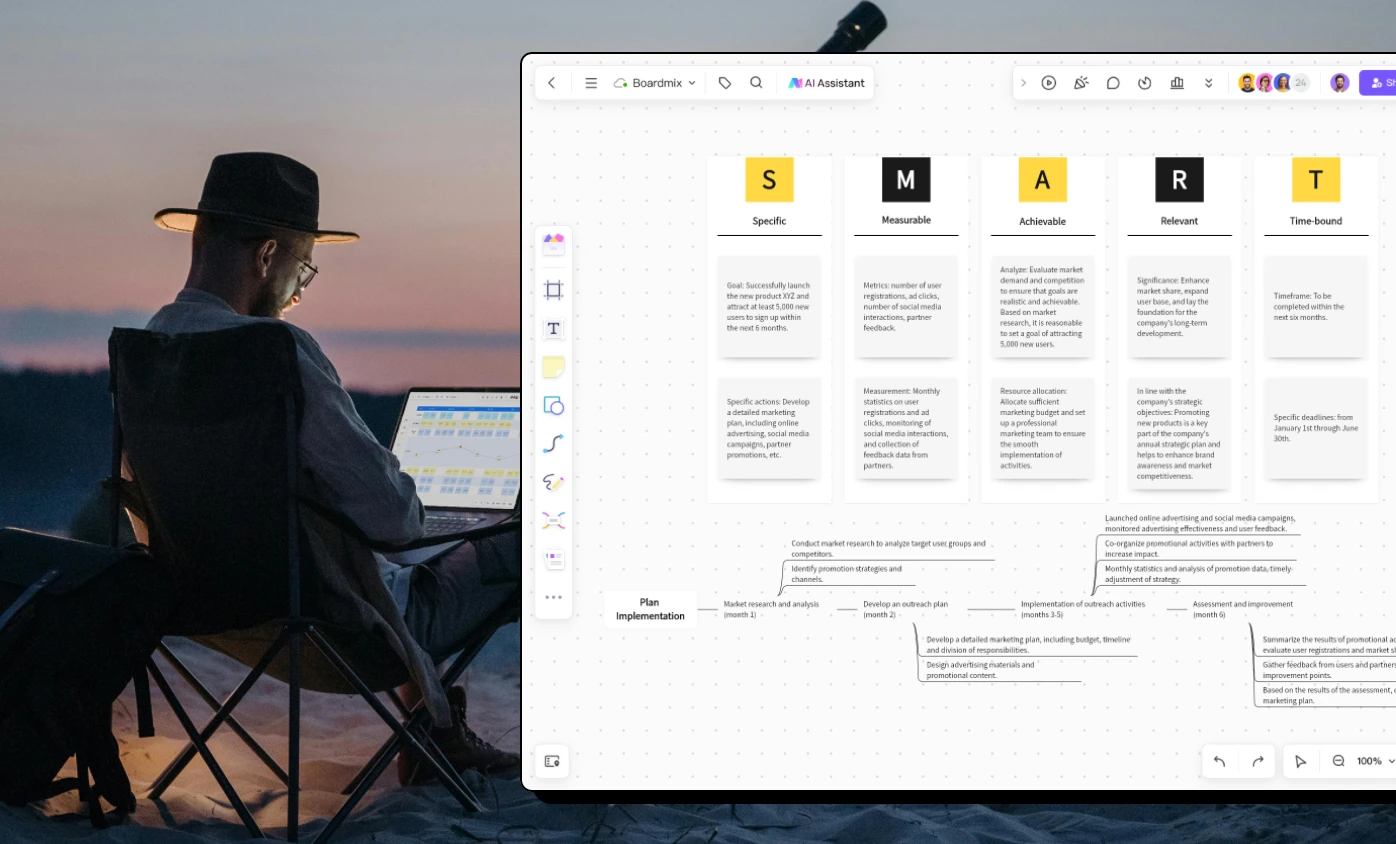
Set a focused promotion objective and decide which audience, result, and campaign period the team will evaluate.
View product promotion template →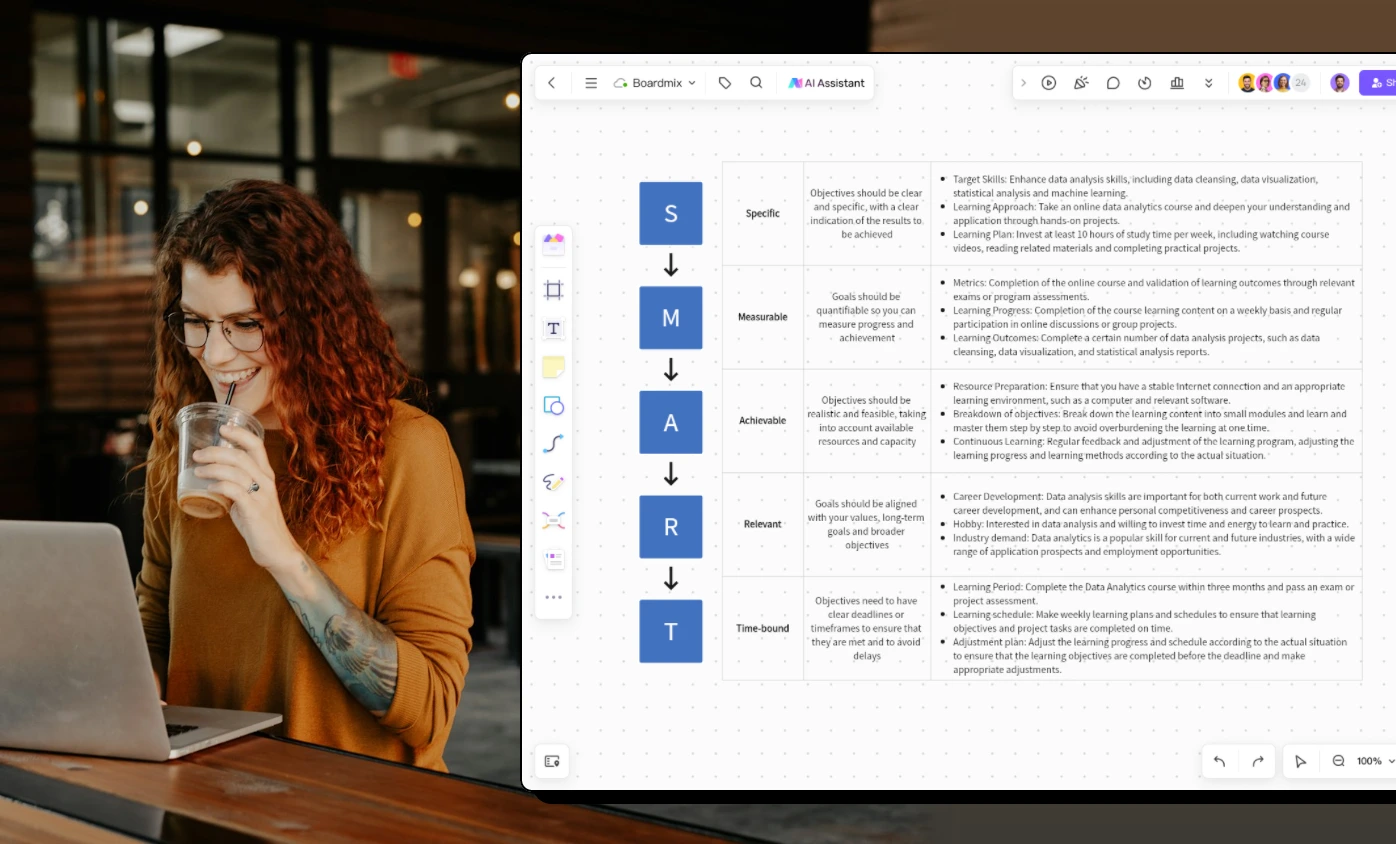
Connect learning to a practical output. Describe the skill you will apply, the work you will produce, and how it will be reviewed.
View data analysis skills template →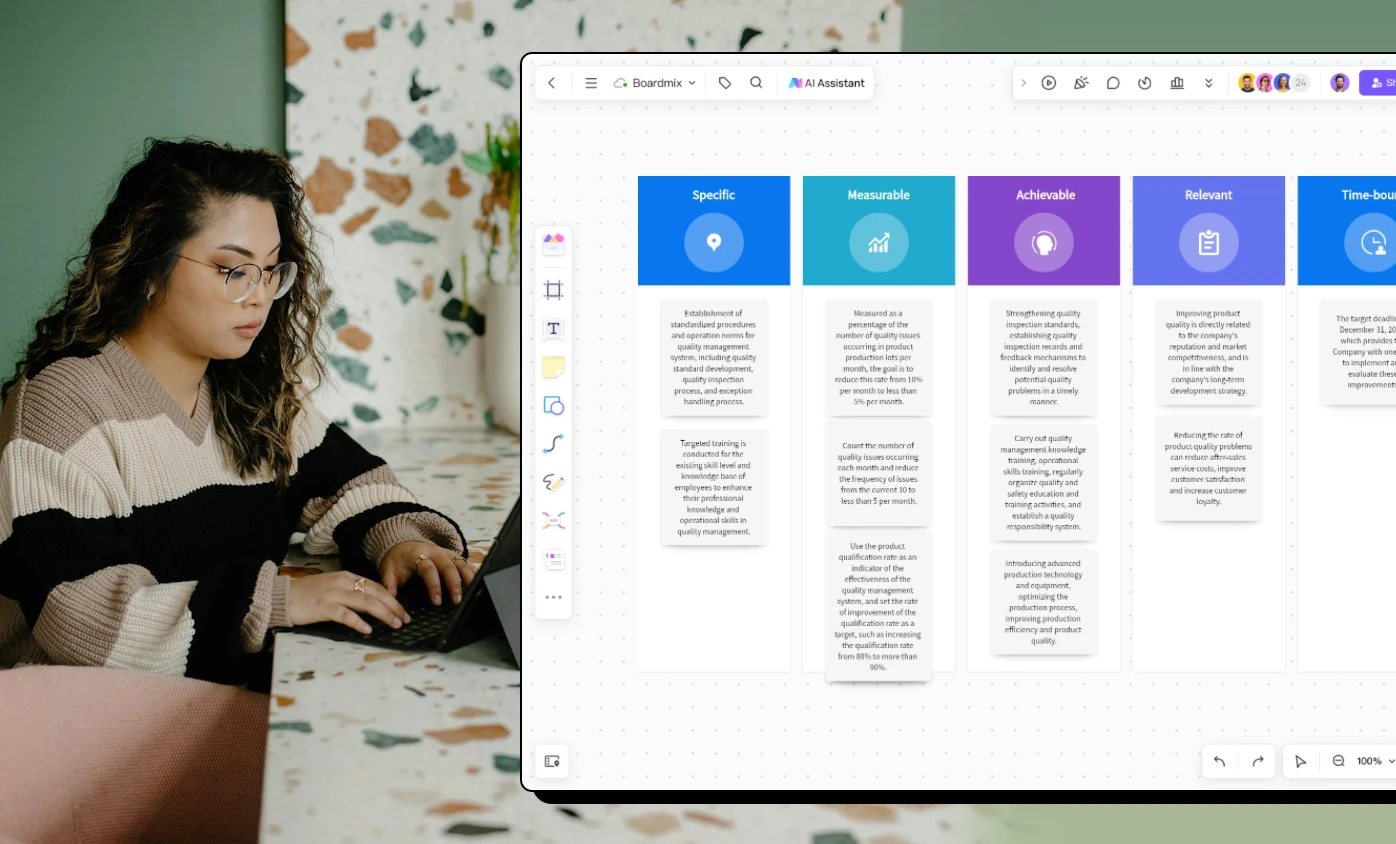
Choose a specific quality problem and a consistent measure. Include the work needed to test whether the change helps.
View product quality template →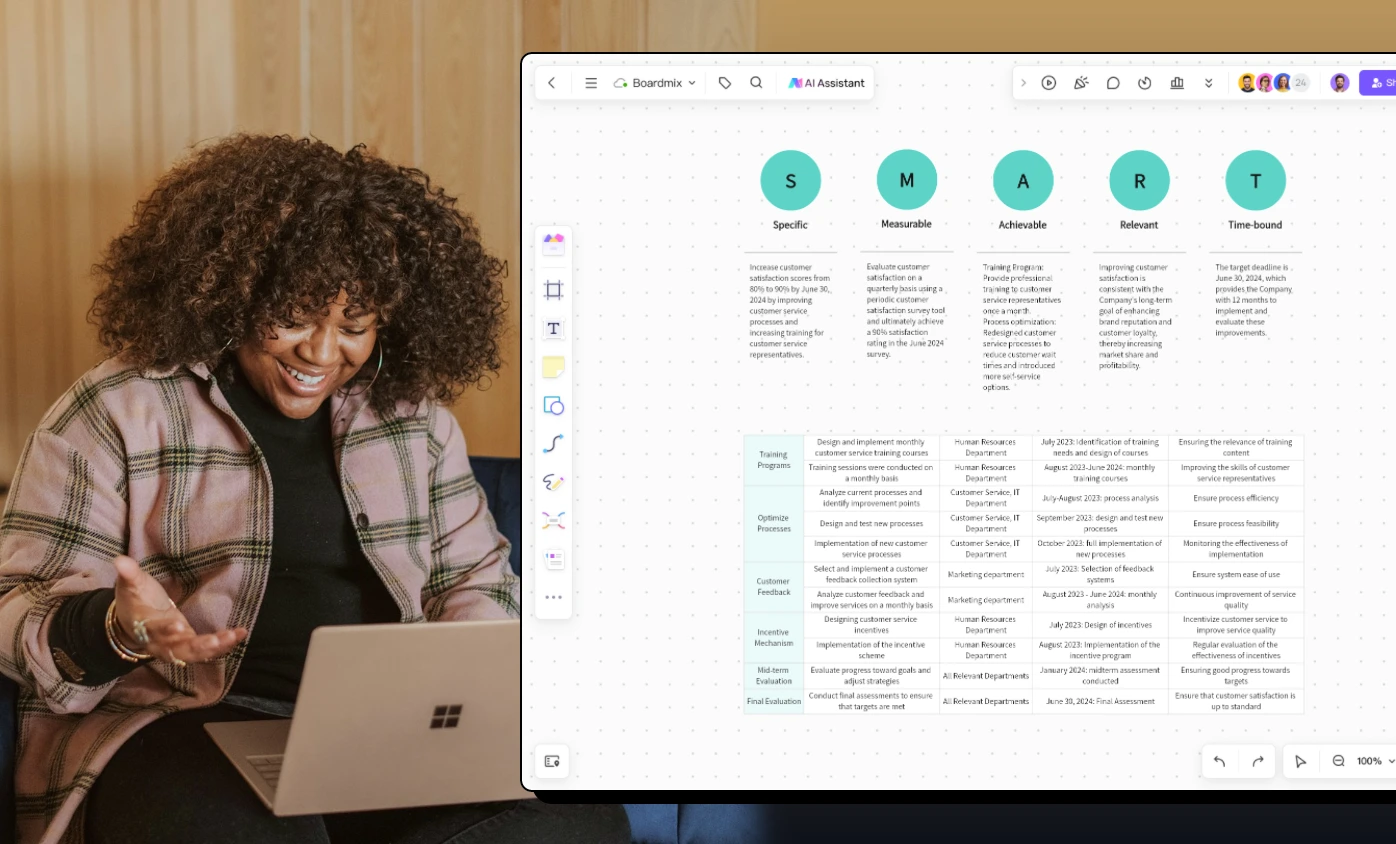
Make the customer outcome and feedback source explicit. Define who you will ask and when you will review the result.
View customer satisfaction template →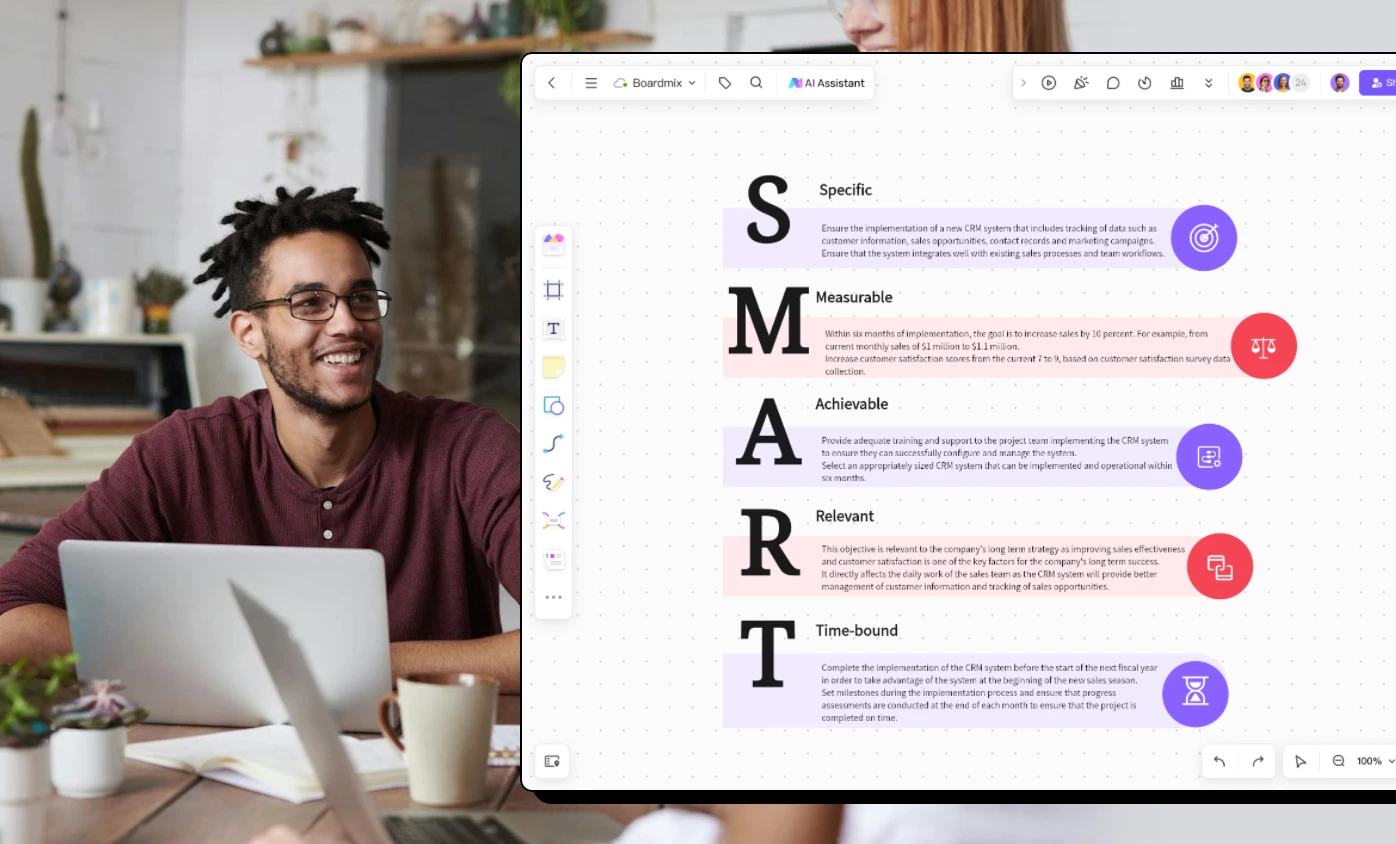
Turn a system rollout into a goal with a defined scope, adoption criteria, responsibilities, and a completion date.
View crm implementation template →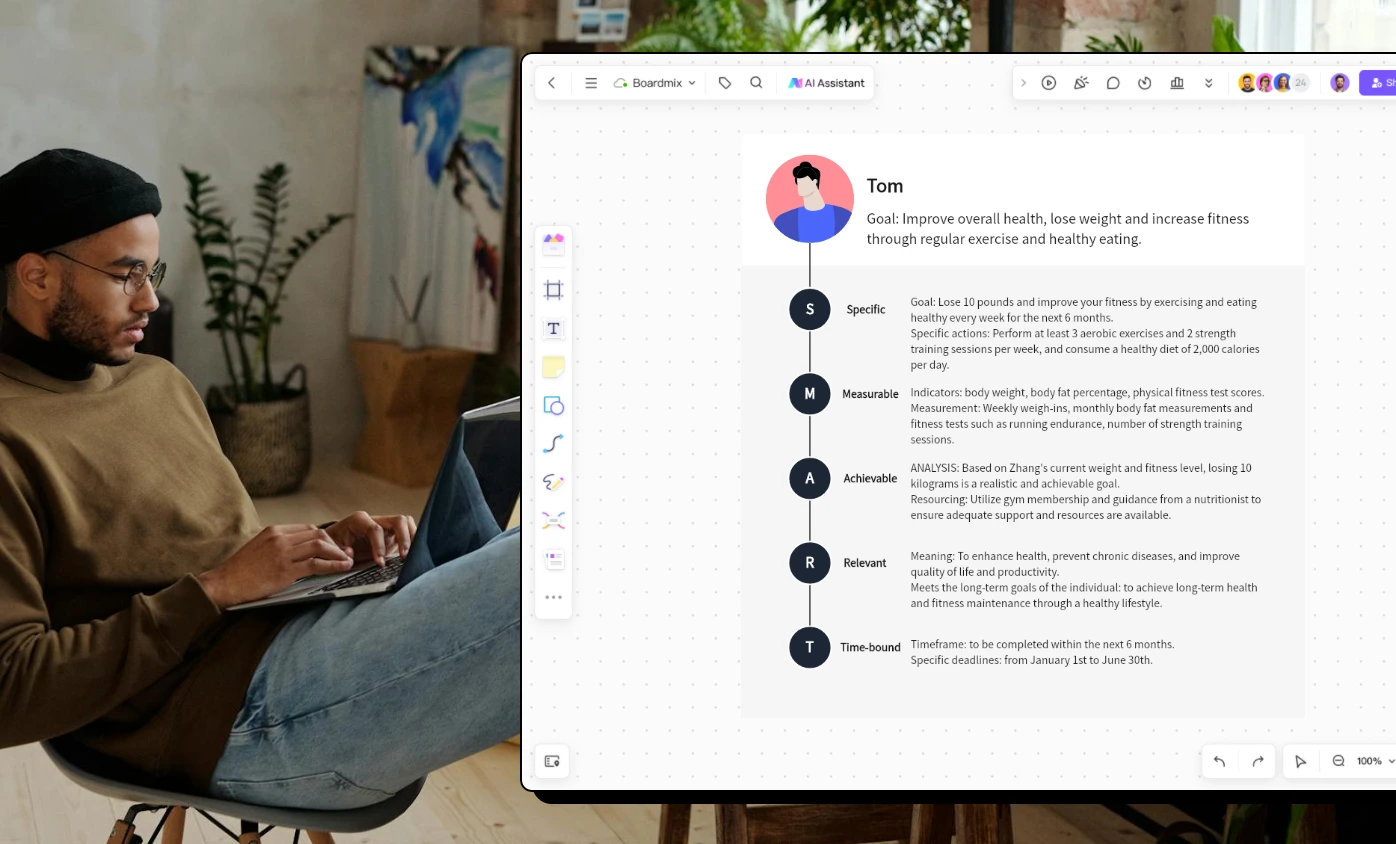
Use a personal-goal structure to connect a routine with a realistic commitment and review date. Adapt the sample to your own circumstances.
View personal goals template →
Define the communication situation to improve, the practice you will undertake, and the feedback you will use.
View communication skills template →Need help adapting the framework? Read the SMART goals template guide.
A GOAL WITH ITS CONTEXT
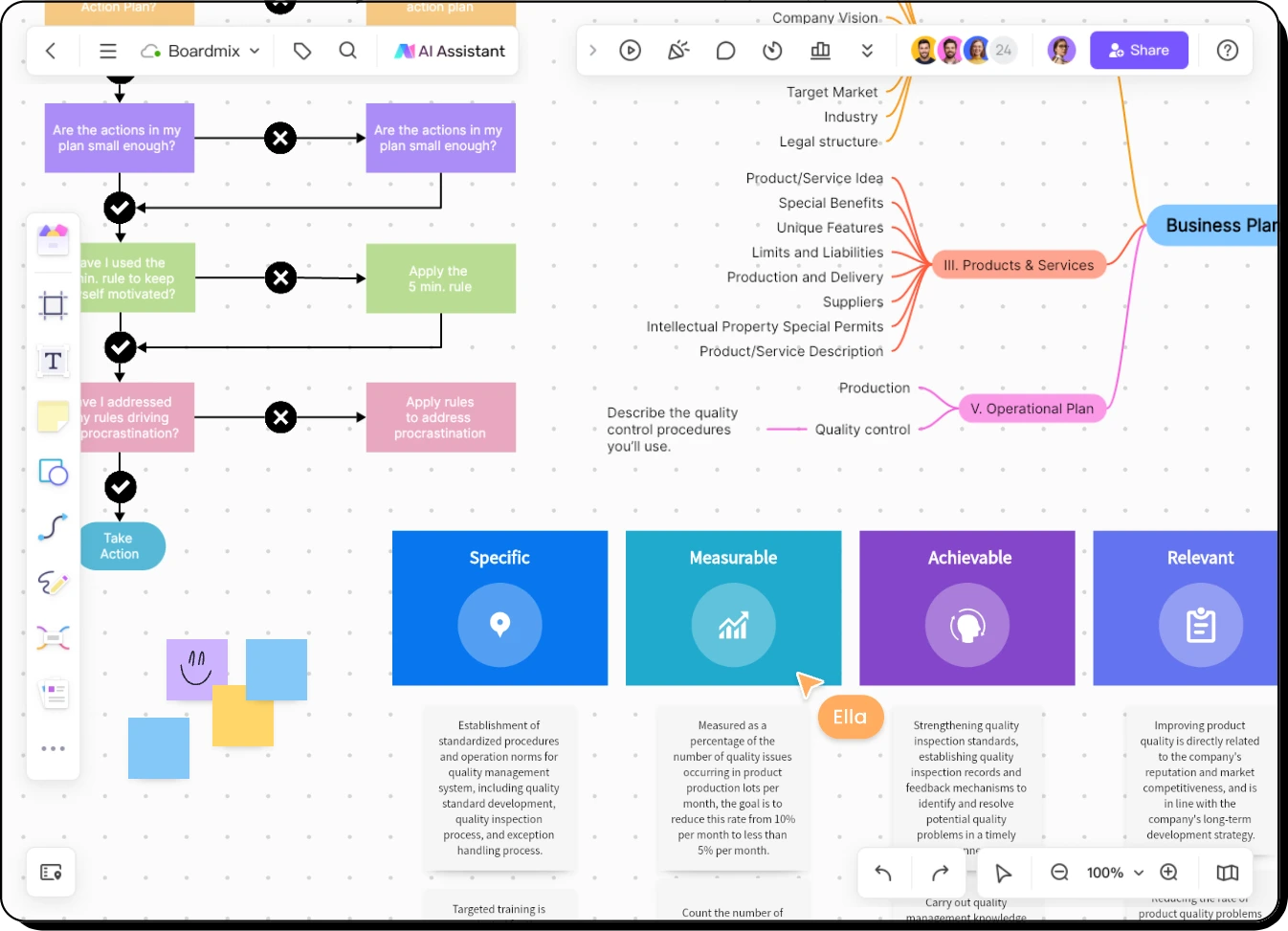
Use Boardmix's visual canvas to place the SMART framework beside the work it guides. Add a mind map for options, a flowchart for a process change, or a timeline for milestones.
Bring progress figures from your reporting source onto the board when you review the goal.
BUILD COMMITMENT TOGETHER
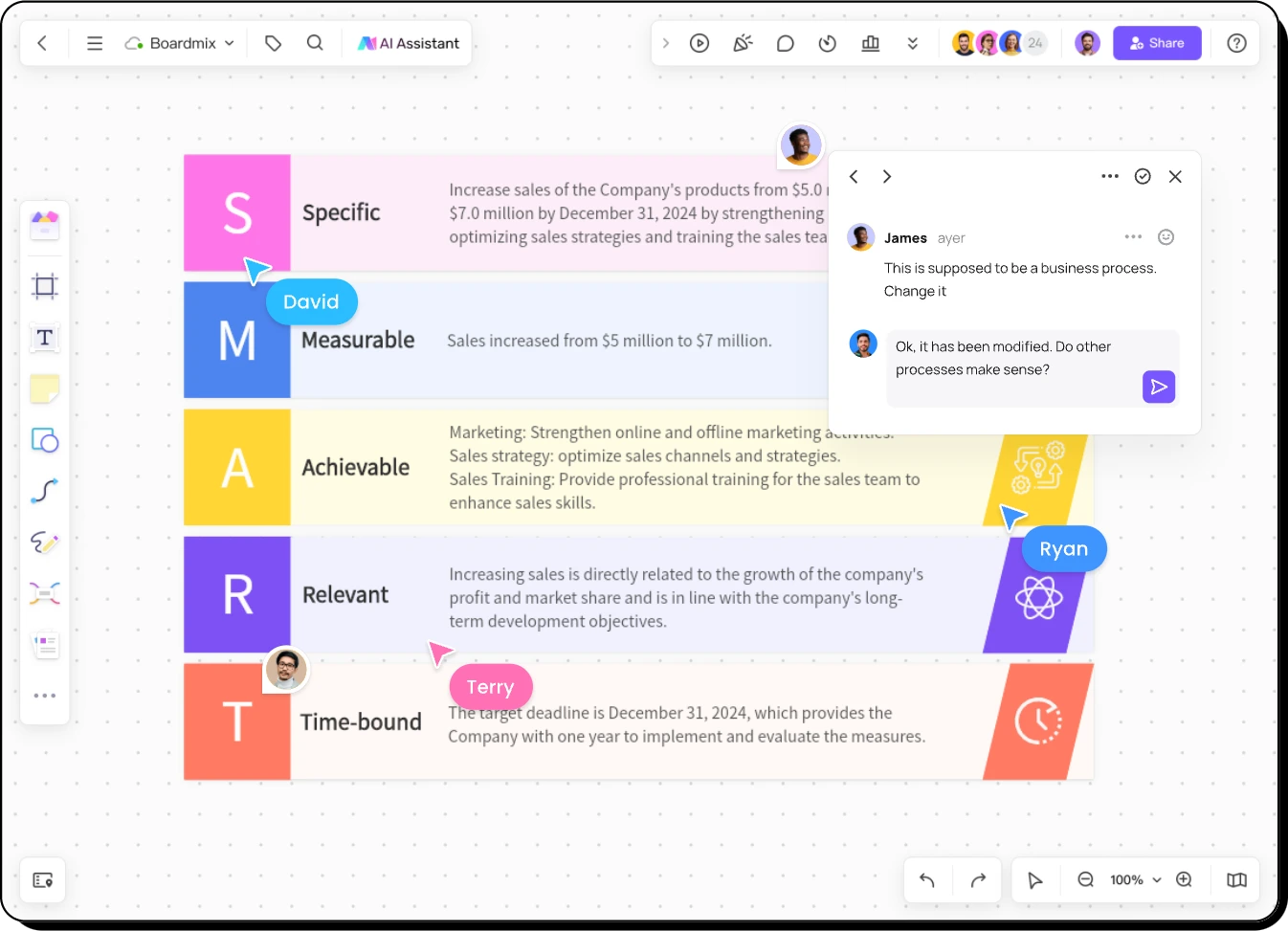
Invite the people doing the work to review the scope, target, and deadline. Use comments to ask what is missing, record trade-offs, and make the final goal easy to find.
During a review, compare the latest result with the baseline, discuss what changed, and decide the next action. A shared board keeps those decisions beside the goal instead of scattered across separate updates.
What changed? What explains it? What will we do next?
START A DRAFT, THEN MAKE IT YOURS
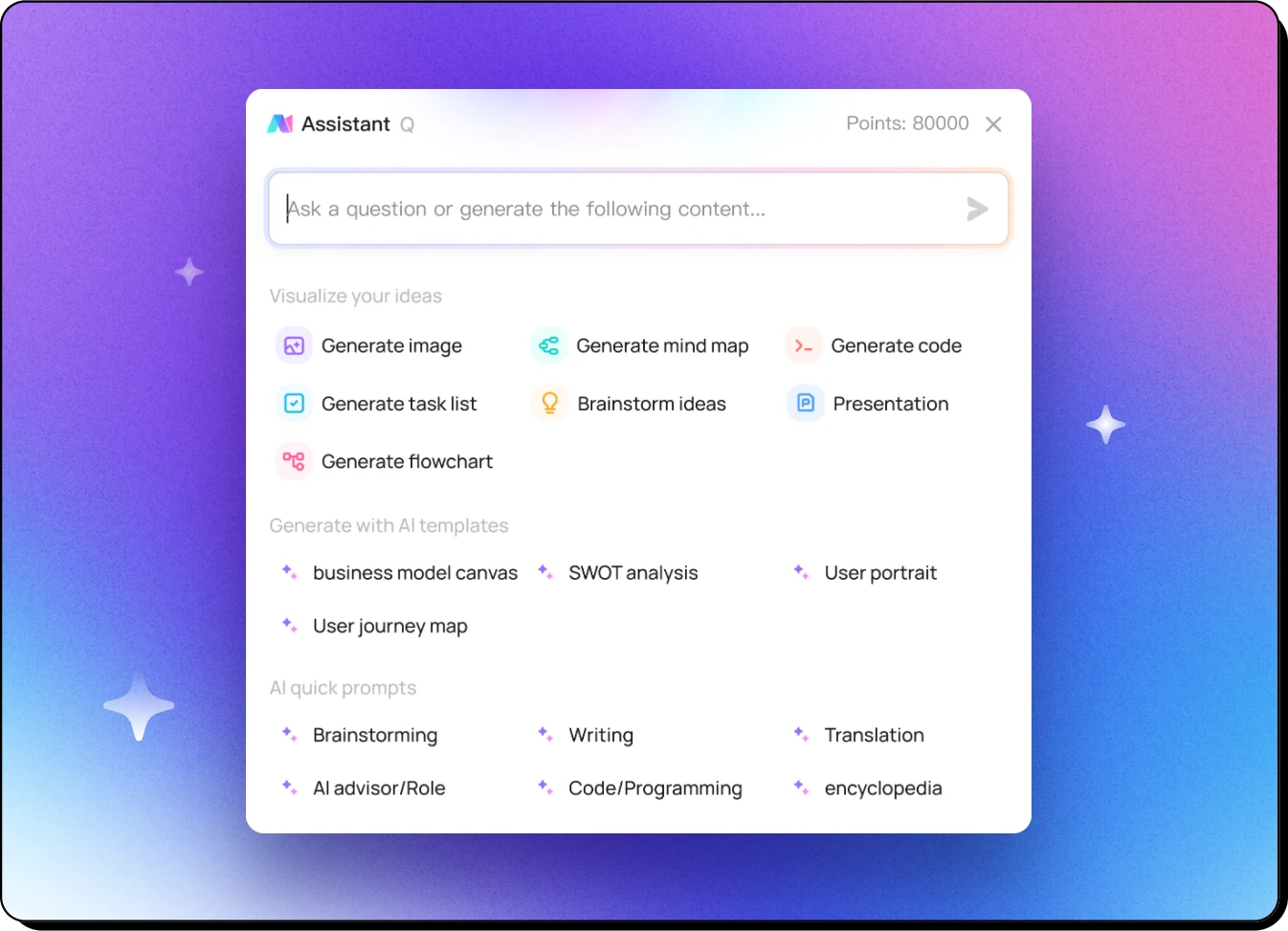
Give Boardmix AI the objective, current situation, and constraints. Use its draft as a starting point for a clearer goal and an outline of the work.
Supply your actual baseline and choose a target the team can support. Edit the measure, ownership, and deadline together before treating the draft as a commitment.
“Help us draft a SMART goal for [outcome]. Our baseline is [measure], our deadline is [date], and our main constraint is [constraint]. Ask about missing information.”
YOUR FIRST GOAL BOARD
Open a board or explore a relevant template. Write the outcome you want, the reason it matters, and the starting situation.
Define the scope, measure, realistic target, relevance, and deadline. Add source links, an owner, and the first actions beside the framework.
Invite teammates to question assumptions and agree on the plan. Return with updated figures at each review, then record the next decision.
SMART GOAL SETTING FAQ
A SMART goal setting tool helps you define specific, measurable, achievable, relevant, and time-bound objectives. Boardmix provides a visual workspace where you can organize the five parts, discuss the plan, and keep progress notes and supporting material together.
A goal describes an outcome and how you will judge it. A task is an action intended to help produce that outcome. In the support example, reducing response time is the goal; preparing a response guide is one task. Completing the guide does not by itself prove the goal was achieved.
Yes. Choose an outcome you can meaningfully assess, such as applying a new skill in a finished project. Define what you will produce, the time you can commit, and a review date. Use a learning or personal-goal example as a starting structure rather than adopting its sample targets unchanged.
Keep the baseline, target, reporting source, owner, and review date beside the goal. Add actual results and dated progress notes when you review it. Compare like-for-like measures and record the actions or decisions that follow. Boardmix keeps this information together on the board; bring in updated figures from the systems where you measure them.
You can share the Boardmix board with teammates for discussion and collaboration, or use the board's export options to prepare material for a report or presentation. Keep a link to the working board so the team knows where to find the current plan.
Boardmix's AI SMART goal workflow can help turn an objective into a structured draft. Give it relevant context, then review the suggested wording and fill in real measures, available resources, and dates. A generated target still needs your team's judgment before it becomes a plan.
GIVE YOUR NEXT GOAL A CLEAR PLAN
Build a SMART goal board with the measures, context, and next steps that matter.
Create a goal board