Real templates from the Boardmix community
7 editable flowchart templates for real workflows
A flowchart template gives you a starting layout of steps, decisions and connectors. Choose a process below, inspect the full diagram and open its community page to make your own copy in Boardmix.
Decisions & fulfillment
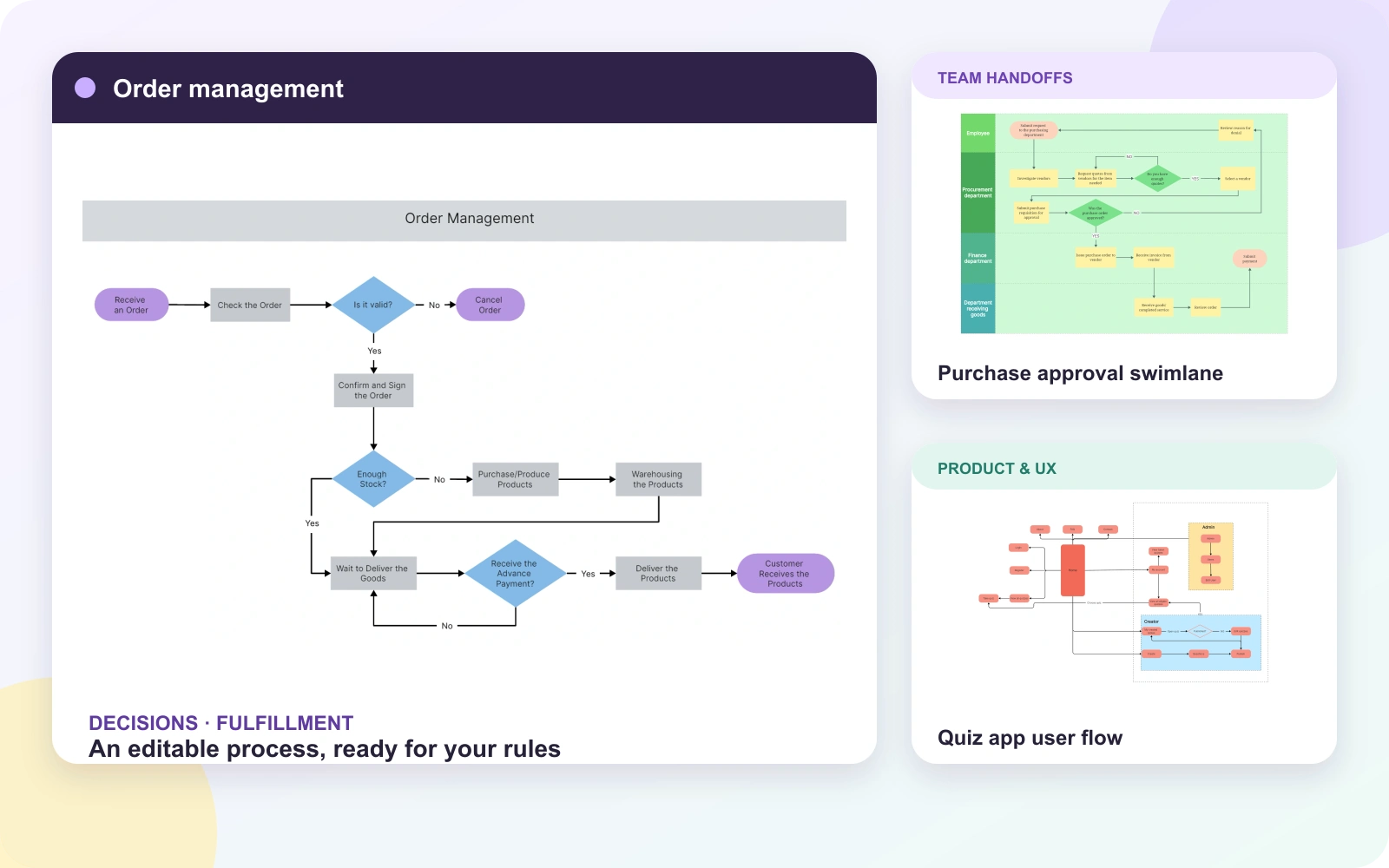
Order management flowchart
Follow an order from validation to delivery, including stock shortages and the payment check.
Make it yours: Replace the order rules, stock check and payment terms.
Approvals & ownership
Purchase approval swimlane
See where requests pass between employees, purchasing, finance and receiving—and where a rejection returns.
Make it yours: Rename the roles, approvers and resubmission steps.
Hiring & evaluation
Recruitment process flowchart
Plan the route from a job description through screening, interviews, reference checks and an accepted or declined offer.
Make it yours: Set your interview stages and explain any special hiring route.
Service & branching
Restaurant ordering flowchart
Compare dine-in, takeaway and delivery paths from the kitchen to payment and handoff.
Make it yours: Match the order channels and payment timing to your service.
Product & navigation
Quiz app user flowchart
Map the pages a learner, creator or administrator visits, including the quiz editing and publishing loop.
Make it yours: Replace the screens, user roles and publish conditions.
Service & escalation
Customer support handoff
Trace an issue across the customer, service team and technical team, then follow the response and feedback.
Make it yours: Define escalation rules, support owners and resolution criteria.
E-commerce & user decisions
Online order checkout flowchart
Follow an illustrative book purchase through account access, product selection, delivery details, payment and order confirmation.
Make it yours: Set your account rules, label the sign-in branches and return corrected details to the information check before placing the order.
Each link opens that specific community template. Choose Use this template there and sign in to make your own copy; the preview buttons let you inspect the diagrams without leaving this page.
Choose the structure, not just the colors
Which flowchart template should you use?
Simple process flowchart
Use a simple process flowchart when the main question is “What happens next?” Start with the trigger, add actions in order and finish with a specific outcome.
Try the request example for a compact starting structure. Keep the actions you need and add a decision only where the route changes.
Decision flowchart
Use a decision flowchart when a condition changes the route. Write a question inside each diamond and label the outgoing arrows, such as Yes and No.
Choose order management for stock and payment decisions, or purchase approval for sign-offs and resubmission.
Swimlane flowchart
Use a swimlane flowchart when ownership matters as much as sequence. Give each role a lane and show exactly where work passes to someone else.
Choose purchase approval for sign-offs or support handoffs for escalation between roles.
Mapping information rather than task order? A data flow diagram shows data moving between processes, stores and external entities. It answers a different question from an approval flowchart.
From template to a useful process
A leave-request flowchart with a complete return path
A useful flowchart covers more than the happy path. This example includes missing information, approval and rejection, so a request never disappears at a decision.
Replace the sample content with four decisions about your process
- Set the boundary. Start when a request is submitted; finish when the employee is notified of the recorded decision.
- Name the required information. Dates, leave type and any required handoff details belong in the completeness check.
- Make rework explicit. Missing information goes back to the employee, then returns to the same check—not straight to approval.
- Close both outcomes. Record approval or the rejection reason, then notify the employee.
Walk through a complete request, an incomplete one and a rejected one. If employees can withdraw a request, add a separate withdrawal ending.
The diagram documents the agreed workflow; drawing it does not configure an automated leave-approval system.
Edit together on an online whiteboard
How to customize a flowchart template in Boardmix
Keep the process, supporting notes and team feedback in one visual workspace instead of passing around disconnected versions.
Open the template you want
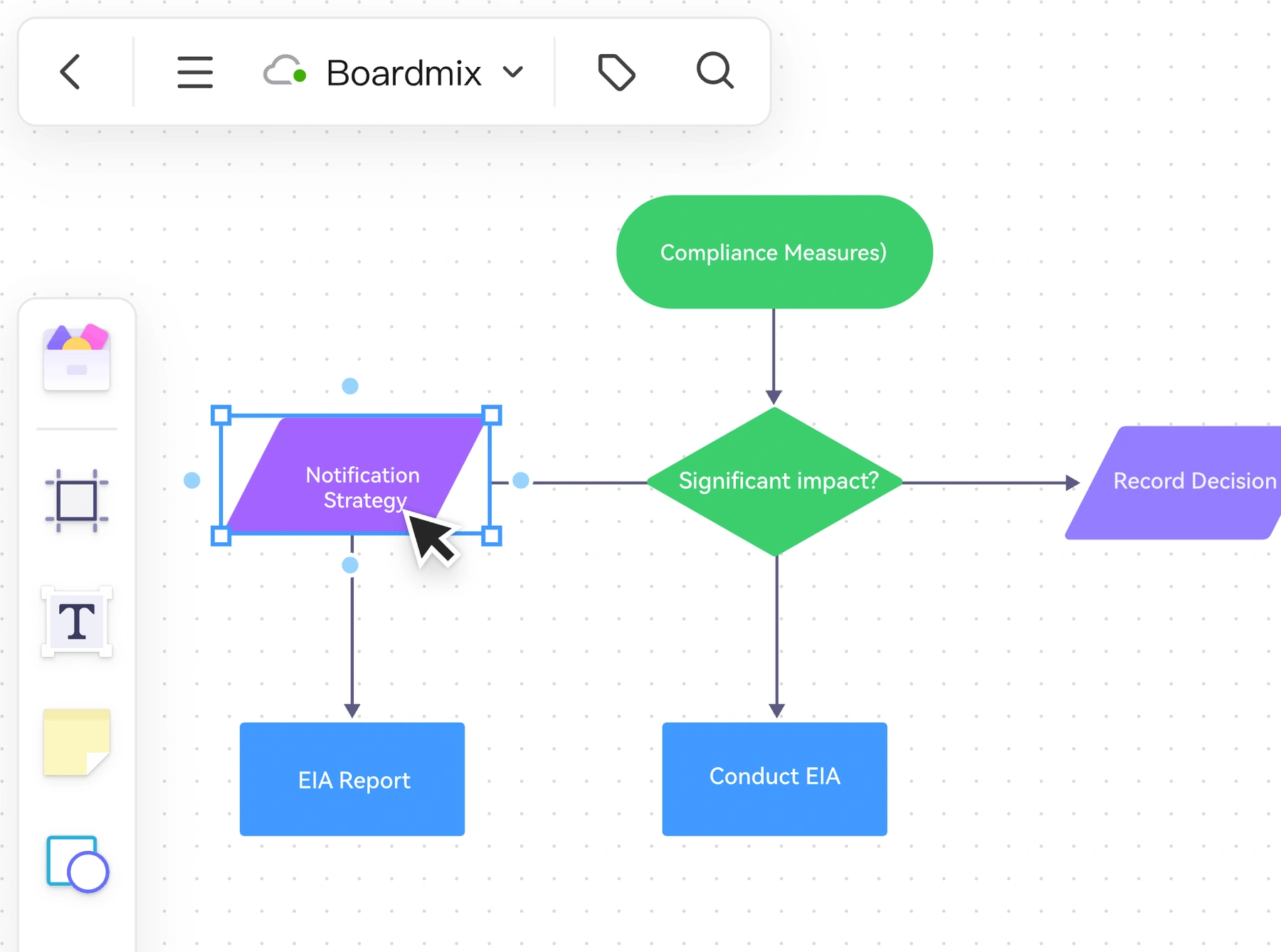
Open a community template above and select “Use this template.” Sign in when prompted, then work in your own copy.
Replace actions, rules and roles
Use short action labels such as “Check stock.” Change decision questions and connect every outcome to a next step, return point or end.
Review it with the people doing the work
Share the board with the appropriate permissions. Ask teammates to check handoffs, add missing exceptions and keep explanations beside the relevant step.
Prefer to draft from a written process? Try the AI flowchart generator, then review its branches and assumptions with your team. Start from a template when you already know the structure you need.
Use a template to improve the work
Map the current process, then design the next one
A finished diagram should help a teammate act. Keep the current workflow and proposed changes side by side on the board so the team can compare what will actually change.
Current process: capture what happens
For a purchase request, show who submits it, what information purchasing needs, when finance reviews it and where incomplete requests return.
- Attach the request form beside the submission step.
- Mark waits and unclear handoffs where they occur.
- Ask each role to confirm its actions and exceptions.
Future process: make one change clear
Suppose requests often arrive without a cost center. Add a completeness check before the purchasing review, with a return route to the requester.
- Name the required fields inside a nearby note.
- Keep complete requests on the direct review path.
- Assign an owner to the change and agree how to check whether fewer requests come back.
Keep both versions labeled. A proposed process becomes the new working version only after the people responsible agree to it.
More ways to map a process
Sales, recruitment, data and supply-chain examples
Use these reference diagrams to compare structures and plan your own map. They are visual examples, separate from the editable community templates above.
Sales process
Map how an inquiry becomes a qualified opportunity, quotation and order. Use the return paths to discuss follow-up when a prospect is not ready to proceed.
Recruitment workflow
Separate staffing requests, screening, interviews and hiring approval. Responsibility lanes help reveal which department owns the next action.
Employee records data flow
Follow information into processing and storage, then to HR or management. This is a data-flow example, not a sequence of yes/no approval decisions.
Supply-chain workflow
Compare procurement, supplier collaboration and inventory activities. For a working team diagram, isolate one end-to-end process rather than placing every activity in one chart.
A small symbol set goes a long way
What goes into a flowchart template?
A flowchart template is an editable starting structure for showing actions, decisions and the order in which they happen. Keep a consistent direction and use the same symbol for the same kind of step.
Need more notation? See the flowchart symbols guide.
- Start or end
- A rounded shape marks the trigger or a defined outcome.
- Action
- A rectangle names a task, such as “Review request.”
- Decision
- A diamond asks a question with labeled outgoing routes.
- Flowline
- An arrow shows the next step or the return point for rework.
Flowchart template questions
Can I use these flowchart templates for free?
You can preview the diagrams on this page without signing in. The linked community entries are currently listed as free templates. Sign in to use a template in Boardmix; workspace capacity and other account features depend on your plan. See Boardmix plans for those limits.
Can I edit the text, shapes and connectors?
Yes. Open a community template and create your copy in Boardmix, then change the labels, shapes and connections to match your process. The additional sales, recruitment, employee-records and supply-chain images on this page are reference examples, not one-click template copies.
Can I download a flowchart template for Word, Excel or PowerPoint?
These are Boardmix templates, not native Word, Excel or PowerPoint template files. If your deliverable must remain editable in one of those applications, choose a format that application supports. Keep a Boardmix link alongside any static image you use in a document so collaborators can return to the working diagram.
What is the difference between a flowchart and a swimlane template?
A basic flowchart emphasizes the sequence of actions and decisions. A swimlane flowchart adds lanes for roles or departments, making ownership and handoffs visible. Choose swimlanes when a process crosses teams; a simple process flow is often clearer for work owned by one person.
How do I start with a simple or blank flowchart?
Use a start shape, a few action rectangles and one end shape. Connect the actions in order. If the process has a rule that changes the route, add a decision diamond with labeled outcomes. You can simplify a copied template or build that structure on a blank Boardmix canvas; add swimlanes only when you need to show different owners.
How do I make a template fit our actual process?
Replace the starting trigger, action labels, decision rules, owners and endings. Then test a normal case and an exception. For each decision, check that all possible outcomes lead somewhere; for each handoff, identify what the receiving person needs.
Turn a process into a shared understanding
Start with a flowchart.
Make it your team's own.
Choose the closest structure, replace the sample steps and review the flow together.