
Idea collection
Gather many possibilities before the team evaluates them.
Browse brainstorming formats →


Online Collaborative Whiteboard

Boardmix Developer Platform

AI tools for diagrams, writing, and ideas

UI/UX Tool, Figma Alternative

AI PPT Maker, Gamma Alternative
Run workshops, plan projects, and work with colleagues on a shared whiteboard.
Explore collaborative workBOARDMIX · BRAINSTORMING
Turn scattered ideas into a clear direction. Brainstorm on one shared board, group related thoughts, and help your team decide what to explore next.
A practical space for workshops, product discovery, and team decisions.
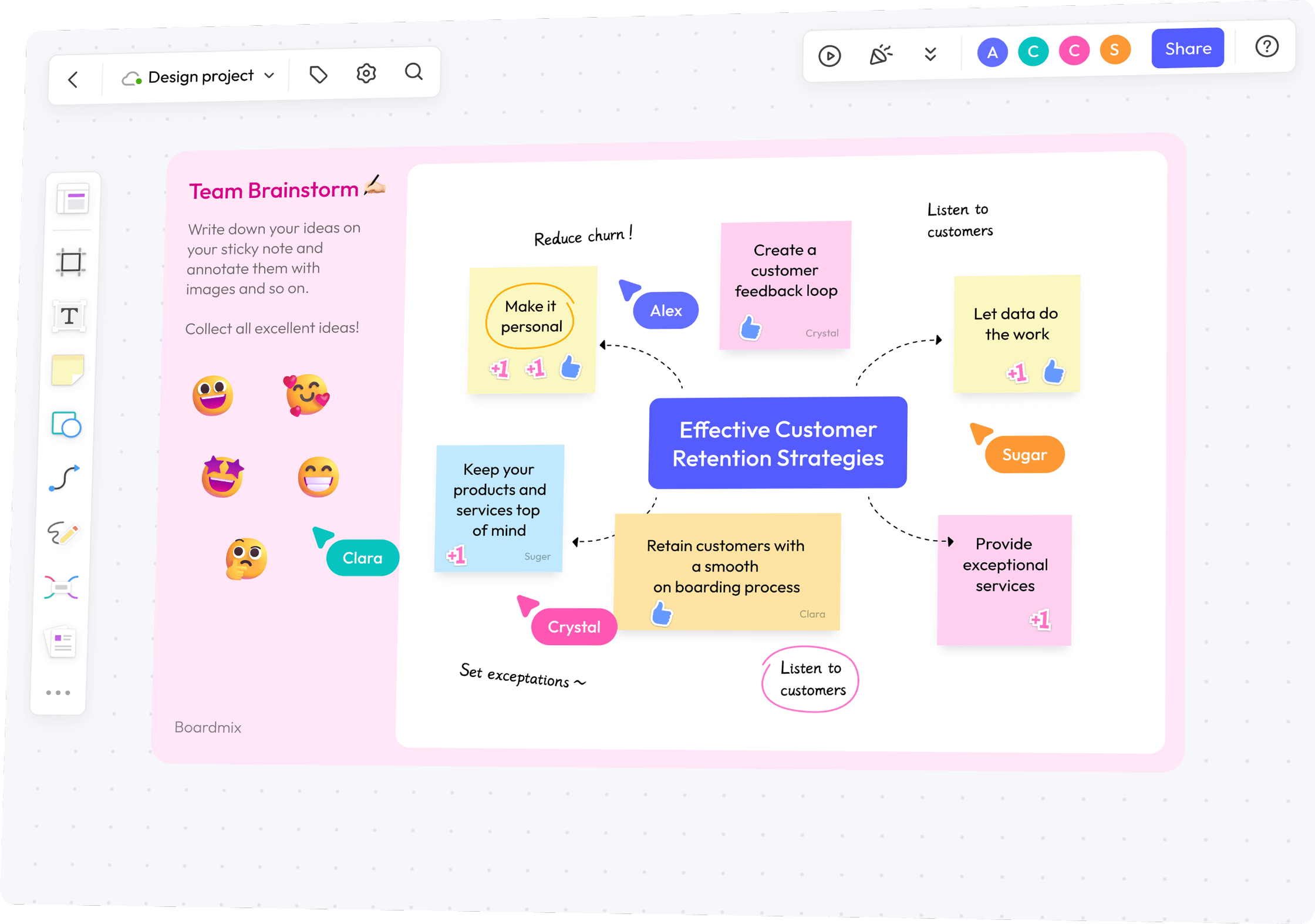
A SIMPLE WORKSHOP FLOW
Start with a question, give everyone a way to contribute, then turn the raw ideas into a small set of themes and next actions.
Write one prompt the group can answer. Add the audience, time horizon, or constraint that makes the question specific.
Give participants space to add notes before discussion. This keeps the first ideas from deciding the whole session.
Group similar notes, name the themes, then vote or discuss which ideas deserve a next experiment.

A VISUAL WORKSPACE FOR IDEAS
Boardmix gives a brainstorm room for notes, images, links, diagrams, and discussion. Use one board for the prompt, the raw ideas, the grouped themes, and the decision that follows.
Need a structured workshop? Explore meeting and workshop templates.

START WITH A RELEVANT STRUCTURE
Choose a format that matches the work, then adapt the prompts and grouping to your team. For a quiet first round, a brainwriting worksheet gives each person a place to develop ideas before discussion.
Gather many possibilities before the team evaluates them.
Browse brainstorming formats →
Compare ideas and make the next discussion concrete.
Explore planning formats →
Turn selected themes into questions, owners, and experiments.
View a team meeting format →WORKED BRAINSTORM
In this fictional workshop, a support team asks: how can a new user find the first useful action without asking support? The group has one week to try a small change before considering a larger onboarding project.
The board holds six ideas: a guided first board, clearer labels, a searchable help entry, a short video, a checklist, and a welcome email. Keep the original notes so a quieter participant’s idea remains visible after the discussion.
Findability contains clearer labels and the help entry. Orientation contains the guided board, video, and checklist. Follow-up contains the welcome email. The team chooses orientation: users need a next action while on the board, before a follow-up message would help.
Choose a three-step checklist beside a sample board; it fits the one-week limit without building a guided flow. Support lead Noor owns the draft. On Friday, observe new users following it: can they start the first task without a spoken hint? Keep the other five ideas for the next review.
Online brainstorming is a structured way for people in different places to contribute, organize, and discuss ideas in a shared digital workspace.
Set one clear question, collect ideas before evaluating them, group related notes, and end with a decision or next experiment.
Yes. Choose a brainstorming template as a starting structure, then replace its prompts and sections with the questions your team needs to answer.
Boardmix supports shared boards for real-time collaboration. Set access permissions appropriate for your participants and use comments to discuss ideas in context.
Bring ideas together, find the pattern, and leave with a next step.
Start brainstorming online