KFC’s strategy connects its fried-chicken identity with the customer experience, restaurant growth, and responsible operations. To understand its mission and vision, separate the brand’s public commitments from the actions it plans to take. A growth ambition describes a destination; it does not establish that every restaurant has already reached it.
KFC's Mission Statement
KFC’s company overview puts fried chicken, customer experiences, employees, and communities at the center of its identity. These themes connect its product identity with the people who buy, prepare, and serve the food.
The customer-facing idea is straightforward: make the meal and the experience around it worth returning for. In a restaurant, that connects food quality with understandable menus, accurate orders, and convenient service.
For a mission analysis, the useful question is how a broad purpose changes a specific decision. A recognizable chicken recipe supports product identity; menu choices and ordering channels determine how different customers can access it.
Employee development and community relationships sit alongside that customer promise. They expand the analysis beyond the meal itself to the people who prepare it and the places where restaurants operate.
KFC's Vision Statement
KFC’s published ambitions describe plans to grow its restaurant business, develop digital ordering, evolve the brand, and serve more eating occasions. These are strategic priorities, not evidence of universal market leadership.
Digital tools and drive-through improvements connect the vision to everyday operations. For example, easier ordering may address convenience, while order accuracy addresses whether the customer receives what they requested. Those outcomes need separate measures.
Brand development also involves a balance between recognition and local relevance. A familiar core product can remain identifiable while menu formats, flavors, and meal occasions vary by market.
In a strategy map, connect each ambition to an action and a measure. A digital-ordering initiative could be assessed through completion rates and order accuracy; restaurant expansion would need different measures, such as operating performance and customer access.
KFC's Core Values
KFC groups its responsible-business commitments under “Done the Right Way,” with three areas: people and communities, chicken and nutrition, and suppliers and climate. Each area concerns a different part of the business and its responsibilities.
People and communities concerns the people connected to the business, including employees and the communities around restaurants. In an analysis, keep employment practices and community programs distinct: they address different groups and require different evidence.
Chicken and nutrition covers food-related responsibilities. KFC’s nutrition and sourcing information discusses animal welfare, supplier oversight, menu development, and nutrition information. A commitment in one area does not establish that every menu item is a healthy choice.
Suppliers and climate extends the analysis beyond the restaurant to sourcing and environmental responsibilities. Assess the stated goal, its geographic scope, and the reported progress separately.
The distinction matters when comparing companies: a purpose explains the intended contribution, a growth ambition sets a direction, and operating commitments describe how the business intends to act.
KFC Mission and Vision Statement Analysis Mind Map
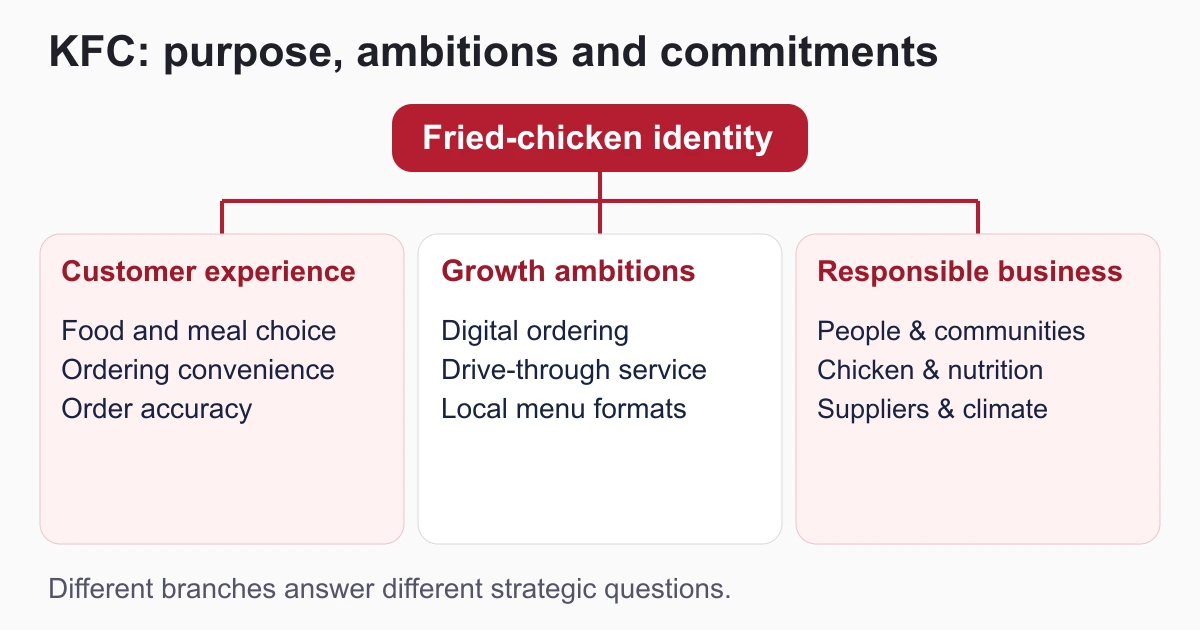
The map separates KFC’s customer experience, growth ambitions, and responsible-business commitments. Keep these branches separate when adding examples so that a proposed action is not mistaken for a demonstrated result.
Key Takeaways
KFC’s fried-chicken identity is the starting point, but the strategic choices extend to ordering, restaurant formats, local menus, and responsibilities across the business. A useful comparison connects each choice to a concrete customer or operational need.
Use a Boardmix whiteboard to map the same three layers for another business: purpose, strategic choices, and operating commitments. Browse the template library, then add source links beside the statements you want to compare.