Unilever’s purpose, strategy, and values answer different questions: why the business exists, where it intends to compete, and how people are expected to act. Its older sustainable-living language belongs to an earlier strategy period; the current framework gives a different basis for analyzing the company’s direction.
Unilever’s Mission Statement
Unilever’s April 2025 investment case states its purpose as “Brighten everyday life for all.” This is purpose language, rather than a separate statement labeled as a mission on that page.
The purpose links the business to everyday consumer needs. For an analysis, consider what a product helps someone do and whether its benefits are clear; the broad wording does not establish a specific social or environmental result.
Consumer brands connect that purpose to particular products and experiences. A useful analysis separates a brand’s customer promise from the corporate strategy that allocates resources across categories and markets.
The earlier purpose of making sustainable living commonplace and the Unilever Sustainable Living Plan are historical context. They should not be presented as the company’s current operating plan. Unilever’s current strategy page sets out its newer framework.
Unilever’s Vision Statement
Unilever’s current strategic framework has three parts: Desire at Scale, Play to Win, and Fit for the AI Age. These describe brand development, organizational culture, and the use of technology, connecting the company’s direction to specific kinds of business decisions.
Desire at Scale concerns the appeal of the brands and their execution in the market. For analysis, distinguish the product experience from the way the brand reaches people: each can affect the same purchase for different reasons.
Play to Win concerns a performance-oriented culture and talent, connecting organizational priorities to the people and roles responsible for delivering them.
Fit for the AI Age concerns a simpler, faster organization supported by technology. An analysis should identify the specific business activity affected, rather than assume that mentioning AI proves an improvement.
Unilever’s sustainability priorities are climate, nature, plastics, and livelihoods. Keep the targets and reported progress separate from the broader growth strategy.
These layers belong on the same strategy map but do different jobs. Purpose supplies a direction, strategic priorities guide choices, and commitments can be attached to specific actions and evidence.
Unilever’s Core Values
Unilever identifies integrity, respect, responsibility, and pioneering as its values in its business integrity guidance. They describe expected conduct and provide a basis for interpreting the Code of Business Principles.
Integrity concerns honesty and ethical conduct. It sets an expectation for decisions and behavior across the business.
Responsibility reflects Unilever's commitment to its various stakeholders - consumers, employees, communities, and the environment. The company recognizes that its actions can have significant impacts and hence takes responsibility for them seriously. This commitment can be seen in its drive to reduce environmental footprints, uplift local communities, deliver high-quality products, and maintain an inclusive workplace.
Respect is manifested in Unilever's recognition of the diversity and uniqueness of individuals. It encourages an environment where everyone's opinions are valued, creating a culture of mutual respect and understanding. Respect also extends beyond employees to suppliers, customers, and communities, fostering harmonious relationships based on mutual appreciation and recognition.
A pioneering spirit has been central to Unilever's business approach since its inception. Unilever cherishes innovation, resilience, and determination, the qualities that enable it to navigate uncharted territories. It encourages a spirit of exploration and continuous learning within the organization, driving it towards innovation and development.
Values and strategy are related but distinct. Values describe the expected conduct of people making decisions, while strategy identifies the choices the business intends to pursue.
Unilever Mission and Vision Statement Analysis Mind Map
The map separates Unilever’s published purpose, its current strategic framework, and the values and sustainability priorities that support the analysis.
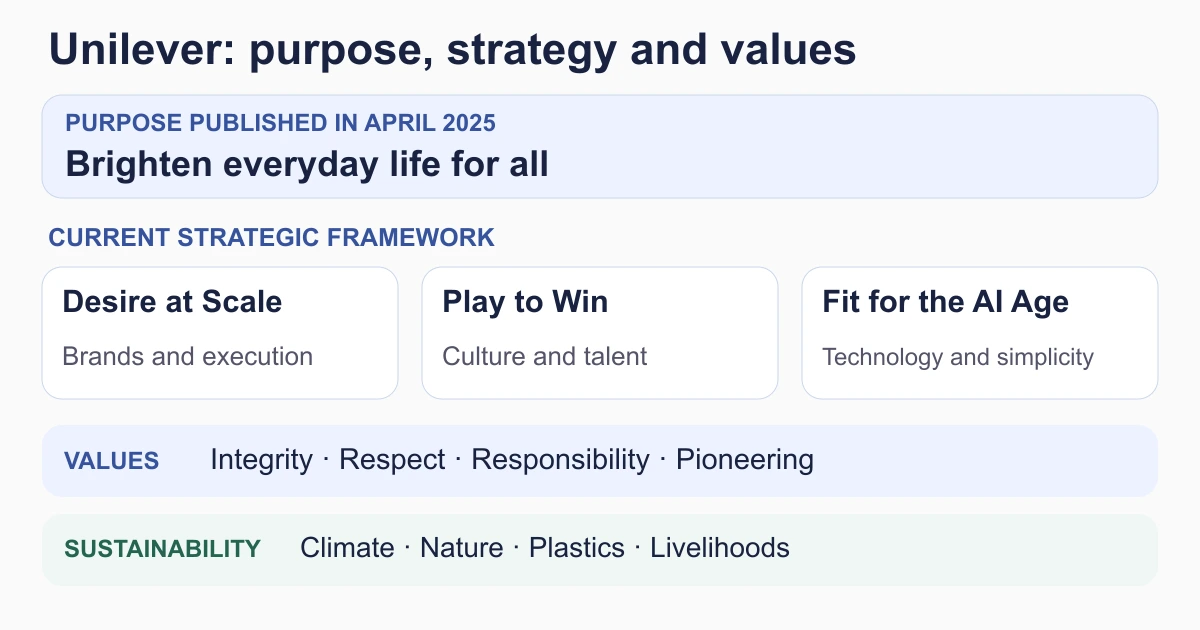
When using this structure for another company, attach each statement to the relevant source and period. This prevents an earlier purpose or plan from being mistaken for a current commitment.
Key Takeaways
The distinctions to retain are:
- The April 2025 purpose concerns everyday consumer needs.
- The current strategy separates brand development, performance culture, and technology-enabled ways of working.
- Values describe expected conduct; sustainability priorities identify areas for targets and reporting.
To analyze another organization, use a Boardmix template as a starting point. Add separate branches for purpose, strategy, values, and evidence, keeping each source beside the statement it supports.