


You searched for Miro enterprise on-premise because your organization needs exactly that — the collaborative whiteboard experience your teams already rely on, deployed inside your own infrastructure. The problem is straightforward and frustrating in equal measure: Miro does not offer self-hosted deployment as a standard option in its product lineup.
This is not a feature gap that Miro is quietly building toward. It is a fundamental consequence of how Miro was designed. And for enterprises operating under serious compliance obligations, it is the reason that Miro — despite its product quality — fails the procurement review before it ever reaches a feature evaluation.
This article explains exactly where Miro’s enterprise offering stops, why on-premise deployment has become non-negotiable for a growing category of organizations, and how Boardmix delivers everything Miro enterprise promises — plus the private deployment architecture Miro will never provide.
What Miro Enterprise Actually Offers
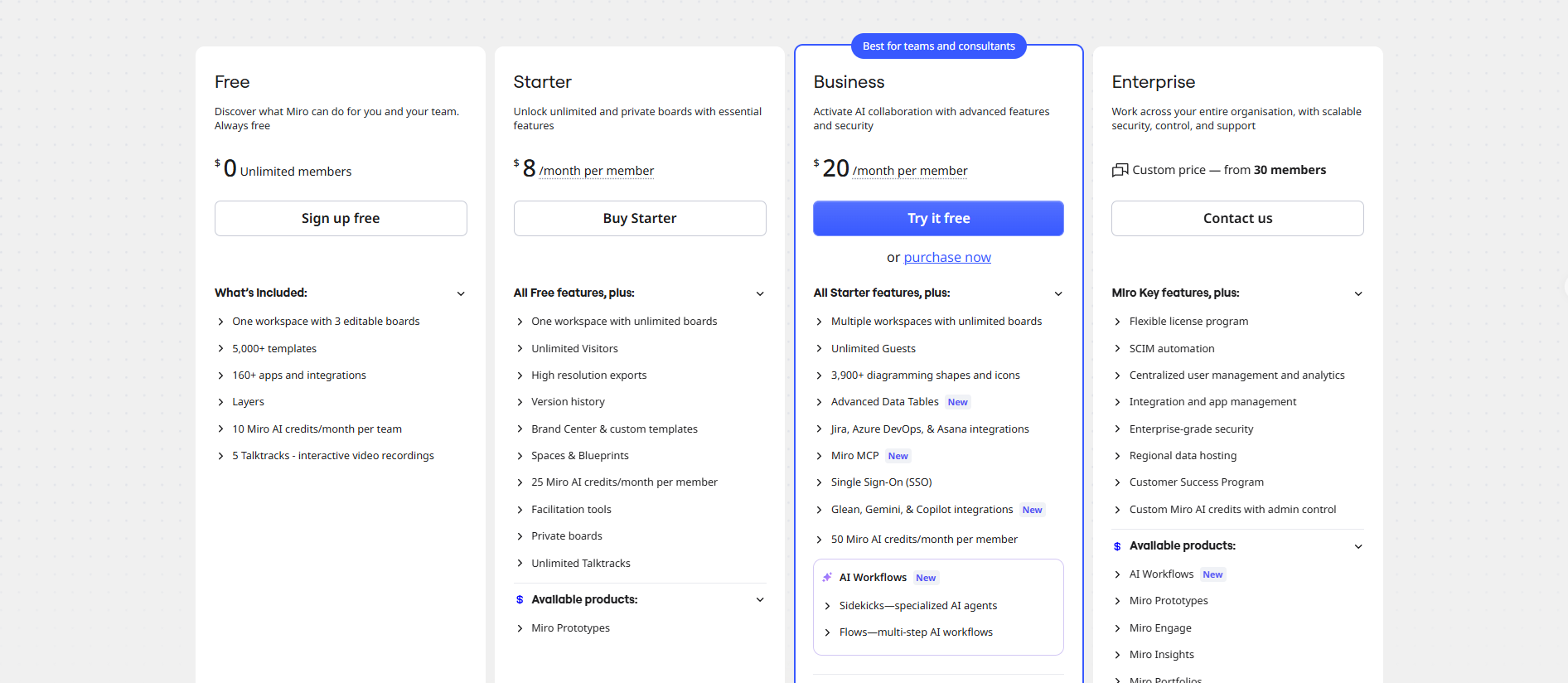
Miro’s enterprise plan is genuinely well-built for what it is. The feature set is extensive: unlimited boards, advanced diagramming tools, a template library with thousands of options, real-time collaboration for large teams, robust SSO and SAML integration, role-based access controls, audit logs, and a set of admin tools that give IT teams meaningful oversight of user activity and workspace configuration.
For organizations without strict data residency requirements, it is a capable enterprise product. The security controls are real. The compliance documentation is thorough. Miro holds SOC 2 Type II certification, is GDPR-compliant, and maintains data centers in specific geographic regions to support some residency requirements.
But all of it — every board, every session, every exported file, every audit log — lives on Miro’s infrastructure. That is the constraint that does not bend regardless of how much you pay or how large your enterprise plan becomes.
What Miro enterprise does not offer:
- On-premise deployment on your own servers or data center hardware
- Private cloud deployment within your own AWS, Azure, or GCP tenancy
- Network-isolated operation disconnected from Miro’s external cloud services
- SDK integration that embeds whiteboard functionality inside your own platforms under your own data controls
- Self-managed encryption where your organization holds the keys
For enterprises in regulated industries, this list is not a minor inconvenience. It is a complete architectural mismatch.
Why On-Premise Is a Hard Requirement — Not a Preference
Enterprise IT teams do not ask for on-premise deployment because they enjoy managing additional infrastructure. They ask for it because their regulatory environment, legal obligations, or internal security policies leave them no other option.
GDPR and data localization laws require specific categories of data to remain within defined geographic or jurisdictional boundaries. A SaaS vendor’s regional data center selection is not equivalent to an organization deploying within its own controlled infrastructure. Legal teams at financial institutions and healthcare organizations understand this distinction — and so do their regulators.
HIPAA and healthcare compliance mandates that covered entities and their business associates maintain direct oversight of how protected health information is handled, stored, and transmitted. Using a third-party SaaS platform for any collaboration touching PHI context creates audit exposure that compliance teams are not willing to accept.
Defense and government contractors operating under frameworks like FedRAMP, ITAR, or equivalent national security standards often face explicit requirements that collaboration infrastructure run inside government-controlled or contractor-controlled networks. Miro’s cloud cannot satisfy these requirements by definition.
Internal security policy at large enterprises. Beyond external regulations, many global organizations maintain blanket policies prohibiting sensitive data from leaving their network perimeter. These policies exist independent of vendor security certifications — they apply to every external service, no matter how reputable.
According to Mordor Intelligence, the collaborative whiteboard software market is forecast to grow from $3.81 billion in 2026 to $9.59 billion by 2031, with on-premises deployment among the fastest-growing segments — driven precisely by regulated industries where cloud-only tools cannot pass procurement.
Gartner’s digital workplace research consistently places data governance among the top-three criteria driving enterprise software selection. Miro’s architecture makes it structurally unable to satisfy that criterion for a significant and growing slice of the enterprise market.
Boardmix: The Enterprise Whiteboard with the Deployment Architecture Miro Cannot Offer
Boardmix is a full-featured enterprise visual collaboration platform built with private deployment as a first-class architectural requirement. Not a bolt-on tier. Not a roadmap item. A core design principle.
Where Miro enterprise stops at the edge of its own cloud, Boardmix extends into your infrastructure — on your terms, under your controls.
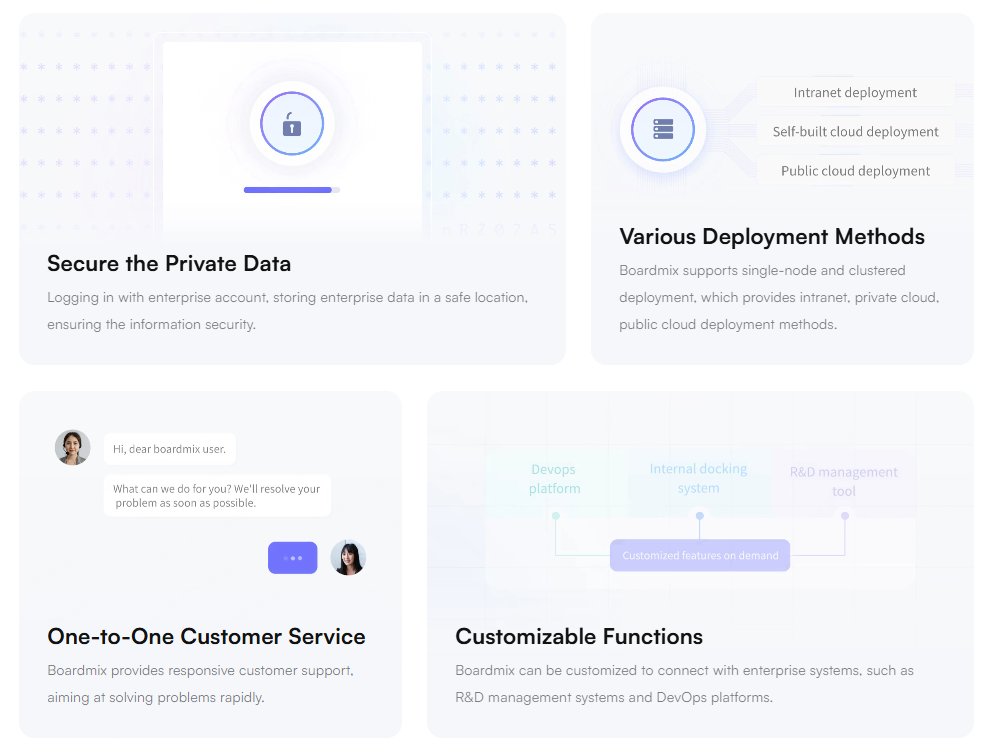
On-Premises Deployment
Boardmix’s on-premises deployment installs the complete application stack — backend services, database, real-time collaboration engine, file storage — directly on your organization’s servers or data center hardware.
No data crosses your perimeter. No external API calls to Boardmix’s cloud services. No dependency on vendor uptime, infrastructure decisions, or policy changes. Your IT team manages access controls, encryption configuration, version updates, and audit log retention using your existing processes and tooling.
The deployment package includes full Docker and Kubernetes support, detailed setup documentation, and dedicated onboarding from Boardmix’s enterprise deployment engineers. You deploy on your timeline, not a vendor-managed release schedule.
This architecture satisfies the requirements of financial institutions, healthcare systems, defense contractors, and government agencies where external data routing is either prohibited outright or subject to approval processes that cloud-only tools cannot survive.
Private Cloud Deployment
For organizations that want cloud-native operational flexibility without the exposure of a shared SaaS environment, Boardmix supports private cloud deployment inside your own cloud tenancy — AWS, Azure, Google Cloud, or other major providers.
Your account. Your IAM policies. Your VPC configurations. Your encryption keys. Boardmix’s infrastructure never processes your data. You benefit from cloud scalability while retaining the data sovereignty that your compliance framework demands. It is the architecture Miro’s enterprise plan gestures toward without ever actually providing.
Whiteboard SDK Integration
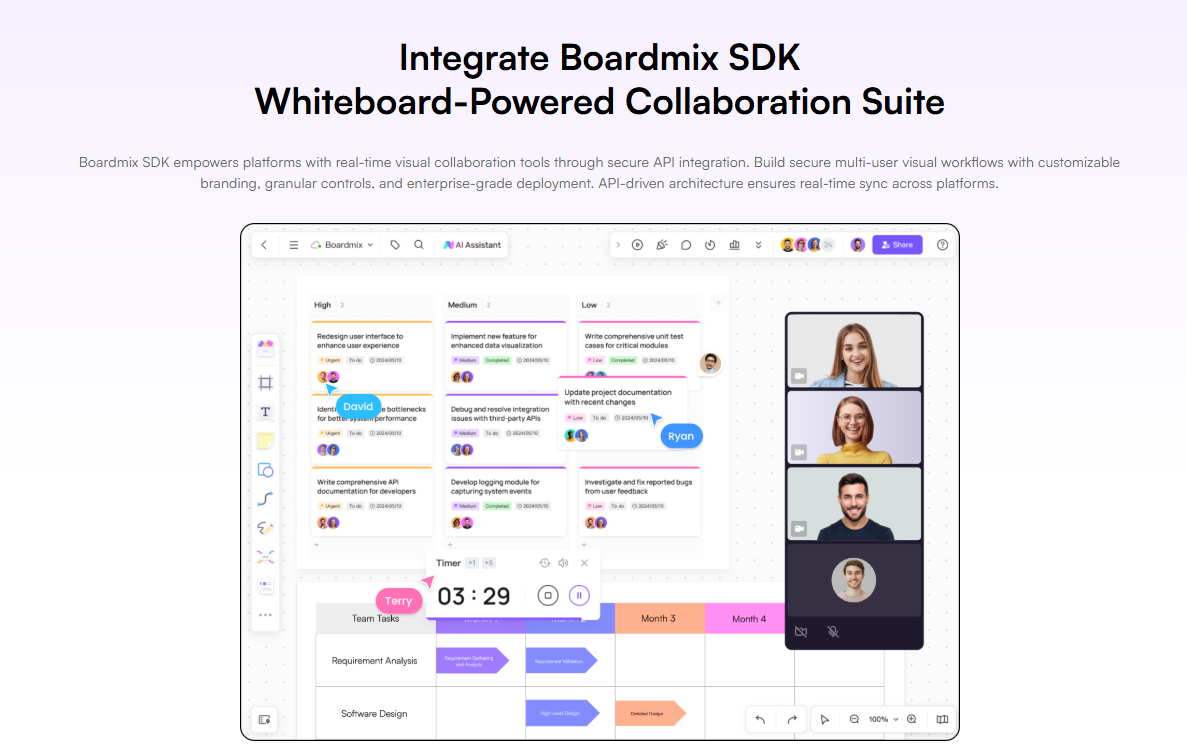
The most architecturally sophisticated option Boardmix offers — and the one with no Miro equivalent at all — is SDK integration. Rather than deploying Boardmix as a standalone whiteboard application, your development team embeds the complete canvas experience directly inside existing enterprise platforms.
OA systems. Internal portals. Engineering platforms. Document management tools. Project management software. The whiteboard lives where your teams already work, under your existing authentication model, with data flowing entirely within your infrastructure.
The SDK supports both on-premises and private cloud environments natively. There is no hidden SaaS dependency inside the integration layer. The security model of your embedded whiteboard is identical to your standalone private deployment.
Boardmix vs. Miro Enterprise: The Deployment Comparison
| Capability | Miro Enterprise | Boardmix Enterprise |
|---|---|---|
| On-premises deployment | Not available | Full support |
| Private cloud deployment | Not available | AWS, Azure, GCP, and others |
| Data residency control | Miro infrastructure only | 100% within your infrastructure |
| Network-isolated operation | Not possible | Fully supported |
| SDK embedding into internal platforms | Not available | Full SDK with private deployment |
| SSO (SAML 2.0, LDAP, Active Directory) | Available | Available |
| Role-based access control | Available | Available |
| Audit logging | Available | Available |
| Encryption key management | Vendor-managed | Organization-controlled |
| AI-powered collaboration tools | Available | Available |
| Real-time multi-user canvas | Available | Available |
| Dedicated deployment support | Standard enterprise tier | Dedicated deployment engineers |
| Licensing model at scale | Per-seat SaaS only | Flexible enterprise licensing |
The deployment column is where the evaluation ends for regulated industries. Beyond deployment differences, both platforms offer comprehensive capabilities — though private deployment versions may have feature optimizations and exclusive enterprise features specific to self-hosted environments.
Who Is Already Making This Switch
Banks and financial institutions. Internal security policy at most financial organizations prohibits routing sensitive strategic or operational data through any external service. Boardmix on-premises deployment passes the security architecture review. Miro is eliminated before the feature evaluation begins.
Hospitals and pharmaceutical companies. Clinical pathway design, research documentation, and operational planning all carry sensitivity that makes shared SaaS deployment problematic under HIPAA frameworks. Boardmix private deployment keeps every whiteboard session inside the covered entity’s own infrastructure.
Government agencies and public sector. Agencies handling citizen data, national security-adjacent workflows, or classified information need tools that operate entirely within government-controlled networks. Boardmix supports fully air-gapped deployments with zero public internet dependency — an architecture Miro cannot replicate.
Engineering organizations protecting IP. Large technology companies with proprietary architecture diagrams, unreleased product designs, and sensitive roadmap documentation benefit from on-premise deployment that keeps whiteboard sessions invisible to the outside world. Boardmix’s SDK option lets these organizations embed visual collaboration directly inside their internal engineering portals.
Making the Switch: From Miro to Boardmix
The migration path is structured and supported. Here is how it typically unfolds:
Step 1. Choose your deployment model. On-premises, private cloud, or SDK integration. Each has distinct infrastructure requirements and timeline implications. Boardmix’s enterprise team helps you scope the right architecture for your environment.
Step 2. Technical scoping session. Boardmix’s deployment engineers assess your existing infrastructure, SSO configuration, network topology, and integration requirements. Nothing is assumed. The deployment plan is tailored to your environment.
Step 3. Private trial deployment. Before any production commitment, Boardmix provisions a trial deployment environment within your infrastructure. Your teams validate performance, feature parity, SSO integration, and user experience on real workflows.
Step 4. Internal security review. Boardmix provides comprehensive compliance documentation — architecture diagrams, data flow maps, security certifications — to support your internal procurement and security approval process.
Step 5. Production go-live. Boardmix’s enterprise deployment team supports the full production launch, including user onboarding, admin training, and post-deployment stabilization.
The Answer to a Search Miro Can’t Satisfy
Every enterprise that lands on a search for “Miro enterprise on-premise” is looking for the same thing: the visual collaboration quality of a modern whiteboard platform, deployed entirely within their own infrastructure. Miro’s answer to that search is silence. The product does not exist and will not.
Boardmix’s answer is a production-ready, fully featured enterprise whiteboard platform that deploys on your servers, inside your cloud tenancy, or embedded directly into your existing systems — with dedicated deployment support, enterprise-grade security architecture, and a feature set that matches Miro capability for capability on every dimension except the one that matters most to your compliance team.
The deployment gap Miro leaves is not a temporary inconvenience. It is a permanent architectural constraint. For organizations that have reached the point where that constraint disqualifies Miro from consideration, Boardmix is the direct path forward.
Ready to deploy visual collaboration inside your own infrastructure? Contact the Boardmix enterprise team to schedule a technical consultation and request a private deployment trial built around your specific environment.