


Most teams don’t fail because they lack ambition. They fail because they confuse two fundamentally different tools for managing it. OKR vs KPI is one of the most misunderstood distinctions in modern goal-setting — and mixing them up quietly derails strategy, muddies accountability, and leaves managers wondering why their team is hitting every number but somehow still falling short of what matters.
This guide cuts straight to the difference. You’ll get clean definitions of both frameworks, a side-by-side comparison across six dimensions, clear guidance on when to use each, the most common mistakes teams make, and a practical walkthrough for building a system that uses OKR and KPI together — not as rivals, but as complementary engines for sustainable growth.
What Is OKR?
OKR (Objectives and Key Results) is a collaborative goal-setting framework in which an organization, team, or individual defines a qualitative, ambitious Objective — describing where they want to go — alongside two to five measurable Key Results that define what evidence will confirm they’ve arrived. OKRs are typically set on a quarterly cadence and are designed to drive focus, alignment, and stretch thinking across an entire organization.
The framework originated at Intel under Andy Grove in the 1970s and was later popularized globally by venture capitalist John Doerr, who introduced OKRs to Google in 1999. Today, companies from small startups to Fortune 500 enterprises use OKRs as a primary vehicle for translating vision into coordinated action. Google’s own Work guide on OKRs remains one of the most referenced resources on implementing the framework.
OKR Example — Product Team
Here’s what a well-formed OKR looks like for a product team launching a new mobile experience:
Objective: Deliver a mobile onboarding experience users love from their very first session.
- Key Result 1: Increase Day-7 user retention from 34% to 55%
- Key Result 2: Reduce onboarding drop-off rate from 62% to 28%
- Key Result 3: Achieve an App Store rating of 4.7 or higher within the quarter
Notice the objective is directional and motivating — it doesn’t contain a number. The numbers live entirely in the key results, and those key results are outcomes, not a checklist of tasks. That distinction is everything.
What Is a KPI?
A KPI (Key Performance Indicator) is a quantifiable metric that measures how effectively an individual, team, or organization is performing against a specific operational target over a defined period. KPIs track the ongoing health of a process or function, providing a reliable signal of whether day-to-day execution is on track, slipping, or exceeding baseline expectations.
KPIs have been a staple of business management since the balanced scorecard era of the early 1990s and are embedded in virtually every industry — from sales and marketing to finance, operations, and HR. Unlike OKRs, KPIs are not aspirational by nature; they are diagnostic. They answer the question “are we running well?” rather than “are we moving to somewhere new?” According to research by McKinsey & Company, organizations that actively monitor a focused set of performance metrics are significantly more likely to sustain execution discipline through periods of strategic change.
KPI Example — Sales Team
A sales team’s KPI dashboard for a given quarter might look like this:
- Monthly Recurring Revenue (MRR): Target $280,000 | Current $261,000
- Lead-to-Customer Conversion Rate: Target 22% | Current 19.4%
- Average Deal Size: Target $4,800 | Current $5,100 ✓
- Average Sales Cycle Length: Target ≤ 30 days | Current 34 days
Each metric is trackable in real time, assigned an owner, and measured against a pre-set threshold. No ambiguity, no narrative — just signal.
OKR vs KPI — Core Differences at a Glance
The OKR vs KPI distinction comes down to purpose: OKRs are designed to drive transformation, while KPIs are designed to monitor operations. Both matter. Neither replaces the other. Here’s how they compare across six critical dimensions:
| Dimension | OKR | KPI |
|---|---|---|
| Purpose | Drive ambitious change and strategic direction | Monitor ongoing operational health and performance |
| Focus | Aspirational outcomes | Quantifiable, measurable targets |
| Measurement | Progress toward stretch goals (graded 0–1 or 0–100%) | Performance relative to a fixed baseline or threshold |
| Cadence | Quarterly (sometimes annual for company-level OKRs) | Weekly, monthly, or real-time dashboards |
| Ownership | Cross-functional teams and individuals; co-created | Department leads and managers; typically assigned top-down |
| Best For | Innovation, growth initiatives, and organizational change | Accountability, stability, and routine performance tracking |
A few dimensions deserve extra attention.
Purpose is the root difference. An OKR asks your team to move the needle on something meaningful — and deliberately sets the bar beyond comfortable reach. A good OKR might be achieved at 70% and still represent a significant win. KPIs, by contrast, are not designed to stretch; they are designed to be hit. Missing a KPI is a problem. Missing an OKR at 70% might be exactly right.
Cadence shapes behavior. Because OKRs reset quarterly, they create natural checkpoints for reflection and course correction. KPIs are often reviewed continuously or monthly, feeding operational decision-making in near real time. Your team needs both rhythms — the long-arc focus of OKRs and the immediate feedback loop of KPIs — to stay both directionally right and executionally sharp.
Ownership changes accountability. OKRs work best when they are co-created: leadership sets the ambition, teams define how to achieve it. That co-creation process generates the engagement that drives real behavior change. KPIs tend to flow downward — set by management, owned by functions. Both models are valid; the key is knowing which accountability architecture you’re activating.
When to Use OKR vs KPI
Understanding the theory is one thing. Knowing when to reach for each tool is where strategy becomes practice.
Use OKR When…
- Your team is navigating a significant change — entering a new market, rebuilding a product, shifting business model, or pivoting strategy. OKRs create the shared narrative and alignment that make large-scale change executable.
- You need to break silos. Because OKRs are often cross-functional, they surface dependencies between teams and force alignment conversations that would otherwise never happen.
- Engagement and motivation are at risk. Teams that co-author their own key results feel ownership of the outcome. That psychological ownership accelerates discretionary effort in ways that top-down targets rarely do.
- You’re building something genuinely new. When the “right answer” isn’t known in advance, OKRs give your team the latitude to experiment, iterate, and learn — rather than optimize toward a metric that may no longer be relevant.
Use KPI When…
- You need to maintain operational performance at a known standard. Customer support SLAs, manufacturing yield rates, cash flow ratios — these require constant monitoring, not quarterly reflection.
- Accountability for routine execution is the priority. KPIs make it immediately clear when a process is slipping and who is responsible for correcting it.
- You’re reporting to stakeholders. Investors, boards, and executive teams speak in KPIs. Revenue growth, churn rate, gross margin — these are the languages of governance, and OKRs don’t translate directly into boardroom dashboards.
- Your function is in maintenance mode. A mature product with stable growth doesn’t need an OKR to “grow users by 40%.” It needs KPIs to ensure the engine stays well-tuned.
Can You Use OKR and KPI Together?
Absolutely — and the most effective teams do exactly that. Think of it this way: OKRs tell you where to push, KPIs tell you whether you’re holding ground everywhere else.
A practical architecture many organizations use: company OKRs define the strategic bets for the quarter; team KPIs ensure that existing operations don’t deteriorate while teams pursue those bets. An OKR might aim to accelerate activation in a new customer segment. The KPIs running in parallel ensure your existing customer retention rate, NPS score, and support response times don’t slip while that push is underway.
The key rule is clarity — every metric on your team’s radar should be explicitly labeled as an OKR key result or a KPI, never both. Confusion between the two is where most goal management systems quietly break down.
Common Mistakes Teams Make with OKR and KPI
Getting the vocabulary right is the easy part. These are the mistakes that trip up even experienced teams.
1. Writing KPIs disguised as OKRs. The most common OKR mistake: setting an “objective” like “Grow revenue to $5M” and calling it done. That’s a KPI target, not an OKR objective. A true objective is qualitative and directional — “Become the go-to solution for mid-market finance teams.” The revenue number belongs in the key results, not the objective itself.
2. Setting too many OKRs. Three to five objectives per team, per quarter — maximum. More than that, and focus collapses. Every team priority fights every other priority, and nothing gets the energy it deserves. OKRs are a focusing tool; stacking ten of them defeats the entire purpose.
3. Treating OKRs as performance reviews. This is the fastest way to destroy OKR culture. When employees know their OKR scores feed into bonuses or promotions, they stop setting ambitious objectives and start sandbagging for safety. OKRs must be decoupled from compensation to remain honest signals of aspiration rather than political instruments.
4. Tracking KPIs without context. A KPI dashboard filled with red numbers tells you that something is wrong, not why — and certainly not what to do about it. KPIs need thresholds, owners, review rhythms, and clear escalation paths to be actionable. Raw metrics without governance are noise, not signal.
5. Running OKR and KPI systems in complete isolation. If your OKR lives in a spreadsheet and your KPIs live in a BI tool and neither team ever looks at the other, you’ll make strategic decisions without operational grounding — and operational decisions without strategic direction. The two systems need a shared home.
How to Build a Goal Management System with Boardmix
This is where the frameworks stop being theory and start becoming work. Boardmix gives your team a single visual workspace to run OKRs and KPIs side by side — from planning to tracking to retrospective.
Start with the OKR Template
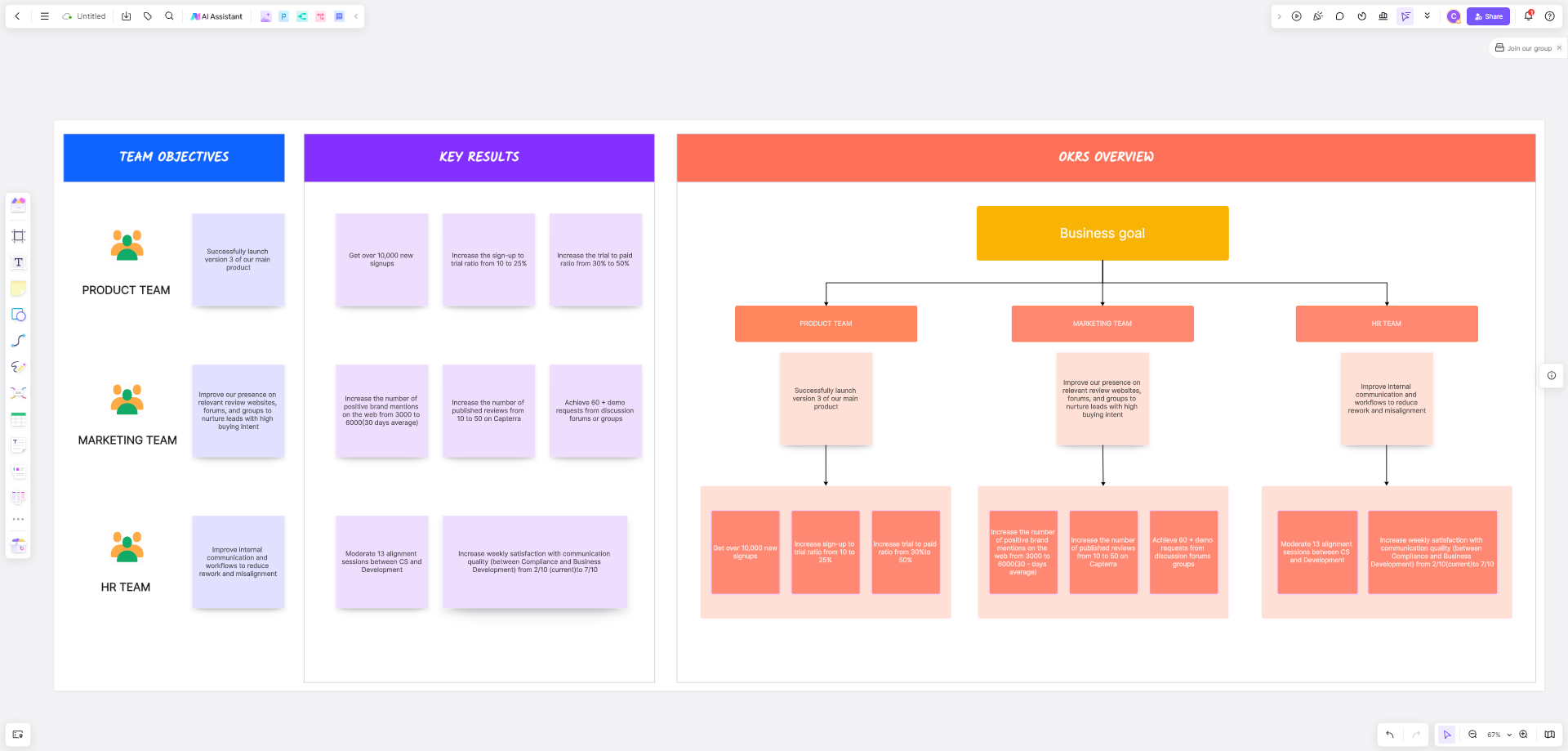
Boardmix’s pre-built OKR template structures the goal-setting process on a shared canvas. Each objective sits in a dedicated card, with linked key result trackers displayed beneath it. Teams can add owners, set target values, log weekly check-in scores, and leave comments — all in context, without leaving the board.
What makes it genuinely useful is the visual relationship between levels. Company OKRs cascade into team OKRs, which cascade into individual key results, and every link is visible on the canvas. When strategy shifts, your team can remap the entire system in one session rather than updating five separate spreadsheets.
Build a KPI Dashboard
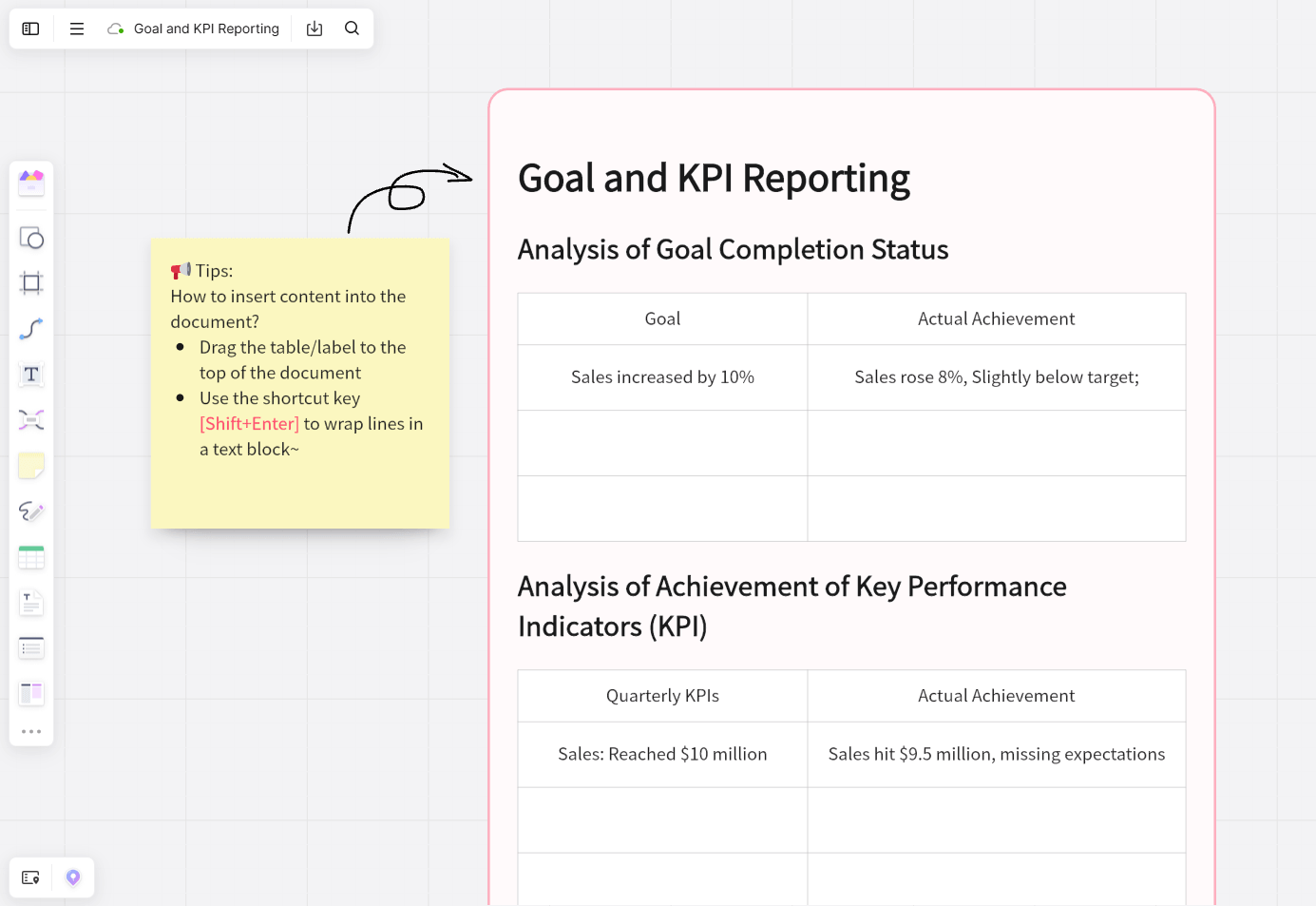
Boardmix’s KPI dashboard template takes a different approach: it organizes operational metrics by function — sales, product, customer success, finance — with color-coded status indicators (green / amber / red) that make performance visible at a glance. Each KPI card includes the metric name, owner, current value, target, and trend direction.
Run your weekly or monthly KPI review directly on the board. Stakeholders can add comments, flag blockers, and link to supporting data sources — turning a static metric display into a living operations room your whole team can navigate together.
Decompose Goals Faster with Boardmix AI
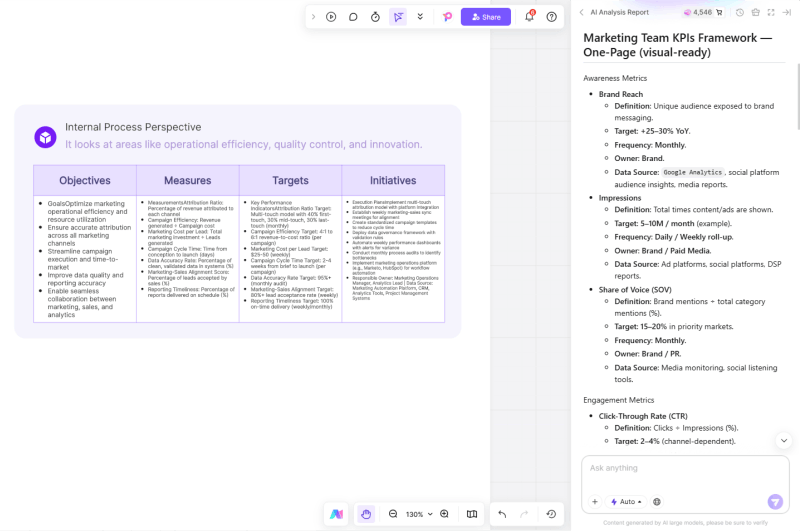
One of the hardest parts of OKR rollout is the blank canvas problem: teams know the destination but struggle to define the right key results to prove they’ve arrived. Boardmix’s built-in AI Agent solves this directly. Feed it a high-level objective — “Improve customer onboarding quality” — and Bosi AI generates a structured set of candidate key results, suggests relevant KPIs to monitor in parallel, and maps dependencies across teams.
It’s not a replacement for the human judgment that makes OKRs meaningful. It’s a starting-point accelerator that compresses hours of goal-design facilitation into minutes, so your team can spend its energy on the strategic conversation rather than staring at an empty template. For teams rolling out OKR and KPI frameworks for the first time, this alone saves weeks of setup friction.
Frequently Asked Questions
What is the main difference between OKR and KPI?
OKRs define where your team is trying to go — they are aspirational, qualitative, and quarterly. KPIs measure how well your team is running today — they are operational, quantitative, and monitored continuously. OKRs drive transformation; KPIs sustain performance. Both are necessary, and neither replaces the other in a complete goal management system.
Can OKRs and KPIs coexist in the same organization?
Yes — and they should. High-performing organizations use OKRs to set the strategic bets for each quarter while running KPIs to ensure that existing functions don’t degrade during the push. The key is labeling every metric clearly as one or the other, so your team always knows whether they’re tracking progress toward a new destination or monitoring the health of current operations.
How many OKRs should a team have per quarter?
Most frameworks recommend three to five objectives per team, each supported by two to five key results. Fewer than three and the team may lack sufficient coverage of strategic priorities; more than five and focus fragments. The test is simple: if every objective on the list genuinely competed for the same limited attention and resources, would your team know which to prioritize first?
Should OKR scores affect employee performance reviews?
No — and this is one of the most critical design principles for sustainable OKR adoption. When OKR scores are tied to compensation or promotions, employees rationally set safe, achievable targets rather than genuinely ambitious ones. OKRs work because they are honest signals of aspiration. Decoupling them from formal performance management preserves that honesty and keeps the framework functioning as intended.
Conclusion
The OKR vs KPI debate is largely a false choice. These are not competing frameworks — they are complementary instruments that operate at different altitudes. OKRs give your team direction, momentum, and the permission to pursue bold outcomes. KPIs give your organization the operational discipline to sustain performance while that pursuit is underway. Use them together, keep them clearly separated, and avoid the common traps outlined above — and you’ll have a goal management system that actually drives results rather than just generating reports.
Ready to build that system for your team? Try Boardmix free today and explore the OKR and KPI templates that let you align strategy, track performance, and accelerate toward your most ambitious goals — all in one collaborative workspace.