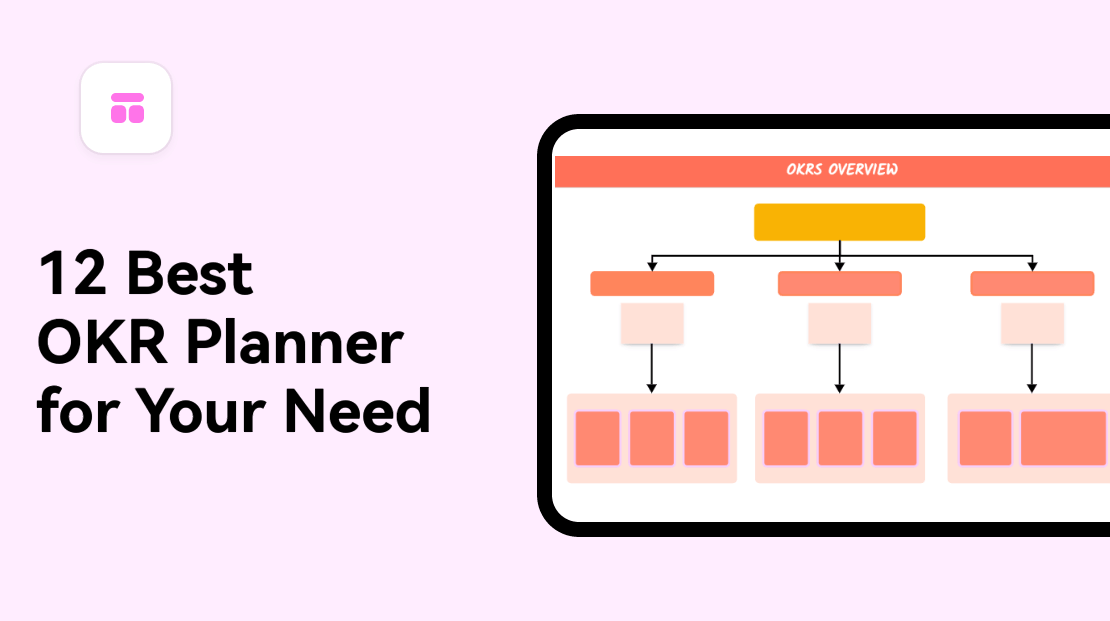
An OKR planner helps a team connect objectives with measurable key results and review progress over a goal cycle. The right format depends on whether you need a shared planning space, structured reporting, or links to day-to-day work.
Compare the tools below by how they help you define objectives, track key results, and review progress. A whiteboard can support planning discussions; a dedicated OKR platform may offer more structured reporting and goal tracking.
What Are OKRs
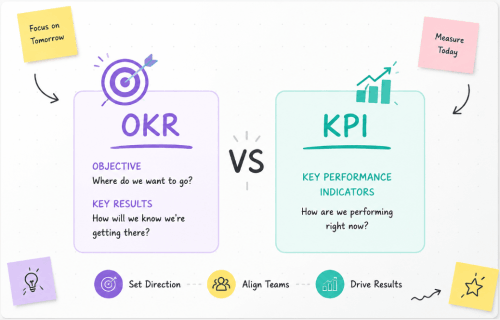
OKRs combine an objective with measurable key results. The objective describes the outcome a team wants; the key results provide evidence of progress toward it.
A useful objective is clear enough to guide choices. Each key result needs a defined measure, a starting point where relevant, and a target. Completing activities is not necessarily evidence that the desired outcome has been achieved.
Why Do You Need an OKR Planner
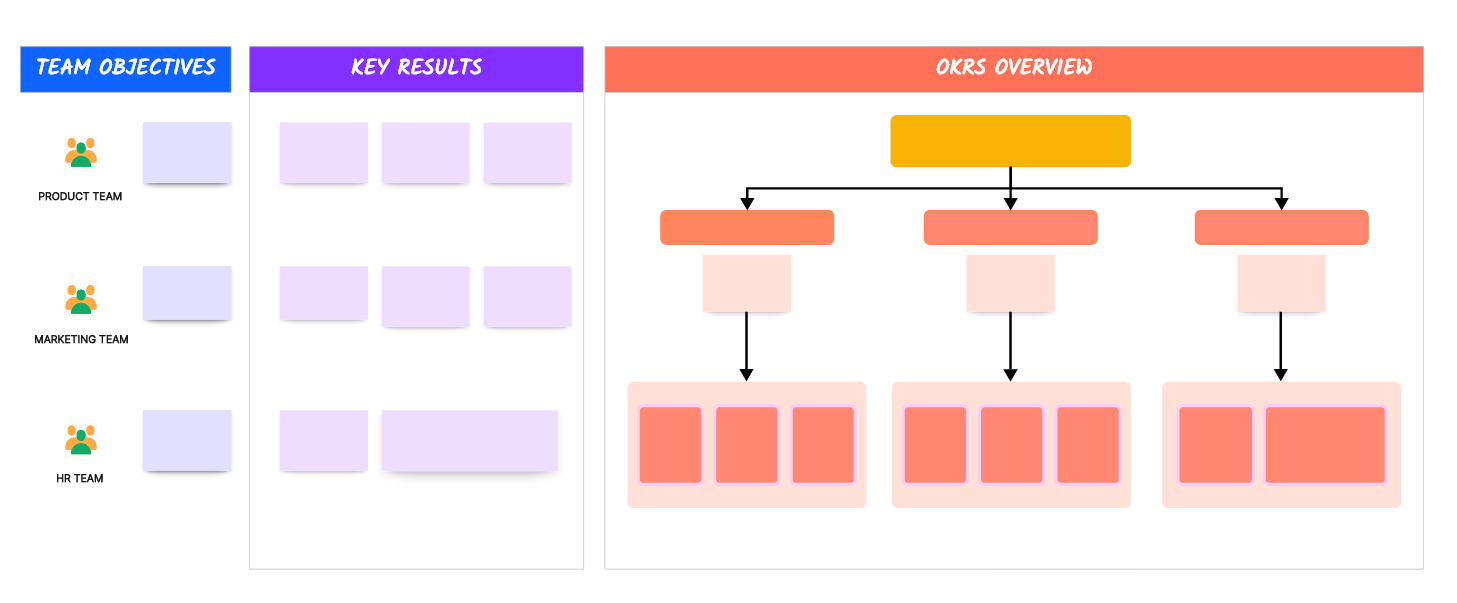
A planner gives the team a shared place to record goals, ownership, updates, and questions. It can support these tasks:
- Clearly define your objectives – a specialized tool will provide you with the features you need to define your goals clearly and concisely.
- Quickly view your key results – in this tool, you can evaluate your progress at a glance.
- Involve your team – efficient OKR planning requires the involvement of the whole team. Your OKR planner will allow you to share your objectives and key results with everyone so that you are on the same page.
What to Look for in an OKR Planner
Compare the tools against the way your team actually reviews goals.
- Goal tracking: Record objectives, key results, owners, measures, and progress updates. Decide whether a visual board is enough or whether you need structured reports.
- The tool’s price – some tools will have free plans, even though there will be limitations. Check each planner’s pricing to find one that is within your budgetary limits.
- Ease of use: Have the people responsible for updates try a small goal cycle. Compare how easy it is to find the objective, update a measure, and explain a change.
- Evidence: Use reviews to identify questions, then verify the features and limits needed by your team. A positive rating does not establish that a particular workflow is supported.
12 OKR Planners Compared
Boardmix
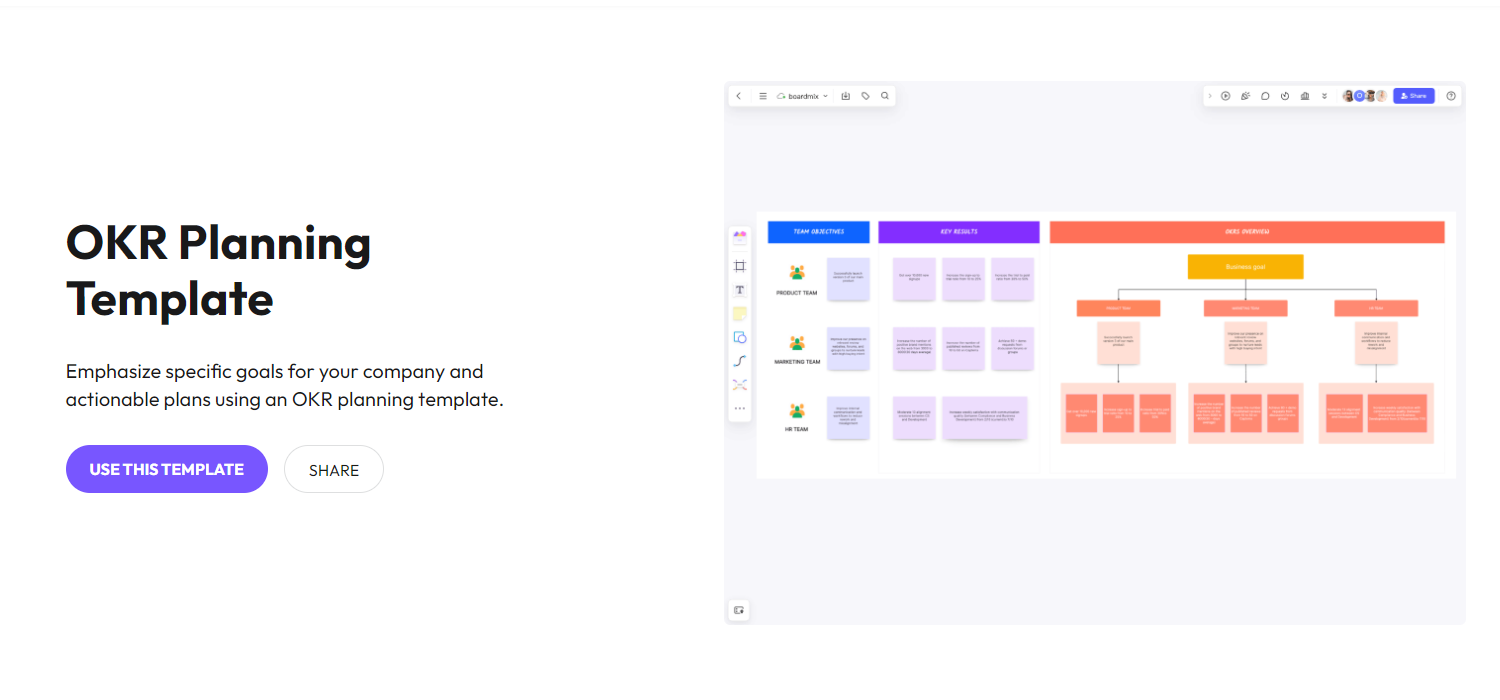
Boardmix provides a shared canvas for mapping objectives, key results, dependencies, and discussion. It suits visual planning sessions; teams needing automated OKR reporting should compare those requirements with a dedicated goal-management platform.
Key Features for OKR Planning
- Ready-made OKR planning template that you can adapt according to your needs and objectives,
- Numerous customization options,
- Variety of preset tools to track your OKR progress, such as Kanban, cards, and tables,
- Real-time collaboration to bring your whole team together,
- One-click sharing option.
Pros and Cons of Boardmix as an OKR Planner
Pros
- A Free plan is available for visual OKR planning within its board and object limits.
- Access the workspace online from a supported browser or application.
- Supports real-time collaboration for more efficient OKR planning,
- Arrange objectives and supporting notes in a visual layout.
- Has introduced dedicated OKR planning templates.
Cons
- No offline functionality,
- You might need some time to learn how to create a planner from scratch.
Pricing
Boardmix Free includes 3 editable boards, up to 100 objects per board, and 1 GB of storage. Paid plans expand the available board and AI allowances. Compare the plans against the number of OKR boards your team needs.
Asana
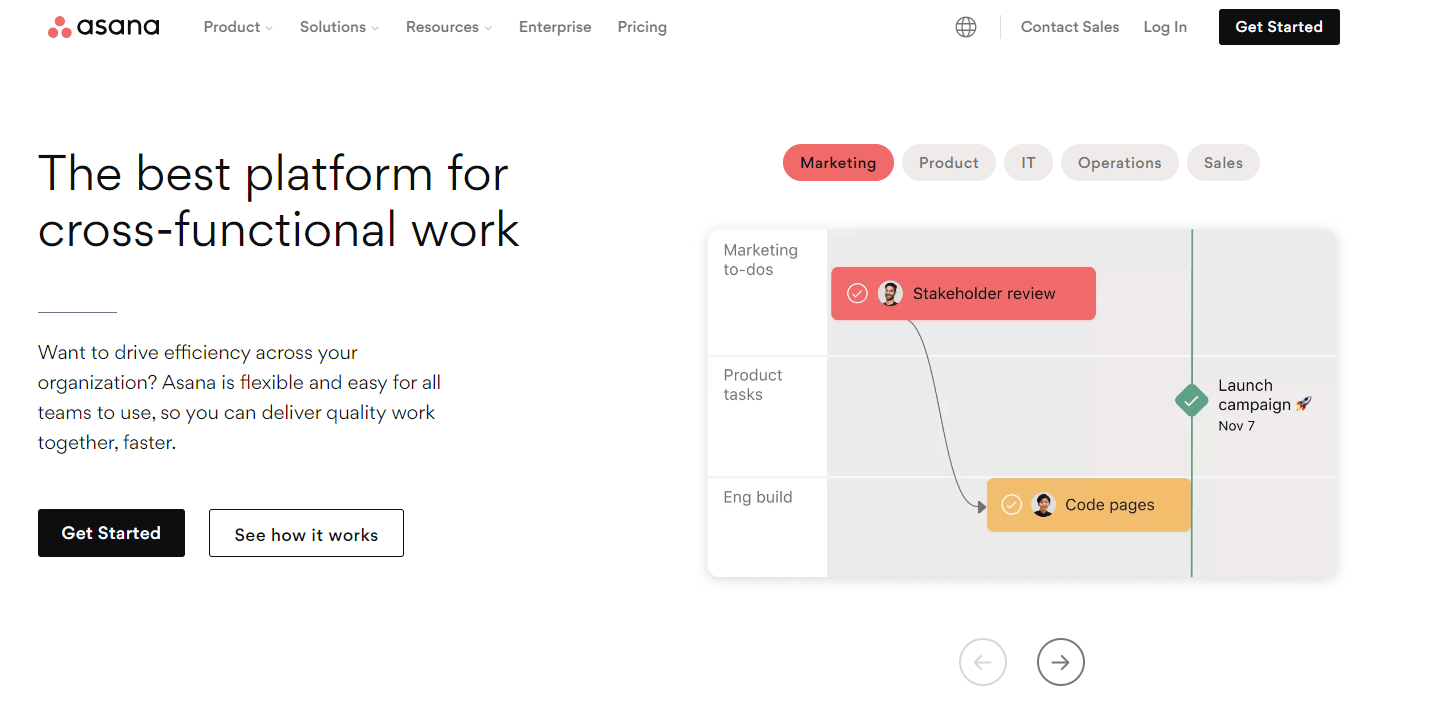
Another great option for an OKR planner is Asana. This task management application allows you to create daily tasks and assign them to your team members. This way, everyone can see how each task relates to the organization’s broader goals, thus giving them a clear vision of what they are working on.
Key Features for OKR Planning
- Digital OKR template to easily share your goals,
- Schedule tasks, assign team members, and add due dates,
- Divide projects into smaller sprints that everyone needs to follow.
Pros and Cons of Asana as an OKR Planner
Pros
- Automates repetitive tasks,
- Allows you to add all relevant information on each task,
- Easy to use,
- Supports integration with numerous apps.
Cons
- Confirm how the selected app handles offline work and synchronization.
- Some useful OKR features are only available in the paid plan,
- The required Goals and reporting features affect which paid plan is suitable.
Pricing
Asana Personal is free for up to 2 users. Starter is $10.99 and Advanced is $24.99 per user per month with annual billing; enterprise options use a sales quote. The plan comparison shows which reporting and goal-management features each tier includes.
Wrike
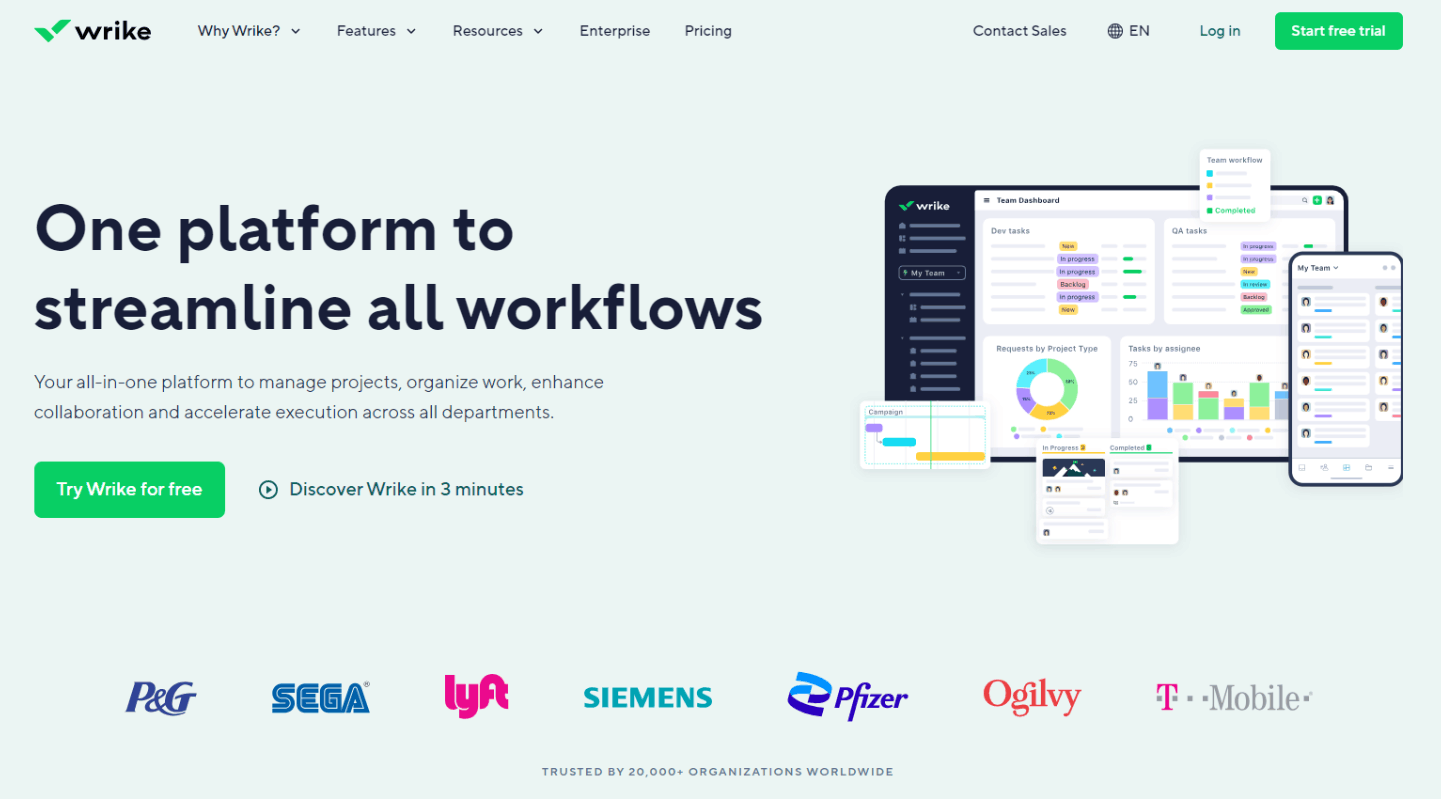
Wrike combines work management with collaboration and reporting options. Compare how its project structure and reports would support your OKR review process.
Key Features for OKR Planning
- Offers OKR planning templates,
- Supports individual OKR planning,
- Quickly mention every member of Wrike to facilitate communication.
Pros and Cons of Wrike as an OKR Planner
Pros
- It has a time-tracking function,
- Makes it easy for different teams within the organization to collaborate,
- Provides detailed analytics.
Cons
- The free plan gives limited options,
- Check how notes, updates, and supporting evidence attach to the goals or tasks you track.
- Define how progress is calculated and confirm that the required report is included in the selected plan.
Pricing
Wrike offers a Free plan for basic task management, with paid Team, Business, Pinnacle, and Apex tiers. Compare user limits, reporting, automation, and resource management in the official plan table.
ClickUp
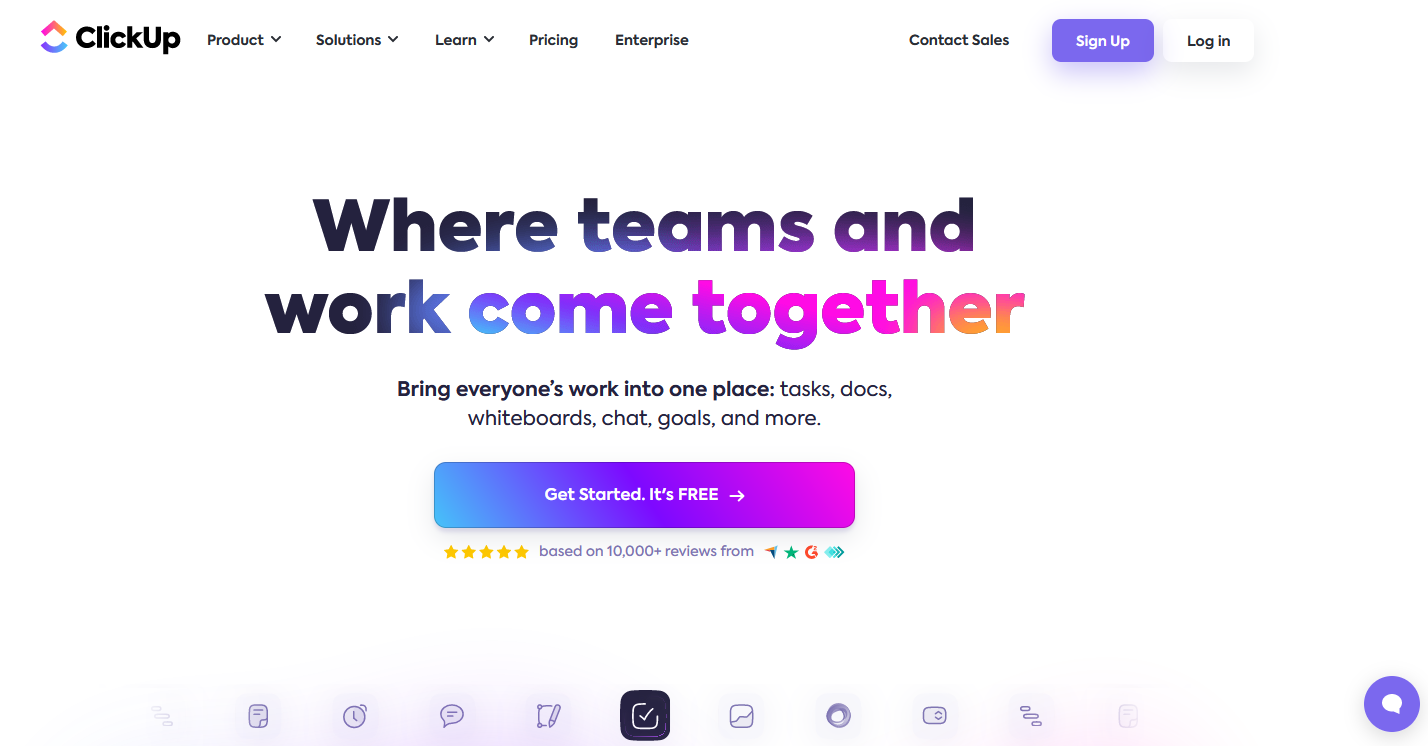
ClickUp combines tasks, goals, and dashboards. It is worth considering when the team wants to connect goal discussions with day-to-day work in the same platform.
Key Features for OKR Planning
- Dedicated goals and targets sections so that you can set up both objectives and key results,
- Track each sprint’s progress with percentage of completion,
- Create public folders with your goals to let every team member access them,
- Customizable dashboard to view everything you need at a glance.
Pros and Cons of ClickUp as an OKR Planner
Pros
- Many capabilities available in the free version,
- Supports integration with numerous third-party apps,
- Automates repetitive tasks,
- Has a built-in notepad.
Cons
- A workspace with many views and settings needs a clear setup for the people updating goals.
- Confirm the dashboard sharing and export options needed by report recipients.
- Check the actions available in the mobile app if teammates will update goals on the move.
Pricing
ClickUp offers a Free Forever plan and paid Unlimited, Business, and Enterprise plans. Unlimited is $7 and Business is $12 per user per month when billed annually. Compare storage, automation, and reporting in the plan table.
Weekdone
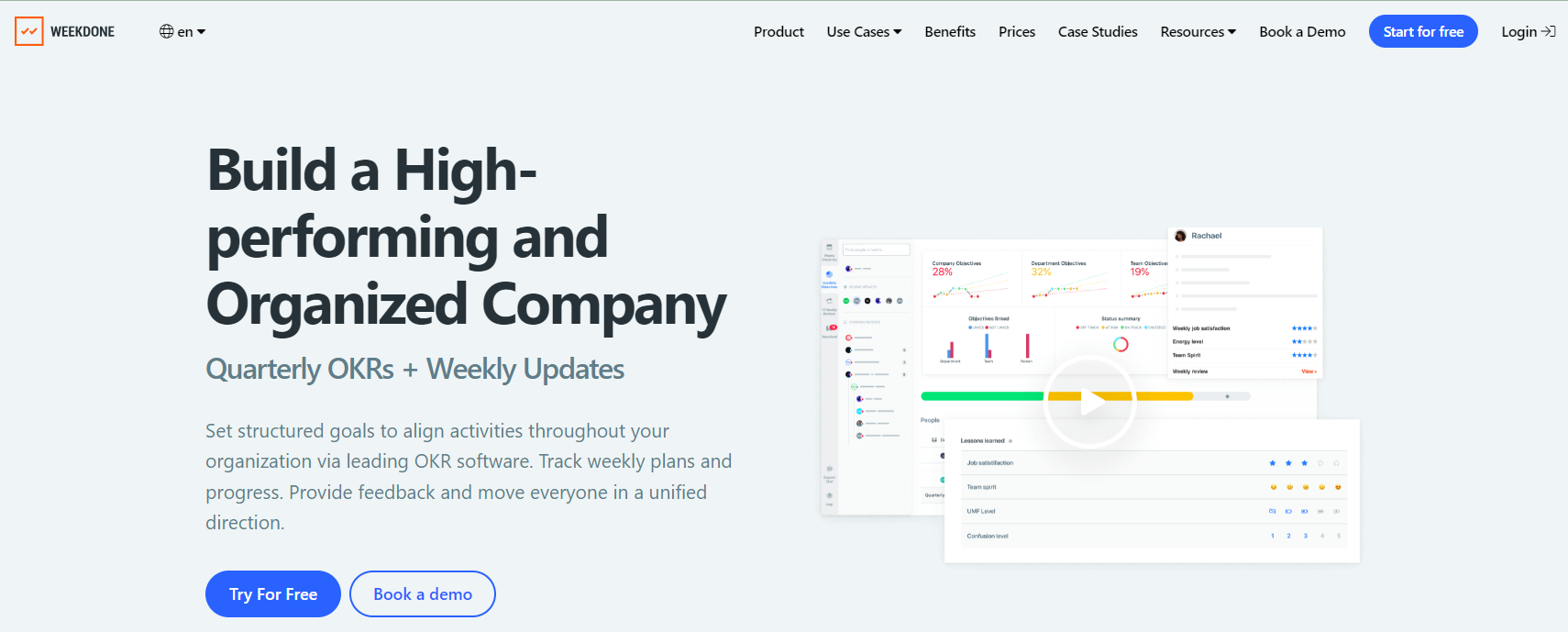
Weekdone is another OKR planner that you should try. It is a tool dedicated to setting structured goals that help you achieve your organization’s objectives.
Key Features for OKR Planning
- Allows team members to upvote others and boost their confidence,
- Updates on the weekly progress,
- Connects all departments of the organization.
Pros and Cons of Weekdone as an OKR Planner
Pros
- Receive weekly reporting directly to your email,
- Dashboards that update in real time,
- Intuitive interface.
Cons
- A team needs a regular update routine for weekly reporting to be useful.
- A structured reporting workflow offers less freedom than arranging an open visual canvas.
- Limited number of users in the free plan,
- Paid pricing scales with team size; compare the total cost for the people who need access.
Pricing
Weekdone is free for up to 3 users. Larger teams can use a 14-day trial; paid pricing depends on the number of users and billing period. Use the team-size calculator for a comparable quote.
Aha!
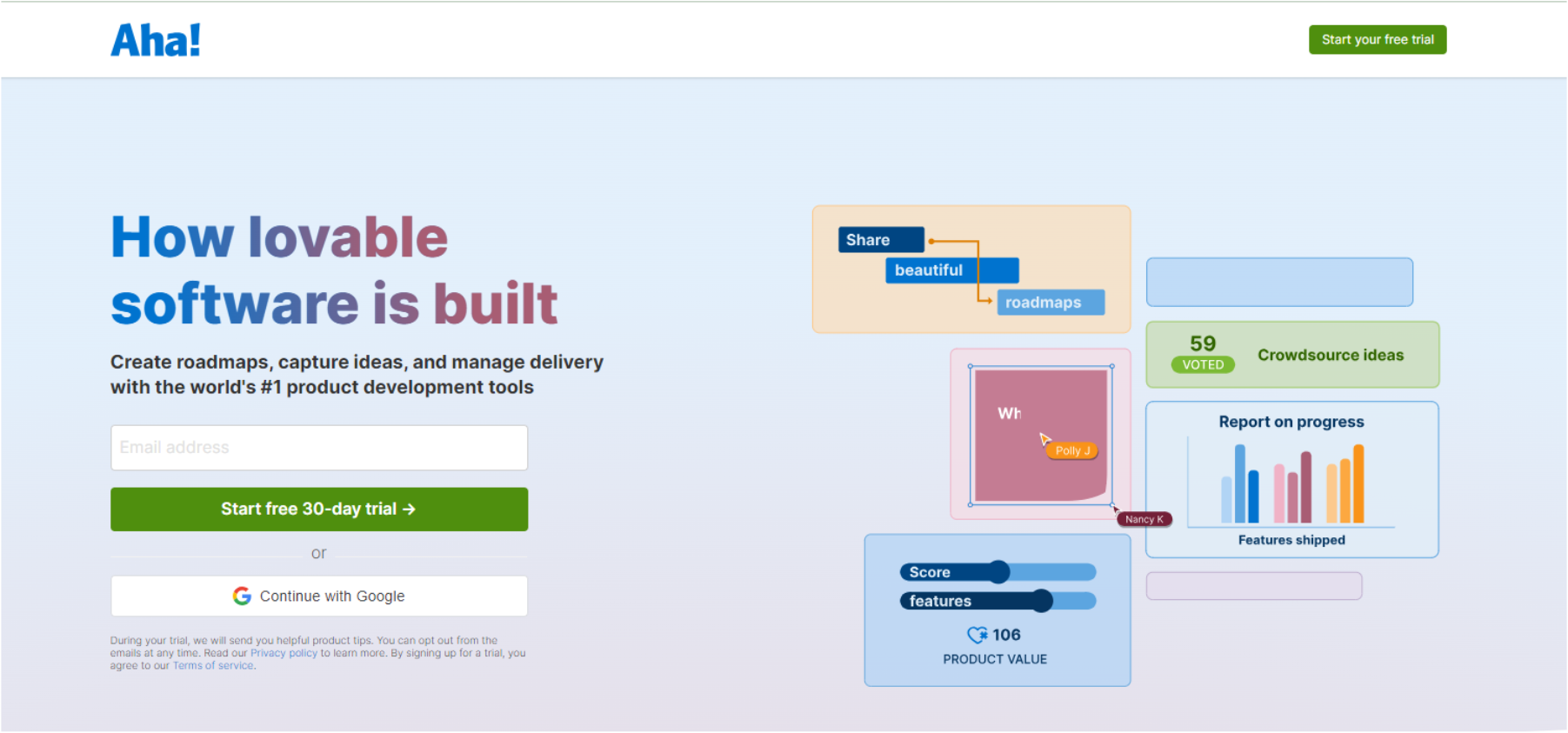
Aha! offers products for product planning and development. Aha! Roadmaps is relevant when goals need to connect with initiatives, releases, and a product roadmap.
Key Features for OKR Planning
- Lets you set up OKRs at every level of your organization,
- Has implemented a product value scorecard for improved task prioritization,
- Has interactive dashboards for reporting.
Pros and Cons of Aha! as an OKR Planner
Pros
- Integrates numerous third-party apps,
- Gives great customization options,
- Supports real-time reporting,
- Supports real-time collaboration between team members.
Cons
- Aha! offers several separate products, so the required combination affects cost and setup.
- A product roadmap workflow may be more than a team needs for a simple shared OKR list.
- Decide where daily discussions will take place alongside the roadmap and goal records.
- Is a little complicated for first-time users.
Pricing
Aha! Roadmaps starts at $59 per user per month and Aha! Ideas starts at $39 per user per month. They are separate products, with pricing and billing options shown on the Aha! pricing page.
Mooncamp
Another great OKR tool that you can try is none other than Mooncamp. This tool offers you a variety of functions that permit you to set your objectives and track their progress effectively.

Key Features for OKR Planning
- Define your objectives quickly and easily,
- Customize templates depending on your needs,
- Real-time updates on the progress made,
- Periodical reports.
Pros and Cons of Mooncamp as an OKR Planner
Pros
- Intuitive and user-friendly platform,
- Very flexible app,
- Supports integration with Microsoft Teams,
- Supports real-time collaboration.
Cons
- Doesn’t integrate with some third-party apps,
- First-time users might need some adjusting.
Pricing
Mooncamp offers Essential, Professional, and Enterprise plans. Compare goal-management features, access controls, and the billing currency in the official pricing table.
Leapsome
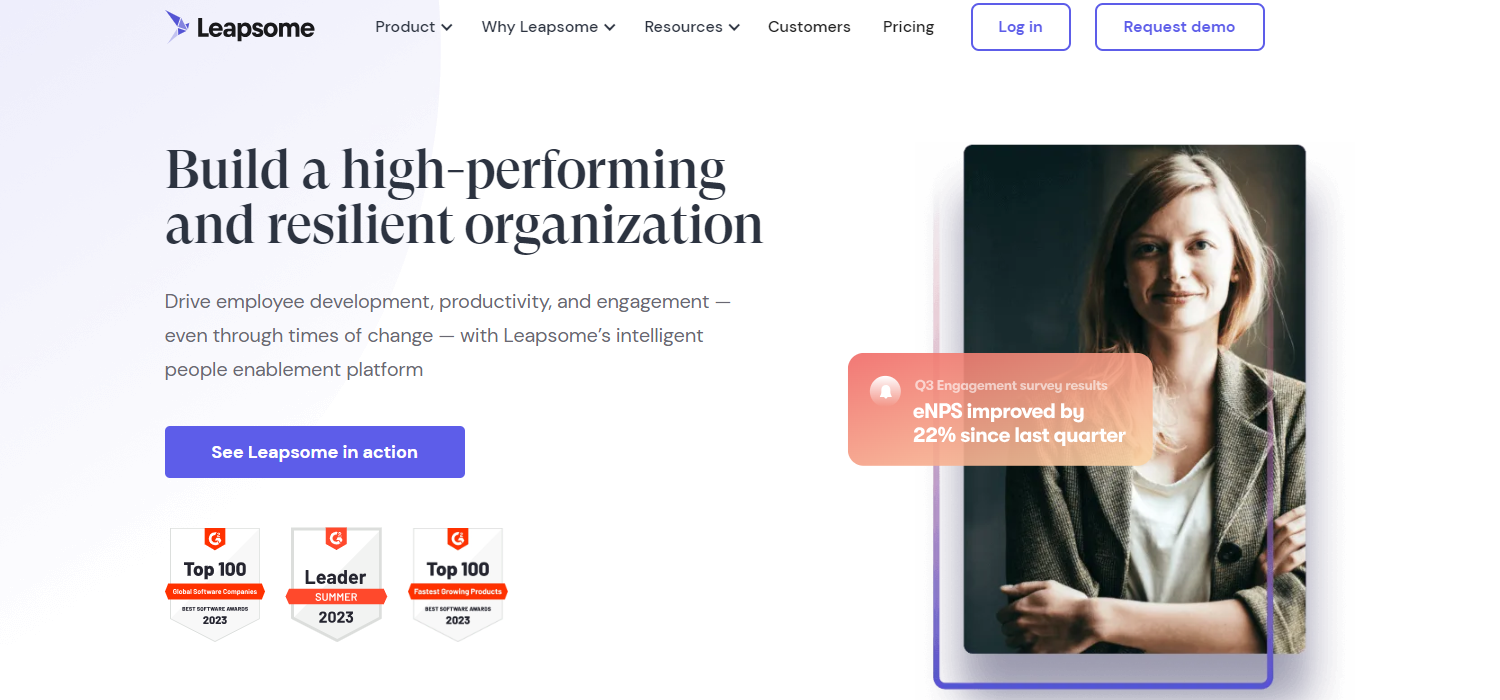
One more OKR tool worth trying is Leapsome, which is a performance management platform. The app gives you all the capabilities you need to ensure that all team members are on the same page, with tasks that align with the organization’s objectives.
Key Features for OKR Planning
- Create goal trees to showcase ownerships and dependencies,
- Leave comments on tasks,
- Set up recurring goal cycles that utilize a predetermined timeline,
- Provides real-time progress timeline.
Pros and Cons of Leapsome as an OKR Planner
Pros
- Provides a personalized “to-do” list,
- Very flexible dashboard,
- Supports integration with Slack,
- Supports 1-on-1 meetings.
Cons
- The team’s required data connections determine how much goal updating must be done manually.
- A performance-management workflow requires decisions about access to personal feedback and review information.
Pricing
Leapsome combines an HR platform with optional modules, including Goals & OKRs. Pricing is calculated per employee per month from the selected platform level and modules. Use the pricing calculator to build the required package.
Betterworks
Betterworks focuses on performance management, including goals, feedback, and employee development. Consider how its review process would fit the way your organization manages objectives.
Key Features for OKR Planning
- Visualize how your objectives align with each other,
- Set milestones to track the progress,
- Send and receive feedback,
- Perform periodical employee surveys.
Pros and Cons of Betterworks as an OKR Planner
Pros
- Every employee can ask for feedback even from their coworkers,
- Supports real-time reporting.
Cons
- A performance-management package includes processes beyond a standalone OKR board.
- The organization needs to define who can view and update goals and employee feedback.
- The selected products and user population affect the subscription proposal.
Pricing
Betterworks offers packages with different performance and talent-management capabilities. Its quote depends on the active user population, selected products, and deployment requirements. Compare the available packages before requesting a proposal.
Profit.co
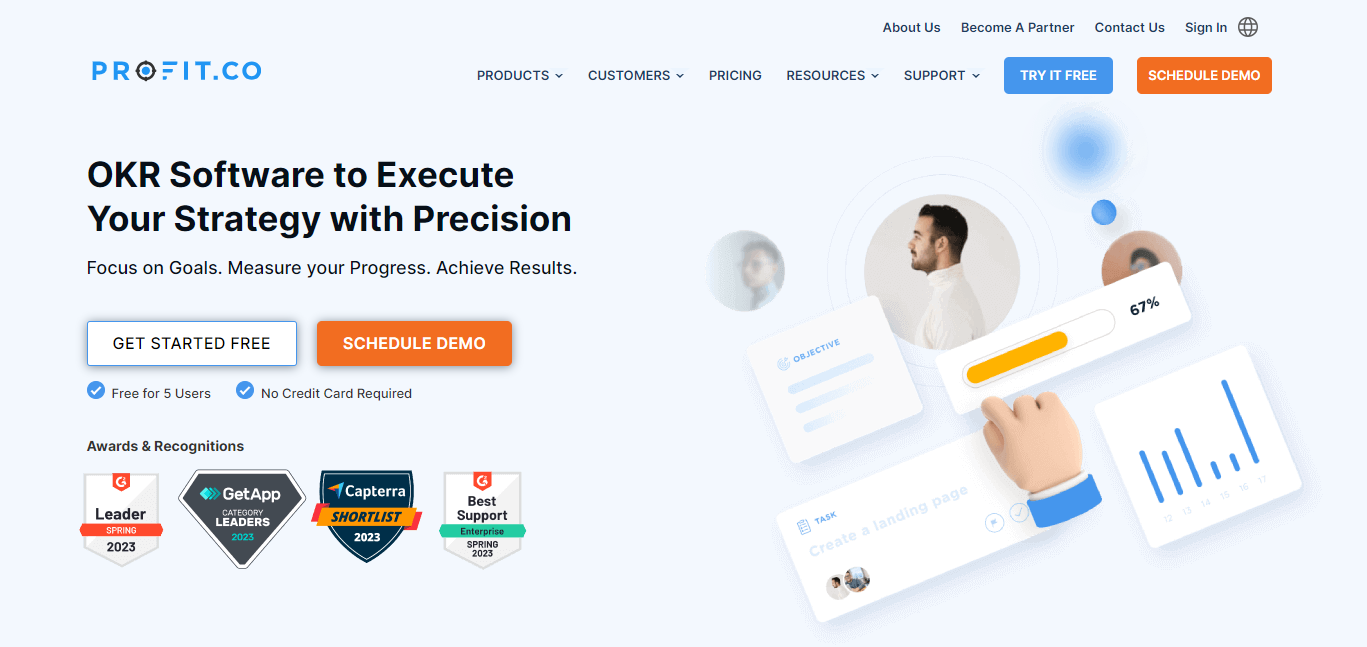
A well-known OKR planner is Profit.co. This is an app that combines both goal and project management, thus being very convenient.
Key Features for OKR Planning
- Numerous customization options,
- Employee reward system to boost your team’s morale,
- Numerous KPIs available for effective monitoring,
- Company news feed to engage employees.
Pros and Cons of Profit.co as an OKR Planner
Pros
- Available OKR planning templates,
- Supports file export in multiple file types,
- Great customer support,
- Integration with Google Sheets and Hubspot among others.
Cons
- Complex interface that has a steep learning curve.
- The required OKR features and modules affect the subscription quote.
Pricing
Profit.co offers a 30-day trial and quoted Essentials and Enterprise plans. Pricing depends on the chosen modules and number of users; see its plan comparison.
Businessmap (formerly Kanbanize)
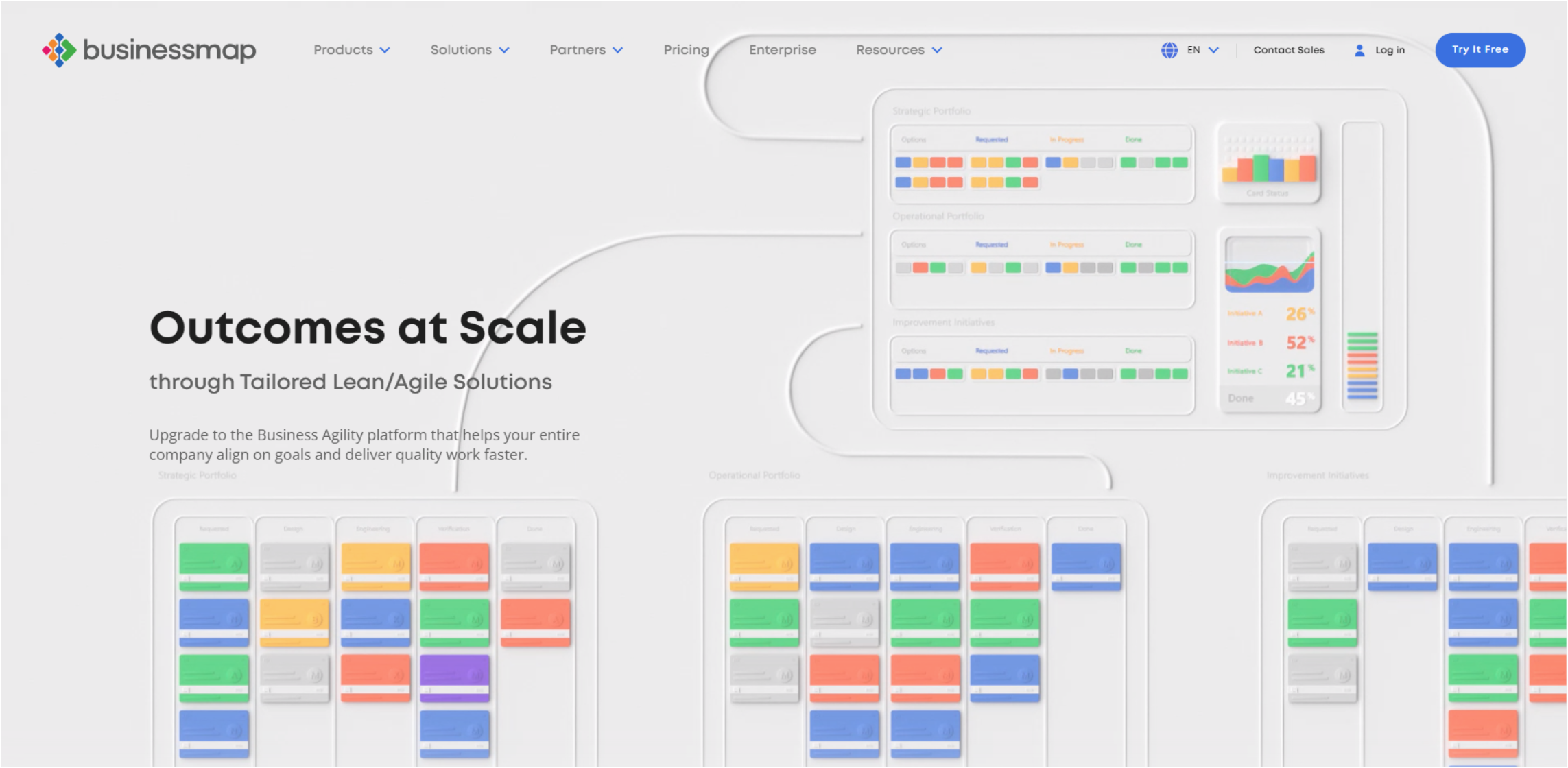
Businessmap, formerly Kanbanize, provides Kanban-based workflow management. Teams can visualize ongoing work and connect delivery activity with broader planning discussions.
Key Features for OKR Planning
- Connects objectives and key results in the same Kanban boards,
- Shows outcomes progress with percentage of completion,
- Generates automatic projections to let you study the outcome trends,
- Offers a wide variety of OKR customization options.
Pros and Cons of Businessmap as an OKR Planner
Pros
- Excellent visualization capabilities,
- Provides detailed analytics,
- Easy to set it up and get started,
- Lets you monitor actual vs. expected progress.
Cons
- Connecting delivery data with goals requires a defined workflow and ownership of updates.
- Teams new to Kanban need to agree on workflow states and work-in-progress policies.
- Cross-team boards need clear boundaries so that the same work is not represented inconsistently.
Pricing
Businessmap, formerly Kanbanize, provides workflow and portfolio-management software. Request pricing for the users and capabilities needed through the official Businessmap site.
15Five
The final tool that it’s worth trying is 15Five. This performance management platform focuses on your employees’ engagement, performance, and management. For this reason, this tool is specifically invaluable to the human resources team of the organizations.
Key Features for OKR Planning
- Lets you define your OKRs to ensure that everyone is on the same page,
- Permits you to monitor your progress in real-time,
- Allows you to set collaborative goals,
- Performs weekly check-ins.
Pros and Cons of 15Five as an OKR Planner
Pros
- Has implemented one-on-one meetings,
- Employees can show their appreciation to their coworkers with the high-five feature,
- Efficient engagement surveys.
Cons
- The selected performance-management package needs to fit the team’s existing HR and goal-review processes.
- Email and notification frequency can get distracting,
- There is no free version.
Pricing
With annual billing, 15Five Engage is $4, Perform is $11, and Total Platform is $16 per user per month. Compare the included feedback, performance-review, and engagement features in the plan table.
The Right OKR Planner for You
Choose an OKR planner that fits the way your team sets goals and reviews results. Use a small goal cycle to compare ownership, updates, reporting, and collaboration. Boardmix can help teams map objectives and discuss progress visually; compare the current plans before choosing a workspace.