



Goal management has become a make-or-break factor for both organizations and individuals. We’ve all been there: a team spends hours in a strategy meeting, drafting a GROW Model that seems promising on paper—clear goals, a basic understanding of reality, a list of potential options, and a shared commitment to execute. Yet weeks later, that plan is buried under a pile of unread emails, derailed by unforeseen challenges, vague action steps, or a lack of real-time oversight. This isn’t a failure of will; it’s a flaw in the traditional GROW Model’s ability to adapt to the complexity of modern work environments.
Enter the AI-enhanced GROW Model: a structured four-step framework (Goal, Reality, Options, Will) that builds on the classic model’s foundations while addressing its inherent limitations. Designed to cut through the ambiguity and subjectivity that plague traditional goal management, this AI-driven iteration is rapidly transforming how we set, track, and achieve goals—from enterprise-level strategic plans to personal career milestones. As AI-powered GROW Models move from niche tools to mainstream essentials, their data-driven intelligent deconstruction and dynamic simulation capabilities are reshaping the very logic of goal implementation, turning abstract aspirations into measurable, actionable, and adaptable roadmaps.
Why 90% of GROW Model Plans Ultimately Fail?
Let’s start with a sobering statistic: According to a 2024 survey by the Project Management Institute (PMI), nearly 90% of traditional GROW Model plans fail to deliver their intended outcomes. This isn’t an overstatement—it’s a reality that plays out in boardrooms, team huddles, and personal goal-setting sessions around the world. To understand why, we need to look beyond surface-level excuses (like “lack of time” or “team disengagement”) and dig into the structural flaws of traditional implementation methods.
The root cause lies in three major pitfalls of traditional implementation methods:
- Vague Goals: Ambiguous objectives that cannot be measured. For example, “improve team efficiency” versus “increase per-person productivity by 30% in Q3.”
- Distorted Reality: Subjective judgments replace data-backed insights, as traditional methods lack real-time business data support.
- Disconnected Actions: Plans lack tracking mechanisms, and manual models struggle to link with risk warnings.
The integration of AI-generated GROW models provides systematic solutions to these pain points:
- Goal Calibration: AI automatically verifies whether goals align with SMART criteria.
- Data-Driven Insights: Real-time data from sales reports, user retention metrics, and more replace gut-feel decisions.
- Risk Prediction: Action plans come with early-warning indicators for potential risks.
How AI Empowers the Practical Application of the GROW Model Across Roles?
The true power of the AI-enhanced GROW Model lies in its versatility. It’s not a one-size-fits-all tool, but a customizable solution that adapts to the unique challenges of different roles. Whether you’re a corporate manager tasked with aligning departmental goals, an HR professional building employee development plans, or a sales rep looking to boost conversion rates, AI-driven GROW applications can streamline your workflow, reduce guesswork, and drive better results. And with tools like Boardmix, these applications become even more powerful, enabling efficient collaboration, real-time tracking, and visual clarity that traditional GROW models can’t match.
Corporate Managers
Pain Points: Difficulty breaking down annual strategic goals (e.g., OKRs) into departmental tasks, lack of visibility into execution progress, and decisions not backed by data.
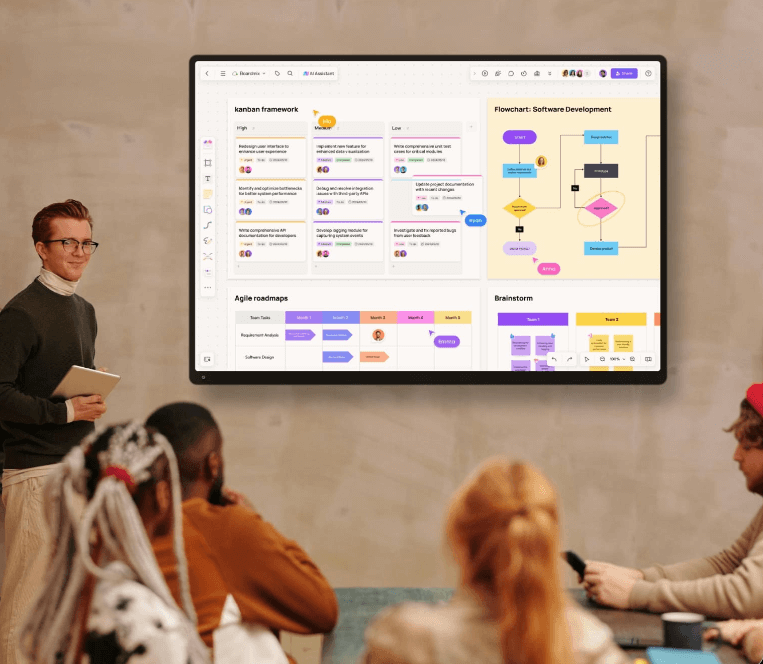
AI + GROW Solution: AI tools use the GROW framework to help managers decompose macro goals into clear, actionable departmental plans. By integrating internal and external data, AI generates tailored strategy recommendations. Using Boardmix’s project Kanban, managers can track task progress and key metrics in real time, enabling truly data-driven decision-making.
HR & Trainers
Pain Points: One-size-fits-all employee development plans, fragmented training programs, and ineffective performance reviews due to a lack of structured tools.
AI + GROW Solution: AI analyzes employee competency and performance data to generate personalized GROW development roadmaps. HR can quickly build systematic, structured GROW training programs using Boardmix’s rich template library and easily share them with employees and instructors.
Sales Professionals
Pain Points: Low lead conversion rates, disorganized customer follow-up processes, ineffective competitive strategies, and stalled sales growth.
AI + GROW Solution: AI applies the GROW framework to output tailored follow-up strategies and action plans based on the customer’s lifecycle stage. Sales teams can use Boardmix’s customer journey map templates and Kanban views to plan and execute GROW strategies for each client. Additionally, AI compares market data to intelligently generate competitive response strategies, helping sales teams break through bottlenecks and boost performance.
A 3 Minute Practical Guide to Generating Your GROW Model with AI
The idea of integrating AI into your GROW planning might sound intimidating, but it’s actually simpler than you think. The goal of AI-driven GROW tools is to save you time, not add complexity. In just 3 minutes, you can go from a vague goal to a structured, actionable plan using Boardmix—no technical expertise required. This step-by-step guide is designed for busy professionals who need results fast, whether you’re a manager, HR rep, salesperson, or anyone looking to turn their goals into reality.
Preparation for AI Generated GROW Model
Visit the Boardmix website, click “Log In / Sign Up” to register, then select “New File” on your dashboard.
Step 1: Activate the AI Assistant & Input Your Core Goal (1 min)
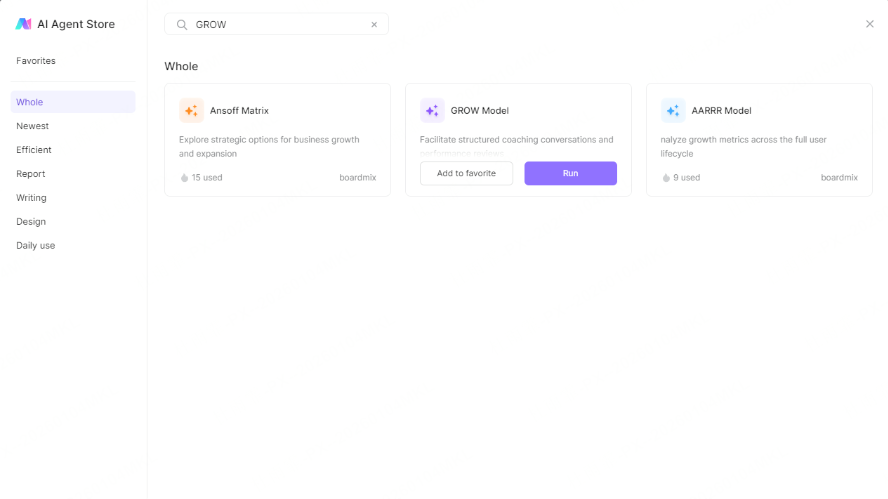
Path: Click the “AI Assistant” icon in the bottom toolbar to select GROW Model, then enter a clear instruction and confirm to generate.
Instruction formula:
“As [your role, e.g., Sales Lead], I need to solve [specific problem, e.g., low new client conversion in Q3] and aim to achieve [quantified goal, e.g., increase new client conversion by 15% in Q3]. Key constraints are [resources/time, e.g., within 2 months, no extra budget].”
Tips:
Avoid vague goals (“improve team performance”).
Insist on quantification (“increase conversion by 15%” or “reduce average response time to under 4 hours next quarter”).
Step 2: Use AI to Deepen & Refine the Content (1 min)
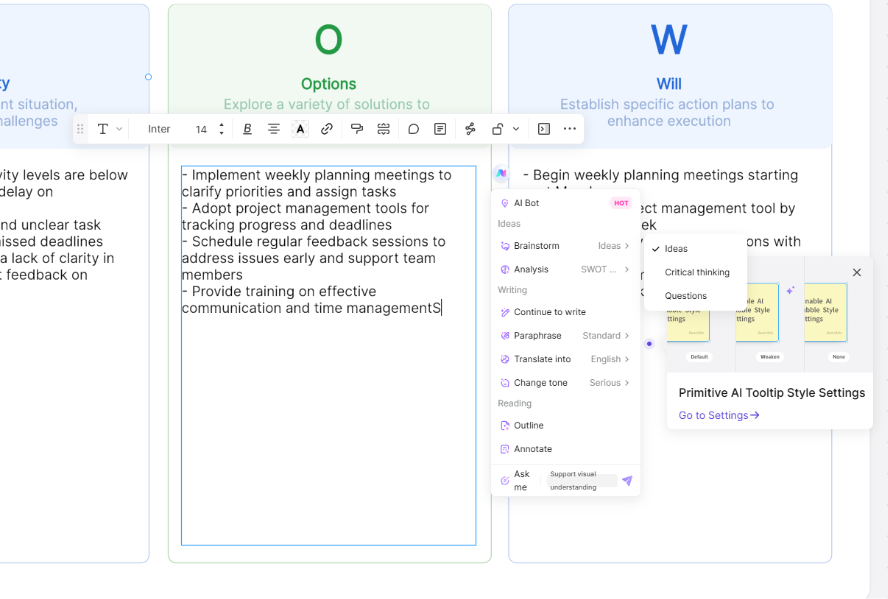
Once the initial GROW draft is generated, leverage the AI Assistant’s sub tools to polish it:
- Reality (R) too general? Click “Generate Analysis Report” for case based data support.
- Options (O) insufficient? Select text and use “Brainstorm” to expand solutions.
- Wording unclear? Highlight text and “Rephrase” for smoother expression.
- Will (W) steps vague? Use the AI chat to detail actions, assign owners, set clear deadlines, and create commitment driven execution statements.
Step 3: Visual Optimization & Team Collaboration (1 min)
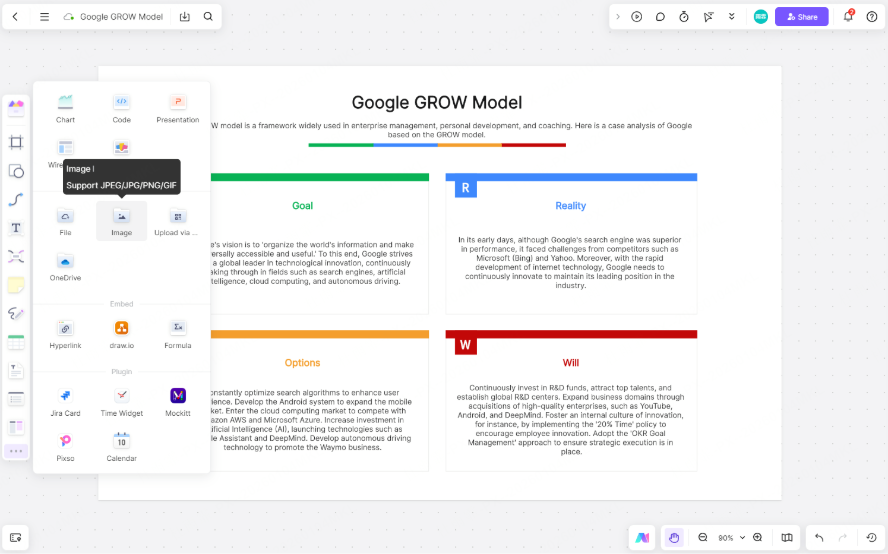
Visual polish: Add icons, connectors, charts, or Kanban cards to make the model intuitive and progress oriented.
Team collaboration: Click “Share” (top right) to invite colleagues with edit/view permissions. Use comments to exchange feedback directly on the GROW plan.
These visual and collaborative features turn abstract GROW plans into clear, trackable, team aligned blueprints, which solves the classic problems of goal ambiguity and lack of feedback loops.
Out-of-the-Box GROW Model Template Resources
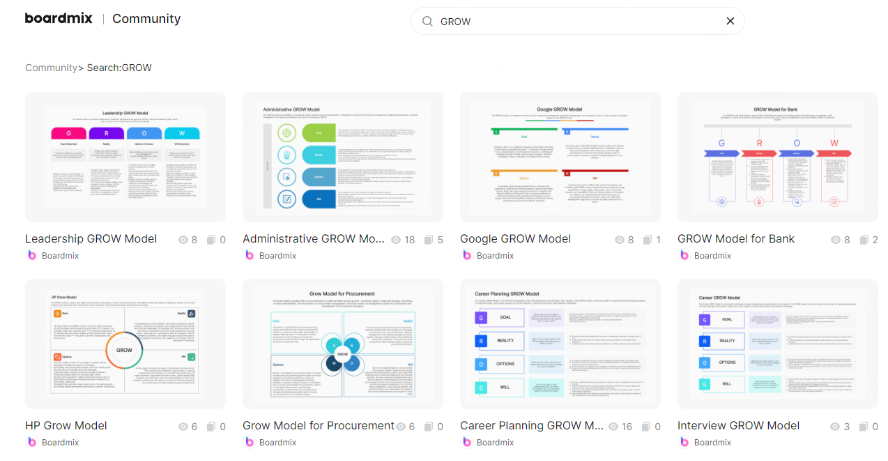
If you’re short on time or not sure where to start, pre-built templates are a game-changer. Boardmix offers a library of GROW Model templates designed for real-world scenarios, so you don’t have to start from scratch. Whether you’re planning your career, preparing for an interview, developing leadership skills, or managing a team project, there’s a template tailored to your needs.
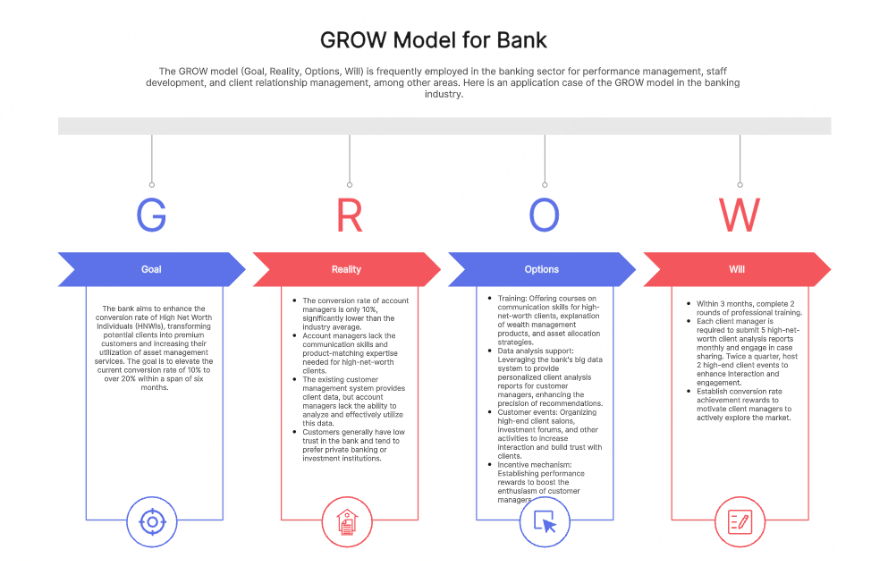
For example, the “Career Development GROW Template” includes pre-filled sections for Goal (e.g., “Advance to Senior Manager within 2 years”), Reality (e.g., “Current skills: project management; Skill gaps: strategic planning”), Options (e.g., “Take a strategic planning course, mentor with a Senior Manager, lead a cross-functional project”), and Will (e.g., “Enroll in course by Q2, schedule monthly mentor meetings”). All you have to do is customize the details to fit your specific situation, and the AI can help refine and enhance the template even further. These templates save you time, ensure that you don’t miss key sections, and provide a structured framework for success.
Conclusion
The AI generated GROW Model turns goal-setting from paper talk into actionable reality, while Boardmix builds an efficient bridge throughout the entire AI-driven GROW process. Its core advantages include:
Visual Collaboration: Cards, flowcharts, and real-time comments keep the team aligned on one board, so there is no version chaos and clear tracking at every stage.
Rich Templates & AI Efficiency: Built-in GROW templates cover multiple scenarios, and the AI Assistant expands options on the fly, which makes GROW an instant, usable tool.
Cross-Device Sync: Access and update your AI-generated GROW plan on large screens, mobile, and more, breaking time space limits and serving as your digital goal-management brain.
Ready to see it in action?
Log in to Boardmix now, input your goal, and experience the AI-generated GROW Model to create your personalized actionable plan in just 3 minutes!