



The 5 Whys analysis is a simple yet powerful problem-solving tool that can resolve nearly 50% of issues with just five targeted questions, saving up to 70% of troubleshooting time for teams across industries—from manufacturing and tech to customer service and project management. At its core, this method relies on iterative questioning to peel back the layers of surface-level symptoms and uncover the root cause of a problem, rather than addressing temporary fixes that only mask issues. Boardmix elevates this tried-and-true approach by streamlining the entire process, allowing teams to focus on creative problem-solving and actionable solutions instead of getting bogged down in manual structural layout or disjointed note-taking.
Without the need to manually map out problems, hypotheses, or causal relationships, users can now leverage Boardmix’s AI capabilities to generate structured inquiry pathways, validate underlying reasons with data-driven insights, and scale the 5 Whys method to tackle even the most complex organizational challenges. In this comprehensive tutorial, you will learn exactly how to harness the power of AI-driven 5 Whys analysis to solve problems more efficiently, accurately, and collaboratively—step by step.
What is AI 5 Whys Analysis?
The AI 5 Whys in problem-solving analytical method represents a significant upgrade to the traditional 5 Whys framework, which was originally developed by Toyota in the 1930s as part of its lean manufacturing philosophy. The foundational principle remains the same: asking "why" five times in a row to thoroughly examine and isolate the root cause of a problem, rather than stopping at the first obvious explanation. What sets the AI-enhanced version apart is its ability to automate, accelerate, and deepen the analysis—making the process faster, more data-driven, and scalable enough to solve complex, multi-layered issues that would overwhelm manual analysis.
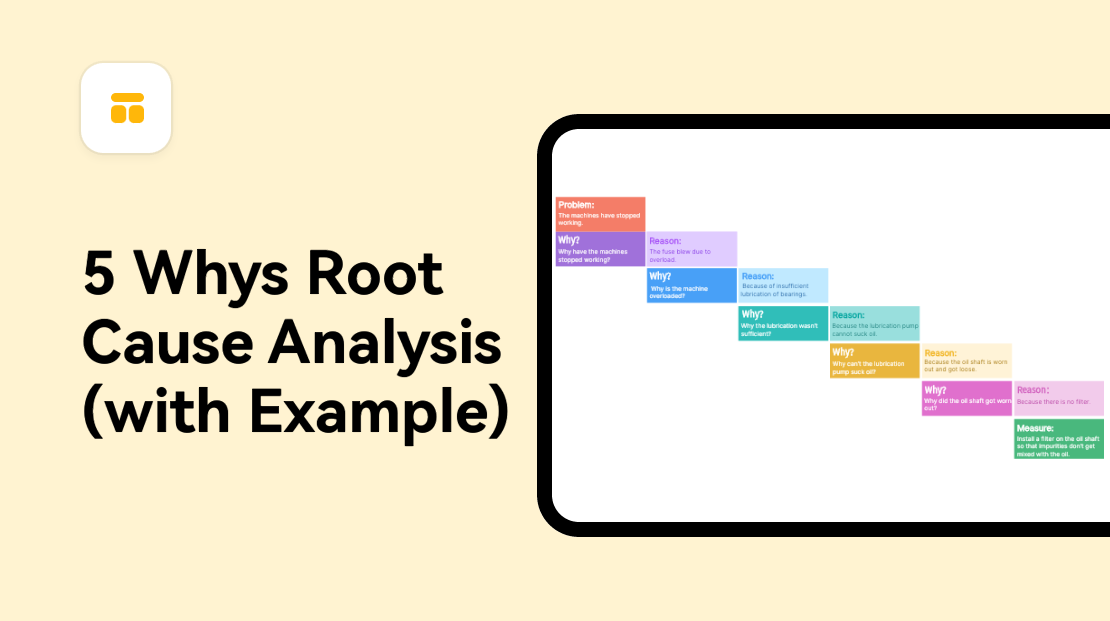
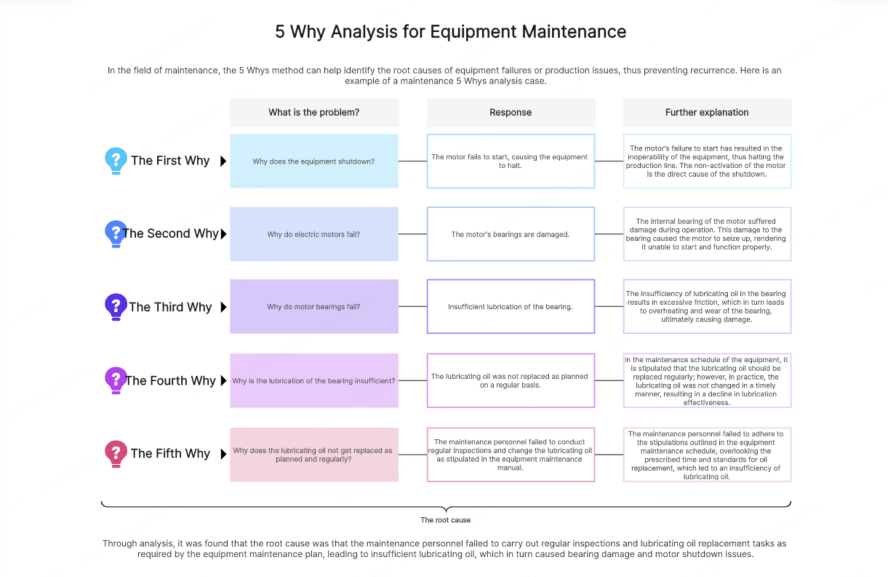
A classic example of the traditional 5 Whys illustrates the core logic, which AI amplifies:
Problem: A machine stopped working on a production line.
Why? The fuse blew due to an electrical overload.
Why? The motor overheated beyond its operational limits.
Why? It wasn’t lubricated properly during the last maintenance check.
Why? The maintenance schedule was delayed due to staffing shortages.
Why? The HR department failed to fill the open maintenance role on time due to outdated hiring protocols.
In this scenario, the root cause is not a blown fuse (a quick fix) but a broken hiring process—a systemic issue that AI can identify faster and validate with data on maintenance delays, staffing metrics, and HR workflows. Boardmix’s AI doesn’t just replicate this questioning; it cross-references internal data, industry benchmarks, and historical case studies to ensure each "why" is rooted in factual evidence, not just subjective team opinions.
Core Advantages of AI-Generated 5 Whys Analysis
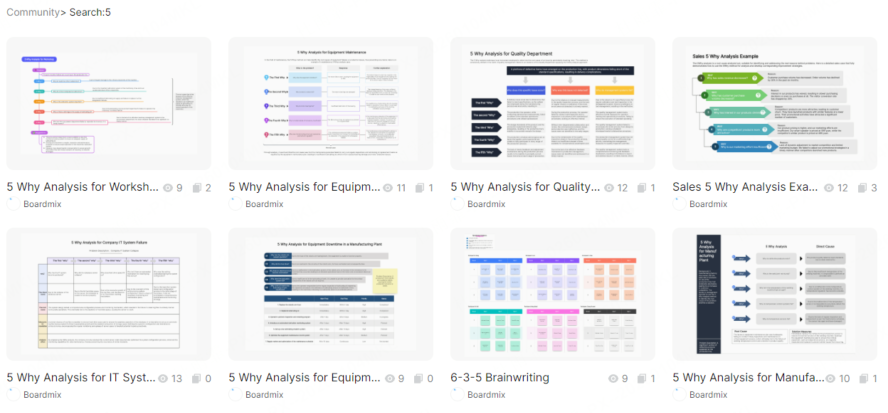
While the traditional 5 Whys method relies heavily on manual, experience-driven questioning—often limited by individual biases, incomplete information, or narrow team perspectives—AI-generated 5 Whys automates causal logic deduction using advanced algorithms and data integration. This marks a fundamental shift from brain-powered, intuition-based reasoning to objective, data-driven insight, with core advantages centered on two critical pillars: efficiency and depth.
Dramatic Efficiency Gains:
AI eliminates the time-consuming process of manual deduction, generating complete, logically sound cause-and-effect chains in mere seconds—instead of the hours or days it might take a cross-functional team to map out the same relationships. The Boardmix AI system instantly synthesizes information from its built-in knowledge base, as well as custom data inputs provided by the team (such as performance metrics, incident reports, or process documentation), to construct a multi-layer causal relationship map that is easy to visualize and iterate on. This efficiency gain is transformative for fast-paced environments, where delayed problem-solving can lead to lost revenue, customer dissatisfaction, or operational bottlenecks. For example, a retail team facing a sudden drop in online sales can use Boardmix’s AI 5 Whys to identify the root cause (e.g., a broken checkout button) in minutes, rather than spending days manually auditing each step of the customer journey.
Unmatched Depth & Breadth:
Human analysts are limited by their own experience, access to information, and cognitive biases—often missing hidden connections between seemingly unrelated factors. AI, by contrast, can connect multi-dimensional data points across departments, systems, and timeframes, surpassing the limits of human expertise. The Boardmix AI system processes real-time business data, industry case studies, historical incident reports, and even external market trends simultaneously to uncover subtle, interrelated causes that human teams would likely overlook. This breadth of analysis avoids the analytical blind spots caused by limited perspective, ensuring that the root cause identified is not just a single factor but a holistic understanding of the problem’s ecosystem. For instance, a tech team investigating app crashes might find via AI 5 Whys that the issue stems not just from a code bug, but from a combination of outdated device compatibility, server latency, and user behavior patterns—insights that a manual analysis might miss.
How to Address Issues Smarter with 5 Whys Analysis Powered by AI?
Selecting the right AI tool is the first critical step toward fully resolving complex issues, as not all platforms offer the same level of integration, collaboration, or customization. We strongly recommend Boardmix, an AI-powered whiteboard application designed for cross-functional teamwork, supporting hundreds of users in real-time communication and collaboration—whether in the same office or working remotely. Boardmix’s intuitive interface and AI-driven features make it the ideal platform to decipher complex problems, visualize causal relationships, and align teams on solutions. Below is a thorough, step-by-step tutorial to guide you through developing a comprehensive AI 5 Whys analysis, from defining the problem to implementing and testing solutions.
Step 1: Call a team meeting to go over the agenda
Before engaging the AI tool, align your team on the problem to ensure everyone is working from the same starting point. Assemble a cross-functional team from departments directly related to the issue—such as development, operations, customer support, quality assurance, or finance—to bring diverse perspectives to the analysis. Collaboratively define the precise issue that needs resolution, using specific, data-backed language to avoid ambiguity. For example, instead of a vague statement like "customer satisfaction is low," frame the problem as "Why did the number of customer support tickets increase by 60% in the past two weeks, with 80% related to delayed order deliveries?"
To refine this problem definition even further, you can use Boardmix’s AI SMART goal tool, which helps translate broad issues into Specific, Measurable, Achievable, Relevant, and Time-bound problem statements. Clear, structured thinking at this stage ensures the AI engine can analyze the relevant context and generate perceptive, targeted "why" layers that align with your team’s goals.
Step 2: Login to Boardmix
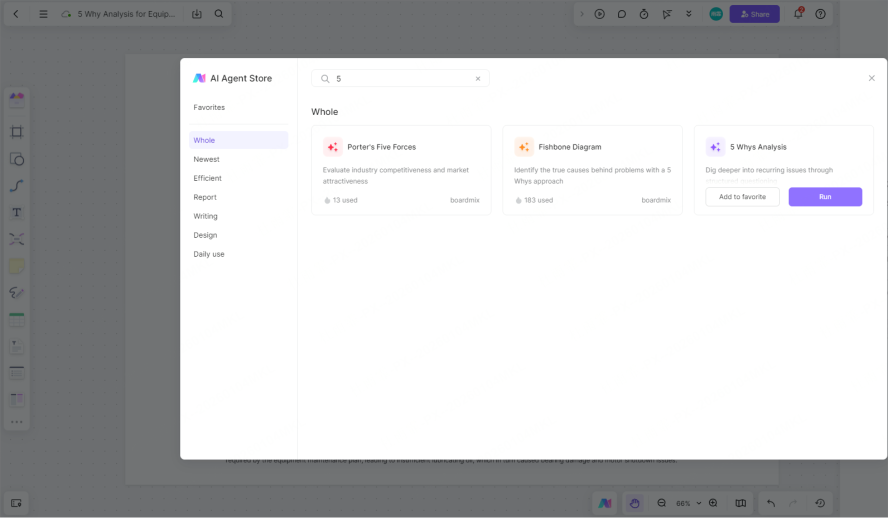
Once the problem is clearly defined, log in to your Boardmix account and navigate to your team’s workspace. Start with a fresh, blank canvas to avoid clutter and ensure the analysis remains focused. Locate the Boardmix AI assistant in the bottom right corner of the interface—this is the central tool for generating your 5 Whys analysis. Input the clearly defined problem statement you developed with your team, and prompt the AI to generate a structured 5 Whys inquiry pathway.
For an even more tailored experience, leverage Boardmix’s community template library by searching for pre-built 5 Whys templates designed for your industry (e.g., manufacturing, customer service, software development). These templates provide a ready-made structure, saving you time on formatting and ensuring your analysis follows best practices for root cause identification.
Step 3: Enter the description of your question
Provide the Boardmix AI system with a succinct, unambiguous problem statement—this is the foundation of an accurate analysis. The AI will use natural language processing to parse the key elements of your problem (e.g., "20% of orders shipped late last month") and generate the first layer of causal reasoning, identifying probable underlying reasons based on its knowledge base and any custom data you’ve uploaded (such as shipping logs, warehouse metrics, or team schedules).
For example, if your problem is "Why were 20% of the orders shipped late last month?" the AI might return initial reasoning such as:
- Warehouse handling processes were slowed by a new inventory system rollout
- The logistics crew was understaffed due to unplanned absences
- Software system synchronization errors caused incorrect order prioritization
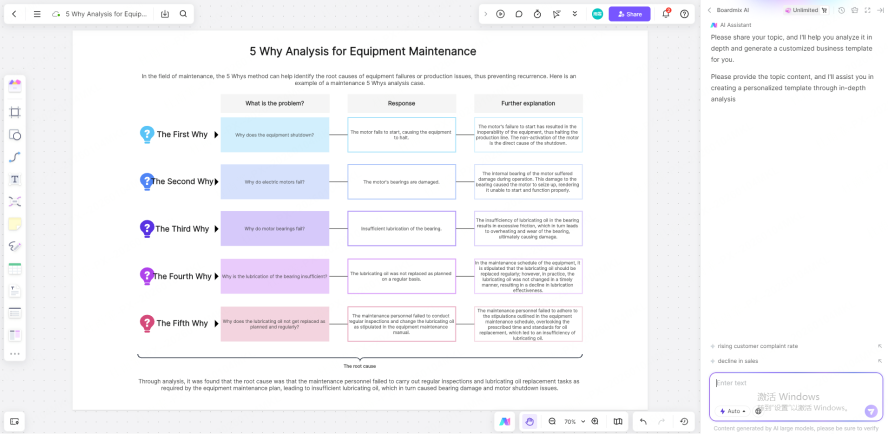
This first layer of reasoning is the starting point for the iterative 5 Whys process, and the AI will automatically structure these potential causes in a visual, easy-to-follow format on your Boardmix canvas.
Step 4: Make changes to your 5 Whys analysis
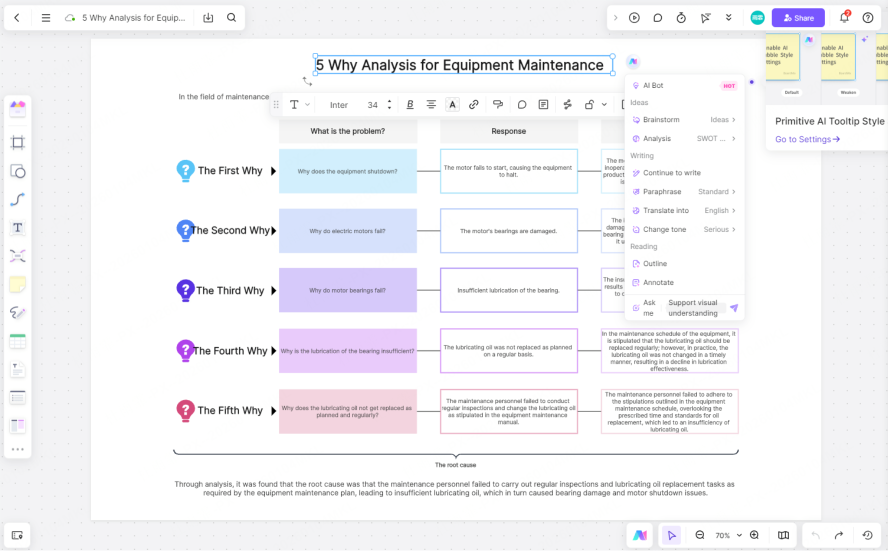
AI-generated outputs are a starting point, not a final answer—surface-level or incomplete reasoning is common in the first iteration. If the AI’s initial "why" layers are too shallow, continue prompting the system to dig deeper, asking follow-up "why" questions either horizontally (exploring parallel causes) or vertically (uncovering deeper root causes). Each iteration should be supported by real data or tangible proof from your team’s internal systems, such as warehouse logs, employee schedules, or customer feedback.
Remember, your team possesses critical domain expertise that AI cannot replicate—use this to refine the AI’s reasoning. Collaborate with your team to edit the AI-generated analysis in real time on the Boardmix canvas, adding context, correcting inaccuracies, or highlighting factors the AI missed. By engaging in a conversational back-and-forth with the AI (e.g., "Why was the logistics crew understaffed?"), you can further develop the 5 Whys analysis and spark creative thinking about potential solutions.
Step 5: Collaborating to identify a solution
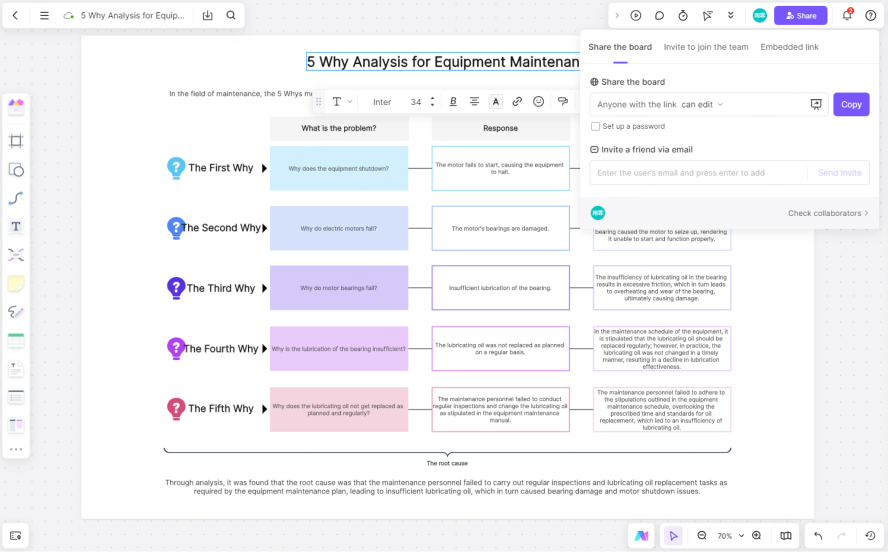
Once you’ve followed the fifth "why" to uncover the root cause of the problem, shift from analysis to action by brainstorming potential solutions with your team. Boardmix’s collaborative features—including real-time comments, color-coded labeling, and version history—enable cross-departmental teamwork to develop targeted, feasible solutions. For example, if the root cause of late shipments is understaffing due to outdated scheduling processes, your team might propose solutions like automating the scheduling system, hiring temporary staff, or cross-training employees from other departments.
Use the Boardmix canvas to list, organize, and prioritize solutions based on feasibility, cost, and impact, ensuring every team member has a voice in the decision-making process—even remote workers.
Step 6: Verify and test the solution
Even the most well-reasoned solutions require testing to validate their effectiveness. Work with your team to establish clear Key Performance Indicators (KPIs) to measure success (e.g., "reduce late shipments to less than 5% within one month") and implement the chosen solution in a controlled test setting. Boardmix’s AI tools can further support this phase by helping you track KPIs, visualize progress, and adjust the solution as needed based on real-time data.
If the issue persists after implementation, use Boardmix’s AI to revisit and revise the 5 Whys analysis, creating a continuous feedback loop that ensures your team is always addressing the true root cause—not just symptoms.
Accessible Example of AI 5 Whys in Problem Solving
To illustrate how AI 5 Whys works in practice, consider a common challenge faced by e-commerce teams: a sudden spike in product returns. Without AI, teams might manually list potential reasons (e.g., "products arrived damaged," "wrong size sent," "customer changed mind") but struggle to identify the root cause amid disjointed data and subjective opinions. This manual listing method is not only time-consuming but also makes it difficult to connect seemingly unrelated factors, leading to incomplete or ineffective solutions.
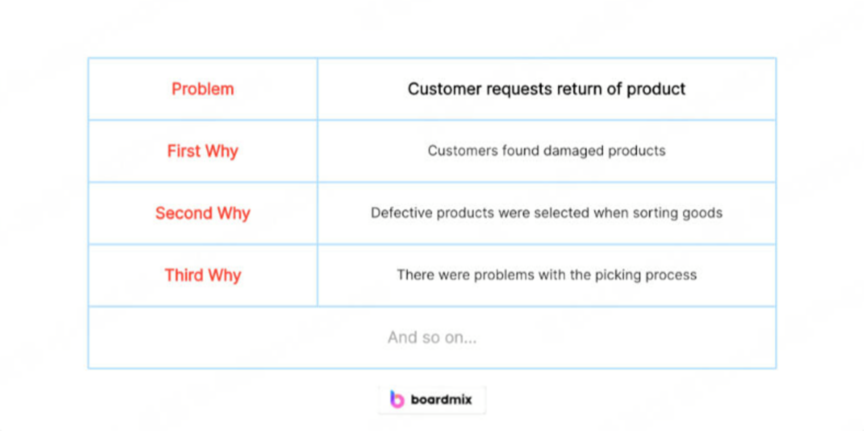
With Boardmix’s AI 5 Whys, the process is transformed: the team inputs the problem ("Why have product returns increased by 30% in the past month?") and the AI immediately generates a visual, structured chart that iterates through five layers of "why" questions, each supported by data (e.g., shipping logs, customer feedback surveys, inventory records). For example:
1. Why are returns up 30%? 75% of returns cite "product not matching description."
2. Why didn’t products match descriptions? Product images on the website were outdated.
3. Why were images outdated? The marketing team didn’t update them after a product redesign.
4. Why didn’t marketing update the images? There was no formal process to notify them of redesigns.
5. Why was there no notification process? Cross-departmental communication protocols were non-existent.
The AI-generated chart visualizes this causal chain clearly, highlighting the root cause (lack of cross-departmental communication) rather than surface-level issues (outdated images). The templates provided by Boardmix are intuitive, containing all essential information (data points, team responsibilities, timelines) in a format that is easy to share and act on.
The true power of AI-driven 5 Whys analysis is its ability to uncover systemic root causes while stimulating creativity and collaborative brainstorming. If your team is stuck on a complex problem and doesn’t know where to start, this AI tool provides a structured, data-backed starting point that turns overwhelm into clarity.
Why use Boardmix to explore the AI 5 whys in problem-solving?
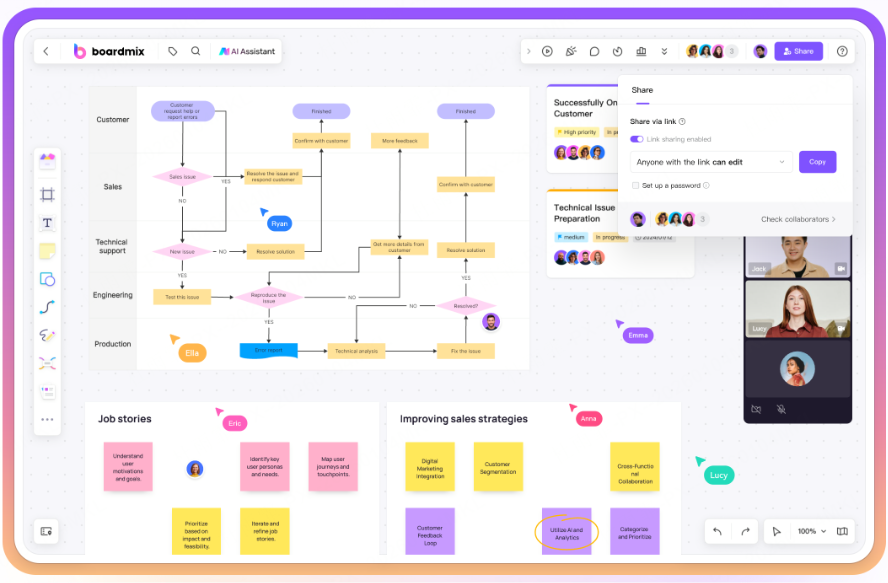
Boardmix stands out as the ideal platform for AI 5 Whys analysis due to its unique combination of AI capabilities, collaboration features, and flexibility—all designed to make problem-solving more efficient and inclusive. Here are three key reasons to choose Boardmix:
Time-Saving:
Boardmix’s AI assistant generates fully structured 5 Whys charts in seconds, eliminating the need to build visualizations from scratch or manually map out causal relationships. This frees your team to focus on solving problems, not formatting documents.
Collaboration-friendly:
Boardmix supports real-time teamwork, allowing any team member—regardless of location—to contribute to the analysis, add comments, or edit the canvas. This ensures alignment and diverse perspectives, even for remote or hybrid teams.
Unlimited canvas with multiple formats supported:
Unlike static tools like spreadsheets or word processors, Boardmix offers an unlimited digital canvas where you can upload and integrate images, videos, audio files, links, SVG graphics, PowerPoint presentations, Word documents, PDFs, and more. This flexibility lets you centralize all relevant data and context in one place, making your 5 Whys analysis comprehensive and actionable.
Pitfall Avoidance Guide for AI-Generated 5 Whys
While AI-generated 5 Whys analysis is highly efficient, it is not infallible—using it without caution can lead to flawed conclusions that address the wrong problems. To ensure accuracy and effectiveness, avoid these three major pitfalls:
Pitfall 1: Over-Reliance on AI, Neglecting Human Validation.
AI is a tool, not a replacement for human expertise. Relying solely on AI-generated conclusions can lead to disconnected or unrealistic insights, as AI lacks the contextual understanding of your business that your team possesses.
Solution: Always cross-check AI results with domain expertise from your team. Use Boardmix’s collaborative features to invite team members to review the AI’s reasoning, add business context, and correct any inaccuracies in real time—ensuring conclusions align with real-world operations and goals.
Pitfall 2: Vague Problem Definition Leading to Flawed Chains.
The AI’s output is only as good as the input it receives. A vague or ambiguous problem statement (e.g., "the app is slow") will result in unfocused, irrelevant 5 Whys analysis that fails to identify meaningful root causes.
Solution: Be hyper-precise when defining the initial problem, using a structured input framework: "Problem Phenomenon + Supporting Data/Background + Analysis Scope + Specific Request." For example: "Intermittent server errors (5% increase in Q1 2024) affecting North American users on mobile devices. Analyze from an infrastructure and deployment perspective to identify root causes and propose immediate fixes." This structured input ensures the AI generates targeted, relevant analysis from the start.
Conclusion
Integrating AI into the 5 Whys problem-solving method is more than a productivity hack—it is a strategic shift that empowers teams to move beyond reactive fixes and adopt proactive, data-driven strategies. AI 5 Whys analysis, particularly when used with Boardmix, improves team productivity by reducing time spent on manual analysis, enhances decision-making accuracy by grounding conclusions in data, and fosters collaboration by centralizing problem-solving in a shared, accessible platform.
Whether you’re a small team tackling daily operational issues or a large organization solving complex systemic problems, AI 5 Whys analysis transforms complexity into clarity—turning overwhelming challenges into manageable, solvable tasks. Try incorporating Boardmix’s AI 5 Whys tool into your next problem-solving session and experience firsthand how technology elevates a simple, proven method into a powerful engine for organizational improvement.