



When a team needs to spark creativity and generate ideas rapidly, brainstorming is the go-to method for organizations of all kinds. However, traditional brainstorming is often limited by physical space, inadequate tools, and messy note-taking, which can stifle creative flow and make it hard to turn ideas into actionable plans. The result is brainstorming sessions that feel unproductive, with great ideas falling through the cracks and teams failing to capitalize on their collective creativity. For businesses competing in fast-paced markets, this lost potential can translate to missed opportunities, slower innovation, and a failure to adapt to changing customer needs.
As a leading online whiteboard platform, Boardmix is becoming the preferred brainstorming tool for teams worldwide. With its flexible infinite canvas, rich creative toolkit, and seamless real-time collaboration experience, it transforms how teams ideate. Unlike traditional tools that create barriers to creativity and collaboration, Boardmix is designed to remove friction at every stage of the brainstorming process—from capturing the first spark of an idea to turning that idea into a concrete action plan.
Why Boardmix is Ideal for Brainstorming
In today's idea-driven world, effective brainstorming is crucial for team innovation. Successful sessions require not just active minds, but also a digital platform that supports free expression, efficient collaboration, and rapid execution. Tools like Boardmix solve common problems like passive listening or losing track of ideas that plague traditional brainstorming sessions. Let’s dive into the six core advantages that make Boardmix a top choice for brainstorming meetings, each designed to address a specific pain point and unlock the full creative potential of your team.
Infinite Canvas for Unlimited Ideas
A core feature of Boardmix is its infinitely expandable digital canvas. Unlike physical whiteboards or sticky notes, there’s no boundary to limit the flow of ideas. The canvas zooms and expands freely in all directions, allowing your team to add ideas, build frameworks, and map connections between concepts without worrying about running out of space or breaking creative flow by switching pages or boards. This spatial freedom is a game-changer for brainstorming, as it fosters fluid, unconstrained thinking—ideas can grow, branch out, and evolve naturally, just like the thought processes that generate them. For example, a team brainstorming a new marketing campaign can start with a core concept in the center of the canvas, then expand outward with social media ideas, content themes, and target audience insights, all without having to erase or reorganize existing notes to make room for new ones. This eliminates the pressure to "edit" ideas prematurely and lets creativity flourish unhindered.
Diverse Ideation Tools for Every Thinking Style
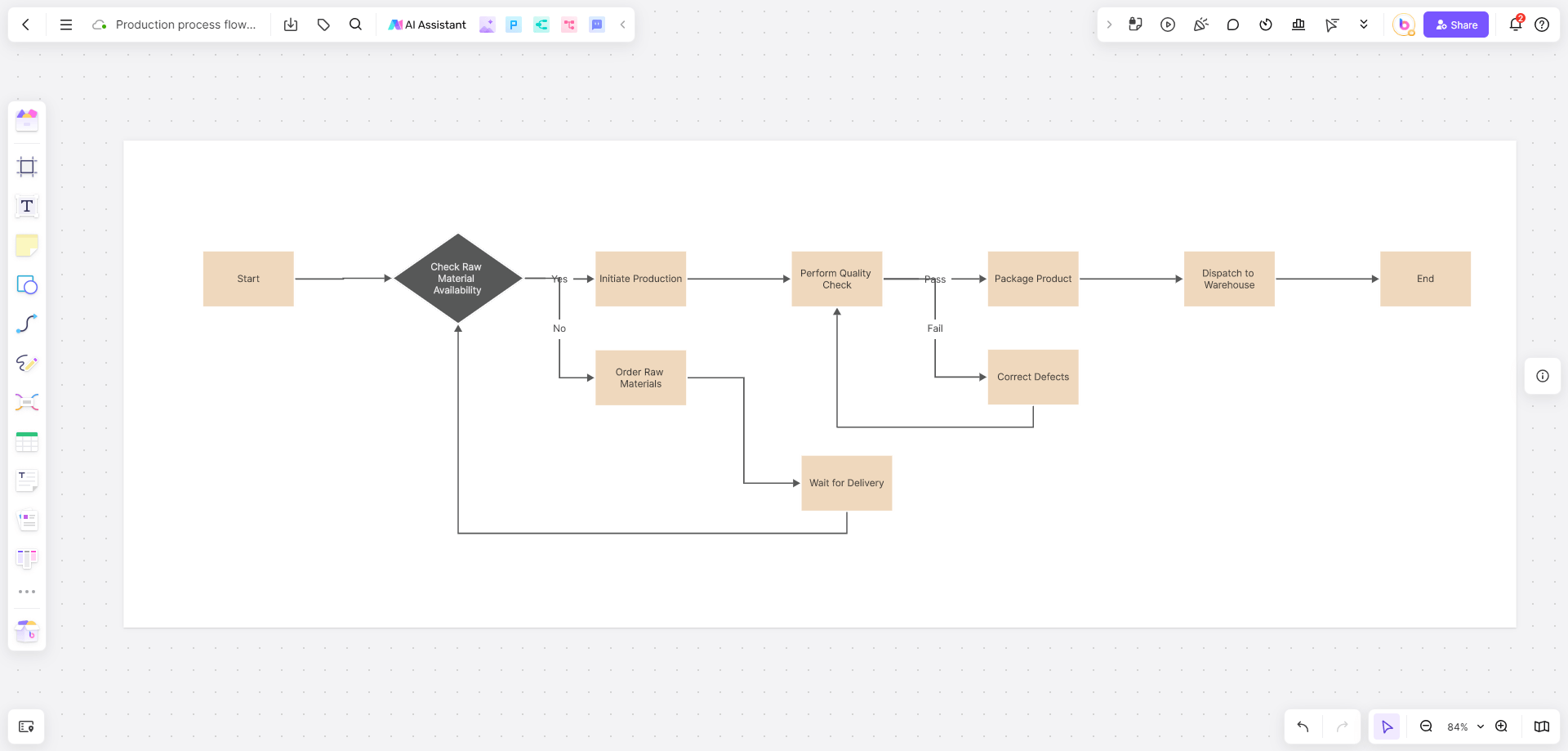
People think and express themselves differently, and a one-size-fits-all approach to brainstorming will always leave some team members feeling unheard. Some capture creative sparks with short, punchy keywords, others prefer to sketch visual concepts or diagrams, and some thrive with structured frameworks like flowcharts or timelines. Boardmix accommodates all these thinking styles with a comprehensive set of flexible tools that put no limits on how ideas are expressed: sticky notes for quick, informal thoughts; freehand drawing tools for visual thinkers; text boxes for detailed explanations; and pre-built shapes for flowcharts, mind maps, timelines, and data charts. This inclusivity ensures that every voice is seen and heard, regardless of how a team member prefers to communicate. For instance, a designer on the team can sketch a rough mockup of a new product feature directly on the canvas, while a product manager adds text-based user stories next to it, and a developer maps out technical feasibility with a flowchart—all in real time, and all on the same canvas. This level of flexibility enables true inclusive co-creation, where diverse perspectives come together to form stronger, more well-rounded ideas.
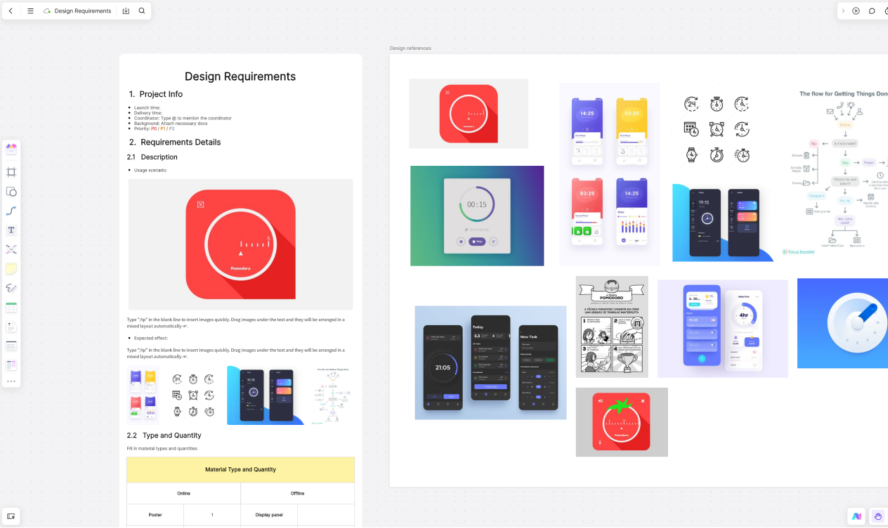
Real-Time Multi-User Collaboration, Breaking Down Barriers
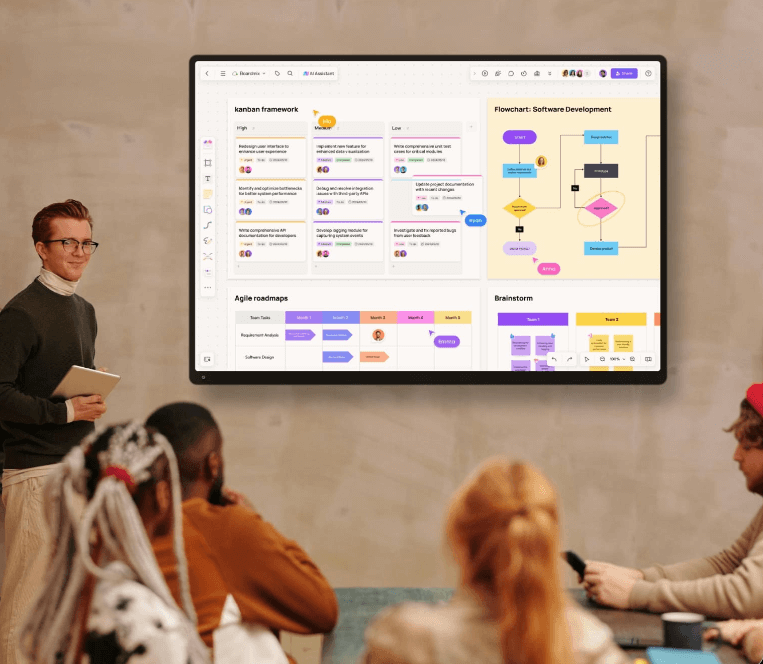
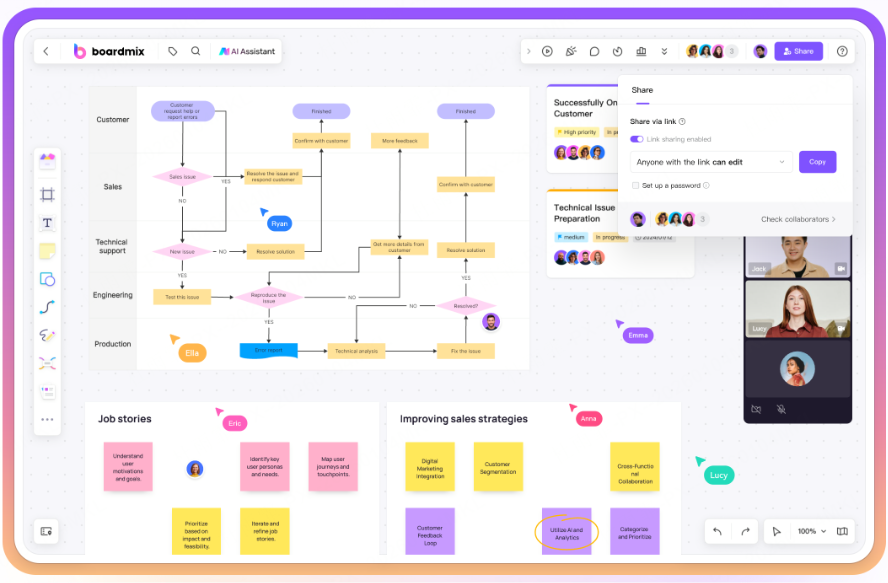
The essence of brainstorming is the "collision" of ideas, which thrives on instant interaction and feedback between team members. Boardmix excels at facilitating this collision by supporting live multi-user collaboration at its core. Whether your team is in the same office, working from home, or spread across different time zones and continents, everyone can edit the canvas simultaneously, drag sticky notes to group related ideas, add comments to build on others’ thoughts, and even see each other's cursors move in real time on the same whiteboard. This creates a virtual "in-the-same-room" experience that boosts engagement and participation, especially for remote team members who often feel disconnected in traditional brainstorming setups. It also reduces the delays and miscommunication that come with asynchronous collaboration, allowing ideas to evolve rapidly through immediate feedback. For example, a team member in Tokyo can add an idea to the canvas, and a colleague in New York can build on it within seconds, asking clarifying questions or adding supporting thoughts—all without waiting for email responses or scheduling a meeting. This speed of interaction keeps the creative momentum going and ensures that great ideas don’t lose their impact while waiting for feedback.
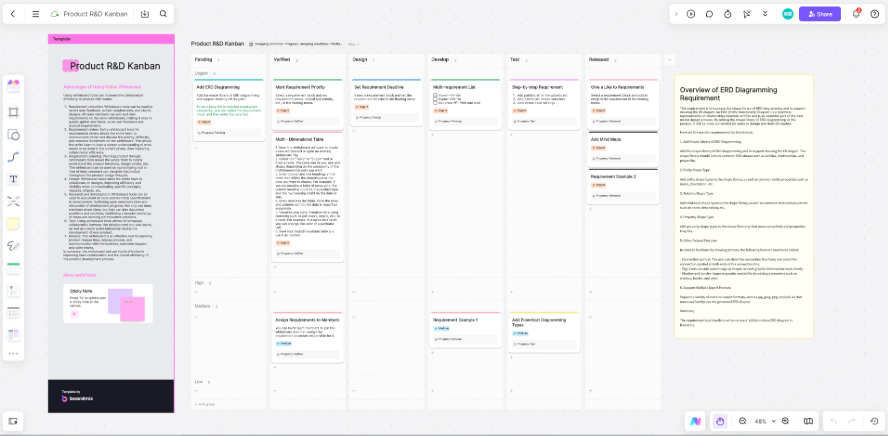
Built-In Voting to Speed Up Decision Making
A common challenge in brainstorming sessions is generating a flood of ideas but lacking a clear way to narrow them down to the most viable ones. This leads to endless discussions, decision paralysis, and sessions that end with no actionable outcomes. Boardmix solves this problem with a simple yet powerful built-in voting tool that turns subjective debates into data-driven decisions. Team members can quickly score ideas on a scale, vote for their top choices, or filter and categorize ideas based on predefined criteria like feasibility, impact, or alignment with business goals. This objective feedback mechanism helps the team identify high-potential concepts quickly and objectively, shortening the cycle from divergent idea generation to convergent decision making. Instead of arguing over "which idea is best," the team can look at the voting results to see which ideas resonate most with the group, ensuring that "ideas have an outlet, and decisions have a basis." For example, after a session generating 50+ ideas for a new product feature, the team can use Boardmix’s voting tool to rank each idea by feasibility and user value, instantly narrowing the list down to the top 5 ideas worth pursuing—saving hours of follow-up discussions and keeping the project moving forward.
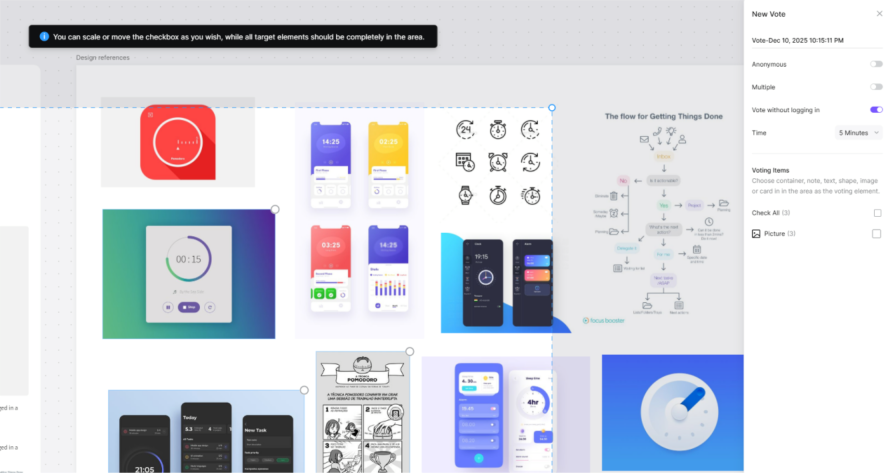
Rich Template Library for Instant Setup & Higher Efficiency
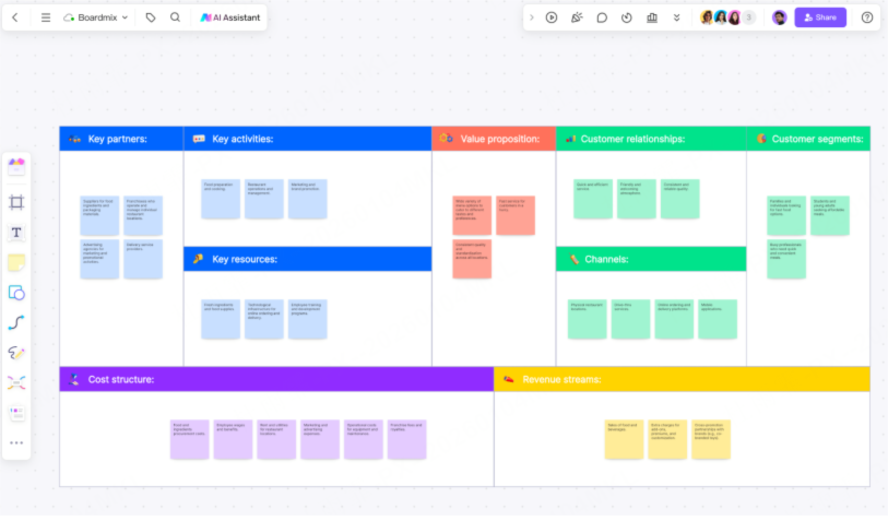
For teams new to facilitating brainstorming sessions, or even for experienced facilitators short on time, structuring a session from scratch can be a daunting task. A poorly structured brainstorming session is often unfocused and unproductive, with team members veering off-topic or struggling to know where to start. Boardmix addresses this with a vast library of proven professional templates, each designed for a specific type of brainstorming activity or strategic framework: Six Thinking Hats for exploring ideas from different perspectives; Fishbone Diagram for root cause analysis; User Journey Map for customer-centric ideation; SWOT Analysis for strategic planning; Double Diamond Model for design thinking; and Affinity Diagram for grouping and organizing unstructured ideas. Simply pick a template that aligns with your session’s goal, and you can jump right into ideation—no need to spend time creating frameworks or guidelines from scratch. This not only saves valuable prep time but also ensures that your session is well-structured and focused, whether you’re brainstorming for agile development sprints, product design iterations, or marketing campaign planning. For example, a team looking to solve a customer pain point can start with a pre-built Fishbone Diagram template in Boardmix, instantly having a structure to identify and analyze the root causes of the problem—making the brainstorming session more efficient and the outcomes more actionable.
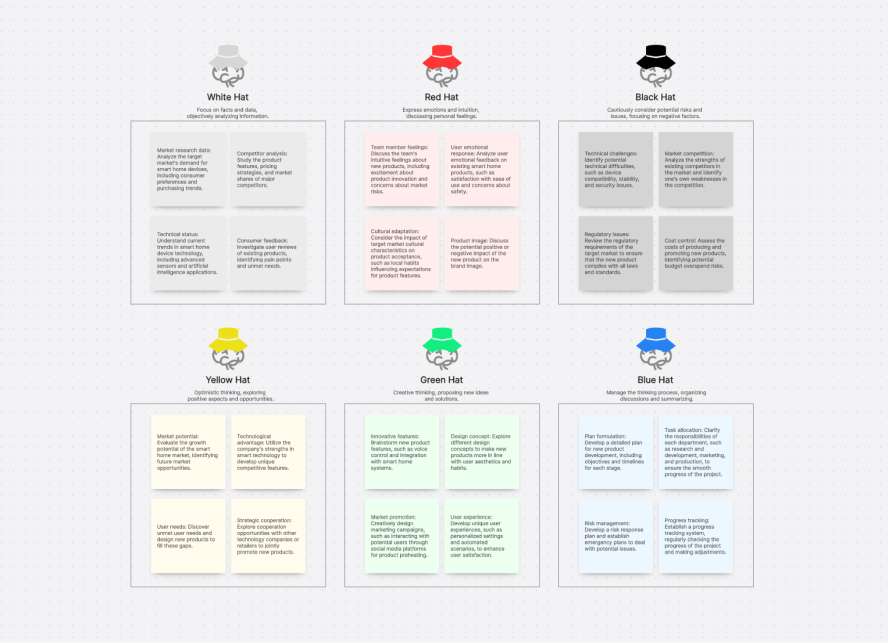
Cross-Platform & Tool Integrations: Bridging Ideas to Execution
An idea’s true value lies not in its generation, but in its execution—and many brainstorming tools fail to bridge the gap between ideation and action. Boardmix stands out by offering seamless cross-platform access and deep integrations with the tools your team already uses to get work done. It works flawlessly on Web browsers, Windows, macOS, iOS, and Android devices, so team members can contribute to the brainstorming session from any device, whether they’re at their desk, on the go, or working from a coffee shop. More importantly, Boardmix integrates deeply with popular work and project management tools like Jira, Figma, Slack, Zoom, and Microsoft Teams. This creates a seamless end-to-end workflow "from inspiration to action": ideas generated in Boardmix can be turned into task cards and synced directly to Jira for development tracking, design files from Figma can be embedded into the canvas for context, and session notes can be shared instantly to Slack or Teams to keep the entire team aligned. This integration eliminates the need to copy-paste ideas between tools or retype information, reducing the risk of lost or misinterpreted ideas and ensuring that the creative output of your brainstorming session translates directly into tangible business outcomes.
How to Run a Brainstorming Session with Boardmix
To run a brainstorming session that is both productive and yields actionable results, you need the right methodology paired with the right tool. Boardmix not only facilitates free-flowing idea generation but also helps teams quickly organize, prioritize, and act on those ideas—eliminating the common "brainstorming hangover" where great ideas are discussed but never implemented. Here’s a step-by-step guide to running a structured, effective brainstorming session using Boardmix, designed to maximize participation and drive meaningful outcomes:
Step 1: Preparation
Start by creating a new Boardmix board and selecting a suitable template that aligns with your session’s goal—options like the pre-built "Brainstorming" template or "Mind Map" template are perfect for most ideation sessions. Clearly state the session’s topic, core goal, and agenda on the canvas (e.g., "Brainstorm new onboarding features for our app" or "Identify ways to reduce customer support wait times") to keep the team focused. Share the board link with all participants in advance, along with any pre-reading materials or context they need to contribute meaningfully. This preparation step is critical, as it ensures that everyone comes to the session with a clear understanding of what you’re trying to achieve, reducing time spent on clarifying goals and maximizing time spent generating ideas.
Step 2: Ideation & Divergence
Once the session starts, encourage all participants to add ideas freely using sticky notes, drawings, text boxes, or shapes—there are no "bad" ideas during this phase, and the goal is to generate as many thoughts as possible without judgment or structuring. Let ideas flow naturally, and remind the team that quantity is more important than quality at this stage. To make later organization easier, use Boardmix’s color-coding and tagging features to mark ideas by category (e.g., "User Experience," "Technical Feasibility") or origin (e.g., "Marketing Team," "Customer Feedback") as they’re added to the canvas. This lightweight organization step saves time later and helps the team see patterns in the ideas as they emerge.
Step 3: Grouping & Convergence
After the ideation phase ends, shift to grouping and converging on the ideas generated. Use Boardmix’s containers or frames to group related ideas together—for example, all ideas about "mobile app features" can be placed in one container, while ideas about "pricing models" go in another. Use connection lines to show logical relationships between concepts (e.g., linking a "chatbot feature" idea to a "reduce support wait times" goal) to build a visual map of how ideas connect. Merge similar or duplicate ideas to refine the list down to core concepts, eliminating redundancy and making the next step (prioritization) more manageable. This phase turns a chaotic list of ideas into an organized, cohesive set of concepts that the team can evaluate meaningfully.
Step 4: Prioritization & Voting
Use Boardmix’s built-in voting feature to prioritize the grouped ideas. Set clear voting criteria (e.g., "highest user impact," "lowest development effort," "alignment with Q3 goals") and have participants vote for the ideas they believe are most valuable or feasible. The voting results are displayed instantly on the canvas, making it easy to identify the top-priority ideas that the team should focus on next. This data-driven approach to prioritization reduces bias and ensures that the ideas chosen are the ones with the broadest support from the team, rather than just the loudest voices in the room.
Step 5: Action Planning
The final step is turning the selected top-priority ideas into actionable next steps directly within Boardmix. Create task cards for each idea, assign owners to take responsibility, and set clear deadlines for follow-up. For teams that use project management tools like Jira, Boardmix’s native integration allows you to sync these task cards directly to Jira, ensuring that the ideas generated in the brainstorming session move seamlessly into execution. This step is what separates successful brainstorming from unproductive discussions—it ensures that ideas don’t stay on the canvas, but instead become real work that drives progress for the team and business.
Following this structured process, Boardmix helps teams move rapidly from unstructured ideation to organized concepts, data-driven decision-making, and finally, concrete action—turning creative thinking into tangible results.
Real-World Brainstorming Use Cases for Boardmix
Boardmix's flexibility and comprehensive feature set make it suitable for a wide range of team scenarios and industries, from product development to marketing, education, and strategic planning. Here are some typical real-world use cases that demonstrate how Boardmix transforms brainstorming across different contexts:
Product Teams: New Feature Ideation & User Pain Point Analysis
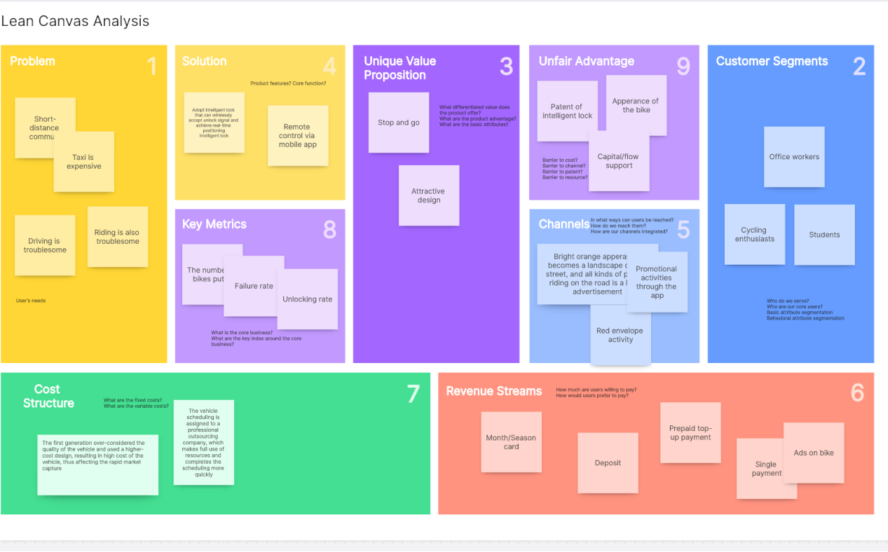
Challenge: Product teams often struggle to efficiently gather and prioritize new feature ideas from complex, scattered user needs—feedback comes from customer support tickets, user interviews, and analytics data, making it hard to see the big picture and identify the most impactful features to build.
Boardmix Solution: Product managers can use Boardmix to centralize all user feedback as sticky notes on the infinite canvas, then group notes by pain point (e.g., "checkout process," "account management") using color-coding to distinguish between high and low-frequency issues. A User Journey Map template can be used to map these pain points to specific stages of the user experience, and the voting tool helps the team prioritize which pain points to address first—ensuring development resources are focused on the features that will deliver the most value to users.
Marketing Teams: Campaign Brainstorming
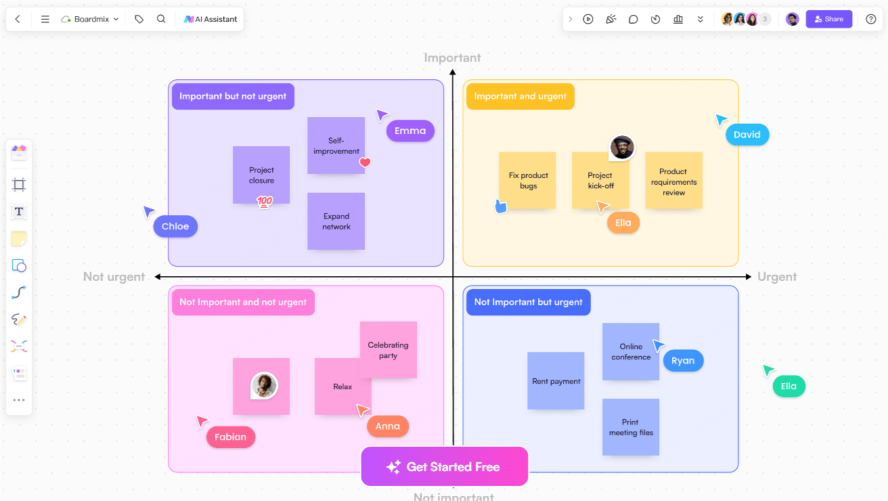
Challenge: Cross-functional marketing teams (designers, copywriters, social media managers, analysts) often have scattered input, leading to fragmented ideas that lack cohesion and alignment with campaign goals.
Boardmix Solution: Marketing teams can start with a pre-built brainstorming template in Boardmix, using frames to categorize ideas by channel (e.g., Instagram, email, TikTok), content type (e.g., videos, infographics, blog posts), or messaging theme. Reference images, competitor campaign examples, or customer persona documents can be embedded directly on the canvas to provide a shared visual context for the team, making discussions more concrete and ensuring that all ideas align with the campaign’s brand and goals. Real-time collaboration allows copywriters to draft taglines next to designer sketches, and social media managers to add platform-specific ideas—all in one place.
Education & Training: Classroom Engagement & Idea Synthesis
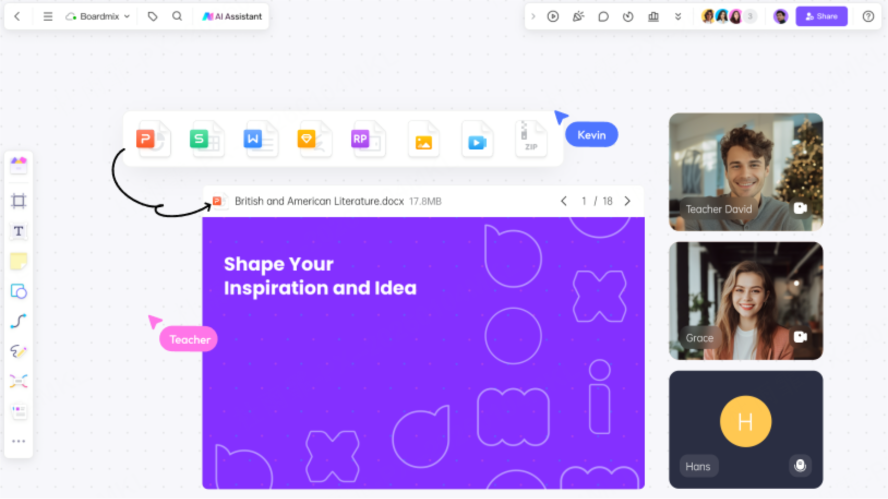
Challenge: Educators and trainers struggle to engage students and foster active participation in virtual classrooms, where passive listening and disconnection are common issues. Traditional online tools offer limited ways for students to collaborate and share ideas in real time.
Boardmix Solution: Instructors can create a Boardmix board for each class session, using sticky notes or text boxes to pose discussion questions or brainstorming prompts. Students submit their ideas in real time via the canvas, with different colors assigned to different groups or perspectives to encourage diverse thinking. After the session, the instructor can export the entire board as a PDF or image to share with the class for review and follow-up, ensuring that all contributions are captured and no student’s idea is lost. This interactive approach turns passive learning into active co-creation, boosting engagement and deeper understanding of the material.
Cross-Department Strategy Sessions
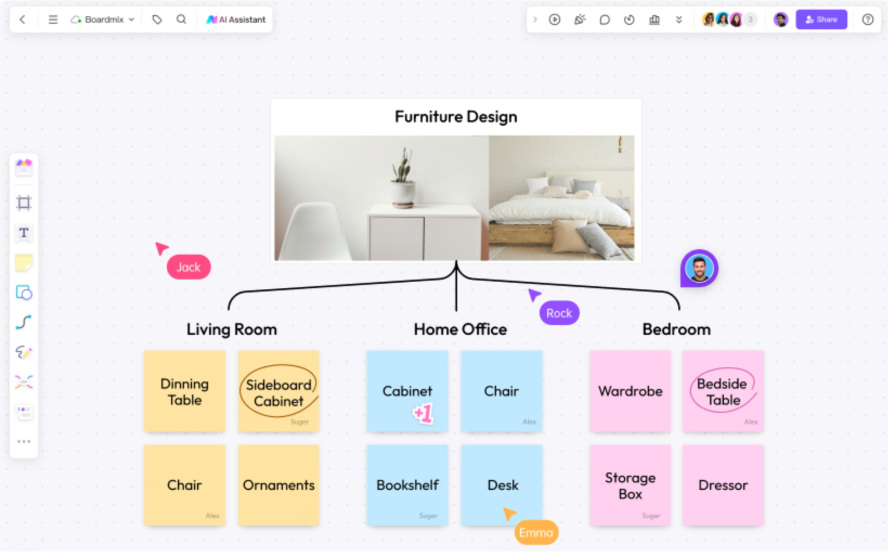
Challenge: Different departments (sales, product, finance, operations) often have different interpretations of strategic goals, leading to misalignment and brainstorming sessions that fail to produce unified action plans.
Boardmix Solution: Facilitators can use Boardmix’s mind map or flowchart templates to visualize the organization’s strategic goals at the center of the canvas, then invite each department to add their ideas for contributing to those goals in separate branches. The visual nature of the canvas ensures that everyone can see how their department’s ideas fit into the bigger picture, reducing siloed thinking and fostering alignment. Connection lines can be used to show dependencies between departments (e.g., sales goals linked to product feature releases), and the voting tool helps the group agree on actionable next steps that all departments can support—ensuring that the brainstorming session leads to a unified strategy, not just separate departmental plans.
Pro Tips for Effective Brainstorming in Boardmix
Maximize your brainstorming success and get the most out of Boardmix with these practical, actionable tips that address common pitfalls and boost the efficiency and impact of your sessions:
Set Time Limits: Use Boardmix’s built-in timer to set clear time limits for each phase of the session (e.g., 15 minutes for ideation, 10 minutes for grouping) to keep discussions focused and prevent sessions from dragging on without progress. Time constraints create urgency and keep the team focused on the task at hand.
Color-Code Everything: Assign specific colors to sticky notes by theme (e.g., red for "high priority," blue for "user-focused"), priority level, or owner to create instant visual clarity. This makes it easy to scan the canvas and understand the structure of ideas at a glance, without reading every note.
Start with Templates: Avoid building frameworks from scratch—use Boardmix’s built-in "Brainstorming" or "Six Thinking Hats" templates to save time and ensure your session follows proven, effective structures. Templates provide a starting point that reduces decision fatigue and keeps the team on track.
Lock Key Elements: Prevent accidental edits or deletions by locking critical elements like session titles, goal statements, or core framework templates on the canvas. This is especially useful in large sessions with many participants, ensuring that the foundational structure of the board remains intact while ideas are added around it.
Boost Engagement with Emojis: Use Boardmix’s stamp and emoji tools to add quick, fun feedback to ideas during the session (e.g., a thumbs-up for "great idea," a lightbulb for "creative," a question mark for "needs clarification"). This informal feedback keeps the mood positive and encourages participation from quieter team members.
Export & Share Immediately: After the meeting ends, export the entire board as a PDF or high-resolution image and share it in your team wiki (e.g., Confluence), project management tool, or Slack channel. This ensures that all ideas are captured and accessible to the team later, preventing great ideas from being forgotten and keeping the momentum going after the session ends.
Conclusion
The true value of brainstorming lies in igniting the spark of innovation through the collision of diverse perspectives and ideas. Boardmix is the ideal platform for this creative exchange, as it breaks down the time and space barriers that limit traditional brainstorming and provides teams with the tools they need to collaborate freely and effectively. Through its infinite canvas, real-time collaboration features, professional template library, and data-driven decision-making tools, Boardmix delivers a structured, engaging, and results-oriented workflow that turns unstructured discussions into actionable ideas.
With Boardmix, brainstorming evolves from an impromptu, often unproductive discussion into a rhythmic, directed, and productive co-creation process—one that generates not just more ideas, but better ideas that the team can act on quickly. Every feature of the platform is designed to remove friction from the creative process, ensuring that your team’s collective intelligence is fully leveraged and that no great idea is ever left behind.
If your team is looking for a more flexible and efficient way to unlock creativity, build consensus, and turn ideas into action, try Boardmix in your next brainstorming meeting. You'll discover that with the right tool, ideas can not only fly freely during the session but also land firmly in the real world, becoming real drivers for business progress, innovation, and growth.