



Symbol mapping is a powerful concept that bridges the gap between abstract ideas and their visual or functional representations. Whether in mathematics, user interface design, or data visualization, symbol mapping helps establish clear and meaningful connections between map symbols and the concepts they represent.
In this article, we’ll explore what symbol mapping is and how it works with practical case studies.
What is Symbol Mapping?
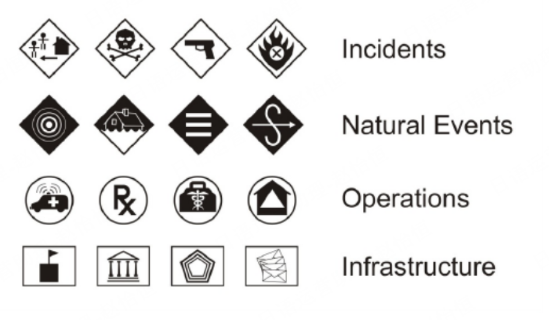
Symbol Mapping is a method of information conversion or transmission by establishing corresponding rules between map symbols and specific meanings, data or operations. The core is to design a clear "translation system" so that abstract map symbols can represent specific objects or behaviors.
For example, Morse Code is a classic example of symbol mapping: different combinations of short signals ("·") and long signals ("—") are mapped to letters, numbers or punctuation marks. For example, the letter "A" corresponds to "·—", and the number "1" corresponds to "·————". This mapping rule allows information to be transmitted across media through simple signals (such as light and sound).
The key to symbol mapping lies in the consistency and reversibility of the rules. Only by clearly defining the mapping relationship can we ensure that the information is accurate during encoding, transmission, and decoding.
Next, we will further learn how to use symbol mapping in different fields.
How to Align Symbol Mappings with Mathematical Structures?
The mapping of symbols to mathematical structures is a core concept, especially in abstract algebra and category theory. This mapping is usually achieved through homomorphisms, which preserve the operations and properties of mathematical structures .

1. Understanding Mathematical Structures
Mathematical structures such as groups, rings, and fields are defined by sets and their operations and axioms. For example:
Group: A set with a binary operation that satisfies closure, associativity, identity, and inverse.
Ring: A set with two binary operations (addition and multiplication) that satisfies the addition properties of the group, the associative property of multiplication, and the distributive property.
Field: A ring where multiplication is also commutative and non-zero elements have multiplicative inverses.
The goal of symbolic mapping is to map elements and operations in one structure to another while preserving its properties.
2. Definition of homomorphic mapping
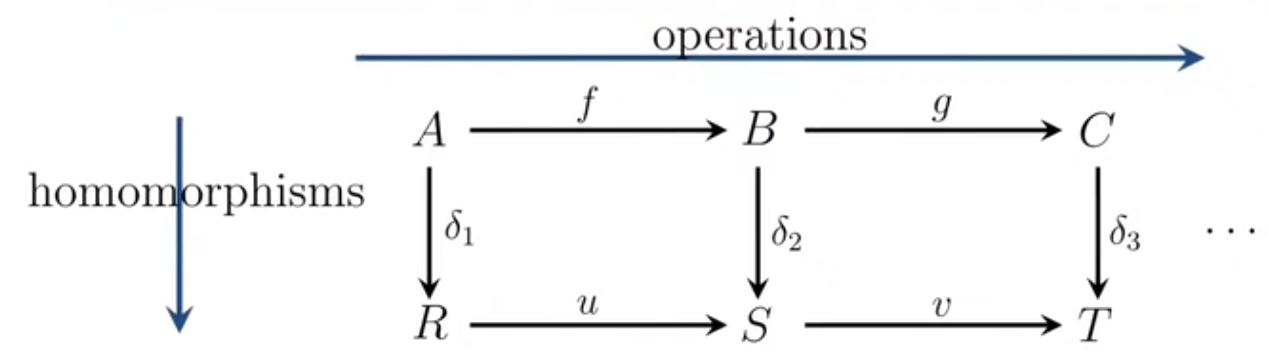
A homomorphic map is a function that maps elements of one mathematical structure to elements of another structure while preserving operations. Specifically:
For groups, if GG and HH are two groups, f:G→Hf:G→H is a group homomorphism, then for any a,b∈Ga,b∈G, we have:
f(a⋅b)=f(a)⋅f(b)f(a⋅b)=f(a)⋅f(b)
Where represents a group operation.
For rings, if RR and SS are two rings, f:R→Sf:R→S is a ring homomorphism, then for any a, b∈Ra, b∈R, we have:
f(a+b)=f(a)+f(b) and f(a⋅b)=f(a)⋅f(b)f(a+b)=f(a)+f(b) and f(a⋅b)=f(a)⋅f(b)
That is, both addition and multiplication are maintained.
For fields, homomorphic mappings require additional guarantees about the mapping of multiplicative inverses.
Symbol Mapping Steps
The process of mapping symbols to mathematical structures can be divided into the following steps:
Define the mapping: clarify the starting and ending structures of the mapping, and define the mapping function ff.
Verify operation preservation: check whether the mapping preserves the operation, for example, verify whether f(a⋅b)=f(a)⋅f(b)f(a⋅b)=f(a)⋅f(b) holds.
Verify property preservation: ensure that the mapping preserves other properties of the structure, such as the identity element, inverse element, etc.
Analyze the type of mapping: According to the properties of the mapping, determine whether it is injective (single homomorphism), surjective (full homomorphism) or bijective (isomorphism).
The process of mapping symbols to mathematical structures is essentially to define and verify a function that preserves operations and properties. Through homomorphic mapping, we can connect different mathematical structures and reveal the intrinsic relationship between them.
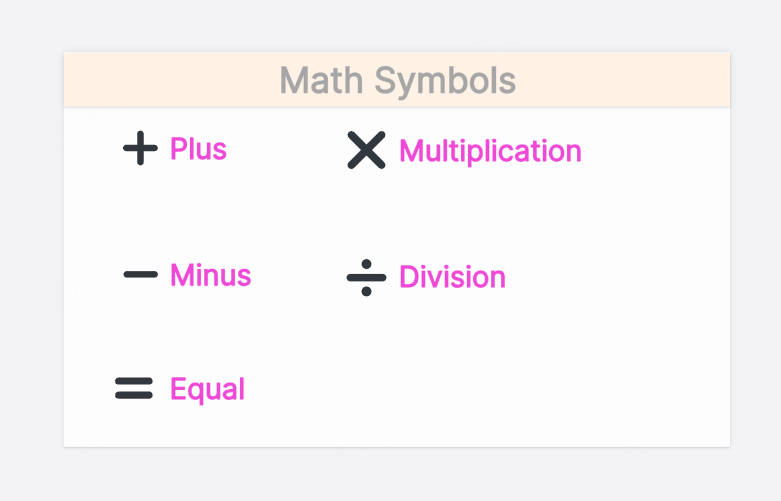
In Boardmix, there is a rich library of mathematical map symbols and formula to help users easily embed mathematical, physical, and chemical formulas. Whether it is element mapping in groups, rings, and domains, or complex mathematical structure analysis, Boardmix allows users to clearly express mathematical concepts through intuitive symbol mapping tools.
For example, when designing homomorphic symbol mappings, users can directly drag and drop mathematical symbols, quickly build formulas, and share and discuss with team members in real time.
Boardmix's diverse symbol for mapping and collaborative functions greatly simplify the process of mathematical expression and team collaboration. Come and experience Boardmix to make mathematical formulas and collaboration simpler and more efficient!
How to Design Symbol Mapping Guidelines for UI Icons?
Designing symbol mapping rules for UI icons is a systematic process that aims to ensure a clear and intuitive connection between icons and the functions or concepts they represent, thereby improving the user experience.
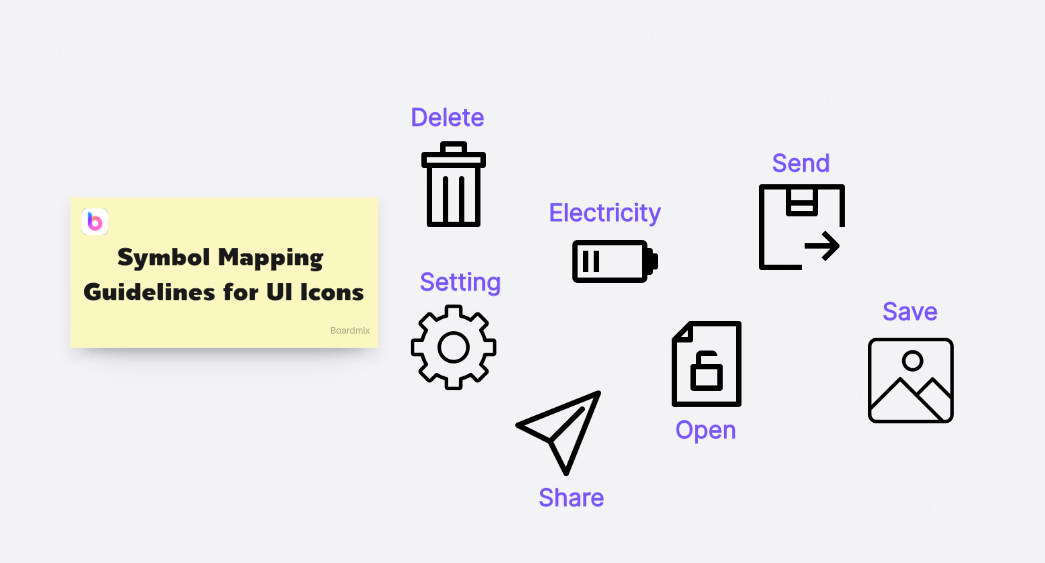
Example of symbol mapping rules for icon design:
- Search function: use a magnifying glass icon.
- Settings function: use a gear icon.
- Delete function: use a trash can icon.
The following are the detailed steps for symbol mapping rules for UI icon design.
1. Clarify needs and goals
First, you need to clarify the goals and usage scenarios of the icon design. At the same time, determine the application scenarios of the icon (such as web pages, mobile applications, or desktop software) and the functions or concepts that need to be expressed (such as search, settings, deletion, etc.).
2. Research existing symbols and standards
Before designing icons, it is very helpful to research existing map symbols and industry standards. Many symbols have been widely accepted and used, such as a magnifying glass for search, a gear for settings, and a trash can for deletion.
3. Design icons
When designing icons, focus on simplicity, consistency, and recognizability. At the same time, all icons should be consistent in style, such as using the same line thickness, color, and perspective angle. In addition, the design of icons should ensure that users can quickly identify the meaning they represent.
4. Establish symbol mapping rules
Symbol mapping rules refer to the rules that match icons with the functions or concepts they represent. Generally, an icon should correspond to only one function or concept to avoid confusion. In addition, cultural differences need to be considered to ensure that icons can be correctly understood in different cultural contexts.
5. Testing and feedback
After the design is completed, user testing is an important step to verify the recognizability and mapping accuracy of icons. By observing how users use and understand icons, potential problems can be discovered and improved.
6. Documentation and specification
In order to ensure the consistency of design, all icons and their mapping rules should be documented and an icon library should be established. The meaning, usage scenarios and design specifications of each icon should be recorded in the icon library.
7. Continuous update and maintenance
As product functions increase and user needs change, the icon library needs to be updated and maintained regularly. Regularly review the use of icons and optimize and expand them based on user feedback and technological changes.
By following the above steps, you can design clear and consistent symbol mapping rules for UI icons, thereby improving the user experience and ensuring that users can quickly understand and use the icons in the interface.
When designing icon mapping guidelines, Boardmix lets your design team collaborate to sketch and refine icons, keeping them simple, consistent, and easily recognizable. With this shared online whiteboard, everyone can discuss and tweak the rules in real time, ensuring a clear, intuitive link between icons and their functions.
The Bottom Line
From mathematical structures to UI design, the applications of symbol mapping are vast and impactful.
Boardmix’s collaborative features, extensive symbol libraries, and real-time editing capabilities make it the perfect platform for designing and refining symbol mappings. Whether you’re working on a team project or exploring creative ideas, Boardmix empowers you to bring your concepts to life. Try Boardmix today and experience how it can transform your approach to symbol mapping!