A useful repository answers three questions quickly: what did we learn, how strong is the evidence, and what changed because of it. Start by linking your research plan to the repository, then keep each finding close to its source. Use the UX research plan to define the question before you organize evidence.

What a UX research repository should contain
Define the decision
Write the decision, audience and review date at the top. For a checkout study, the decision might be whether to shorten the payment form—not a broad question such as “understand users”.
Capture evidence with context
For every note, record source, date, method, participant or artifact context, and the smallest quote or screenshot that supports the observation. Separate observation from interpretation.
Cluster themes and confidence
Group related observations into themes and mark confidence with a short reason: repeated across sessions, supported by analytics, or still an open hypothesis.
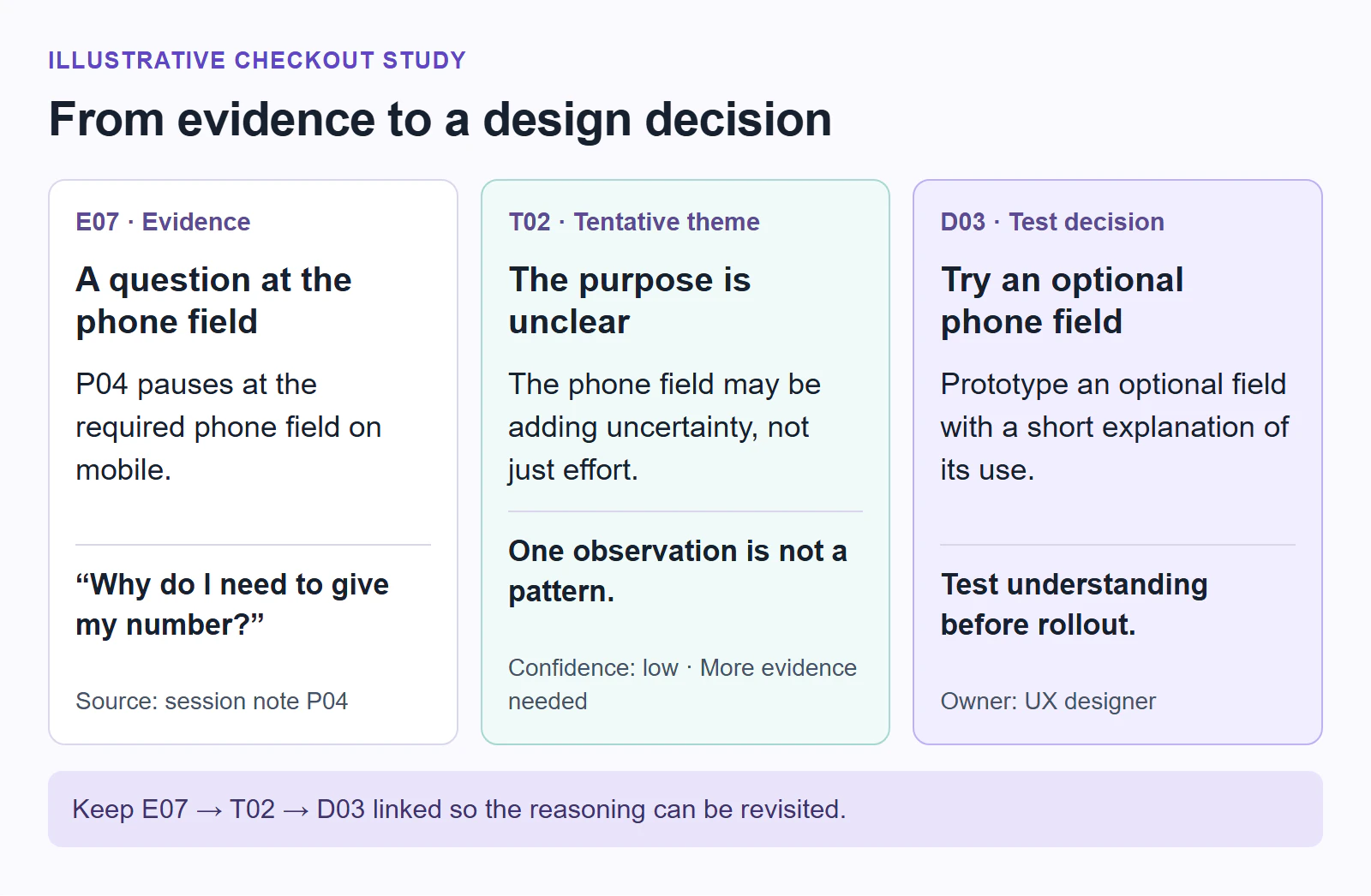
In this illustrative checkout study, E07 records participant P04 pausing at a required phone field and asking why the number is needed. T02 is the tentative interpretation that the purpose is unclear; one observation does not establish a pattern. D03 assigns the UX designer a prototype with an optional field and a short explanation. The next session checks whether people understand the request. Keep the evidence, interpretation and test decision linked so another teammate can revisit the reasoning.
Connect insight to action
Give each insight an owner, decision link and next step. A finding without an action can remain in a research area, but should not be presented as a product requirement.
Example: a checkout repository can have columns for question, evidence, theme, confidence, decision, owner and next review. One card links the interview quote, one links the analytics event, and the decision card records the chosen form length.
Keep the repository usable
Archive superseded conclusions instead of deleting them. A monthly review can merge duplicates, check broken links, and remove only material that has an explicit retention rule.
Build it in Boardmix
In Boardmix, create one frame for the decision, one for raw evidence, one for themes, and one for actions. Use comments for unresolved questions and link the repository to your UX research plan.