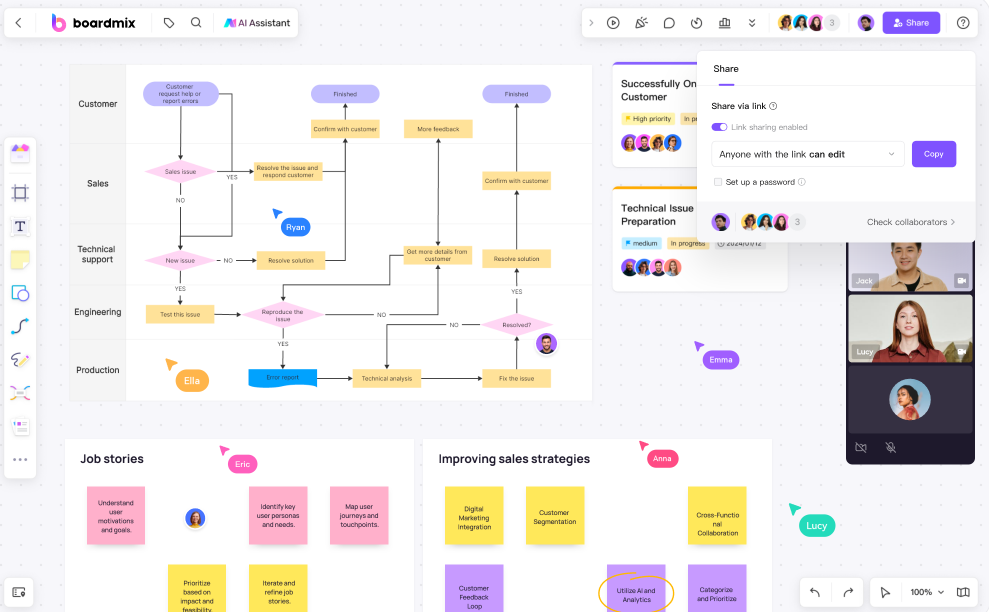



An AI whiteboard combines an editable visual canvas with an AI assistant: you provide a task, topic, or selected board content, the AI creates a draft, and you check its structure and facts before refining, collaborating, or exporting. The result is a starting point that people can rearrange, annotate, discuss, and turn into a finished visual artifact.
This guide shows how to use the Boardmix AI whiteboard in eight practical workflows, from brainstorming and process mapping to writing and image creation. The same method applies throughout: give the AI useful context, inspect the editable output, make deliberate changes on the canvas, and share or export only after human review.
What Is an AI Whiteboard?
An AI whiteboard is a visual workspace where AI-assisted generation and ordinary canvas editing happen together. A standalone chatbot normally returns a linear response, while an image generator often returns a flat visual. An AI whiteboard can instead place a structured draft on a canvas so you can move branches, rename nodes, reconnect steps, add evidence, and place related material beside the result.
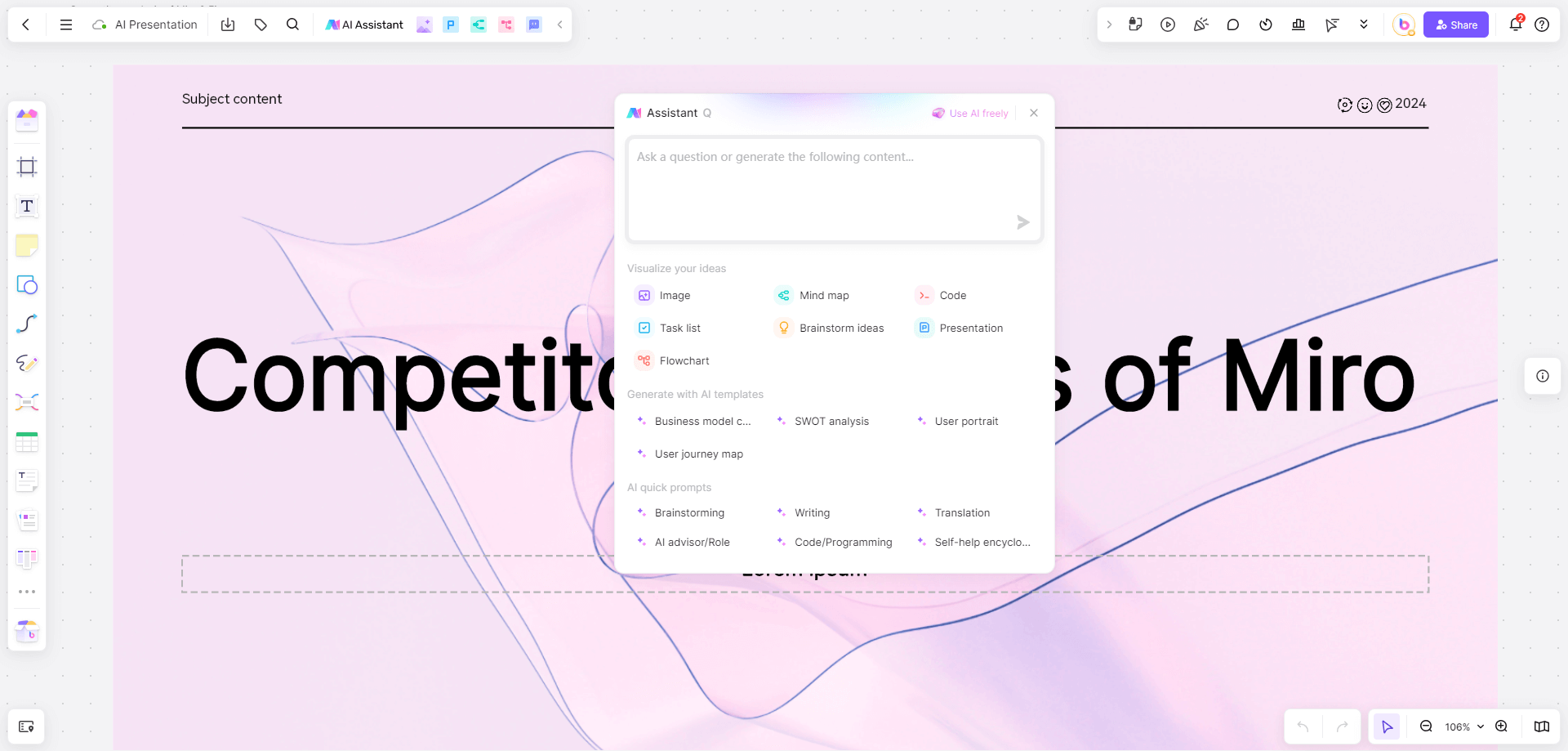

That distinction matters because most real work is not finished after generation. A brainstorm still needs priorities. A process diagram still needs exception paths and owners. A presentation still needs evidence and an audience-aware story. Keeping the draft editable makes it easier to expose assumptions, compare alternatives, and involve the people who understand the subject.
Boardmix pairs this draft-and-edit loop with an online canvas. Teams can keep notes, diagrams, comments, and supporting material in the same workspace, then use presentation or export options when the content is ready. AI supports the first pass; it does not replace subject expertise, approval, or accountability.
How Boardmix AI Works
Start by describing the artifact you need and the purpose it must serve. Depending on the task, the input may be a topic, a set of process steps, source text, a reference image, or existing elements selected on the board. Boardmix's AI assistant can work with board context, but the user still decides which source material is relevant and what the output must contain.
The AI returns an editable draft rather than a decision. On the canvas, you can correct labels, rearrange groups, add missing facts, change visual emphasis, and ask collaborators to comment or vote. This separates three responsibilities clearly: the AI proposes a structure, the canvas makes that structure visible and editable, and people verify the content and make the final call.
- Prepare the board. Open or create the working board, then place the approved notes, requirements, examples, or other source material nearby.
- Define the output. Enter a prompt or select the relevant board content, and state the editable artifact you need, its audience, and its constraints.
- Check the generated draft. Compare its facts, labels, hierarchy, and logic with the source before spending time on visual polish.
- Finish with people. Edit the draft on the canvas, invite the right reviewers, resolve feedback, and inspect the presentation or export before sharing.
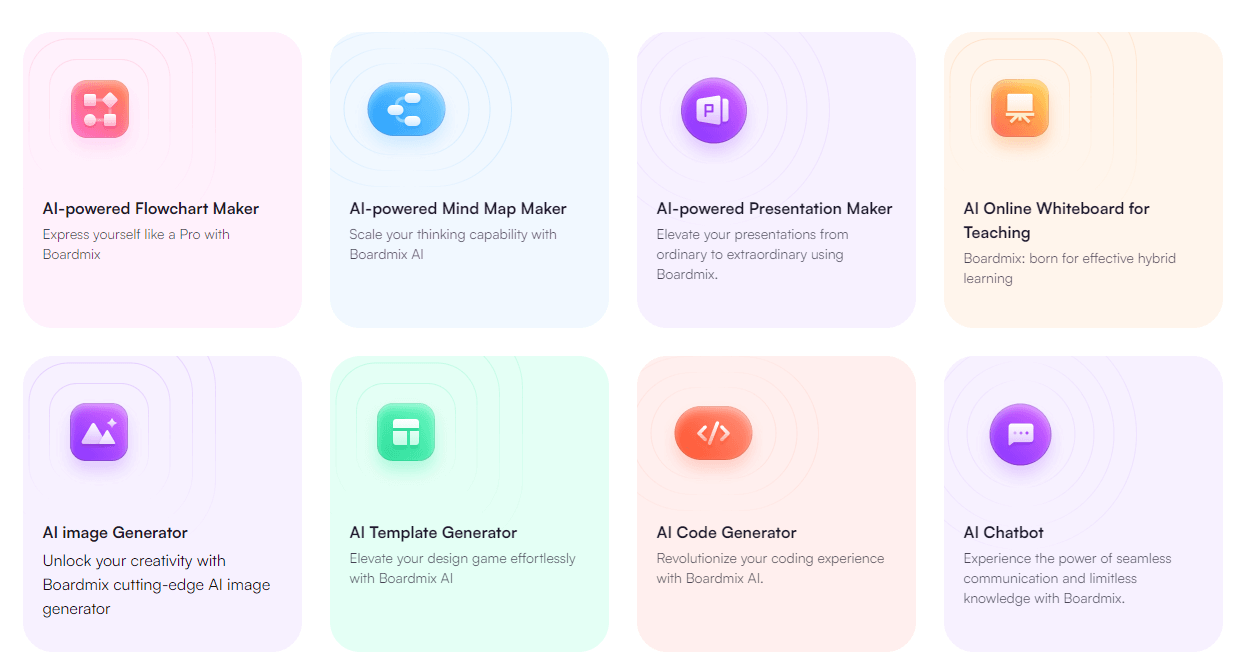
| Workflow | Useful input | Editable draft | Human review |
|---|---|---|---|
| Brainstorming | Goal, audience, constraints, and seed ideas | Themes, questions, or idea clusters | Duplicates, assumptions, priorities, and next actions |
| Collaboration | Session goal, participants, evidence, and decision rule | Shared activity or discussion structure | Participation gaps, evidence, ownership, and the final decision |
| Flowchart | Scope, actors, steps, decisions, and exceptions | Process-flow draft | Sequence, branch labels, missing paths, and endpoints |
| Mind map | Central topic, source text, and desired depth | Hierarchical branch draft | Logic, overlap, omissions, and label clarity |
| Presentation | Audience, objective, source material, and tone | Outline or slide draft | Evidence, narrative, density, and visual consistency |
| Business diagram | Diagram type, source facts, and required fields | SWOT, canvas, persona, or journey draft | Evidence, categorization, completeness, and actionability |
| Writing | Task, source text, tone, and constraints | Draft, rewrite, or summary | Facts, sources, nuance, originality, and tone |
| Image or sketch | Subject or reference, style, composition, and intended use | Image concept or visual variation | Artifacts, prompt fit, accessibility, rights, and data policy |
Use the matrix to choose a starting workflow, not to skip the brief. More context is not automatically better: include the facts and constraints that affect the artifact, leave out unrelated material, and tell the AI when information is unknown. A narrow, reviewable draft is usually easier to improve than a large board built from vague instructions.
8 Practical AI Whiteboard Workflows
The workflows below use the same input, draft, review, and refinement loop, but each needs different source material. Choose the one that matches the deliverable you actually need, then keep the related evidence close to the generated structure on the board.
1. Brainstorm and organize ideas
For brainstorming, give the AI a clear challenge rather than a one-word topic. Include the goal, audience, constraints, decision deadline, and a few seed ideas if you have them. Ask for themes, questions, risks, or options in a form that can be grouped on the canvas. This creates enough structure to start without pretending that the first set of ideas is complete.
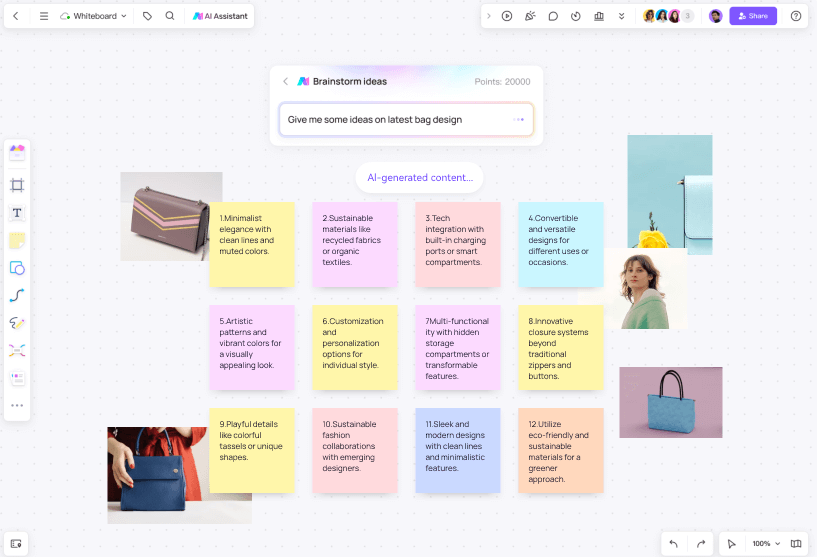
Use the visual layout to promote the strongest part of the original whiteboard method: seeing relationships that are harder to notice in a document. Merge duplicates, rename vague clusters, separate facts from assumptions, and add a parking area for ideas that do not fit the current decision. Colors can distinguish themes or status, but they should carry a consistent meaning rather than decorate the board.
When several people contribute, let them add evidence and alternative interpretations before voting. A vote can help reveal preferences, but it is not proof that an idea is sound. Record the chosen next actions, owners, and unresolved questions so the brainstorm becomes an input to work instead of an attractive archive.
2. Support business and education collaboration
A shared AI whiteboard can give a group a common starting structure. In a planning session, a team might provide a goal, customer evidence, constraints, and a decision rule, then ask for themes and open questions. Participants can add comments, challenge unsupported assumptions, group related evidence, and turn agreed items into owners and actions.
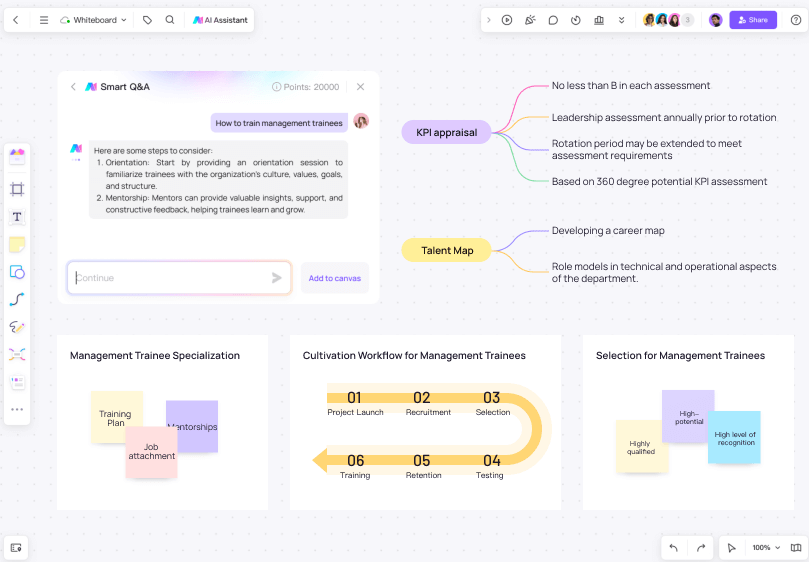
In education, an instructor might provide a lesson objective and source material, then generate a concept structure that students must explain, correct, or extend. A study group could organize a reading into claims, supporting evidence, counterarguments, and remaining questions. The value comes from the interaction around the draft, not from treating generated content as an answer key.
Set roles before the session: one person facilitates, subject experts verify claims, participants contribute evidence, and a named owner records the final decision. For remote groups, keep instructions and the definition of done visible on the board. This reduces ambiguity and makes it easier for someone who joins later to understand what was decided and why.
3. Generate and refine a flowchart
A useful flowchart prompt describes a bounded process. State the start and end conditions, actors or systems involved, main steps, decision points, exception paths, and the audience that will use the diagram. If the process comes from a policy or operating procedure, include that source rather than asking the AI to infer how the organization works.
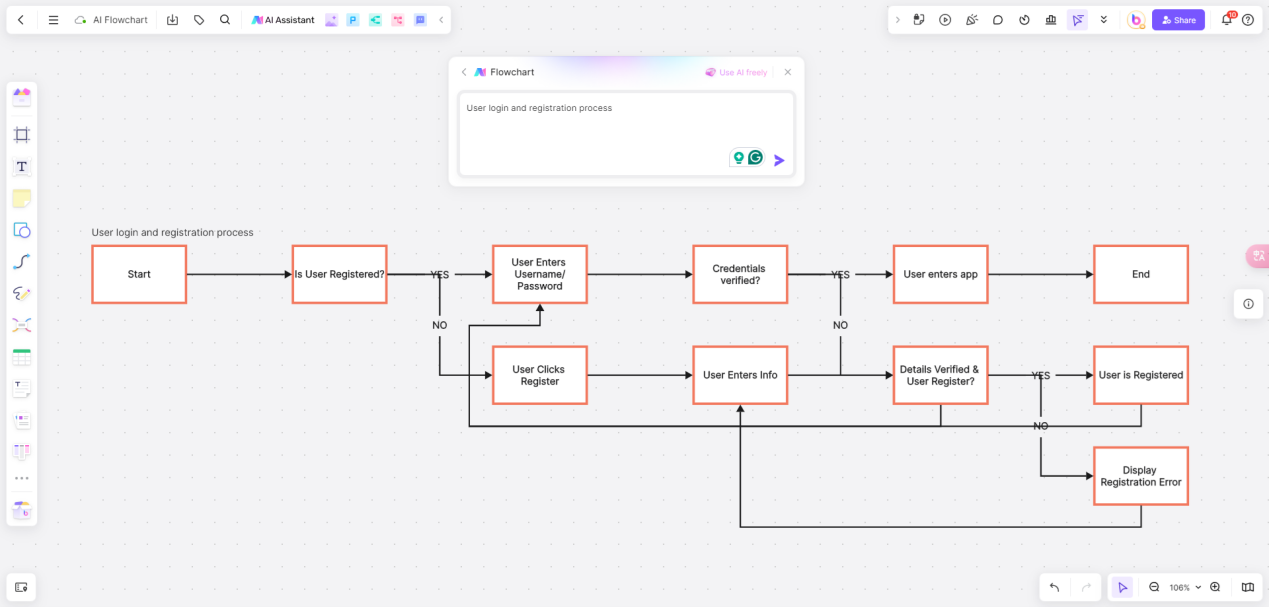
Review the generated draft from left to right or top to bottom. Confirm that every decision has clearly labeled outcomes, each path reaches a valid endpoint, and handoffs identify an owner. Look for missing retry, rejection, escalation, and failure paths. Then simplify labels, align shapes, and use color sparingly so readers can follow logic without decoding a visual key.
For example, a customer-support escalation flow should show the intake trigger, severity criteria, assignment, response target, resolution, and what happens when information is missing. The AI can arrange a first pass, but the support and compliance owners should verify policy language before the chart is used. For a focused text-to-process workflow, use Boardmix's dedicated AI flowchart maker.
4. Build a mind map from a topic or text
Mind maps work best when the central topic is specific and the branch logic is stated. Provide the source text or subject, the map's purpose, the desired depth, and any branch categories that must appear. A study map might use concepts, evidence, examples, and questions; a project map might use goals, workstreams, dependencies, risks, and stakeholders.
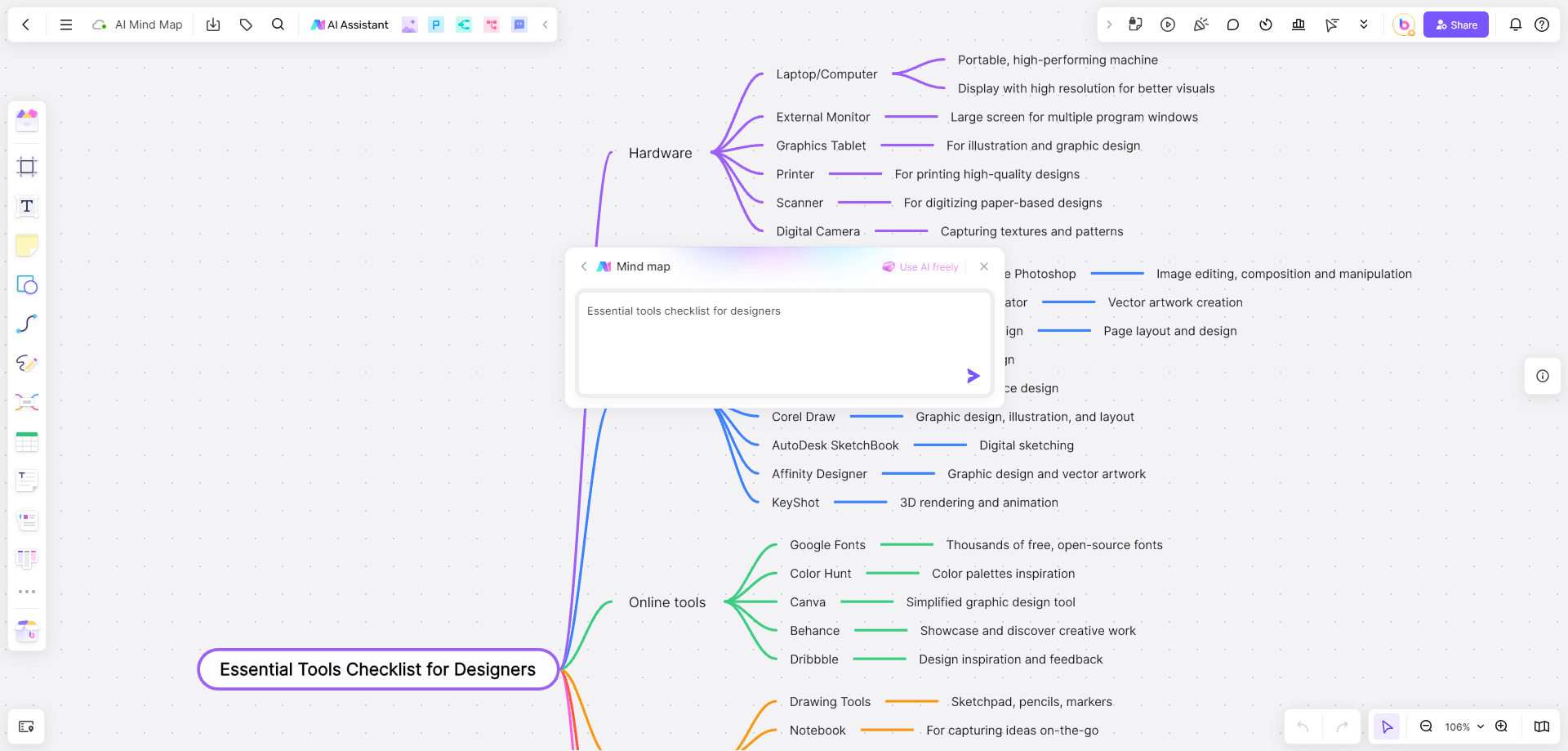
After generation, test the hierarchy instead of accepting it as a tidy outline. Sibling branches should be comparable, child nodes should genuinely belong to their parent, and the same idea should not be repeated under several labels. Shorten long node text, split overloaded branches, and add cross-links only when the relationship is meaningful.
Visual choices should clarify the structure. Use colors for a stable category such as workstream or confidence, add icons only when their meaning is obvious, and keep the central idea easy to find. Invite collaborators to add missing concepts or sources, then resolve overlaps before the map grows. Boardmix's AI mind map maker provides the dedicated generation path when the mind map itself is the task.
5. Draft and edit a presentation
Begin with the audience, objective, source material, required sections, and desired tone. A request such as "make a presentation about the launch" leaves the AI to invent the story. A stronger brief explains what the audience should understand or decide, which evidence is approved, how long the presentation should be, and what must stay out of scope.
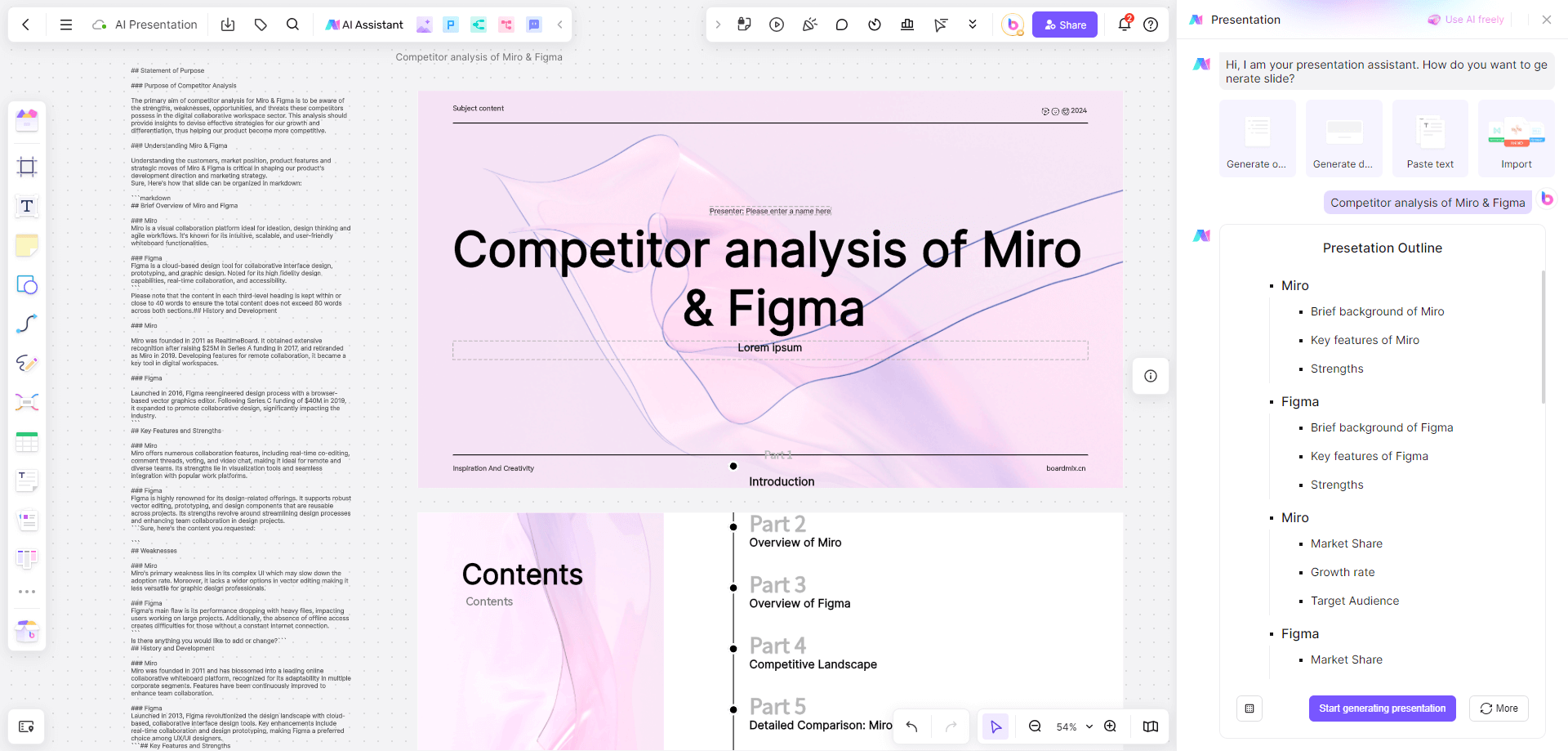
Use the generated outline to inspect the narrative before polishing slides. Each section should advance the argument, and important claims should connect to a source. Remove repetition, separate background from recommendations, and make the requested decision explicit. Then choose a visual style and adjust layout, colors, and text density to fit the audience and presentation setting.
Collaboration is particularly useful at this stage. A subject expert can check evidence, a presenter can add speaking context, and a reviewer can flag slides that depend on unexplained jargon. Inspect the presentation in its actual delivery mode as well as on the canvas. Text that looks acceptable while zoomed in may be unreadable in a meeting or exported file.
6. Create business diagrams
Business diagrams turn structured facts into a shared model. Before generation, name the diagram type, the decision it should support, the audience, the source facts, and the fields that must be completed. A business model canvas, SWOT analysis, customer persona, and customer journey map answer different questions; choosing the artifact first prevents unrelated information from being forced into the same layout.
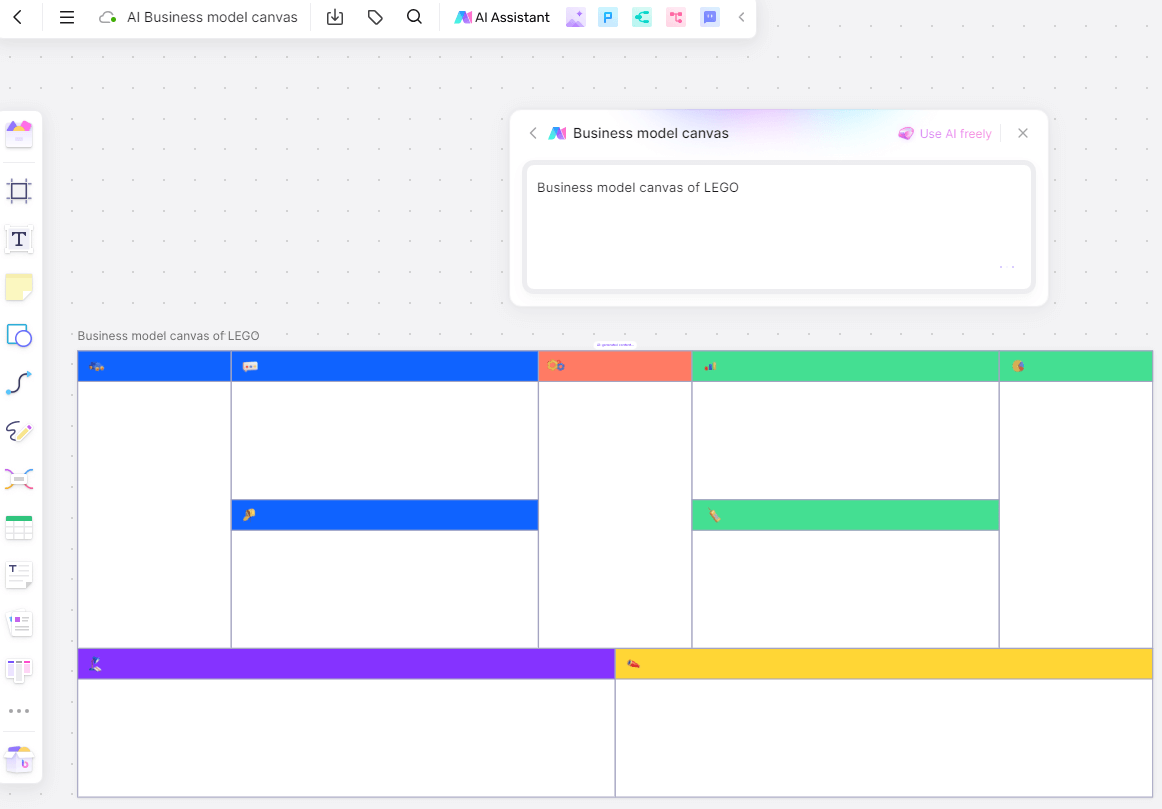
For a business model canvas, provide evidence for customer segments, value propositions, channels, relationships, revenue, resources, activities, partners, and costs. Ask the AI to leave uncertain fields marked as assumptions. On the board, compare dependencies between fields: a channel should reach the named segment, a key activity should support the value proposition, and costs should reflect the resources and activities shown.
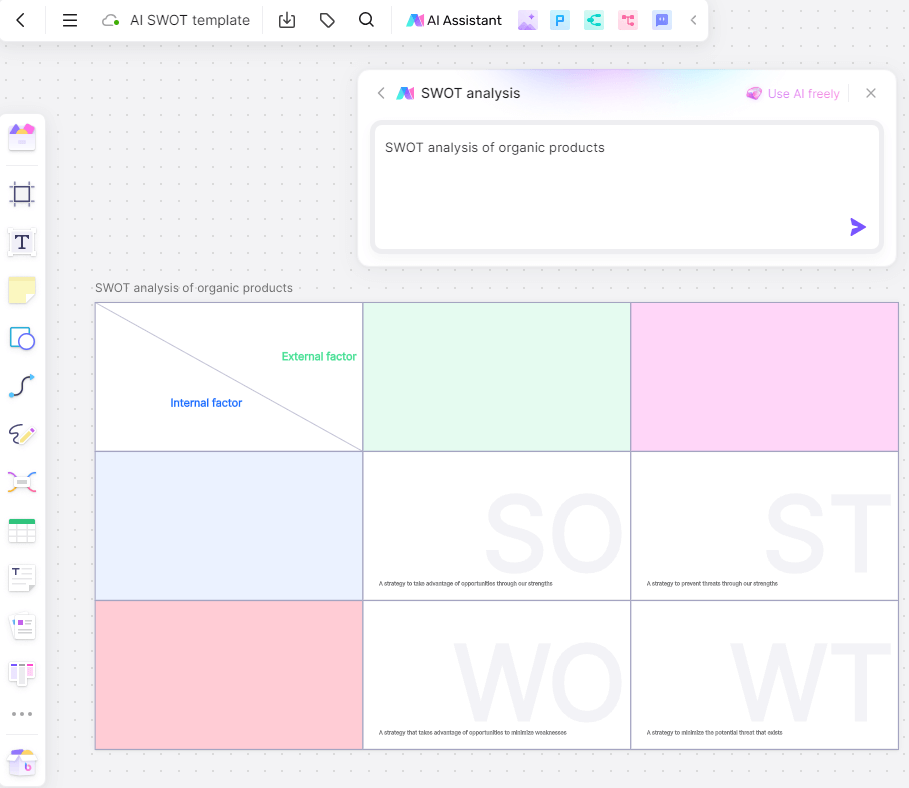
A SWOT draft needs an explicit scope and time horizon. Separate internal strengths and weaknesses from external opportunities and threats, attach evidence, and remove duplicated points stated with different wording. The useful next step is not a longer list; it is connecting a small number of supported observations to actions, owners, and signals that would change the decision.
Persona and journey-map drafts need the same discipline. Base persona needs and behaviors on research rather than invented demographics. For a journey, state the scenario, stages, user goal, touchpoints, evidence, friction, and ownership. Review whether the stages reflect the real experience and whether proposed improvements address a documented problem.
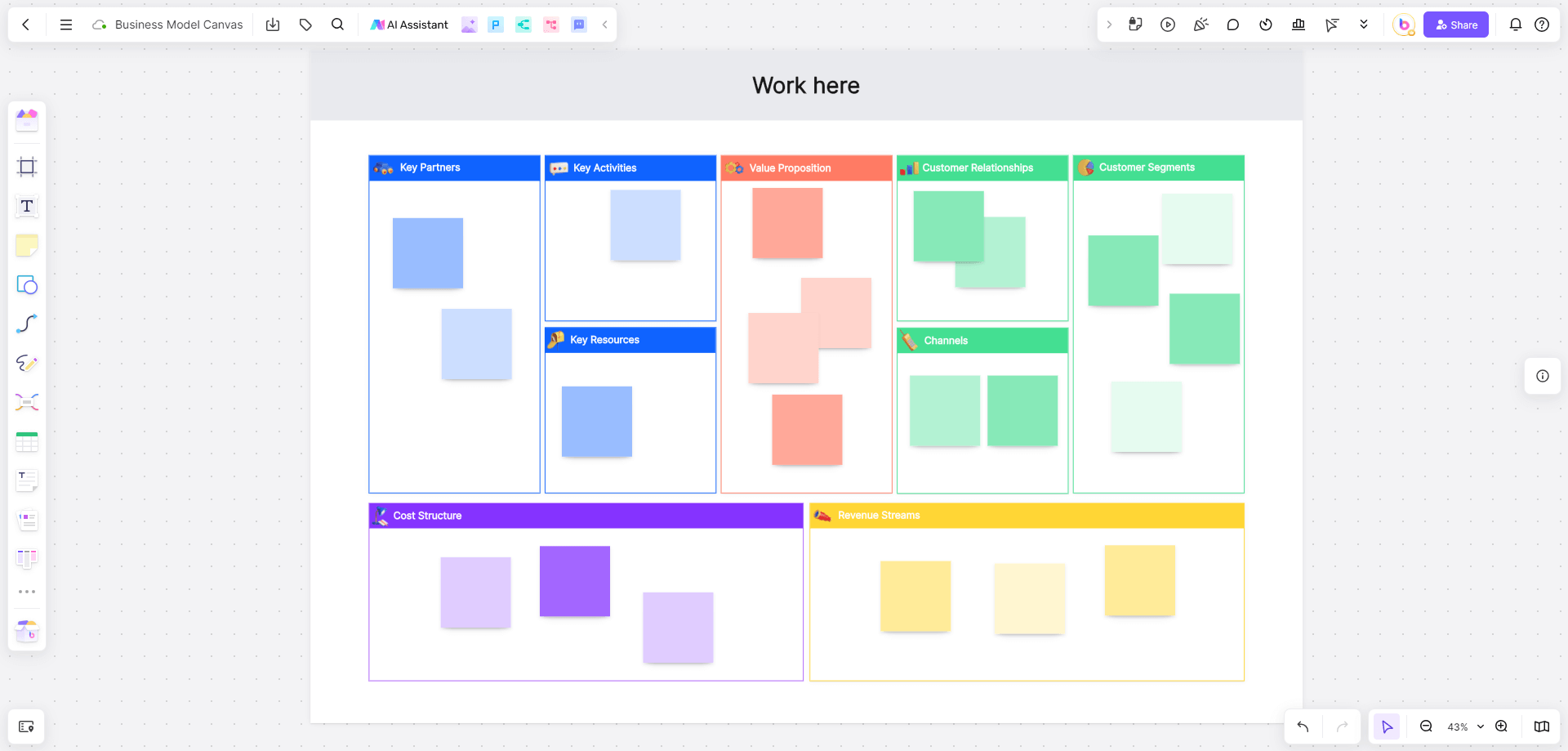
A practical business-model workflow is to place source notes beside the generated canvas, tag each statement as evidence or assumption, and edit one field at a time. Then ask stakeholders to review the parts they own. Finish by recording the riskiest assumptions and the next validation activity. This retains the speed of a generated structure while keeping the strategic reasoning visible.
7. Draft, rewrite, or summarize text
Writing tasks can begin with a prompt or with text selected on the board. State the purpose, audience, tone, length, required facts, source boundaries, and output format. Boardmix AI can support ideation, outlining, drafting, rewriting, grammar or style refinement, and summarization, while the surrounding canvas keeps references and visual context close to the draft.
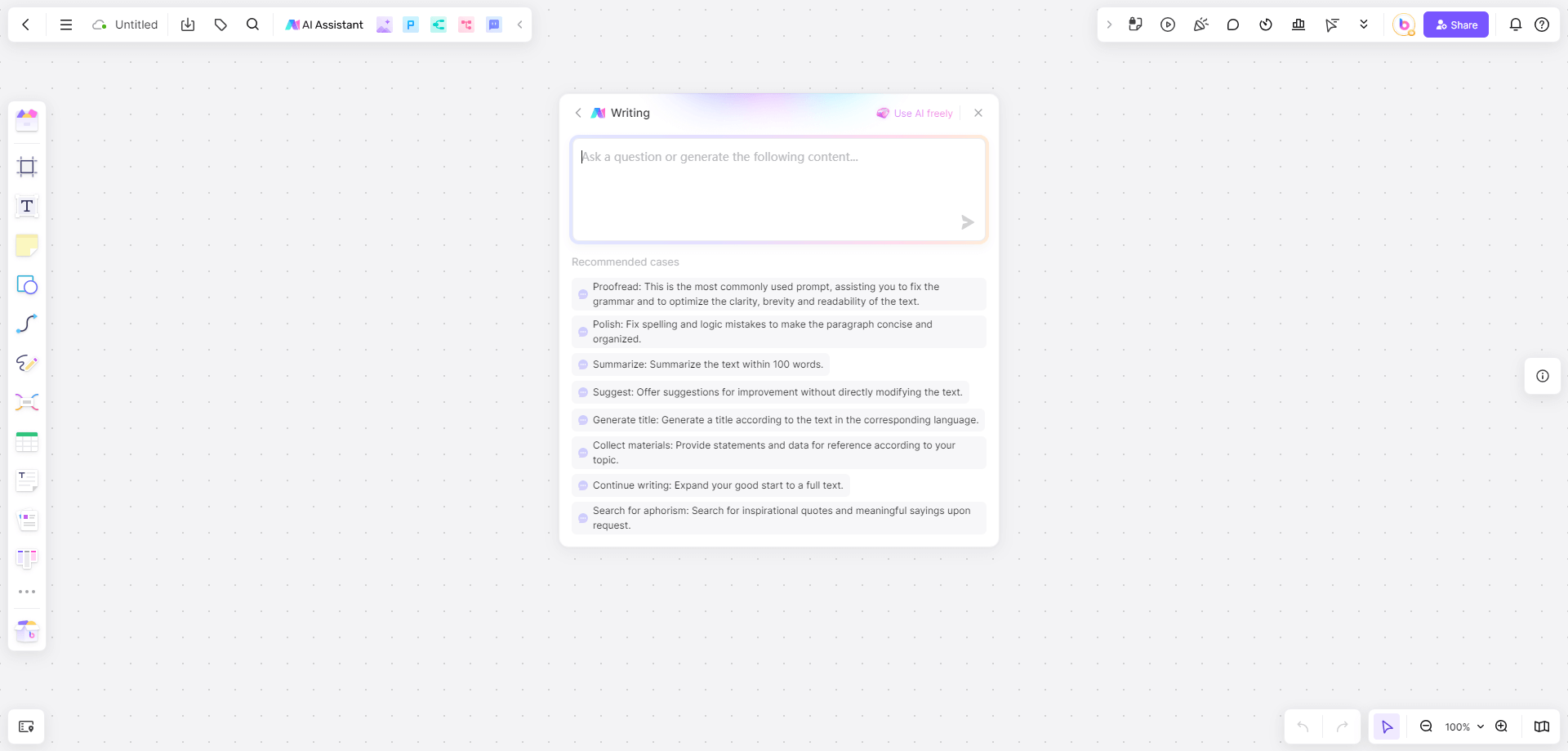
For a first draft, ask the AI to distinguish supplied facts from assumptions and to identify missing information. For a rewrite, explain what should change, such as clarity, tone, or length, and what must remain unchanged. For a summary, define the audience and maximum length, then compare every important statement with the original.
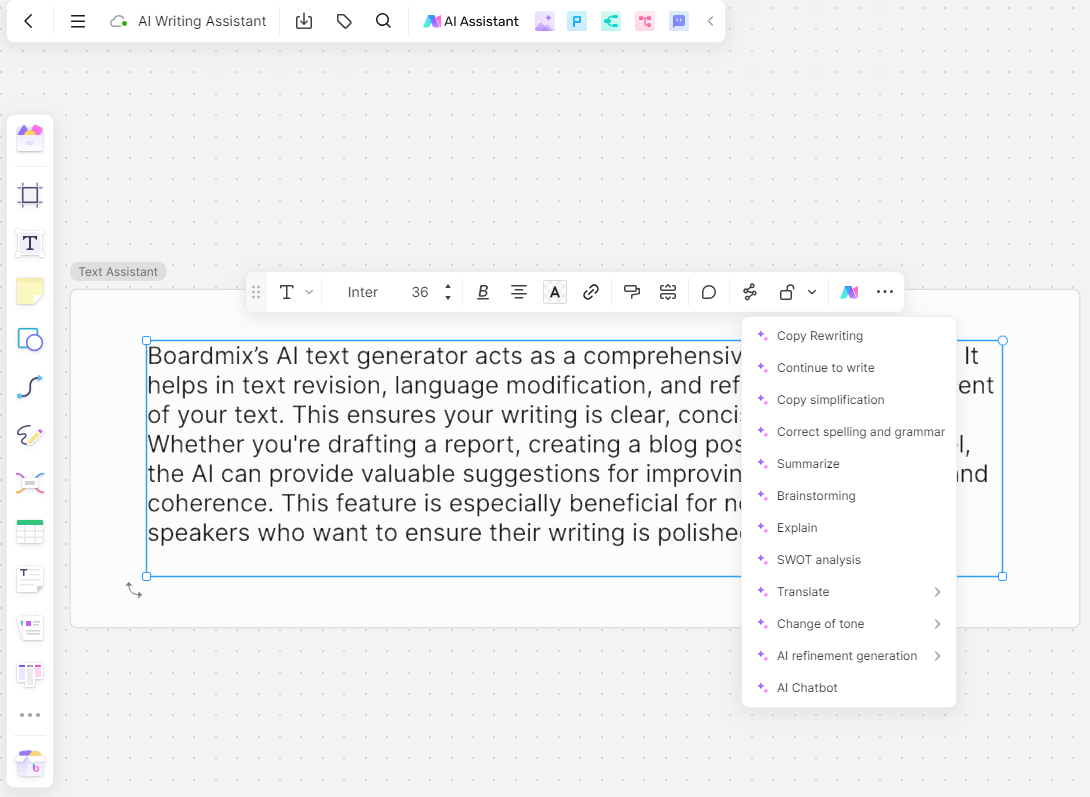
Human review still covers factual accuracy, citations, omissions, tone, and originality. Do not treat smooth language as evidence that a claim is correct. Keep approved wording and source passages visibly separate from generated alternatives, especially in legal, medical, financial, or regulated contexts. When the text will be published, use the organization's normal review and rights-clearance process.
The canvas can also support editorial collaboration: group feedback by section, mark which suggestions were accepted, and keep the final copy next to the source outline. That makes the reasoning easier to follow than a chain of disconnected prompts and reduces the chance that a later rewrite silently removes a required fact.
8. Generate an image or develop a sketch
For image work, describe the subject, intended use, visual style, composition, aspect ratio, and any elements that must appear or be avoided. If you use a reference image, confirm that you are allowed to submit it and explain which qualities are relevant. A reference should guide the request, not replace a clear brief.
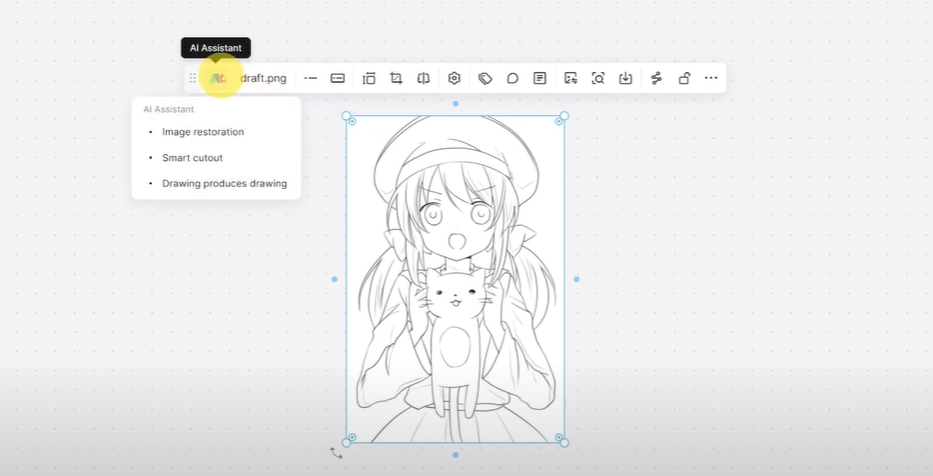
Review the result at full size. Look for distorted details, inconsistent perspective, unintended text, weak contrast, and differences from the requested subject or brand style. Check whether the image remains understandable for its intended audience and add appropriate alternative text when it is published. A visually appealing result can still be unsuitable if it misrepresents a product, person, process, or data point.
When developing a line drawing or sketch, use generation as an exploration step. Compare variations, keep the version that best supports the message, and refine it deliberately on the board. Before sharing, check rights, brand approval, and whether the prompt or reference contained confidential or personal information.
A Repeatable Prompt-to-Board Workflow
A reliable prompt describes the work around the artifact, not just its name. Use this six-step process whether you are creating a map, diagram, presentation, text draft, or image concept:
- Define the outcome and audience. State what the artifact should help someone understand, decide, or do. Include the delivery setting and the level of detail the audience needs.
- Supply source material or select relevant board elements. Provide approved notes, requirements, process steps, research, or references. Exclude unrelated and unapproved data.
- Specify the artifact and constraints. Name the format, required sections, boundaries, tone, visual conventions, and any facts the AI must not infer.
- Generate a first draft and inspect it against the source. Check whether the output reflects the supplied material before spending time on layout.
- Revise the prompt or edit the canvas directly. Correct specific gaps, restructure weak areas, and preserve changes that already work instead of repeatedly starting over.
- Collaborate and finish. Invite the right reviewers, resolve feedback, record decisions, and inspect the presentation or exported file before distribution.
Reusable prompt pattern: Create a [artifact] for [audience or purpose] using [source or context]. Include [required elements], exclude [out-of-scope items], and structure the result as [format]. Flag assumptions or missing information instead of inventing details.
For a cross-functional product launch, for example, you could ask for a planning board for product, marketing, sales, support, and operations. Supply the approved launch objective, date, audience, dependencies, research, and known risks. Request workstreams, decision points, owners, dependencies, and unresolved questions, while excluding unapproved dates or performance claims.
After generation, compare the clusters with the source brief. Add missing compliance and support work, remove duplicate activities, turn vague labels into observable deliverables, and connect dependencies to owners. Ask each function to review its area, then create a small decision log and a clearly marked next-action zone. The finished board is useful because the team improved and agreed on it, not because the first prompt produced a polished arrangement.
How to Review AI Output Before Sharing
Review the content and the visual structure separately. A board can look orderly while containing wrong facts, and accurate notes can still be difficult to follow if the hierarchy or connectors are unclear. Use this checklist before the artifact becomes a decision aid, teaching resource, client deliverable, or published asset:
- Source accuracy: verify names, numbers, dates, quotations, definitions, and claims against the approved source.
- Completeness: look for missing steps, exception paths, stakeholders, evidence, dependencies, and edge cases.
- Structure: check hierarchy, grouping, sequence, connectors, branch labels, and whether each element has one clear role.
- Audience fit: remove unexplained jargon, choose an appropriate level of detail, and make the intended takeaway or decision explicit.
- Visual clarity: check contrast, text density, spacing, alignment, and readability at the zoom level or export size people will actually use.
- Data and rights: confirm that source material was permitted, sensitive details were handled correctly, and generated text or images can be used as intended.
- Collaboration and export: resolve comments, record approval, and inspect the final file or presentation rather than relying only on the canvas view.
Assign review by expertise. A process owner should check the flow, a subject expert should check the content, and the person delivering the artifact should check audience fit. For consequential work, keep the source and decision record available so later readers can understand why the board says what it says.
Plans, Credits, and Data Considerations
Boardmix offers a free plan, but AI use is limited by credits rather than being an unlimited service. Allowances and plan details can change, so consult the current AI credits and plan limits before choosing a workflow for recurring or high-volume work. Estimate how many people will generate content, which outputs need revision, and what export or collaboration features the project requires.
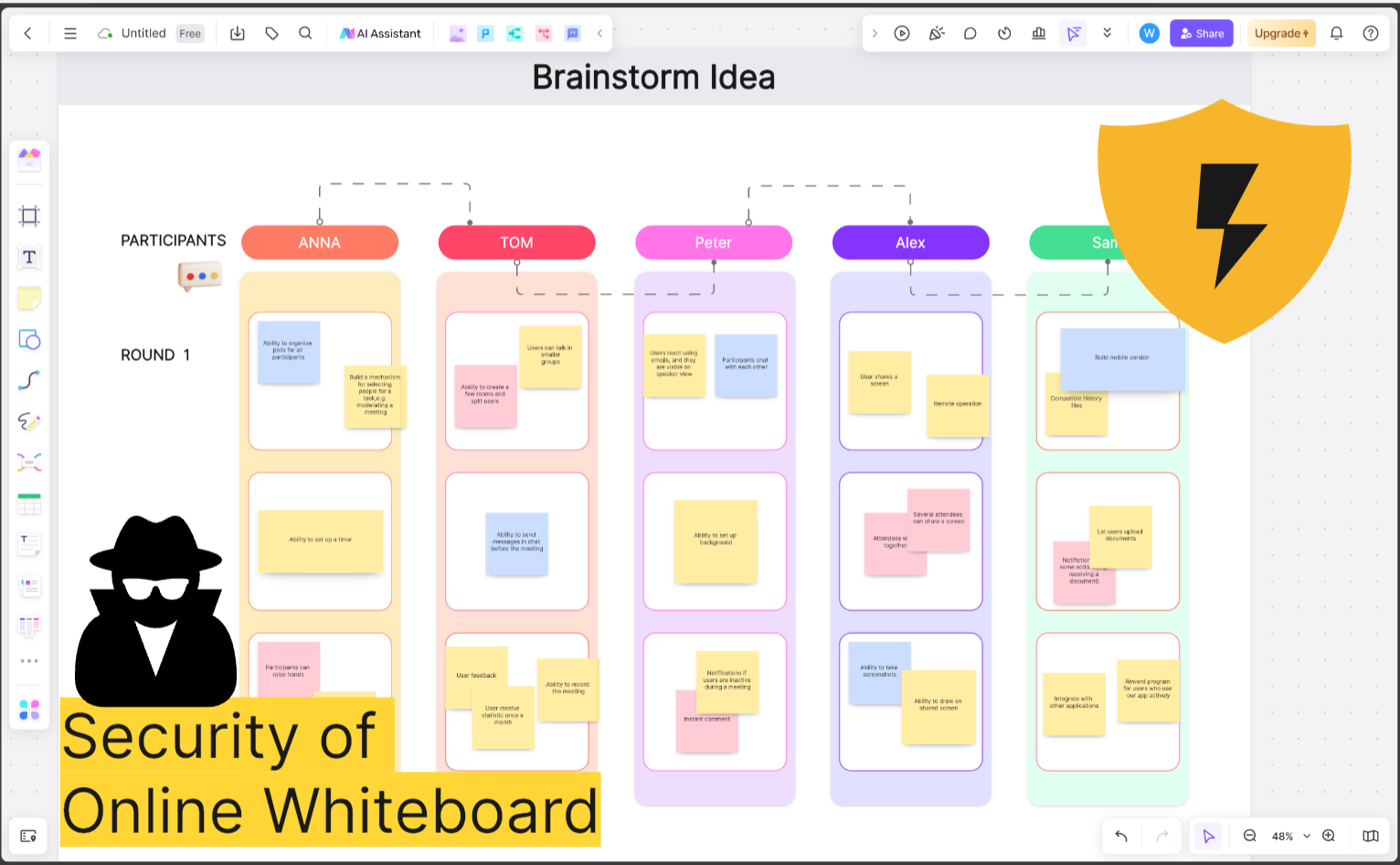
Data handling also belongs in the workflow. Boardmix's privacy policy says information used with AI features is provided to AI models for analysis, and reference images are sent to the selected model for image generation. Follow your organization's rules before using confidential, personal, regulated, or client-restricted material.
When approval is uncertain, remove or anonymize sensitive details, use representative placeholders, and keep protected source material out of the prompt. Check that collaborators also understand the boundary. The right question is not only whether AI can create the artifact, but whether the selected input is appropriate to submit and share.
AI Whiteboard FAQ
What is an AI whiteboard?
An AI whiteboard is an editable visual canvas with AI assistance. It can turn a prompt, source material, or selected board content into a draft such as a diagram, mind map, outline, text, or image concept. People then verify facts and logic, rearrange the output, add context, collaborate, and decide when it is ready to share.
Is Boardmix AI free?
Boardmix has a free plan, but AI use is credit-limited. The number of credits and the features included in each plan may change, so check the pricing page linked above before relying on a specific allowance. For a real project, also confirm board, collaboration, storage, history, and export requirements rather than evaluating AI access alone.
Can an AI whiteboard create a flowchart from text?
Yes. Provide the process scope, actors, start and end conditions, major steps, decisions, and exception paths to create an editable first draft. A process owner should still check sequence, branch labels, missing paths, ownership, and endpoints. Source policies or procedures should remain the authority when the generated diagram conflicts with them.
Can Boardmix AI organize or analyze existing board content?
Boardmix AI can use selected board elements as context for supported tasks. Select only the material relevant to the question and state the output you need. Review the result for omissions and misinterpretation, especially when the selection mixes notes, diagrams, and incomplete ideas. Do not assume that every board object carries the same context automatically.
Are AI-generated boards accurate?
Accuracy is not assured by a clean layout. Verify facts against the source, test diagram logic, check labels and connectors, and look for missing branches or stakeholders. Treat generated content as a draft. The level of review should increase when the board affects customers, students, policy, safety, finances, or another consequential decision.
Can I use sensitive information in an AI whiteboard?
Do not submit sensitive information unless your organization has approved the workflow and the data handling fits its policy. Review Boardmix's policy, minimize the input, and remove or anonymize confidential, personal, regulated, or client-restricted details when possible. Reference images need the same care because they are sent for image-generation processing.
The Bottom Line
Boardmix is a practical fit when you want AI-generated starting points that remain editable and collaborative on a visual canvas. The eight workflows differ in their inputs and review criteria, but they share one discipline: provide relevant context, generate a draft, inspect it against the source, edit it deliberately, and involve the people responsible for the result.
Use AI to reduce the effort of getting from a blank canvas to a reviewable structure, not to remove judgment from the process. A finished board should make its evidence, assumptions, ownership, and next action clearer than they were before generation.