When two people lead an online workshop, agree on the handoff before the session: who takes over, what the group should have produced, which questions remain open and what happens next. At the transition, the outgoing facilitator summarizes that state and the incoming facilitator confirms it aloud. Passing the microphone is only one part of the transfer.
A shared Boardmix whiteboard for workshop planning gives both facilitators a place to keep the working material and a short handoff note together. The note should explain what is true now, so the second person can continue the discussion without making participants repeat it.

Agree on responsibilities before the workshop
Consider a 60-minute workshop about improving a new employee's first week. Eight participants will compare two small changes: a first-day information page and a named onboarding buddy. Maya leads the discussion of current problems; Luis leads the comparison of options. Priya, the team manager, chooses which change to pilot after hearing the group.
Before the call, Maya and Luis agree to switch after the problem discussion, around minute 30. They also name who will watch the chat, record questions and keep an eye on the remaining time. These supporting jobs should continue when the speaking role changes.
| Stage | Leads the discussion | Supports the session |
|---|---|---|
| Opening and problem discussion, approximately 0–30 minutes | Maya | Luis records unresolved questions and prepares the comparison area. |
| Option comparison and decision, approximately 30–55 minutes | Luis | Maya watches the chat and records the reasons behind the decision. |
| Readback and next steps, 55–60 minutes | Luis | Maya checks that the written record matches what the group said. |
Changing facilitators does not change the decision owner. Luis can guide the comparison, but Priya still makes the pilot decision. If a facilitator wants to argue for an option, say so and let the other person guide that part of the discussion. For the wider agenda and decision process, use the meeting facilitation guide.
Prepare a board both people can run
In Boardmix, use text headings or frames for three nearby areas: Current problems, Options and Decision and next steps. Put the question and decision owner above them. Add a small Facilitator handoff area between the first two so the transition is visible without searching the canvas.
Give the two options matching fields: problem addressed, proposed change, effort or dependency, and question to resolve. Keep participants' original notes in Current problems; use labels such as P1 and P2 to refer back to them. The incoming facilitator needs the evidence as well as a summary.
Before the meeting, both facilitators should open the same board under their intended accounts and add a test note. Check that each can edit the areas they will manage. Boardmix distinguishes sharing a file with guests from inviting someone into a team or project; its invite-and-share guide explains those scopes. A role written on a sticky note does not grant product permissions.
Also rehearse who will share their screen in the meeting service. The shared board and the call have separate controls. If Luis needs to take over screen sharing, confirm that he can do it before Maya stops sharing. The workflow here uses ordinary text, notes, shapes and comments; the Boardmix user guide documents these tools.
Write the handoff note as the session unfolds
A prepared agenda says what you hoped would happen. The handoff note says what actually happened. Luis can update it while Maya leads, then Maya checks it before the switch. Keep it short enough to read aloud.
| Field | Example entry at the transition |
|---|---|
| Current point | Problem discussion complete; start comparing the two options. |
| Agreed so far | Focus on finding help during the first week. Changing account setup is outside today's scope. |
| Evidence to keep visible | P1: a new starter could not find the team contact. P2: guidance links were scattered. |
| Still open | Who could serve as a buddy, and how much time could they offer? |
| Next prompt and time | “Which option addresses these problems within our capacity?” About 25 minutes remain, plus five for the final readback. |
| Decision owner and support | Priya chooses the pilot. Maya now records reasons and watches the chat. |
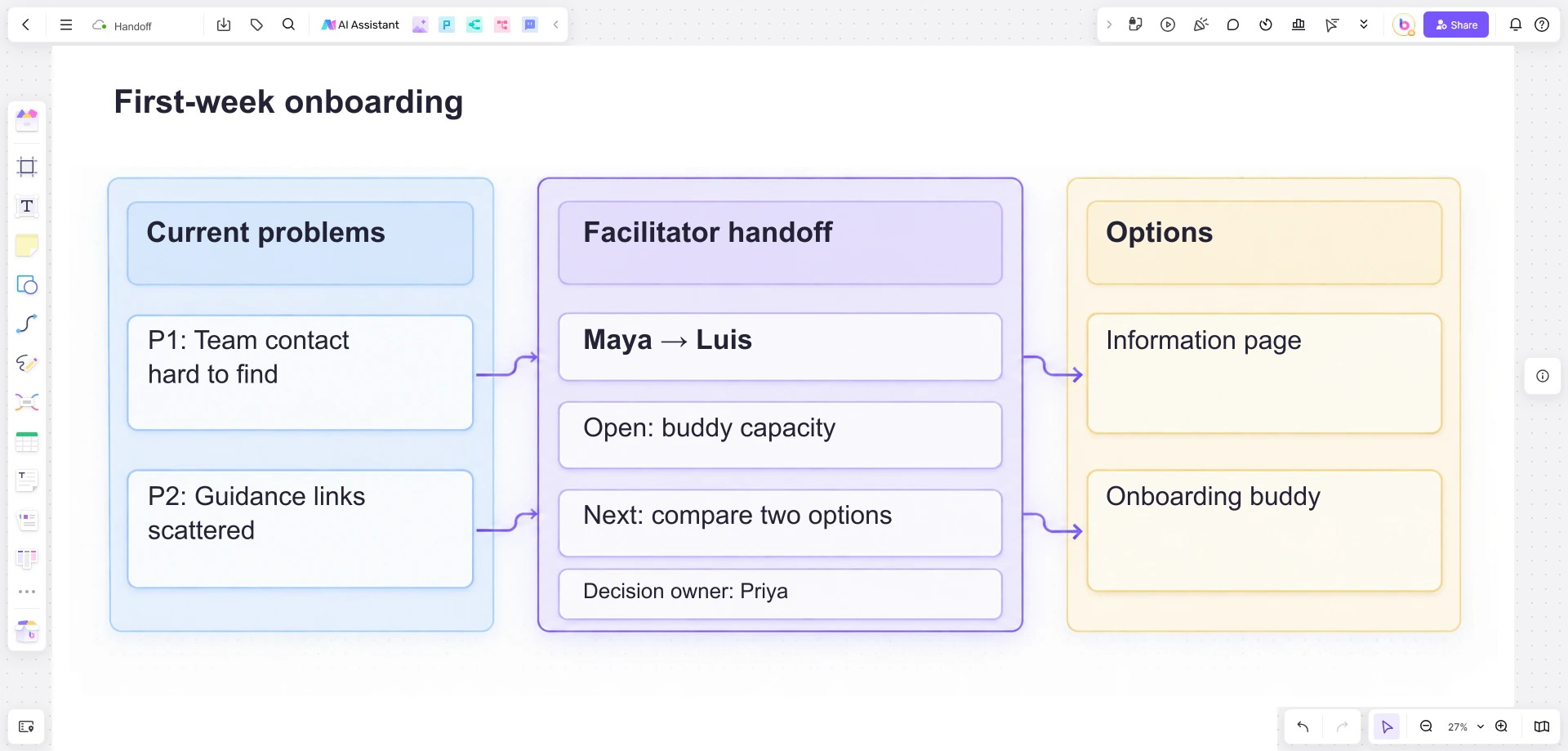
Notice what is missing: “Everyone agrees the buddy idea is best.” At this point the group has clarified the problem, not chosen a solution. A handoff that turns interest into consensus can steer the next facilitator before the comparison starts.
If someone has raised a concern, capture the concern itself: “Buddy availability is unknown.” Avoid character judgments such as “Sam is resistant.” Put sensitive coordination in an appropriate private channel, rather than assuming an area on a shared board is private.
Make the transition a short conversation
At the agreed boundary, Maya stops the activity and points to the note: “We have two problems about finding help, and two options to compare. Buddy capacity is still open. Luis will lead the comparison; I will capture questions and the decision reasons. Priya remains the decision owner.”
Luis confirms the state: “I will start by asking what each option would require. We have about 25 minutes before the readback. Before we compare them, have we missed a concern that affects the choice?” This gives participants a chance to correct the record while the first facilitator is still present.
Then Luis gives one concrete instruction: “In the Options area, add one dependency beside either the information page or the buddy proposal.” Participants know where to work and what to produce. Maya takes the support role without answering every question over Luis.
If the first activity runs late, update the handoff rather than pretending the agenda is unchanged. At minute 35, Luis might say: “We have 20 minutes for comparison and the decision, then five to confirm actions. We will compare these two options and leave additional ideas for a later discussion.” If a missing fact prevents a decision, name the question and its owner instead of forcing a vote to recover time.
Plan for an unplanned takeover
Agree on a fallback before the call: if the current facilitator loses connection, the other person leads while a named participant helps with notes. The backup should already have the board open, know the current area and be able to use the meeting service. Do not rely on the disconnected person to grant access.
If Maya drops out before the handoff, Luis can say: “Maya has disconnected. I will continue from the note. We were clarifying where people look for help; we have not selected an option.” He asks the group to confirm the last completed step, then resumes there. If the note is stale or ambiguous, a brief reconstruction is better than presenting a guess as agreement.
If Maya returns, avoid silently changing leaders again. Luis can keep leading to the next natural boundary while Maya resumes note-taking. State the arrangement so participants do not have to guess whose instruction to follow.
Leave one final record after the switch
In the example, Priya chooses a small information-page pilot while a colleague investigates buddy capacity. Luis reads back the decision, reason, owner and next deliverable; Maya checks the board against his words. An illustrative closing note is: “Pilot one first-week information page. Maya drafts it by Thursday; Priya reviews it Friday. Luis checks buddy availability for a later decision. The pilot does not settle whether a buddy is also needed.”
Mark the handoff note as a transition record and leave the final decision clearly labeled beside the options. Future readers should not mistake the open question at minute 30 for the team's final position.
To prepare your own session, open a Boardmix workspace and put the first handoff note beside the activity where the lead changes. Rehearse the outgoing summary, the incoming confirmation and the next participant instruction together. Those three sentences are the part participants will experience.