Introduction to SIPOC Diagrams
SIPOC (suppliers, inputs, process, outputs, and customers) diagrams are vital tools used in the process improvement and quality management spaces. These visual aids, particularly essential in industries like software development, provide a bird's-eye view of a process, ensuring every team member is on the same page. With software development projects becoming increasingly intricate, using tools like Boardmix can simplify the creation of SIPOC diagram for software development.
Use the four illustrative examples below as starting points. Before filling in a SIPOC, define where the process starts and ends. For example, a feature-delivery process might begin with an approved request and end when the release is available to users.
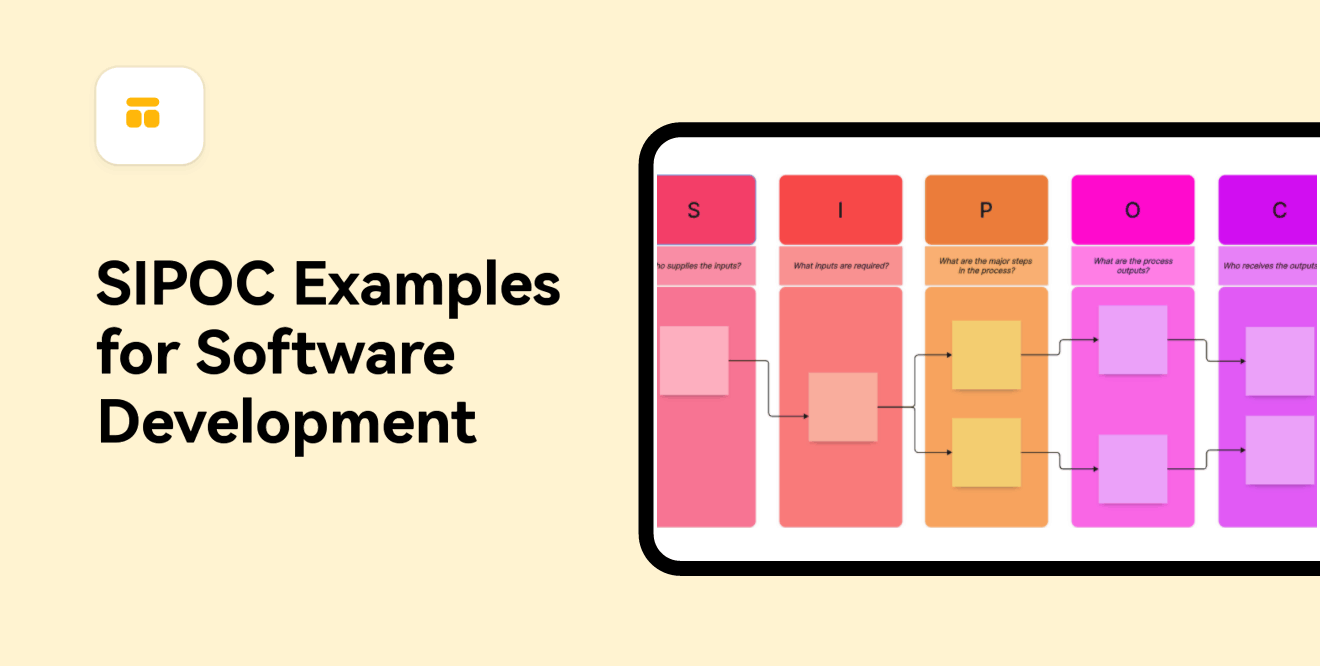
4 SIPOC Examples for Software Development
SIPOC Example for Software Development -01
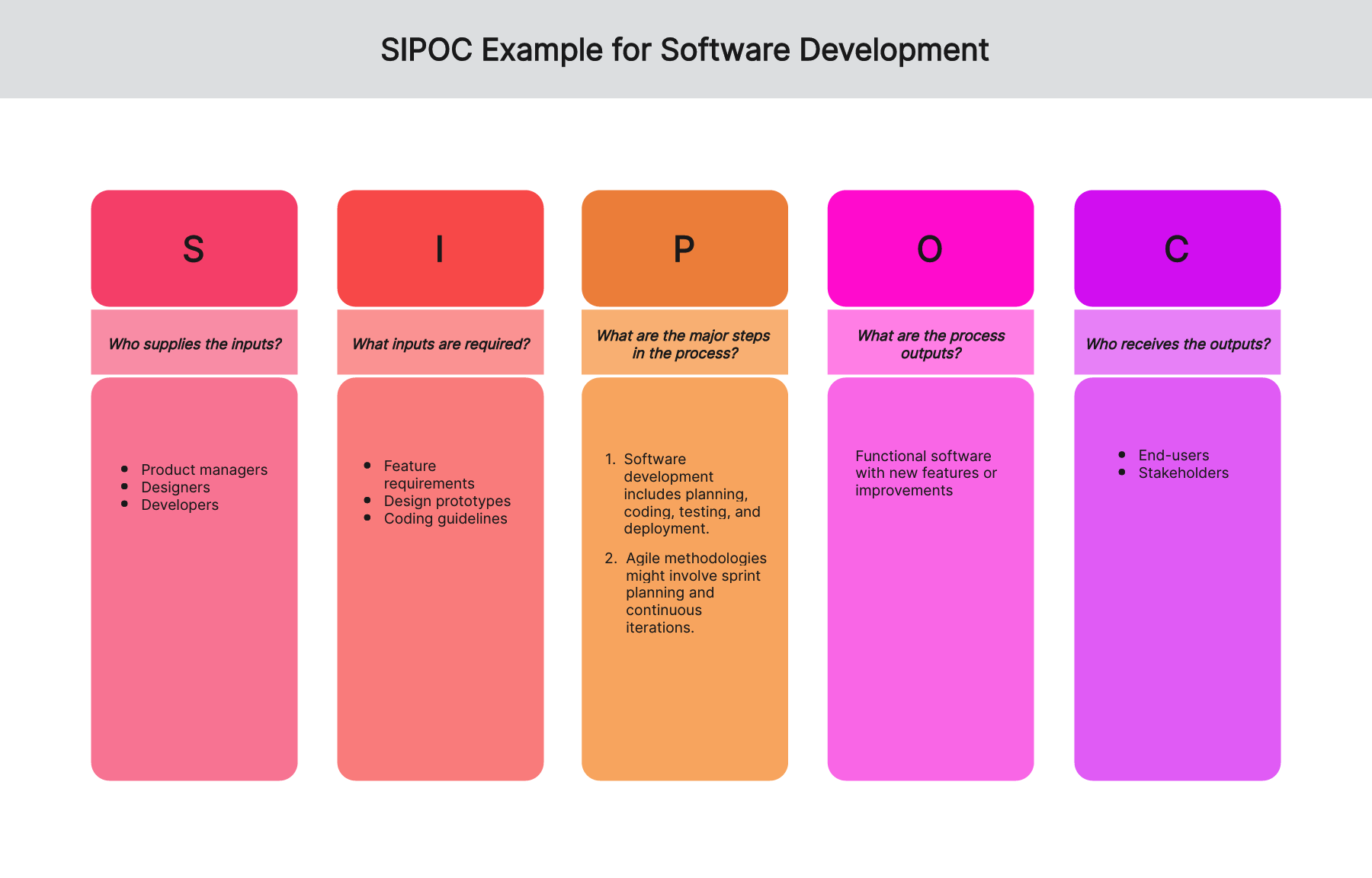
- Supplier: Product managers defining features, designers creating mockups, developers writing code.
- Input: Feature requirements, design prototypes, coding guidelines.
- Process: Software development includes planning, coding, testing, and deployment. Agile methodologies might involve sprint planning and continuous iterations.
- Output: Functional software with new features or improvements.
- Customer: End-users who benefit from the software's functionality, and the teams that receive its outputs. Investors or business leaders belong in the customer column only if they receive a defined output.
SIPOC Example for Software Development - 02
- Suppliers: Stakeholders, product managers, end-users.
- Inputs: Project requirements, funding, development tools.
- Process: Requirement gathering, design & prototyping, coding, testing, deployment.
- Outputs: Working software, documentation, test results.
- Customers: End-users, clients, internal teams.
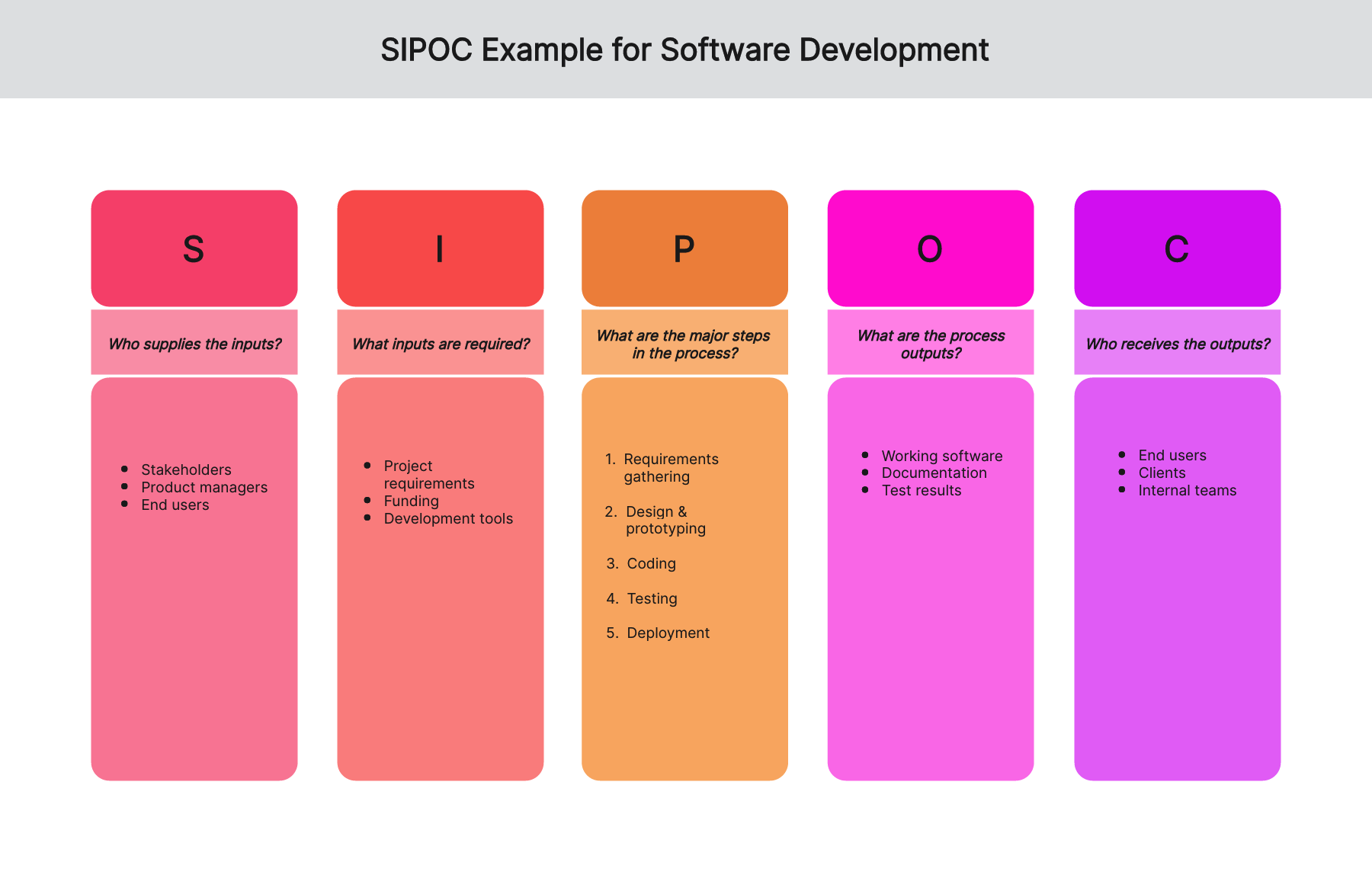
Description: In this scenario, the stakeholders and product managers provide the requirements and necessary tools. The development lifecycle then begins with requirement gathering and concludes with deployment. The end product is then provided to the end-users and clients.
SIPOC Example for Software Development - 03
- Suppliers: Tech leads, business analysts.
- Inputs: Functional specifications, system requirements.
- Process: System architecture design, module development, integration, quality assurance.
- Outputs: Integrated software modules, QA reports.
- Customers: IT departments, external clients.
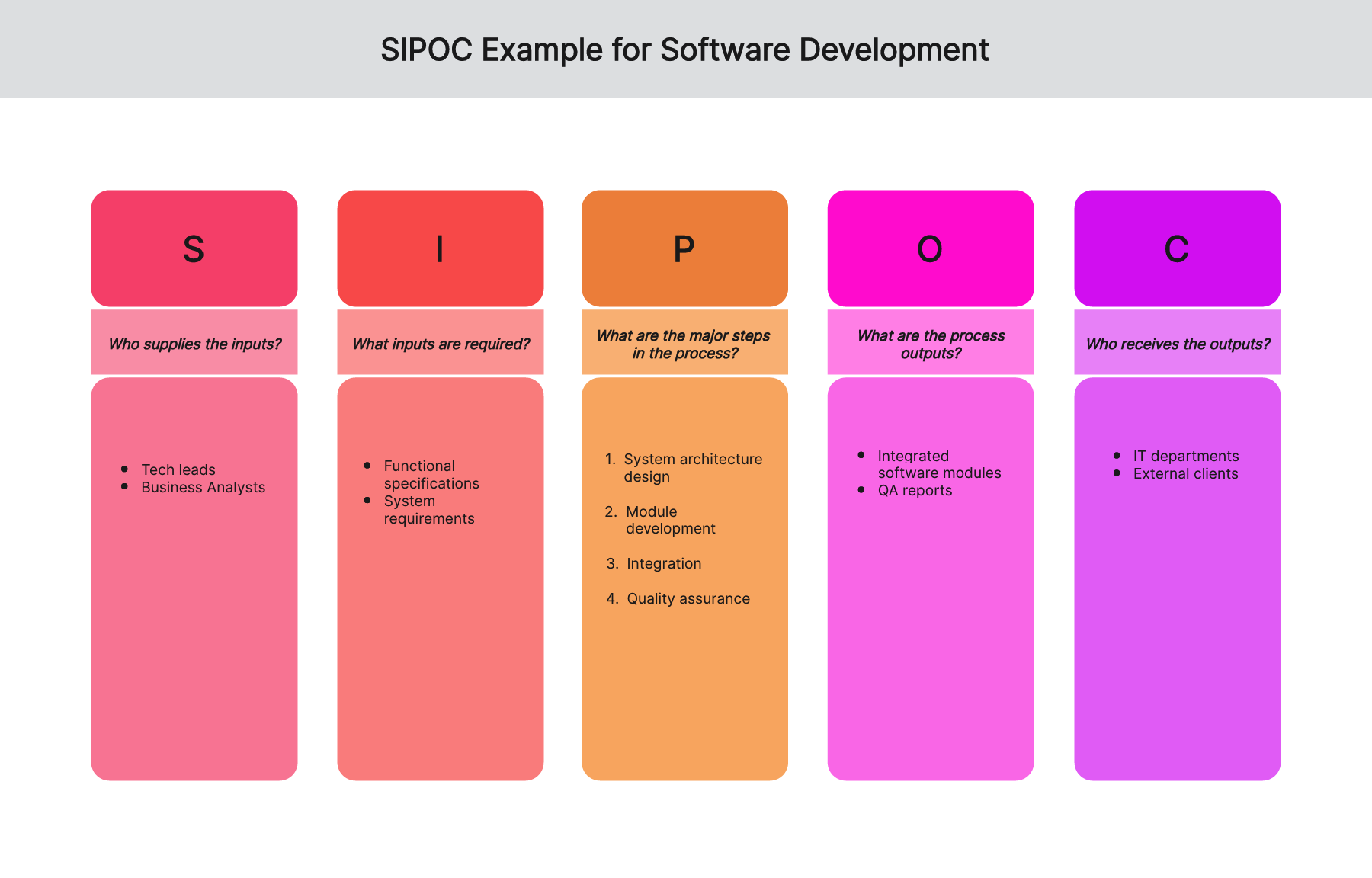
Description: In this module-centric example, the tech leads and business analysts provide functional specifications. Following a systematic architecture design, modules are developed, integrated, and then put through rigorous quality assurance. The IT departments or external clients then utilize the finished product.
SIPOC Example for Software Development - 04
- Suppliers: UI/UX designers, database administrators.
- Inputs: User interface designs, database schemas.
- Process: Front-end development, back-end development, database integration, user testing.
- Outputs: Interactive UI, back-end functionalities, user feedback.
- Customers: Web users, mobile users.
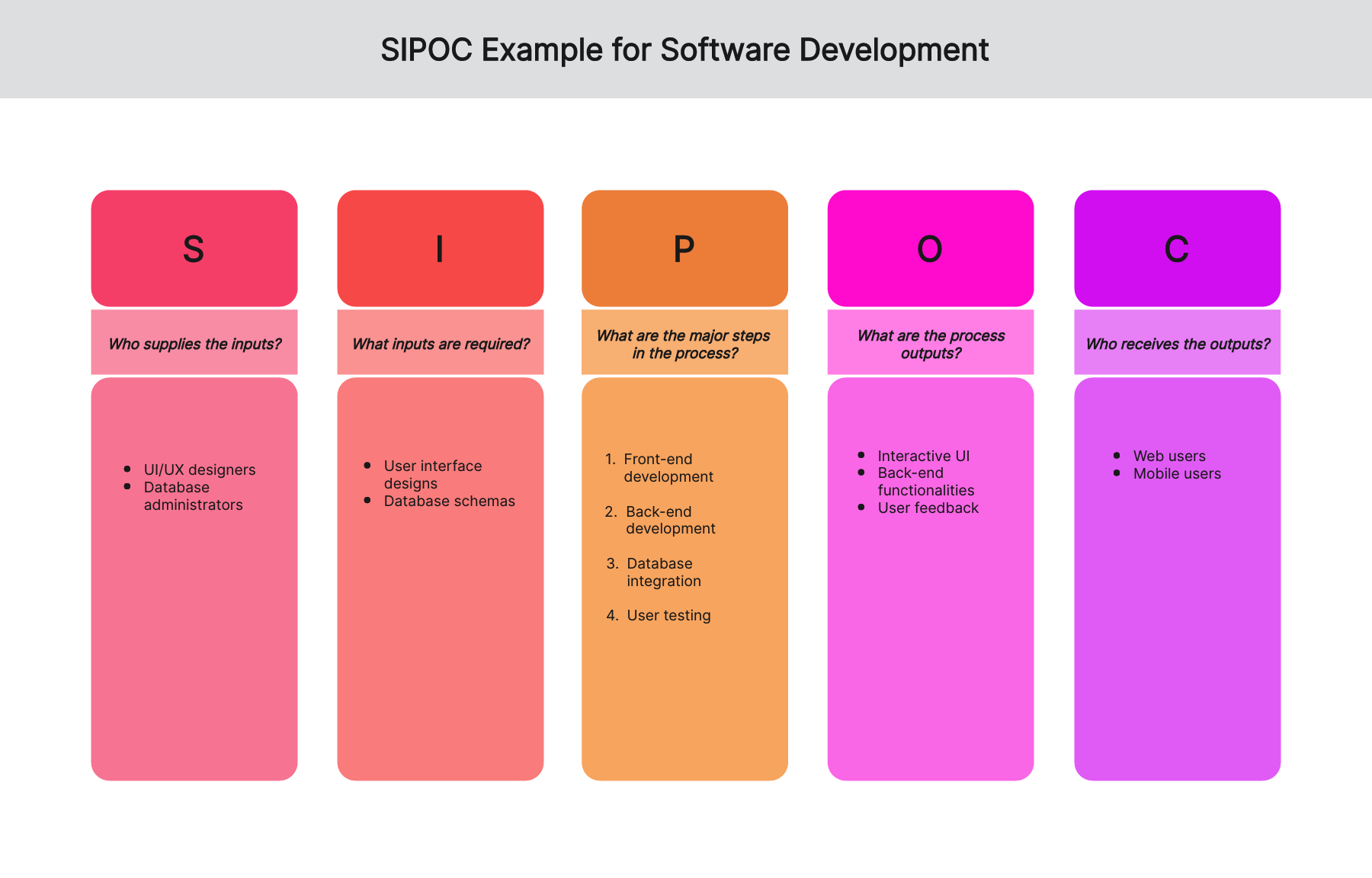
Description: Here, the process starts with designs from UI/UX designers and database schemas from DBAs. Front-end and back-end development are performed in tandem, integrating with the database, and then it's released for user testing. The primary consumers are web or mobile users who interact with the interface.
Develop Your Own SIPOC Using Boardmix
Crafting your SIPOC (Supplier-Input-Process-Output-Customer) diagram is easy with Boardmix. Simply sign up, select the ready-made SIPOC template, customize the diagram elements, and use the intuitive drag-and-drop interface to arrange and connect components. Enhance clarity with icons and symbols, then save and share your finished diagram.
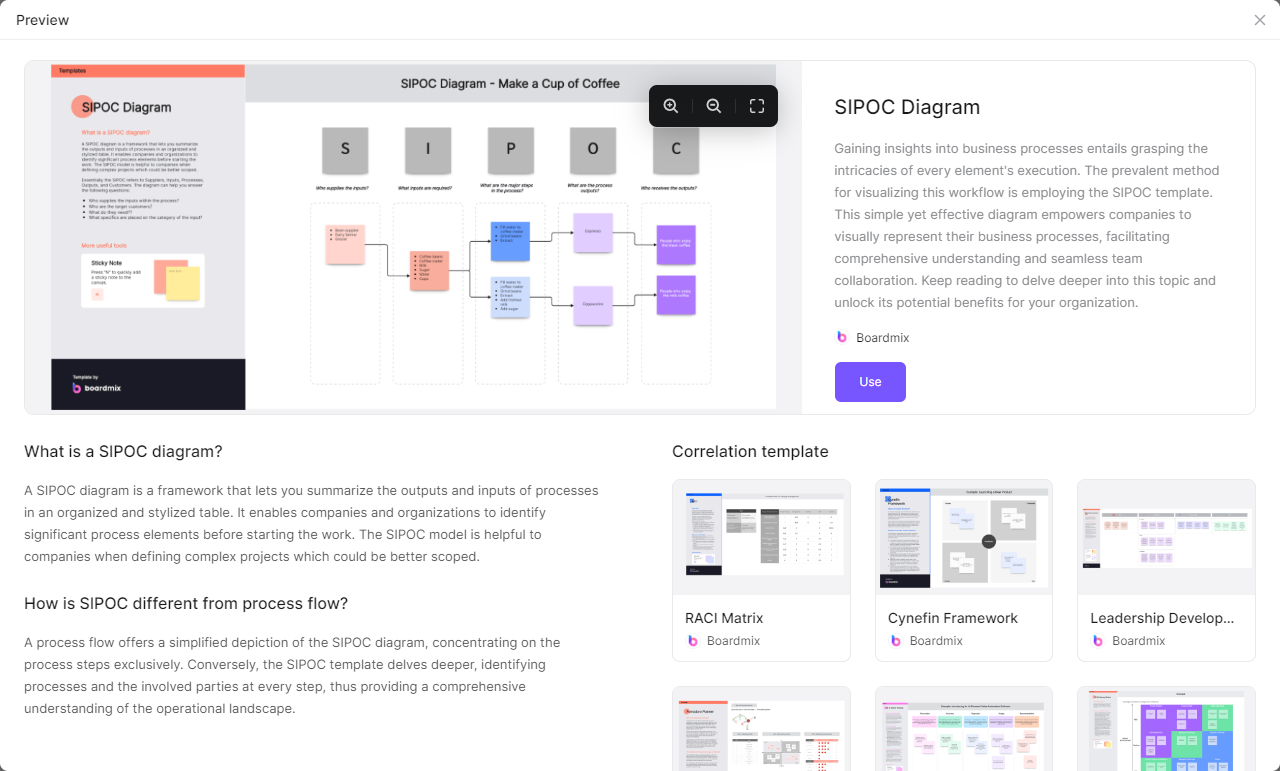
In Boardmix, keep the five columns at the same level of detail. For example 03, link each output—integrated modules or QA reports—to its receiving team. Add detailed tasks on a separate board or section so the SIPOC remains a high-level view.
Key points
Start with the example closest to your workflow, then confirm the process boundary and the inputs and outputs with the people who do the work. Use the Boardmix SIPOC template shown above to capture those agreements before drawing a more detailed process map.