


Conversational AI platforms have evolved far beyond simple chatbots. Today they describe a sophisticated ecosystem of agentic systems that reason, plan, and execute multi-step tasks with minimal human oversight. By 2026, these platforms are front-and-center collaborators reshaping how teams brainstorm, how customers are served, and how businesses grow. Voice interfaces, multimodal inputs, real-time collaboration, and deep enterprise integrations have all converged to make this the most consequential year yet for AI-powered interaction.
Whether you’re a startup accelerating creative output or a global enterprise streamlining operations at scale, choosing the right platform matters more than ever. This guide covers the top 10 conversational AI platforms in 2026, updated with the latest features, real-world use cases, and what makes each tool genuinely worth your attention.
Comparison Table: Top 10 Conversational AI Platforms for 2026
| Platform | Primary Use Case | Key AI Feature | Best For |
|---|---|---|---|
| Boardmix | Visual collaboration & brainstorming | BM Bot, AI mind maps, poster agent | Teams, workshops, product & strategy |
| Writup AI | Marketing copywriting | Brand voice training, 50+ templates | Marketing teams, content at scale |
| OpenAI ChatGPT | General-purpose enterprise AI | GPT-5/o-series, agentic tasks, voice | Customer service, enterprise workflows |
| Apple Siri | Personal AI assistant | Apple Intelligence, on-device AI | Individual productivity, Apple ecosystem |
| Salesforce Einstein Copilot | CRM & sales intelligence | Agentic CRM actions, predictive analytics | Sales, service & marketing teams |
| Microsoft Copilot | Enterprise productivity | M365 integration, Copilot Studio | Large organizations, knowledge workers |
| Bank of America Erica | Digital banking | Proactive financial insights, 24/7 support | Retail banking clients |
| HireVue | HR & recruitment | AI video assessment, bias reduction | Enterprise talent acquisition |
| Hootsuite AI | Social media management | OwlyWriter AI, sentiment monitoring | Social media teams, brand managers |
| Shopify AI (Sidekick) | E-commerce & retail | Personalized recommendations, inventory AI | Online merchants, e-commerce teams |
1. Boardmix: AI-Powered Collaboration Whiteboard for Modern Teams
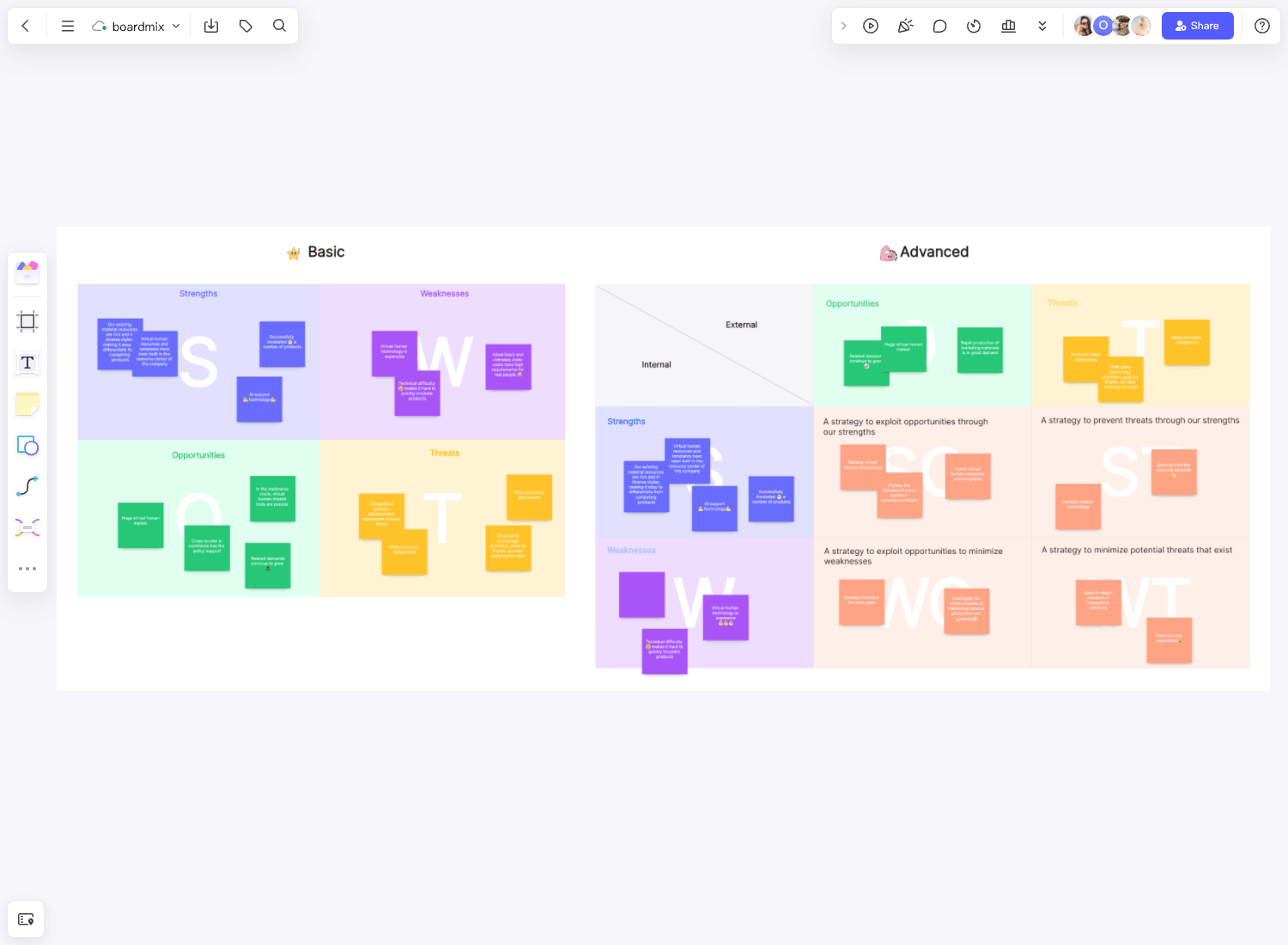
Boardmix is an AI-powered online whiteboard built to turn collaborative chaos into strategic clarity. Far beyond a digital canvas, Boardmix has evolved into a full-featured agentic collaboration platform where your team’s ideas, data, and deliverables all live together in real time.
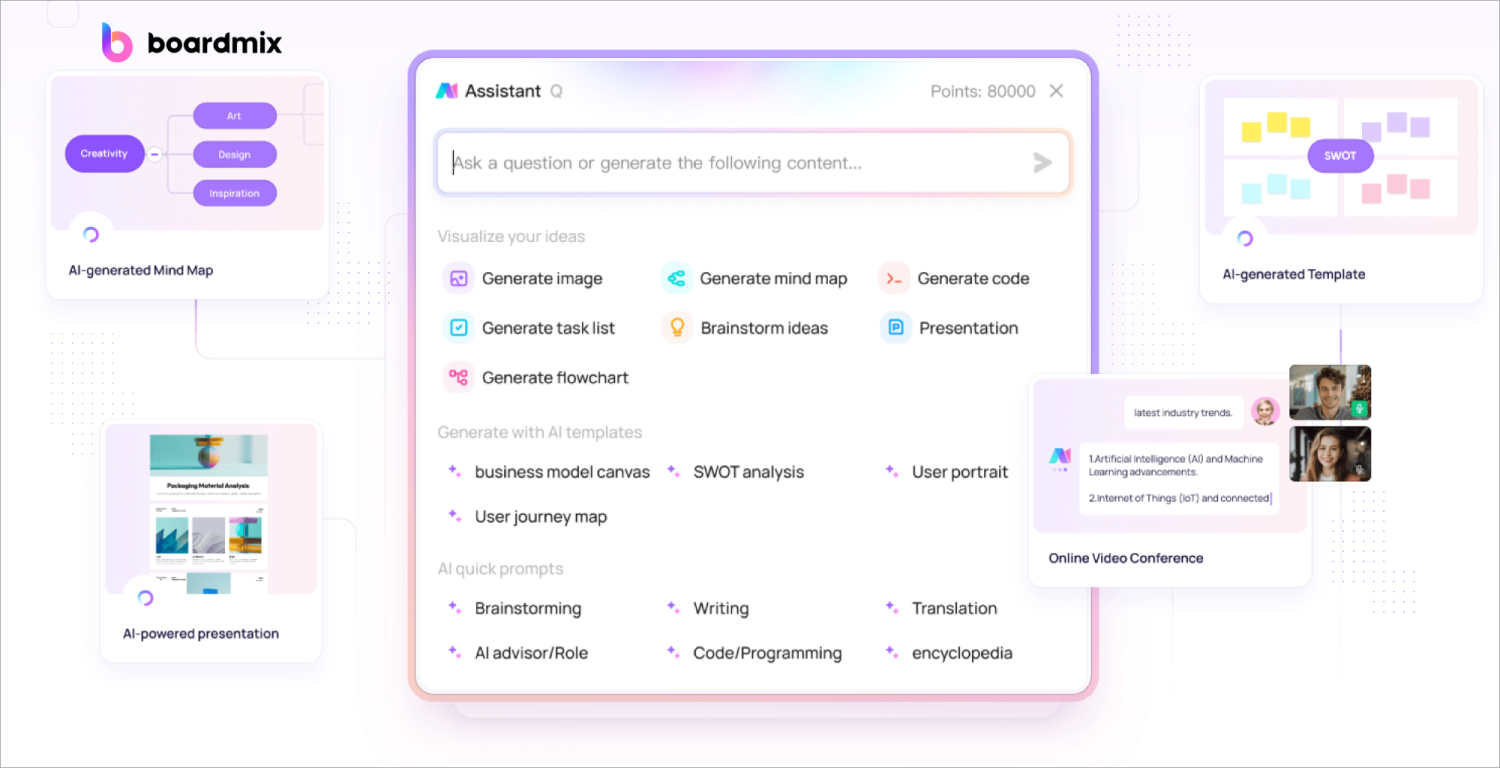
The platform’s built-in BM Bot AI assistant acts as a conversational co-pilot directly on the whiteboard. Ask it questions, request content generation, or kick off entire creative workflows without ever leaving the canvas.
Recent updates introduced a poster design agent, AI image generation natively on the whiteboard surface, and smarter support for large distributed teams working simultaneously.
1. BM Bot AI Assistant & Poster Design Agent: Boardmix’s BM Bot lets you have a natural conversation directly on the whiteboard — ask it to generate content, summarize discussions, or brainstorm ideas. The newly launched poster design agent takes it further, allowing teams to create professional visual assets through simple conversational prompts, no design skills required.
2. AI-Generated Visuals & Structured Outputs: From AI-generated mind maps and flowcharts to presentations, icons, code snippets, and task lists — Boardmix can convert a brief text prompt into a complete visual workflow in seconds. The platform also now displays AI-generated images directly on the whiteboard, making it seamless to blend visual inspiration with collaborative planning.
3. Real-Time Collaboration at Scale: Boardmix supports live co-editing with hundreds of participants simultaneously, making it a go-to solution for remote teams, workshops, and large-scale strategy sessions. Integrated video conferencing, sticky notes, agile templates, and AI-assisted organization tools ensure that every session moves from ideas to outcomes — fast.
What sets Boardmix apart is how tightly the conversational AI is woven into the visual thinking experience. You don’t just chat with a bot. You watch your ideas materialize as structured diagrams, polished presentations, and actionable task lists, all within the same workspace.
2. Writup AI: Conversational AI Platform for Brand-Consistent Marketing Copy
Writup AI is a dedicated AI-powered marketing copywriting platform designed for teams that need to produce brand-consistent content at scale, without sacrificing voice, quality, or creativity.
Every brand competes for attention across a dozen channels simultaneously. Writup solves one of the most persistent problems in modern marketing: maintaining a consistent, recognizable tone across SEO articles, social media posts, ad copy, and email campaigns, all generated at the speed of AI.
1. Brand Voice Training & Multi-Language Support: Writup allows teams to train the AI on their unique brand voice, feeding it tone guidelines, example content, and messaging frameworks so every output feels unmistakably on-brand. Combined with multi-language support, global marketing teams can localize campaigns without diluting brand personality across markets.
2. 50+ Content Templates Across Every Format: Whether you need a high-converting landing page, a punchy social caption, a nurture email sequence, or a long-form SEO article, Writup’s library of 50+ content templates covers the full marketing funnel. Each template is engineered to maximize engagement for its specific format and channel.
3. Team Collaboration & Scalable Workflows: Writup is built for teams, not just solo writers. Multiple stakeholders can collaborate on drafts, leave feedback, and approve content within a single platform — accelerating review cycles and ensuring brand governance at scale. For content-heavy organizations running multiple campaigns simultaneously, this workflow-first approach is a genuine differentiator.
Marketing teams at growing companies use Writup to eliminate the bottleneck between strategy and execution. Feed it your brand voice, your audience, your goals, and it produces copy that actually sounds like you.
3. OpenAI ChatGPT (GPT-5/o-series): Customer Service and Enterprise Interaction Reimagined
OpenAI’s ChatGPT, now powered by the GPT-5 and o-series models, has grown from a consumer chatbot into one of the most widely deployed enterprise conversational AI platforms on the planet. ChatGPT Enterprise seats have reportedly grown 9x year-over-year.
The 2025-2026 iteration goes well beyond text generation. It now supports voice mode, agentic task execution, deep research across connected data sources, and true multimodal input covering text, images, files, and more.
1. Agentic Task Execution & Deep Research: The latest o-series models can now autonomously break down complex goals, plan multi-step workflows, execute tasks using connected tools, and synthesize research from across the web and enterprise data sources — all through a conversational interface.
2. Voice Mode & Multimodal Interaction: Advanced Voice Mode allows for natural, real-time spoken conversations with the AI, enabling hands-free workflows and more human-feeling interactions for customer-facing deployments. Combined with image, document, and data input support, ChatGPT now handles genuinely rich, context-aware interactions.
3. Enterprise-Grade Deployment: ChatGPT Enterprise offers role-based access controls (RBAC), MCP connector integrations, custom GPT configurations, and compliance tooling designed for large organizations — making it a serious contender for enterprise conversational AI deployments at scale.
4. Apple Siri with Apple Intelligence: The On-Device Personal AI Assistant
Apple Siri has undergone its most significant reinvention in years with the rollout of Apple Intelligence (introduced in iOS 18 and expanding through iOS 19). Where the old Siri handled individual voice commands in relative isolation, the new Siri is a context-aware, on-device AI assistant that understands the full scope of what you’re doing across apps, conversations, and calendars. Crucially, Apple’s approach leans hard into on-device AI processing — meaning most requests are handled locally, without your personal data leaving your phone.
1. Apple Intelligence Integration: Siri now understands personal context across your apps, drafting replies referencing your emails, summarizing notifications, and taking actions across third-party apps based on natural language instructions.
2. On-Device Privacy-First Processing: Siri prioritizes on-device computation for fast, private AI responses. When complex tasks require cloud processing, Apple’s Private Cloud Compute architecture ensures data is not stored or accessible to Apple.
3. Cross-Ecosystem Task Management: Siri connects seamlessly across iPhone, iPad, Mac, Apple Watch, and beyond, managing calendars, messages, reminders, smart home controls, and app interactions through a unified voice and text interface.
5. Salesforce Einstein Copilot: Agentic CRM AI for Sales and Service Teams
Salesforce Einstein Copilot represents the evolution of Einstein AI, now rebranded and rebuilt around agentic AI capabilities deeply embedded in the Salesforce platform.
For sales, service, and marketing teams, Einstein Copilot is no longer just a predictive analytics layer. It’s a conversational AI assistant that takes action: drafting communications, updating CRM records, retrieving customer insights, and guiding reps through complex deal cycles, all through a natural language interface within Salesforce.
1. Agentic AI Actions in CRM: Einstein Copilot can autonomously complete multi-step CRM tasks — such as drafting a follow-up email, pulling deal context, updating pipeline records, and scheduling next steps — all triggered by a simple conversational prompt from within the Salesforce interface.
2. Predictive Analytics & Lead Scoring: Leveraging years of Salesforce data intelligence, Einstein’s predictive analytics engine surfaces high-priority leads, forecasts deal outcomes, and flags at-risk accounts, giving sales teams a data-backed edge in their daily prioritization.
3. Unified Customer Service Intelligence: For service teams, Einstein Copilot synthesizes case history, customer sentiment, and knowledge base content to provide agents with real-time guidance — significantly reducing handle times and improving first-contact resolution rates.
6. Microsoft Copilot: Enterprise Conversational AI Woven into Daily Work
Microsoft Copilot is arguably the most broadly deployed enterprise conversational AI platform in operation today, embedded across Microsoft 365, Teams, Outlook, Word, Excel, PowerPoint, and beyond.
For millions of knowledge workers, Copilot is no longer a novelty. It’s the AI layer through which they summarize meetings, draft documents, analyze spreadsheets, and manage communications every single day.
1. Deep Microsoft 365 Integration: Copilot is natively embedded in the tools teams use daily — summarizing Teams meeting transcripts, drafting Outlook emails with full context, generating PowerPoint presentations from Word documents, and analyzing data in Excel through natural conversation. The integration depth is genuinely unmatched.
2. Enterprise Security & Compliance: Built on Microsoft’s enterprise-grade security stack, Copilot respects existing role-based data access permissions, operates within compliance boundaries (GDPR, HIPAA, and more), and does not use organizational data to train underlying models — a critical consideration for regulated industries.
3. Copilot Studio for Custom Agents: Organizations can build custom conversational AI agents using Copilot Studio, tailored to specific business processes, internal knowledge bases, and third-party data sources — enabling companies to extend AI across unique workflows without requiring deep technical expertise.
7. Bank of America Erica: The Financial Chatbot That’s Logged Billions of Interactions
Bank of America’s Erica is one of the most battle-tested conversational AI platforms in financial services, having surpassed 2 billion cumulative client interactions.
That milestone underscores the scale at which AI-driven banking assistance now operates. Available 24/7 through the Bank of America mobile app, Erica handles everything from account inquiries to proactive financial insights, helping millions of customers manage their money conversationally.
1. 24/7 Financial Assistance at Scale: Erica handles balance inquiries, bill payments, fund transfers, and transaction searches around the clock. No branch visits, no hold times.
2. Proactive & Personalized Financial Guidance: Rather than waiting for users to ask, Erica proactively surfaces insights, alerting customers to unusual spending patterns, upcoming due dates, and savings opportunities, acting as a genuinely intelligent financial companion.
3. Seamless Account Management: Users can manage virtually every routine banking task through Erica, from checking balances to setting up alerts, with seamless handoff to live agents when needed, creating a fluid end-to-end digital banking experience.
8. HireVue: AI-Driven Conversational Assessment in HR Recruitment
HireVue remains one of the most influential conversational AI platforms in HR technology, using AI-powered video interviews and asynchronous assessments to help employers screen candidates more efficiently and equitably.
With talent acquisition under pressure from both volume and bias concerns, HireVue’s combination of structured AI assessment and human oversight continues to resonate with enterprise hiring teams modernizing their recruitment pipelines.
1. AI-Powered Video Interview Analysis: HireVue analyzes candidate responses for verbal communication, content clarity, and structured thinking, helping hiring managers evaluate larger applicant pools in less time.
2. Bias Reduction & Structured Assessment: HireVue’s models use structured interview formats that evaluate candidates against job-relevant competencies consistently, reducing the influence of unconscious bias in early-stage screening.
3. Efficient Candidate Screening at Scale: By automating initial screening, HireVue allows HR teams to focus on the most qualified candidates, compressing timelines while maintaining a consistent, documentable evaluation process across all applicants.
9. Hootsuite AI (OwlyWriter): Social Media Management Powered by Conversational AI
Hootsuite’s AI capabilities, anchored by OwlyWriter AI, have transformed a powerful social media management platform into a conversational content engine.
In 2026, social media teams face an impossible content calendar: multiple platforms, multiple formats, multiple audiences, all demanding fresh content constantly. OwlyWriter AI helps teams break through the blank-page barrier with AI-generated captions, post ideas, content repurposing, and performance-driven copy suggestions.
- OwlyWriter AI for Content Generation: OwlyWriter instantly generates captions, post copy, and content ideas for every major platform, pulling from a brief, URL, or simple prompt. Teams can repurpose long-form content into social snippets and maintain a consistent posting cadence.
- Performance Insights & Optimal Scheduling: Hootsuite’s AI analyzes historical engagement data to recommend optimal posting times, content formats, and messaging angles for each platform and audience, turning data into strategy without a dedicated analyst.
- Sentiment Monitoring & Crisis Alerts: Hootsuite monitors brand mentions and audience sentiment in real time, alerting teams to emerging negative trends or potential crises early enough to respond effectively, turning social listening from reactive to proactive.
10. Shopify AI (Sidekick): E-Commerce Personalization and Merchant Intelligence
Shopify’s AI assistant, Sidekick, gives every merchant — from solo entrepreneurs to enterprise retailers — an intelligent conversational business partner available around the clock.
Sidekick answers complex questions about store performance, suggests optimizations, helps configure products, and guides merchants through campaigns in plain English.
Combined with Shopify’s broader AI infrastructure, it’s a clear picture of how conversational AI platforms are reshaping e-commerce from both sides of the transaction.
1. Sidekick: Your AI Business Advisor: Merchants can ask natural language questions like “Why did my conversion rate drop?” and receive actionable, context-aware answers drawn directly from their store data, no dashboard digging required.
2. Personalized Shopping Experiences: Shopify’s AI analyzes customer behavior, purchase history, and browsing patterns to deliver hyper-personalized product recommendations and targeted marketing messages, boosting average order value.
3. AI-Powered Inventory Management: Shopify’s predictive tools help merchants forecast demand, identify trending products, and manage stock levels more intelligently, reducing costly over- and under-stocking mistakes.
How to Apply Conversational AI in Your Industry?
Conversational AI is transforming the way businesses interact with customers, streamline operations, and generate insights. Implementing conversational AI in your industry is more than just about technology. It requires a shift in mindset and strategy. Here are a few key considerations.
1. Understand Your Audience: Know who your customers are, what they want, and how they prefer to communicate. This information is critical to designing an effective conversational AI strategy.
2. Choose the Right Platform: Your choice of platform will depend on where your customers spend most of their time online. It could be a popular social media platform, your company website, or a mobile app.
3. Ensure Smooth Human-AI Handoff: While AI can handle a significant portion of interactions, some situations will require human intervention. Make sure there's a seamless transition between your AI system and human agents when needed.
4. Prioritize Data Security: As conversational AI involves processing sensitive customer data, ensuring data security should be a top priority.
Conversational AI offers immense potential to redefine customer interaction, enhance productivity, and generate valuable insights across all industries. It’s about finding the right way to integrate it into your existing processes and continually learning from it to deliver better services.
Conclusion: Choosing the Right Conversational AI Platform in 2026
Every tool on this list solves a real problem for a specific type of team. Matching the right platform to your actual use case saves time, budget, and a lot of trial and error.
- Boardmix is the go-to for teams that brainstorm, plan, and collaborate visually. Pick it when your work lives on whiteboards, not in documents.
- Writup AI suits marketing teams that need on-brand content across multiple channels, fast. A strong fit for anyone scaling copy without scaling headcount.
- OpenAI ChatGPT (GPT-5/o-series) works best for organizations needing a flexible, powerful AI across customer service, research, and internal workflows at enterprise scale.
- Apple Siri with Apple Intelligence is the natural pick for individuals already deep in the Apple ecosystem who want private, on-device AI built into their daily routine.
- Salesforce Einstein Copilot belongs in the hands of sales and service teams running on Salesforce who need AI that acts, not just advises.
- Microsoft Copilot is the obvious choice for knowledge workers inside Microsoft 365 environments where AI assistance inside Teams, Outlook, and Excel matters most.
- Bank of America Erica serves retail banking customers who want 24/7 financial guidance without calling a branch or waiting on hold.
- HireVue fits enterprise HR teams handling high-volume recruitment who need structured, consistent candidate screening at scale.
- Hootsuite AI (OwlyWriter) is built for social media managers juggling multiple platforms and content calendars who need AI-generated copy and smart scheduling in one place.
- Shopify AI (Sidekick) is the right tool for online merchants who want plain-English answers about store performance and smarter inventory decisions without digging through dashboards.
Start with what fits your workflow today!