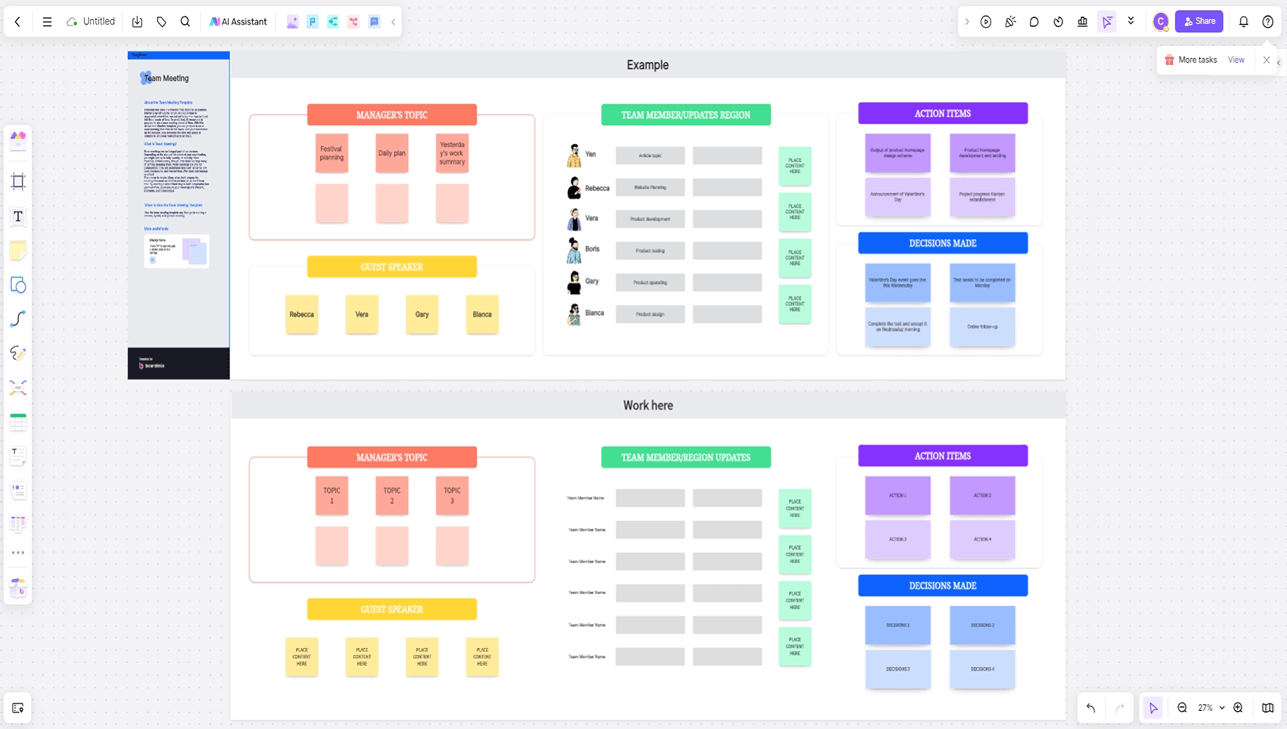
Looking for the best mind map tools? The right choice depends on what you need to do after the map is drawn. Boardmix is the strongest fit for teams that want mind maps, diagrams, and real-time collaboration in one workspace. XMind is a better fit for structured personal mapping, while MindMeister and Coggle keep browser-based collaboration simple.
This guide compares eight practical options for brainstorming, study, planning, and team work. It puts the free-plan boundary, export path, collaboration model, and AI availability next to each recommendation so you can choose a tool that will still work when the first map becomes a real deliverable.
Quick Answer: Which Mind Map Tool Should You Choose?
Choose Boardmix for collaborative visual work, MindMeister for lightweight online maps, XMind for structured personal maps, Coggle for simple branching, Mindomo for education and rich exports, Miro for whiteboard-led workshops, EdrawMind for desktop and AI features, and GitMind for AI-first experiments. Free limits and plan features change, so confirm the linked product page before committing important work.
If one constraint matters more than the overall shortlist, use the focused comparisons for free mind map tools, online mind map tools, or AI mind map tools.
What Makes a Mind Map Tool Worth Using?
A mind map tool is useful when it helps you move from a central idea to a readable structure without losing context. The best tools make branch creation fast, let you reorganize without redrawing the map, and keep the result usable outside the editor.
- Structure: quick branches, hierarchy, layouts, themes, and a canvas that stays readable as the map grows.
- Workflow fit: support for brainstorming, study notes, project planning, meetings, or turning a map into tasks and slides.
- Collaboration: clear roles, comments, version history, and a sharing model that matches the sensitivity of your work.
- Portability: imports and exports that open cleanly in the next tool, not just a screenshot that cannot be edited.
- Free-plan reality: limits on maps, boards, storage, AI credits, watermarks, and export formats matter more than a "free" label.
How We Compared These Mind Map Tools
We used the same buyer questions for every tool: Can a new user create a useful map quickly? What remains available without paying? Can a team edit it safely? Can the map be exported or moved? Does AI create an editable structure or only a picture? The factual limits below are taken from each product's current pricing or help pages, checked September 29, 2026. They are a decision guide, not a controlled speed or output-quality benchmark.
For a fair trial, use the same short source outline in each product, then check hierarchy edits, citations or links, permissions, and one required export in the next tool. That test exposes the difference between a polished demo and a workflow you can repeat.
8 Best Mind Map Tools in 2026
| Tool | Best for | Free-plan reality | Collaboration | Export / AI signal |
|---|---|---|---|---|
| Boardmix | Teams and mixed diagrams | 3 editable boards, 100 objects per board, 1 GB storage, standard export | Real-time editing, comments, version history | Basic mind maps; AI limited by credits |
| MindMeister | Simple browser collaboration | Up to 3 maps on Free | Real-time sharing and editing | Broader exports require a paid plan |
| MindMaster / EdrawMind | Desktop plus AI workflows | Limited functions, 100 MB storage, 500 AI-token trial | Team sharing on paid tiers | Graphics/PDF export on Free; more formats and no watermark paid |
| Coggle | Fast, simple branching | Free forever with no map size or space limit | Real-time collaboration | .mm and text export; no AI focus |
| XMind | Structured personal maps | Up to 10 online maps, 3-day history, 50 AI credits | Basic sharing; richer collaboration on paid plans | Free export is limited; AI credits are trial capacity |
| Miro | Whiteboard-led workshops | Unlimited members, 3 editable boards, limited AI | Strong team collaboration; Free boards are team-visible | High-resolution export and private boards are paid |
| Mindomo | Education and structured planning | 3 diagrams, 1 AI credit, 3 export formats | Real-time sharing; guest editing on Professional | Rich paid export and presentation options |
| GitMind | AI-first map experiments | Free tier and AI credits vary by current plan | Sharing and team features depend on plan | Check the live plan before relying on AI or exports |
1. Boardmix - best for collaborative maps and diagrams
Verdict: Boardmix is the best starting point when a mind map needs to become a workshop board, flowchart, or project plan. The current pricing page lists a Free plan with one team workspace, three editable boards, up to 100 objects per board, 1 GB of storage, standard-definition export, and ten version-history records. AI mind mapping is available with credit limits; it is not an unlimited Free-plan promise.
Use the mind map workspace when you want templates, an infinite canvas, live comments, and the option to keep related diagrams beside the map. For a text-to-structure workflow, the AI mind map tool can create a draft that you still edit and verify on the canvas.
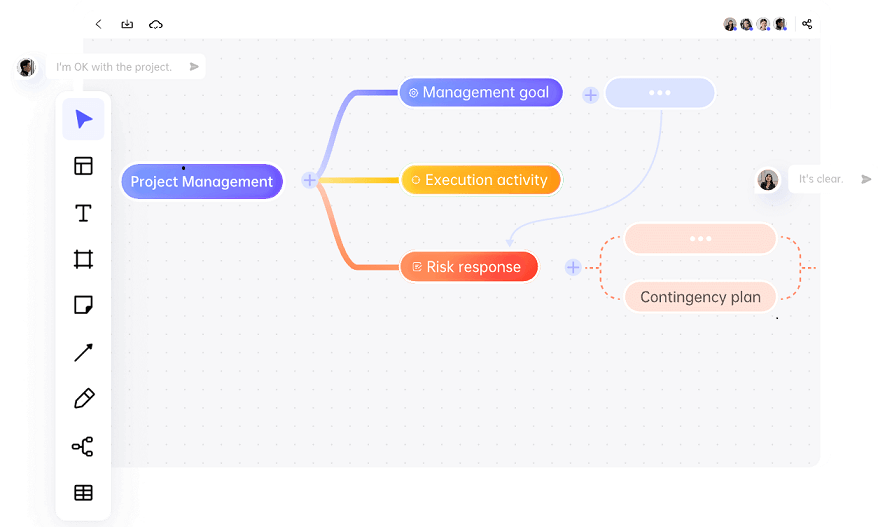
Boardmix is a strong fit for distributed teams because the map remains connected to the surrounding discussion and supporting files. It is less attractive if you only need a small offline map and never collaborate. Check the object, storage, export, and AI limits before using the Free plan for a long-running project.
Best for: teams, workshops, product planning, and mixed mind maps plus diagrams.
- Strengths: collaborative canvas, templates, multiple diagram types, version history, and a clear path from idea to deliverable.
- Trade-offs: the Free plan limits boards, objects, storage, export quality, and AI credits.
2. MindMeister - best for lightweight online collaboration
Verdict: MindMeister is a focused browser-based choice for people who want a clean mind-map editor rather than a broad whiteboard. Its official product page describes real-time collaboration and a Free plan with up to three maps. The free tier is easy to try, but do not assume that every export is free: the MindMeister export guide says exporting mind maps requires a Personal, Pro, or Business plan.
Choose MindMeister when browser simplicity matters more than a large canvas of unrelated diagram types. If export is part of your first deliverable, test the exact format before inviting a team.
3. MindMaster / EdrawMind - best for desktop depth and AI features
Verdict: The product shown in the original article as MindMaster is now commonly presented as EdrawMind. It is a better match for users who want a dedicated mind-mapping application, many layouts, and AI assistance alongside a broader desktop toolset. The official EdrawMind pricing page lists a limited Free plan with built-in templates, 100 MB of storage, 500 AI tokens for trial, and graphics/PDF export; more formats and no-watermark export are paid-plan benefits.
EdrawMind is a sensible choice for a personal knowledge base or a map that must be edited in a dedicated application. It is not the simplest option for a team that wants one shared whiteboard with diagrams and meeting context.
4. Coggle - best for simple branching and free experimentation
Verdict: Coggle keeps the core mind-map experience intentionally narrow. Its official Free Forever page says there is no size or space limit, and highlights real-time collaboration plus export to .mm and text. That makes it useful for quick outlines, lessons, and lightweight shared maps.
Choose Coggle when the map itself is the deliverable. If you expect to add tables, files, voting, or a second diagram type, start with a wider workspace instead.
5. XMind - best for structured personal mapping
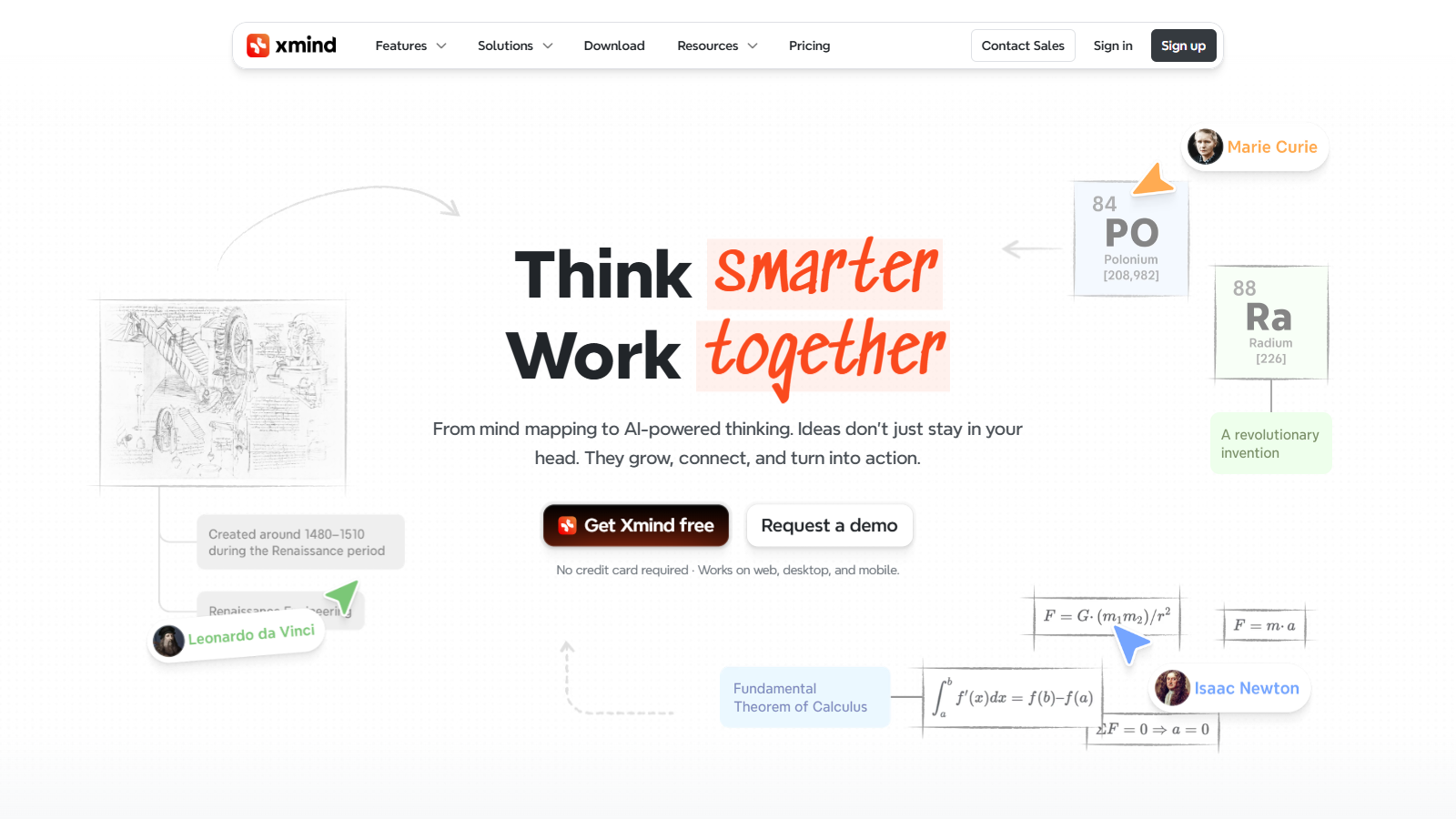
Verdict: XMind is a strong fit for people who care about hierarchy, themes, and a polished personal workflow. Its current pricing page lists up to ten online maps on Free, three-day version history, five Pitch slides, and 50 XMind AI credits. The Free tier is designed for exploration; advanced collaboration, longer history, and broad export formats sit in the paid plans.
Use XMind for study notes, outlines, and project decomposition when you do not need everyone editing the same canvas. Before you choose it for a team, test the exact online sharing and export path you need. See the XMind plan comparison for current limits.
6. Miro - best for whiteboard-led workshops
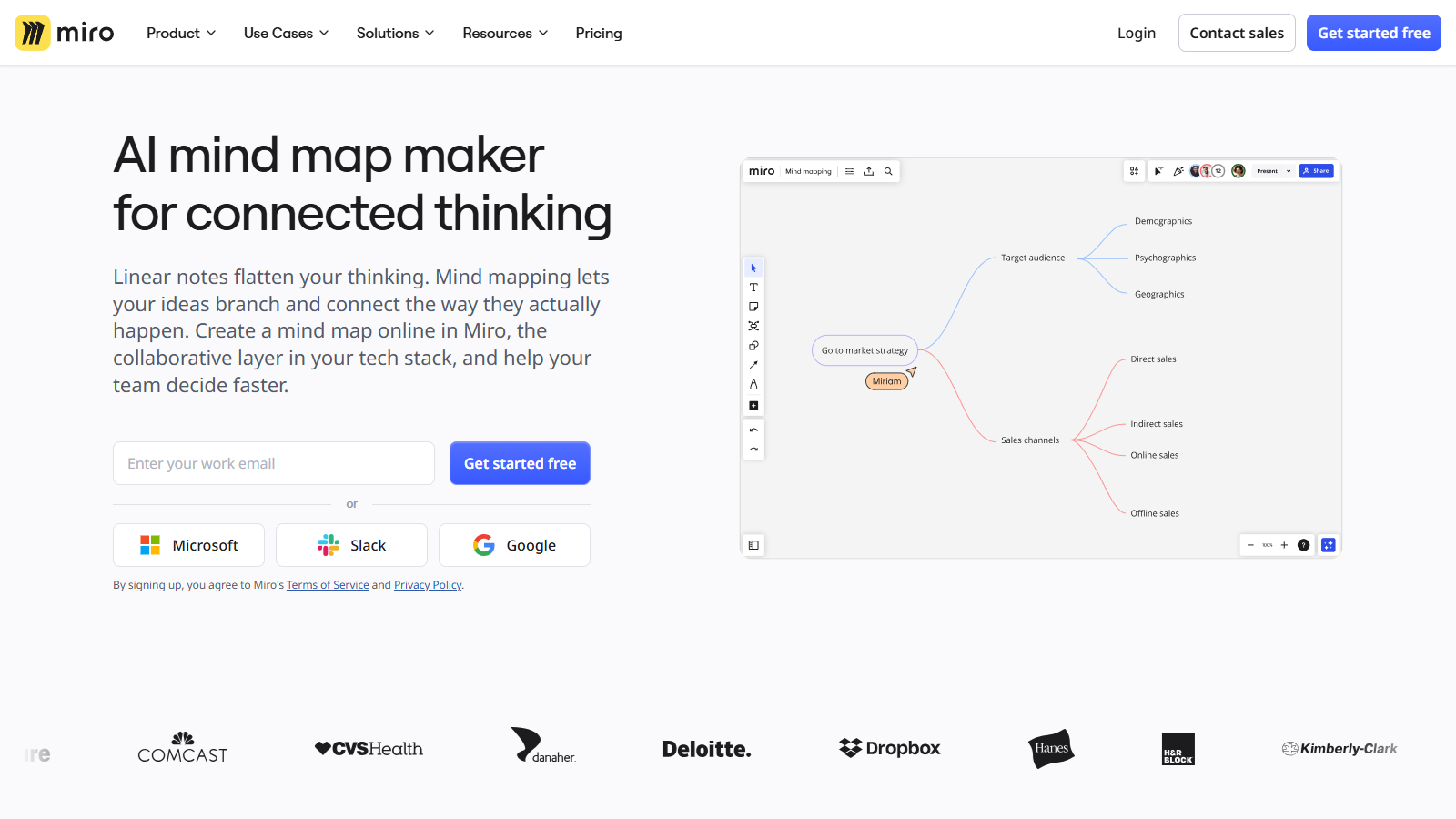
Verdict: Miro is compelling when the mind map is one element of a larger workshop board. Its official mind-map page lists unlimited members, one workspace with three editable boards, templates, integrations, and 10 Miro AI credits per month on Free. Miro's Free-plan help page also makes the privacy boundary explicit: boards are visible to team members by default, private boards are paid, and visitors cannot edit or comment on Free boards.
Choose Miro for facilitation, sticky notes, voting, and a team already working in the Miro ecosystem. Choose a more focused tool when you mainly need a personal map or predictable file export. Confirm the current Miro mind-map plan details before purchase.
7. Mindomo - best for education, outlines, and rich exports
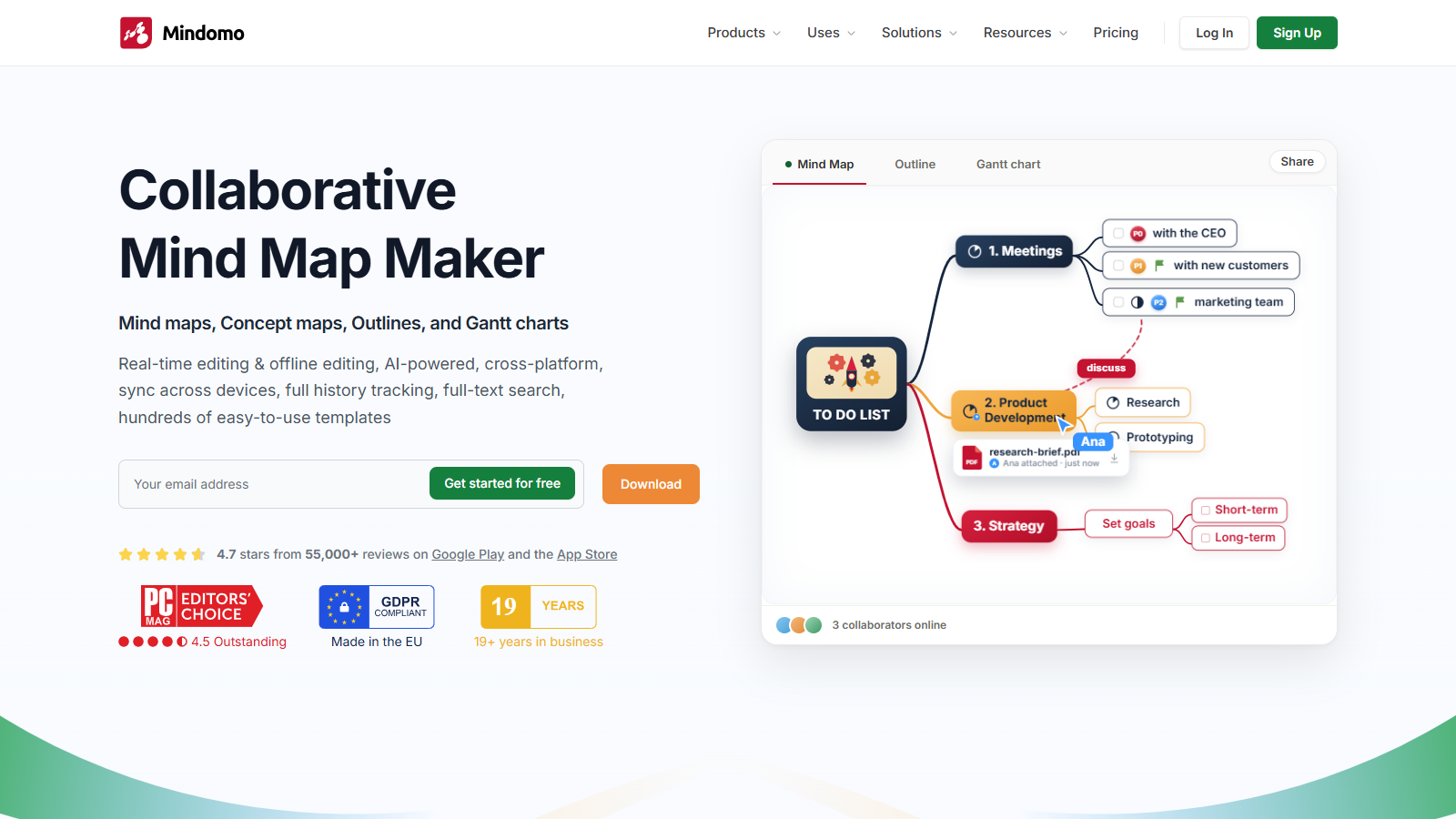
Verdict: Mindomo combines mind maps with outlines, timelines, Gantt charts, and classroom-friendly workflows. Its current pricing page lists three diagrams, one AI credit, and three export formats on Free. Paid tiers add PDF, Word, PowerPoint, image, OPML, and other formats, plus printing and deeper collaboration controls.
Mindomo is a good fit when a map must become a lesson plan, outline, or project schedule. It is less attractive if you need unlimited free maps or a team-wide canvas. Check the Mindomo feature comparison for the current export list.
8. GitMind - best for AI-first experiments
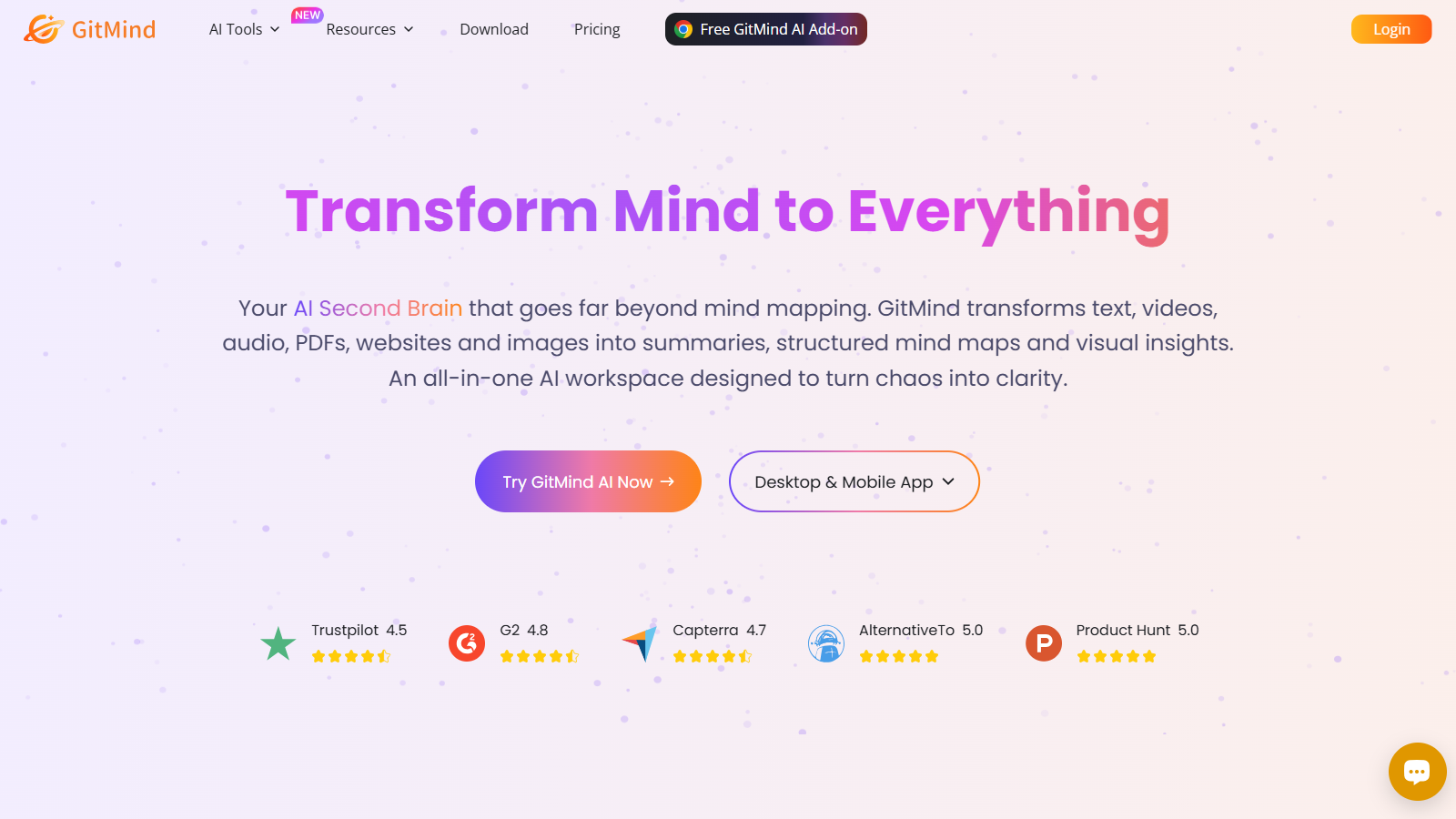
Verdict: GitMind is worth testing when the main goal is turning notes or documents into an initial map with AI. Its pricing and credit rules change more frequently than a traditional desktop tool, so treat the Free tier as an experiment: upload a representative source, inspect the generated hierarchy, edit several branches, and try the export you need before adopting it for a repeatable process.
See the current GitMind pricing page for the live quota and collaboration rules. Do not compare an AI-generated image with an editable map; verify that the nodes, links, and hierarchy survive after generation.
Mind Map Tool FAQs
What is the best mind map tool for teams?
Boardmix is the best all-around choice when the team needs mind maps alongside diagrams, files, comments, and a shared canvas. Miro is stronger for facilitation-heavy workshops; MindMeister is simpler when the team wants focused browser maps.
Which mind map tools are genuinely free?
Coggle advertises a Free Forever plan. Boardmix, Miro, MindMeister, XMind, Mindomo, and EdrawMind all have free tiers, but each limits some combination of maps or boards, storage, AI, history, collaboration, or export. A free account is not the same as unlimited free output.
Which mind map tools work offline?
Dedicated desktop options such as XMind and EdrawMind are the safest starting points for offline work. Browser-first tools can still be excellent, but confirm offline access and sync behavior before taking a map on a trip or into a restricted network.
Is AI mind mapping worth paying for?
AI is worth paying for when it saves time on a real source document and still produces an editable, reviewable hierarchy. Run the same outline through two tools, check factual omissions and branch order, and count how often you need to rebuild the map manually.
Can I export a mind map to PDF or PNG?
Most tools support an image or PDF path, but the free boundary varies. MindMeister reserves broad export for paid plans, Mindomo lists only three Free formats, and EdrawMind separates graphics/PDF from its broader paid export set. Always open one exported file in the next tool before you commit to a platform.
Conclusion: choose the workflow, not the feature count
For a collaborative team that needs more than a single diagram, start with Boardmix and test the Free limits against one representative project. Choose XMind or EdrawMind for structured personal work, Coggle for a simple free map, MindMeister for focused browser collaboration, Mindomo for education and export-heavy planning, Miro for workshop facilitation, and GitMind when AI generation is the first requirement.
The most reliable decision is a short, repeatable test: use the same source, make the same hierarchy changes, verify permissions, and reopen the required export. That tells you more than a long feature list.