


Microsoft's value chain creates value through a software-and-cloud feedback loop: the company secures computing capacity and specialist talent, develops platforms and products, distributes them through direct and partner channels, supports customers continuously, and uses operational feedback to guide the next investment cycle. This analysis treats physical device logistics as relevant while recognizing cloud infrastructure, product engineering, licensing, security, and customer success as the more distinctive activities.
The mapping applies Porter's activity framework to Microsoft's current business model rather than treating the company like a conventional manufacturer. It uses Microsoft's FY2026 Form 10-K as the primary company source and separates value-creating activities from the narrower movement of goods described in the value chain and supply chain comparison.
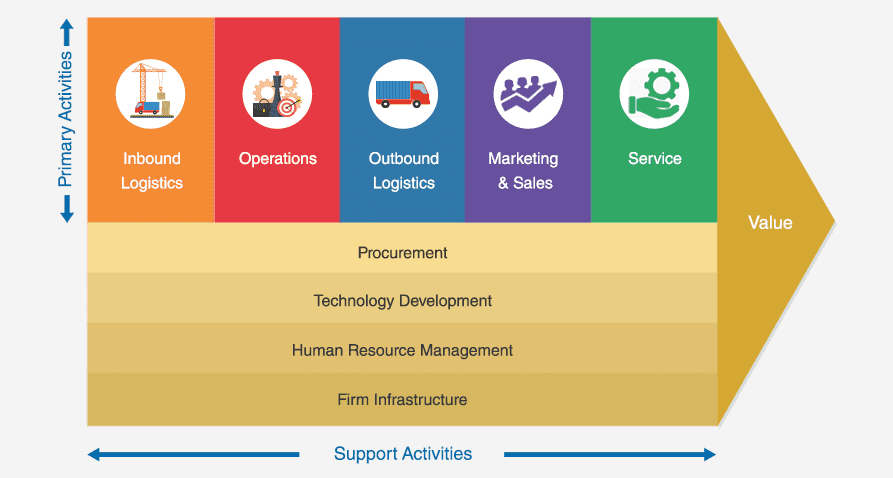
Primary Activities of Microsoft Value Chain
For Microsoft, the five primary activities are best read as connected digital and physical systems. The important question is not merely where a product moves, but how infrastructure, software, partners, and service turn an initial technical input into recurring customer value.
Inbound Logistics
Microsoft's critical inputs include permitted land, energy, network capacity, servers, GPUs, and other components for its datacenters; parts and contract manufacturing capacity for devices; licensed technology and content; and the expertise required to design and operate its products. The FY2026 Form 10-K identifies datacenter land, predictable energy, networking supplies, servers, and GPUs as capacity dependencies, and notes that only a limited number of suppliers qualify for some server and device components.
This makes resilience more important than simple inventory efficiency. Geographic concentration, long equipment lead times, power availability, supplier quality, and security requirements can constrain the services Microsoft is able to deliver. A useful analysis should therefore distinguish cloud-capacity inputs from the separate physical supply chain for Surface, Xbox, and other devices.
Operations
Operations combine product research, software engineering, model and service development, testing, security, datacenter operations, manufacturing oversight, localization, billing, and customer lifecycle management. Microsoft develops most products and services internally while using third-party manufacturers for devices. That combination gives the company direct control over much of its software roadmap while retaining a supplier-dependent hardware layer.
The scale of product development is a material part of the value chain. Microsoft reported $35.6 billion in research and development expense for FY2026 and approximately 77,000 employees in product research and development as of June 30, 2026. The strategic value is not the spending alone; it is the ability to reuse cloud, identity, security, data, and AI capabilities across products such as Azure, Microsoft 365, Dynamics, GitHub, LinkedIn, and gaming.
Outbound Logistics
Outbound logistics is predominantly digital. Cloud capacity is provisioned to customers, software is licensed or delivered as a subscription, updates are distributed continuously, and digital content is delivered through Microsoft-controlled and partner channels. Devices still require forecasting, contract manufacturing, inventory, and physical distribution, but they should not define the whole value chain.
Enterprise agreements, cloud marketplaces, original equipment manufacturers, distributors, resellers, and independent software vendors extend Microsoft's reach. For a cloud workload, availability, latency, deployment tooling, identity, and billing are part of delivery quality; for a device, availability and shipment remain the relevant measures. Mixing those two flows can hide different costs and risks.
Marketing & Sales
Microsoft sells through direct enterprise relationships, digital self-service, product-led adoption, OEM licensing, and a broad partner ecosystem. Its bundles can connect productivity, security, cloud, data, and collaboration products under one commercial relationship. This can lower acquisition and integration friction for customers, but the analysis should also account for switching concerns, licensing complexity, regulatory limits, and competition within each product category.
The partner channel is more than a promotional outlet. Integrators, managed service providers, developers, and software vendors help customers configure, extend, and operate Microsoft technologies. Their delivery quality influences whether a sale becomes sustained use, which connects marketing and sales directly to service and product feedback.
Services
Support, security updates, documentation, training, consulting, reliability engineering, and customer success help customers realize value after purchase. These activities are especially important for subscription and usage-based services because renewal and expansion depend on adoption, performance, trust, and problem resolution over time.
Service also closes the feedback loop. Support incidents, telemetry, partner observations, and customer requirements can reveal reliability gaps or unmet needs. The value-chain question is therefore whether Microsoft can convert that evidence into safer products, better capacity planning, and clearer customer outcomes without weakening privacy or security controls.
Support Activities of Microsoft Value Chain
Microsoft's support activities supply the capital, governance, talent, technology, and supplier controls that allow the primary activities to operate at global scale. They should be assessed as shared capabilities rather than isolated administrative functions.
Infrastructure
Corporate infrastructure includes datacenters, the global operations service center, finance, legal and regulatory compliance, cybersecurity, risk management, and capital allocation. The FY2026 Form 10-K says the operations center supports contract and order processing, billing, credit and collections, customer lifecycle AI and cloud operations, vendor management, and logistics. For cloud services, infrastructure capacity and operational resilience are directly tied to the customer experience.
Human Resource Management
As of June 30, 2026, Microsoft reported approximately 223,000 full-time employees: 89,000 in operations, 77,000 in product research and development, 43,000 in sales and marketing, and 14,000 in general and administration. This distribution shows why engineering and operational expertise are not merely overhead; they are core inputs to the products and services customers buy.
Technology Development
Technology development spans cloud infrastructure, AI, security, operating systems, developer tools, productivity software, gaming, and fundamental research. Its value depends on more than releasing features. Shared platforms must be reliable, interoperable, governable, and reusable across business lines, while product teams still need enough autonomy to serve distinct customer jobs.
Procurement
Procurement covers device and packaging suppliers, datacenter components and construction, cloud operations, corporate facilities, and other goods and services. Microsoft's supply chain integrity program describes supplier standards, risk-based due diligence, and separate teams for devices, datacenter capacity, cloud operations, and corporate procurement. That evidence supports a more specific analysis than a generic claim that Microsoft simply chooses high-quality suppliers.
Microsoft Value Chain Analysis Example
Consider a simplified enterprise cloud workload. The example shows how one customer outcome crosses several activities rather than moving neatly through a single linear chain:
- Secure inputs: Microsoft plans datacenter capacity and sources servers, accelerators, networking equipment, energy, and licensed technology.
- Build and operate: engineering teams develop the cloud service, test it, apply security controls, and operate the required infrastructure.
- Reach the customer: direct sellers, partners, marketplaces, documentation, and trials help the organization evaluate and deploy the service.
- Deliver ongoing value: capacity, monitoring, updates, billing, and support keep the workload available and usable after the initial purchase.
- Learn and reinvest: service incidents, usage patterns, partner feedback, and customer requirements inform capacity and product priorities.
The analysis becomes actionable when each step has evidence and a measurable constraint. Examples include deployment lead time, service reliability, capacity utilization, security incidents, support resolution time, adoption, renewal, and supplier concentration. These measures should be validated for the business unit being studied instead of assumed at company level.
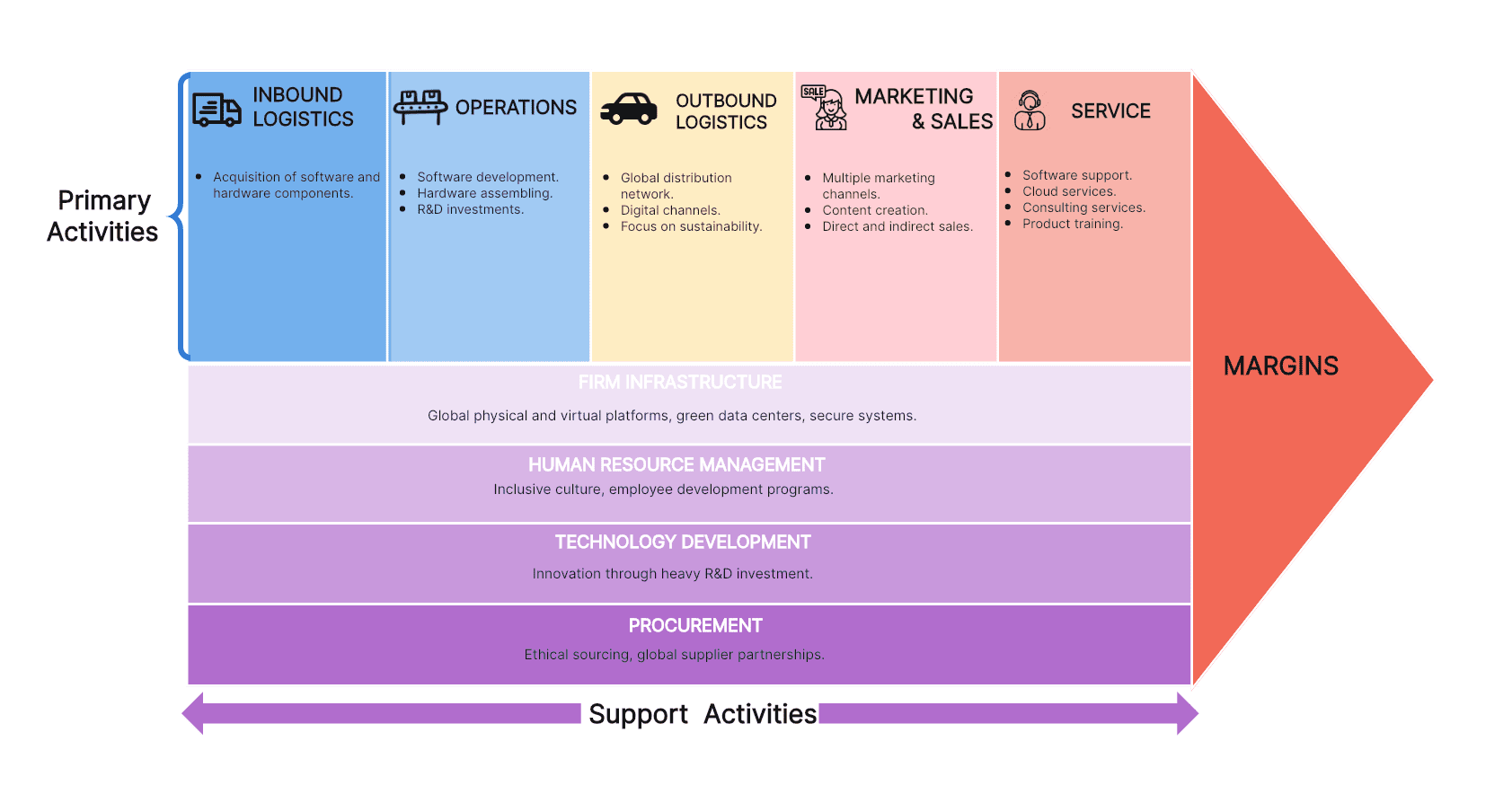
The diagram is a hypothesis map, not proof that every activity performs well. Label the reporting period, link each claim to a source, separate facts from inference, and note where public disclosures do not provide enough detail.
Key Takeaways
- Microsoft's value chain is primarily digital and service-based, with a distinct physical chain for devices and datacenter equipment.
- R&D, cloud capacity, security, partners, and customer success reinforce one another and are more company-specific than a generic logistics narrative.
- Supplier concentration, energy and capacity availability, service reliability, regulation, and customer adoption are important constraints on value creation.
- Current company filings should replace undated claims or old 2020 metrics, and every conclusion should identify whether it is a reported fact or an analytical inference.
To map another organization, start with the Boardmix guide to value chain analysis, then organize the company-specific evidence in a value chain template. Keep the Microsoft example focused on Microsoft; the general guide and template should own the broader instructional keywords.