



AI-powered SWOT analysis is reshaping the fundamentals of strategic business planning. Traditional methods, often time-consuming and subjective, are revealing their limitations. AI integration not only rapidly consolidates vast amounts of data but also extracts key insights through intelligent algorithms, enabling businesses to achieve higher-level strategic layouts at a lower cost. This guide explores the value, practical methods, and application scenarios of AI for SWOT analysis on a visual online whiteboard.
Core Advantages of AI-Generated SWOT Analysis
Big data and machine learning supporting
Supported by big data and machine learning, AI-driven SWOT analysis overcomes the inefficiency of manual compilation, offering a more comprehensive and objective strategic perspective that traditional methods cannot match. Traditional SWOT analysis relies on manual data collection (e.g., spreadsheets, manual note-taking from meetings) and subjective interpretation of trends—processes that can take 20+ hours for a single project and are prone to bias from individual team members’ experiences or limited industry knowledge. AI flips this paradigm: its core value lies in using smart algorithms to uncover hidden data correlations, shifting strategic analysis from "experience-driven" to "data-driven."
Ability of scanning and categorizing
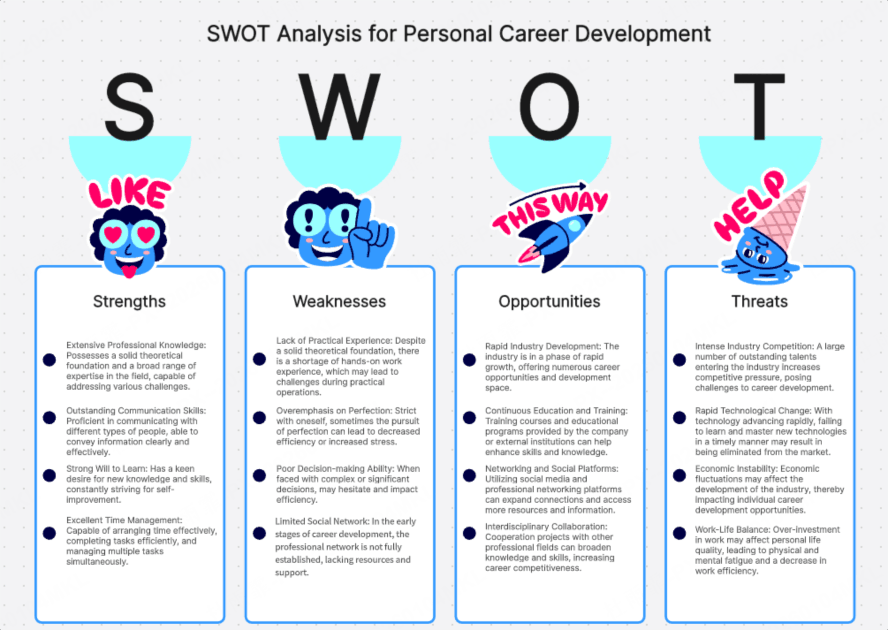
Utilizing Natural Language Processing (NLP) and machine learning models trained on millions of industry documents, AI scans structured and unstructured data from 50+ sources, including industry reports, market research papers, user feedback surveys, social media sentiment analysis, competitor press releases, and internal sales data. It automatically categorizes this information into Strengths, Weaknesses, Opportunities, and Threats, then integrates it within a standardized analysis framework to generate a structured SWOT matrix.
Speed and objectivity
Unlike human analysts, who can only process 10-20 data sources at most, AI processes massive information in 5-10 minutes, avoiding human oversight (e.g., missing a critical competitor threat) or cognitive bias (e.g., overemphasizing a minor strength due to personal experience). This speed and objectivity make AI-powered SWOT analysis particularly suited for fast-paced industries like e-commerce, tech startups, or retail—sectors requiring real-time strategic adjustments to respond to market shifts, new competitor launches, or changing consumer behavior.
Predictive value
Beyond speed and objectivity, AI adds predictive value to SWOT analysis. Advanced algorithms can forecast how current Weaknesses might escalate into Threats (e.g., "supply chain delays" → "loss of market share to competitors with faster delivery") or how Strengths can be leveraged to capitalize on emerging Opportunities (e.g., "strong brand loyalty" → "expansion into new geographic markets"). This predictive layer turns static SWOT matrices into forward-looking strategic tools, helping businesses stay ahead of industry trends rather than just reacting to them.
How Boardmix Transforms SWOT Analysis with AI?
Boardmix stands out from generic AI tools by integrating cutting-edge AI technology with robust collaborative features, streamlining the entire SWOT process—from initial data analysis to final strategic execution. Unlike standalone AI generators that produce static text-based SWOT matrices, Boardmix embeds AI within a visual, collaborative online whiteboard, creating an end-to-end workflow for teams.
Built-in AI Assistant
- Using Boardmix’s built-in AI Assistant, users simply input a clear prompt (e.g., "SWOT analysis for a sustainable skincare brand targeting Gen Z in Europe").
- The AI then autonomously gathers relevant online data—including EU sustainability regulations, competitor product launches, social media sentiment around eco-friendly beauty products, and raw material cost trends—to generate a structured matrix.
- This matrix details not just basic Strengths, Weaknesses, Opportunities, and Threats, but also four actionable strategic suggestions aligned with classic SWOT strategy frameworks: SO (Strengths-Opportunities: leverage strengths to seize opportunities), ST (Strengths-Threats: use strengths to mitigate threats), WO (Weaknesses-Opportunities: improve weaknesses to capitalize on opportunities), and WT (Weaknesses-Threats: minimize weaknesses to avoid threats). For example, a SO suggestion for the skincare brand might be "Leverage strong organic ingredient sourcing (Strength) to tap into growing EU demand for plastic-free beauty products (Opportunity)."
Real-time collaboration
Real-time collaboration is a cornerstone of Boardmix’s value proposition. Team members across different departments (marketing, product, supply chain) can simultaneously edit the SWOT matrix, add context-specific comments (e.g., "Our supply chain team can address this Weakness by Q3 2025"), and suggest data-driven changes—all without version control issues. The system automatically tracks version history for every edit, timestamping changes and linking them to specific team members, making it easy to trace adjustments and resolve disagreements about strategic priorities.
Infinite canvas
Boardmix’s infinite canvas eliminates the constraints of static documents. Users can combine their SWOT analysis with other strategic elements: embed market trend charts next to Opportunities, link customer feedback quotes to Weaknesses, or add mind maps to break down SO strategies into actionable tasks. The completed document can be shared via a customizable link (view-only, comment-only, or edit permissions) with stakeholders, clients, or remote team members—no need to send multiple file versions via email.
This "AI Generation + Real-Time Collaboration + Multi-Tool Integration" model transforms SWOT analysis from a static, one-time document into a dynamic strategic management tool. It’s ideal for agile teams that need to respond quickly to market changes, such as a startup pivoting its product roadmap or a multinational adjusting its regional strategy in response to new trade policies.
Step-by-Step Guide: AI-Generated SWOT Analysis in Boardmix
Want to quickly create a professional, data-driven SWOT analysis and enable efficient cross-team collaboration—even if you have no prior strategic planning experience? Boardmix's AI Assistant can generate a structured matrix with one click, and your team can then refine strategies, validate insights, and break down tasks all within the same platform. Follow this simple 3-step guide—perfect for beginners and experienced strategists alike!
Prerequisite: Sign up for a free Boardmix account (no credit card required) or log in with your Google/LinkedIn credentials. From your dashboard, create a new blank whiteboard to serve as your SWOT analysis workspace.
Step 1: Input Your Topic & Generate the SWOT Framework
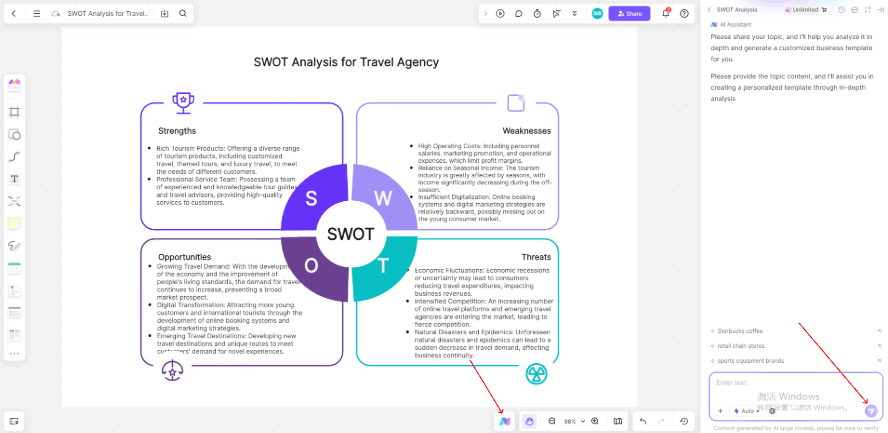
Locate the AI Assistant icon (a speech bubble with a lightning bolt) in the right sidebar and click it, then select the "SWOT Analysis" template from the pre-built strategic tools library. Input a specific, detailed topic (vague topics yield generic results)—for example, "Electric Vehicle Manufacturing Startup in Southeast Asia" or "B2B SaaS Project Management Tool for Remote Teams." Avoid overly broad prompts like "SWOT for tech company." The AI will process your query in 30 seconds or less, then generate a structured four-quadrant canvas with the four key modules: Strengths (S), Weaknesses (W), Opportunities (O), and Threats (T). Each quadrant includes initial data-driven insights—for the EV startup, Strengths might include "low-cost local battery supplier partnerships," while Threats could list "new government import tariffs on EV components."
Step 2: Deepen Analysis & Refine Content
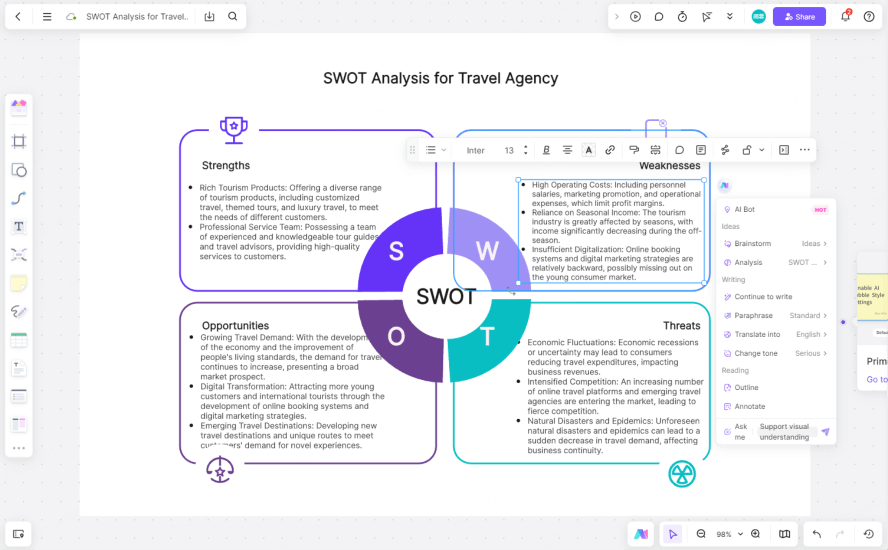
The AI-generated draft is a starting point—customize it to align with your business’s unique context and goals. To elaborate on any point (e.g., expanding a Weakness like "limited brand awareness"), copy the text from the quadrant and paste it into the AI dialog box with specific instructions: "Expand this Weakness to include data on brand recognition scores in Southeast Asian markets and compare to top 3 competitors." Alternatively, select any text element in the matrix and click the "AI Polish" option to automatically transform casual, internal language (e.g., "we’re bad at social media") into professional strategic terminology (e.g., "insufficient social media engagement strategy leading to low brand visibility among target demographic"). You can also use the AI Assistant to validate insights: ask "Verify if this Opportunity (growing EV adoption in Indonesia) is supported by 2026 market research data" and the AI will pull the latest industry reports to confirm or refine the point.
Step 3: Export, Share, and Execute
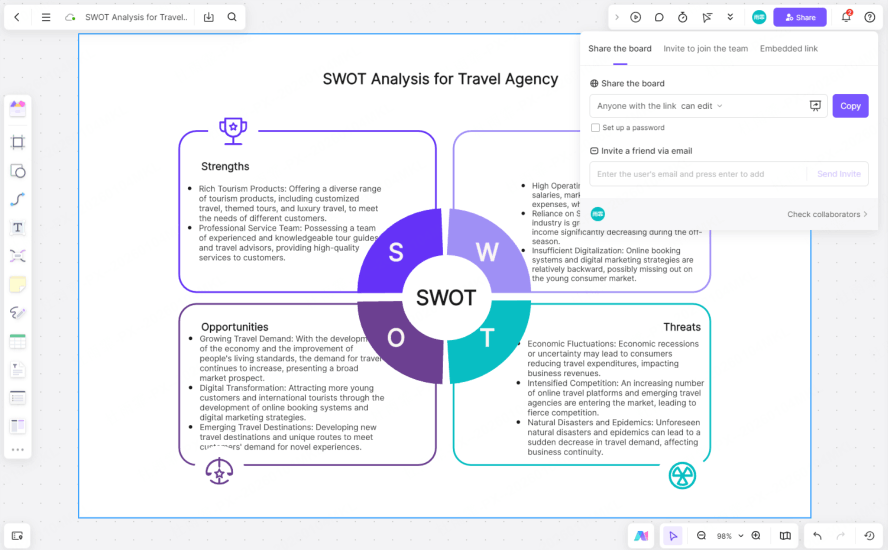
Once your AI-generated SWOT analysis is refined and validated by the team, turn insights into action with Boardmix’s integrated tools:
- Export it by clicking "Export" in the top left navigation bar to download the SWOT matrix in high-resolution formats (PDF, PNG, JPG) optimized for presentations, client reports, or internal meetings, and you can also export it as a CSV file to integrate with your company’s strategic planning software;
- Collaborate by clicking the "Share" button in the top right to invite team members via email or shareable link, set granular permissions (edit, comment, view) to control access, and use comment threads to discuss specific quadrants (e.g., "Let’s prioritize addressing this Threat in our Q2 strategy meeting"), with version history letting you revert to previous drafts if needed and real-time editing ensuring remote teams stay aligned;
- Execute by closing the loop from analysis to action by creating a task board directly within the same whiteboard file, using Boardmix’s drag-and-drop task cards to break down SWOT strategies (e.g., an SO strategy like "Leverage battery supplier partnerships to enter Indonesian market") into actionable plans: assign task owners (e.g., "Supply Chain Manager"), set deadlines (e.g., "June 30, 2025"), and add status trackers (e.g., "In Progress," "Completed"), eliminating the need to switch between SWOT documents and project management tools.
By following these three steps, you not only complete your SWOT analysis in a fraction of the time of manual methods but also leverage Boardmix's AI toolchain to turn abstract insights into a concrete, executable plan—boosting decision-making efficiency by up to 60% compared to traditional SWOT workflows.
Conclusion
AI-generated SWOT analysis unlocks its full potential only when paired with a collaborative and visual tool like Boardmix. Traditional AI SWOT generators stop at data output, but Boardmix synchronizes analysis results in real-time on an online whiteboard, allowing teams to directly annotate the SWOT matrix, discuss data-driven modifications, and decompose strategic tasks—achieving a closed-loop workflow of "Analyze > Discuss > Execute."
This integrated approach is transformative for businesses of all sizes: startups can use it to align founding teams on market opportunities and risks during brainstorming sessions, while multinationals can use it for cross-departmental strategy alignment across global offices. Boardmix ensures AI-generated business insights don’t sit idle in a folder—they take root in actionable plans that drive real business results.
Ready to transform your strategic planning from slow and subjective to fast and data-driven? Try Boardmix's AI Assistant today with a free 14-day trial (no credit card required) and experience seamless, collaborative SWOT analysis that scales with your team’s needs.