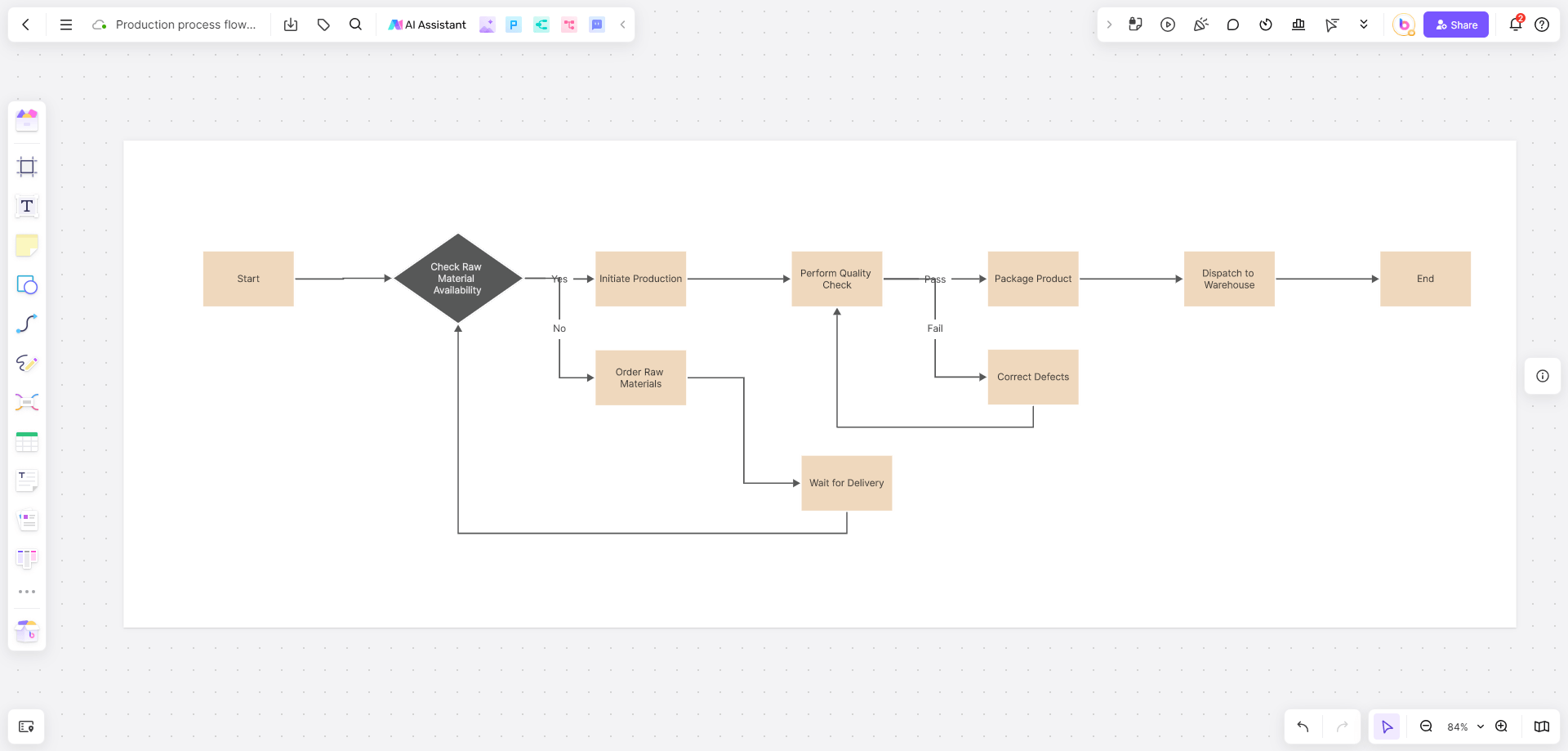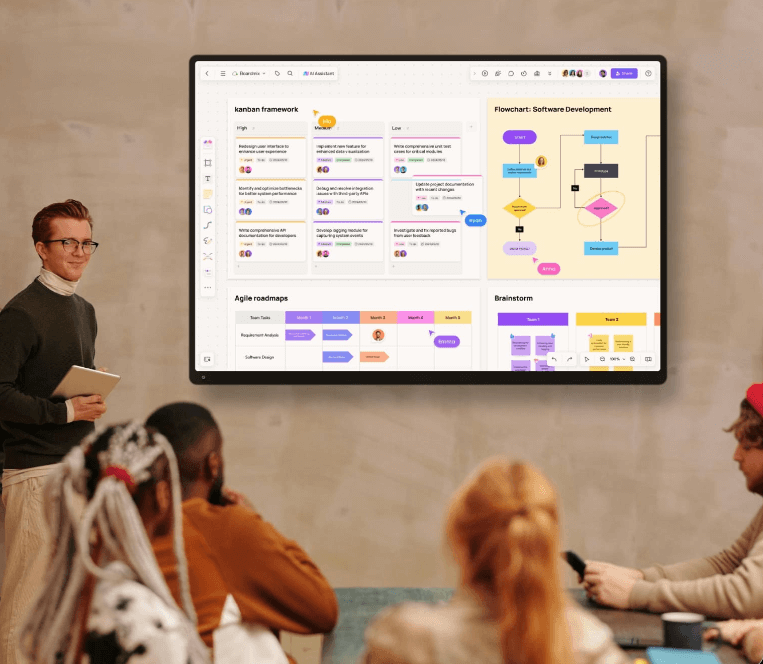




Thinking maps are powerful visual thinking tools that help users organize, analyze, and express information clearly, and they are particularly useful in teaching, learning, project management, and brainstorming. As an online whiteboard, Boardmix provides a wealth of free thinking maps templates that are supporting online editing, collaboration, and one-click PDF download, allowing you to easily access high-quality thinking map templates anytime, anywhere.
If you are looking for printable thinking maps templates and want to download PDF versions for free, Boardmix is the choice you can't miss. In this article, we will introduce how to use these thinking map templates, and how to download PDF files for free.
1. What Are thinking maps?
Thinking maps are structured diagram tools used to help individuals or teams think and express ideas more clearly. They are often used in education, business decision-making, project management and problem solving, and can visualize complex information, thereby improving comprehension and memory.
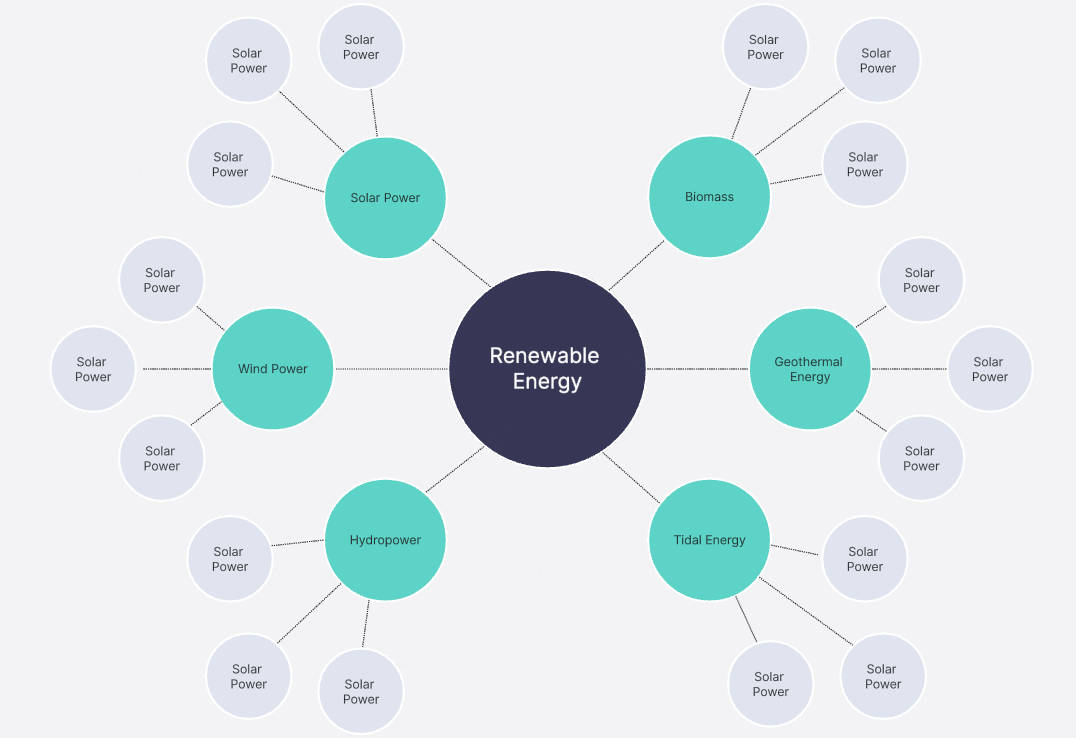

8 types of thinking maps and their uses are as follows:
Circle Map: used to define concepts, with the theme in the center and related information expanded around.
Bubble Map: used to describe things, with the theme in the center and adjectives or characteristics on the periphery.
Double Bubble Map: compare two things, with similarities placed in the middle and differences on both sides.
Flow Map: used to show sequence or process, such as event development or work steps.
Multi-Flow Map: analyzes cause-effect relationships, lists causes on the left and results on the right.
Brace Map: used to decompose the whole and parts, suitable for structural disassembly.
Tree Map: used to classify information, and expand different categories layer by layer.
Bridge Map: establish analogy relationships and show similar logic between concepts.
Whether you are a teacher, student, business manager, or someone who needs to better organize information and think, using Boardmix's thinking maps templates can greatly improve your work and study efficiency.
2. Why Choose Boardmix for Free Thinking Maps Templates?
Boardmix, as a professional online collaborative whiteboard, provides a wealth of free thinking map templates, and supports users online editing, team collaboration, downloading and printing PDF. Compared with traditional hand-drawn thinking maps, using Boardmix has the following obvious advantages:
Massive free templates: Directly select the appropriate thinking maps without starting from scratch.
Online editing and customization: Freely modify text, color, shape, and create your own thinking map.
One-click PDF download: Supports exporting high-definition PDF files for easy printing and sharing.
Multi-person real-time collaboration: Team members can edit together, suitable for classroom teaching, brainstorming and project management.
Cloud storage: Access your thinking maps at any time to avoid data loss.
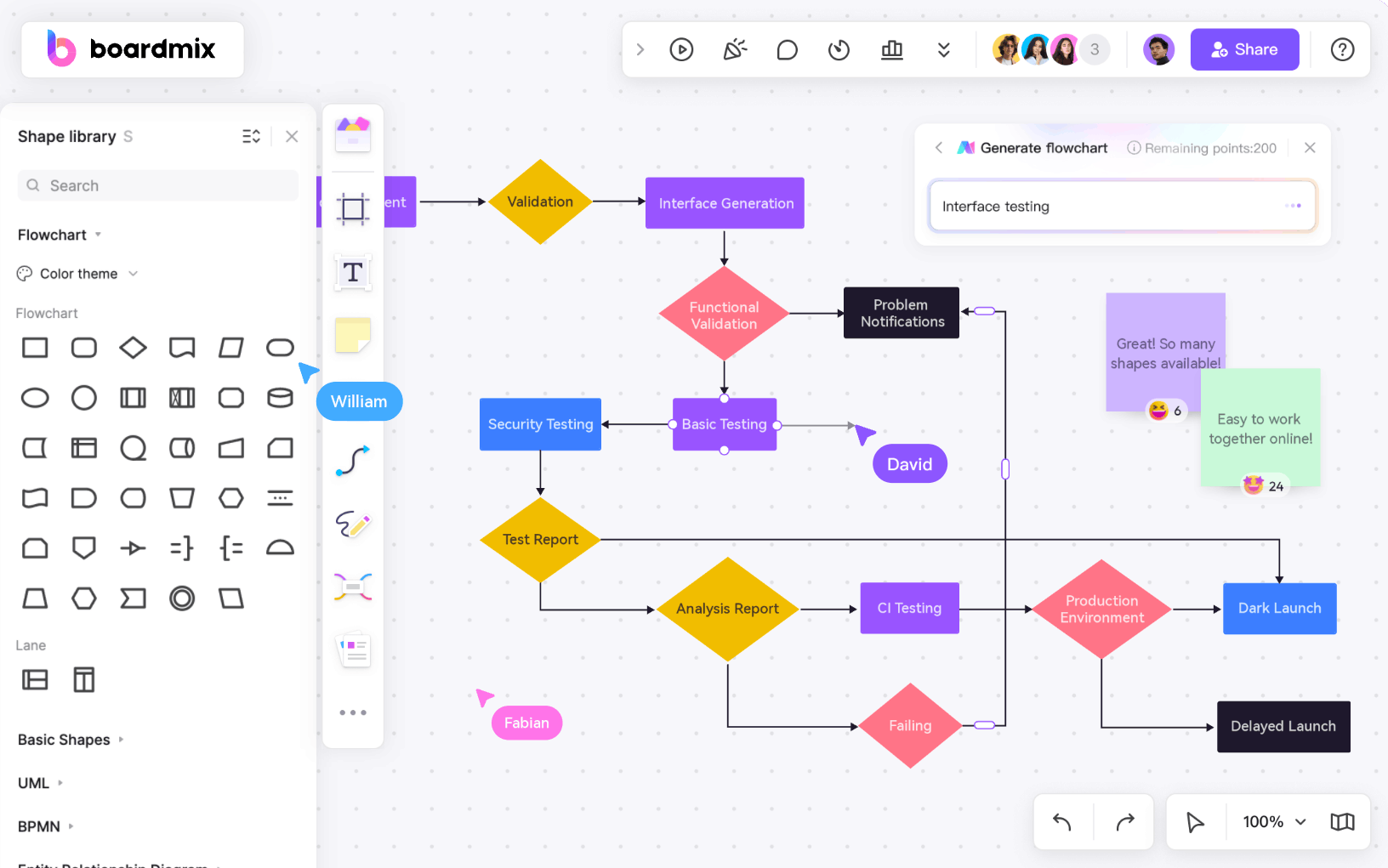
With Boardmix, you can easily create professional-level thinking maps and download thinking map as PDF for free to print or share.
3. How to Use Boardmix to Create and Download Thinking Maps PDF?
On Boardmix, you can quickly create thinking maps and download printable PDF in just a few simple steps.
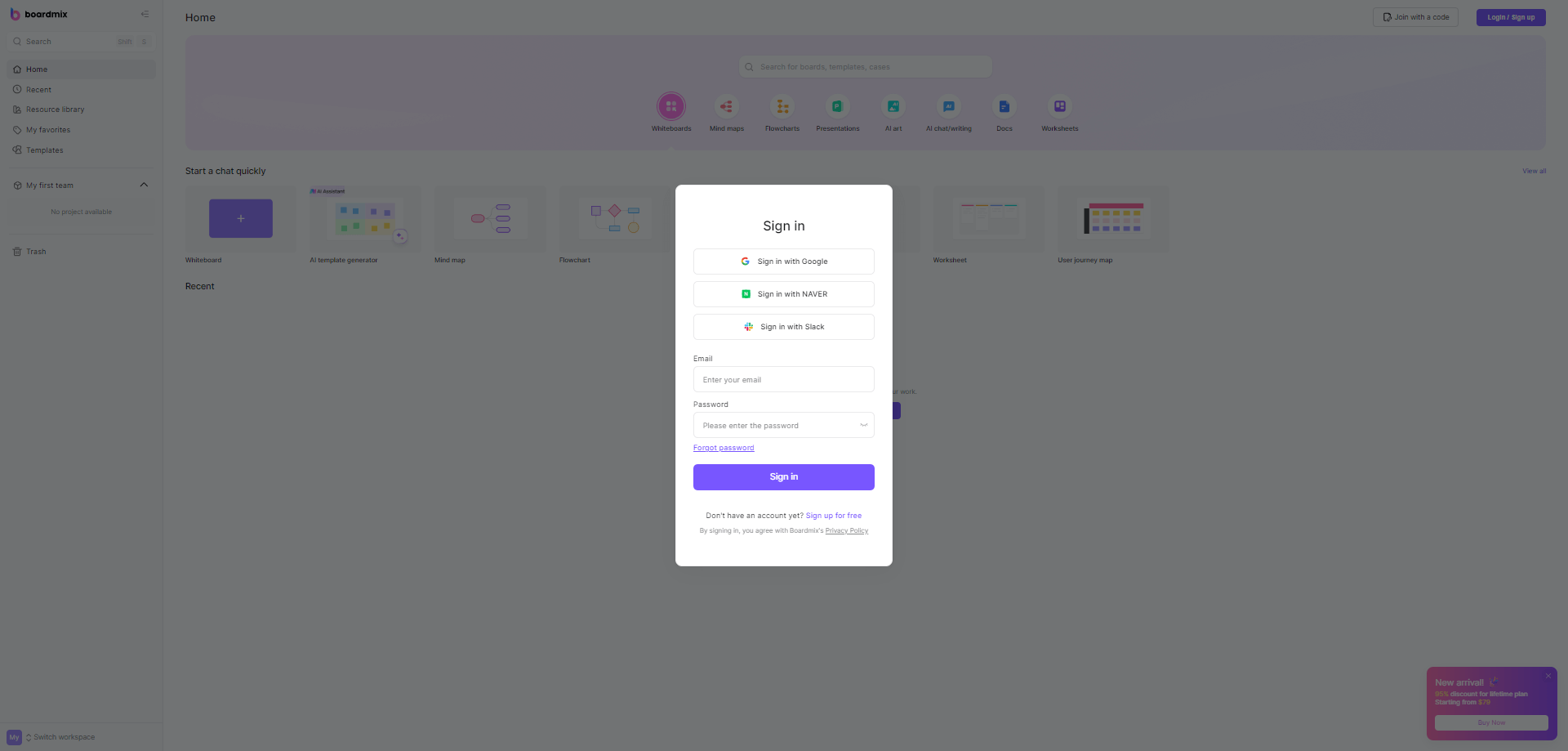
Step 1: Access Boardmix and Choose a thinking map Template
- Open the Boardmix official website, and log in to your account. If you don’t have one, you can register for free).
- Enter the Template library or Community, search "thinking map", and browse 8 different types of templates.
- Choose a thinking map template that suits you, such as circle map, tree map, flow map.
Step 2: Customize Your Thinking Map
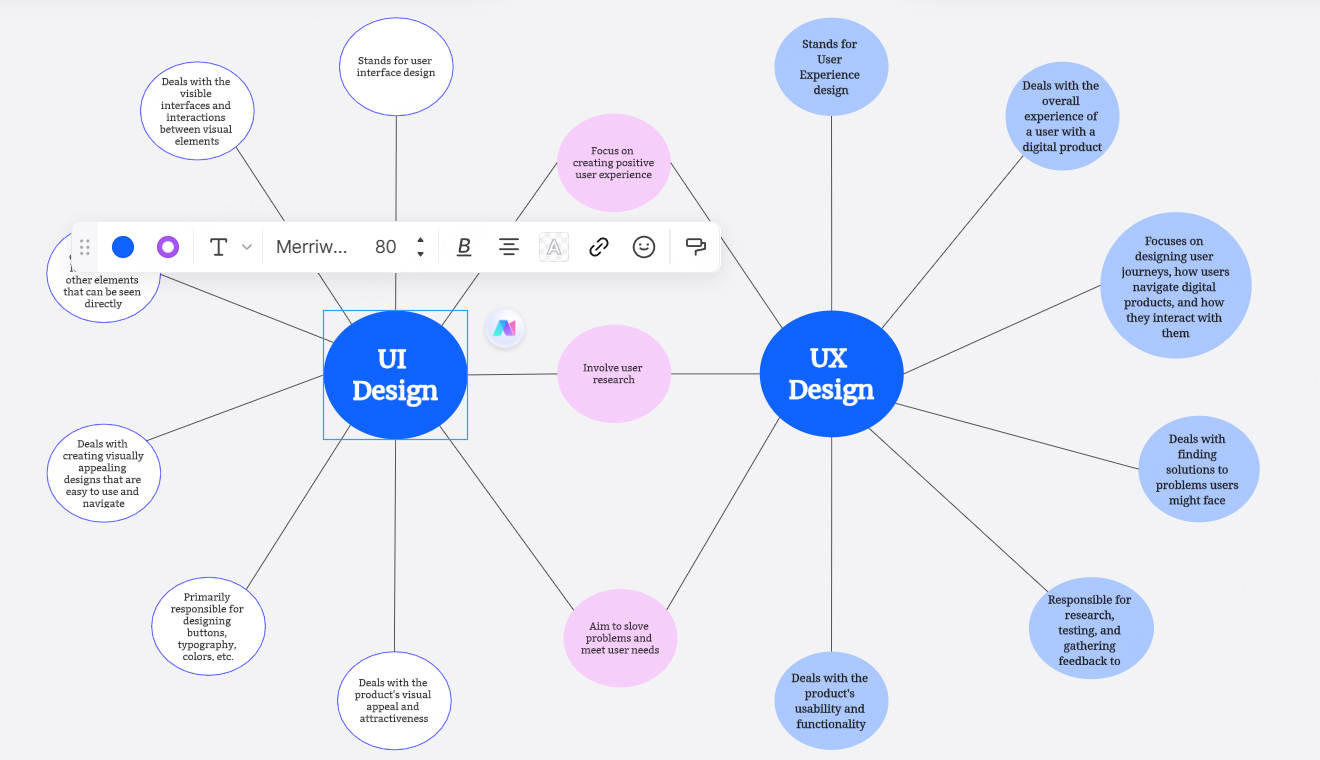
- Click the text box to edit the content and enter your ideas or key information.
- Drag and drop to adjust the layout to make the structure of the thinking map clearer.
- Change the color, font and line to personalize your thinking map.
- Add pictures or annotations to enhance the visualization of information.
Step 3: Download Your thinking map as a PDF
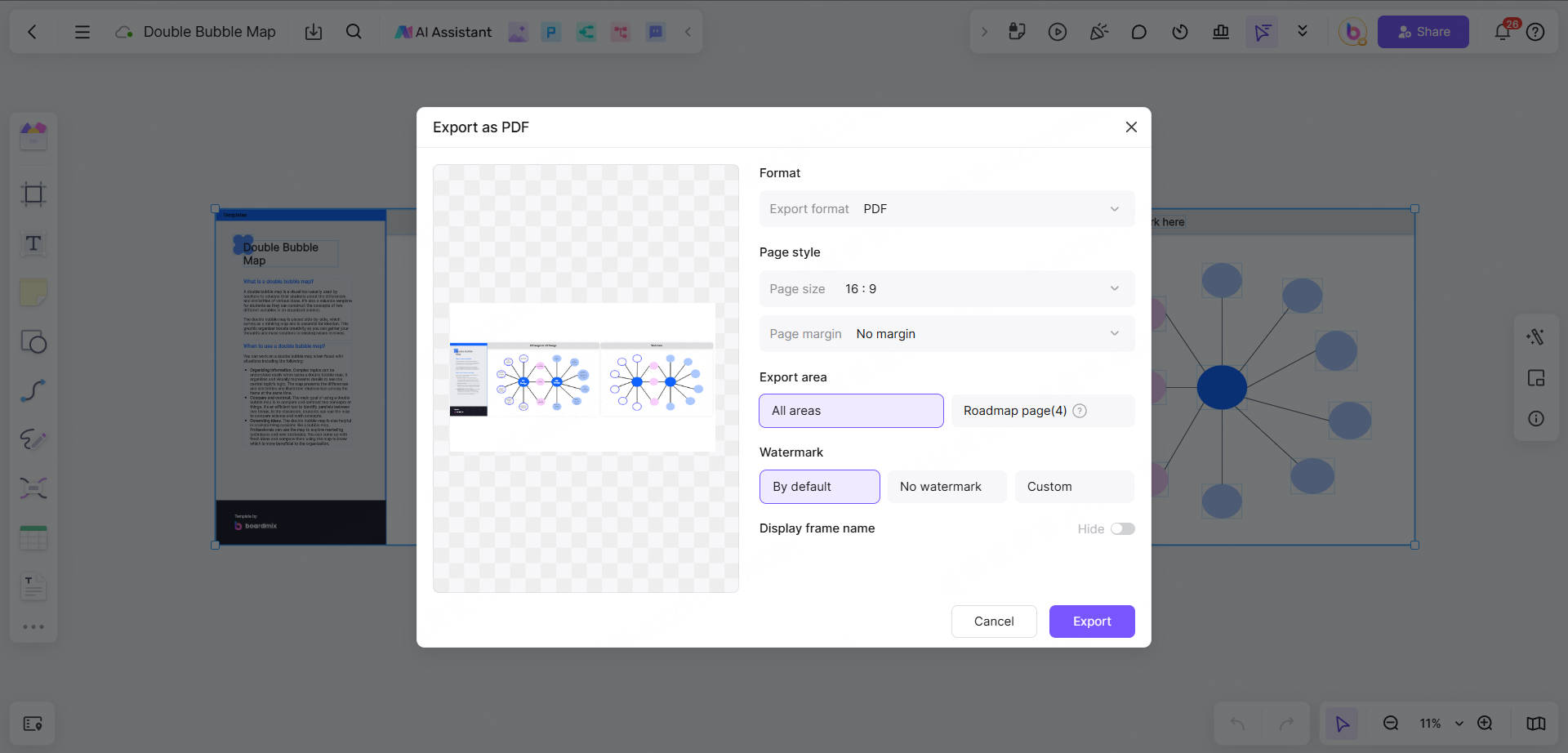
After editing, select all your thinking map element, then right-click to export to as PDF. You can print the thinking map PDF or share it online, which is convenient for classroom teaching, conference presentations or personal review.
4. What are Thinking Map Examples and Applications?
Thinking map can be used for teaching
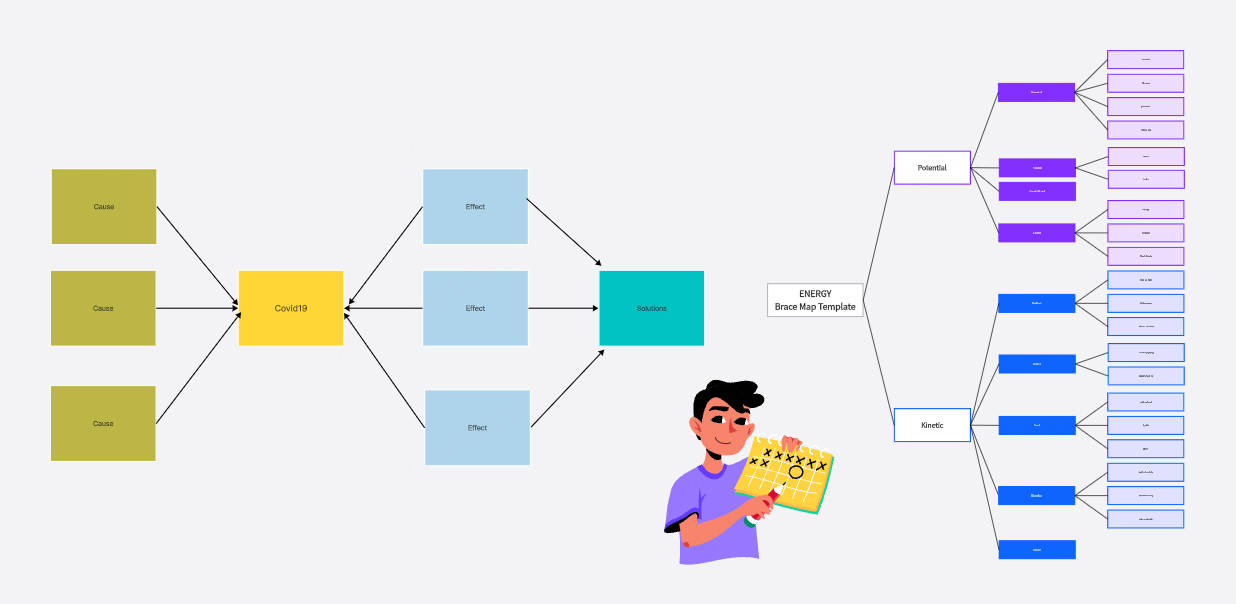
Mind maps can be applied to classroom teaching design. For example, the tree map is widely used for hierarchical display of biological classification system, and the flow map is used for visual reconstruction of the temporal relationship of historical events. The course knowledge framework can be compared and analyzed across disciplines through double bubble map to strengthen the systematic nature of cognitive structure.
Thinking map can be used for classroom interaction
The collaborative thinking map construction process can be implemented on the online learning platform. Multi-flow map is configured as a causal analysis tool for group research, and real-time editing tracks and version iteration records can be traced to ensure the auditability of the cooperation process.
Thinking map can be used for homework preparation
The knowledge system can be summarized and organized through bridge map to achieve theoretical transfer, and the topological structure of the key points of the exam can be modularly disassembled using brace map, which significantly improves the efficiency of review material generation.
Thinking map can be used for business strategic planning
The market opportunity analysis framework can be defined through circle map, and the construction of the product function matrix is standardized as the application scenario of bubble map. Strategic decision support systems often integrate flow map modules for visual deduction of implementation paths.
Thinking map can be used for process optimization
The node relationship in supply chain management can be modeled as the input and output system of multi-flow Map. ISO quality management process documents generally use flow map to visualize SOP, and cross-departmental collaboration interfaces use tree map to clearly divide the responsibility matrix.
Thinking map can be used for problem diagnosis
Operational bottleneck analysis tasks are often decomposed into the physical system disassembly process of brace map, and customer complaint traceability research uses multi-flow map to establish a causal chain model, thereby optimizing the efficiency of generating root cause analysis (RCA) reports.
thinking map personal cognitive management application
Thinking map can be used to build a knowledge system
Cross-domain learning content can be analogically associated through bridge map, and systematic organization of literature research notes usually uses tree map to achieve classification coding, so the topological structure of the personal knowledge base is standardized.
Thinking map can be used for information processing optimization
The parsing process of complex text information can be implemented as causal relationship modeling of multi-flow map, and the argumentation logic of academic papers can be linearly verified through flow map, so that the absorption efficiency of reading materials can be quantitatively improved.
5. Get Started with Free Printable Thinking Maps on Boardmix!
If you need high-quality thinking maps and want to download PDF for free printing, then Boardmix is your best choice. There are lots of free templates to use for free. No need to draw them yourself, just use professional templates. They are suitable for a variety of scenarios. Whether it's teaching, office or personal learning, it's easy to get started. So why wait? Visit Boardmix and create your thinking maps for free, and download PDF for printing!