


Short answer: turn meeting notes into a mind map by separating the meeting topic from decisions, evidence, questions and actions. The map is useful only when each important branch can be traced back to a note or an agreed owner.
Why convert meeting notes into a mind map?
Meeting notes are usually chronological. A mind map is organised by relationship. Converting one into the other helps a team see which points belong to the same topic, which decisions depend on a constraint, and which actions still have no owner. It does not replace the original notes: keep the source document linked so that a short label is not mistaken for the full context.
Use this workflow for project kick-offs, research read-outs, design reviews and planning meetings. For formal minutes, legal records or regulated decisions, keep the approved record as the source of truth and use the map as a navigation layer.
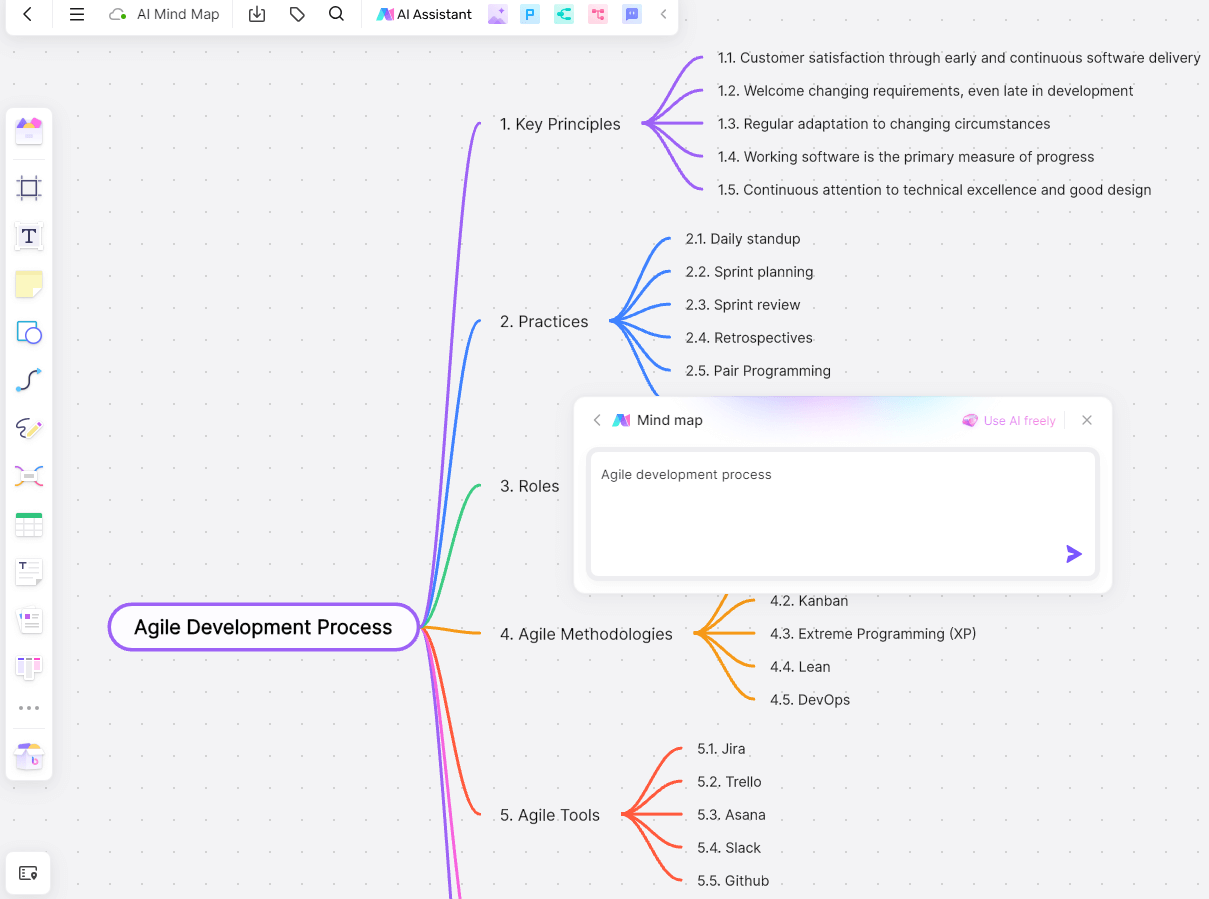
A shared Boardmix mind map gives the team a place to connect decisions, evidence and action owners while keeping the original notes nearby.
Start with a clean note set
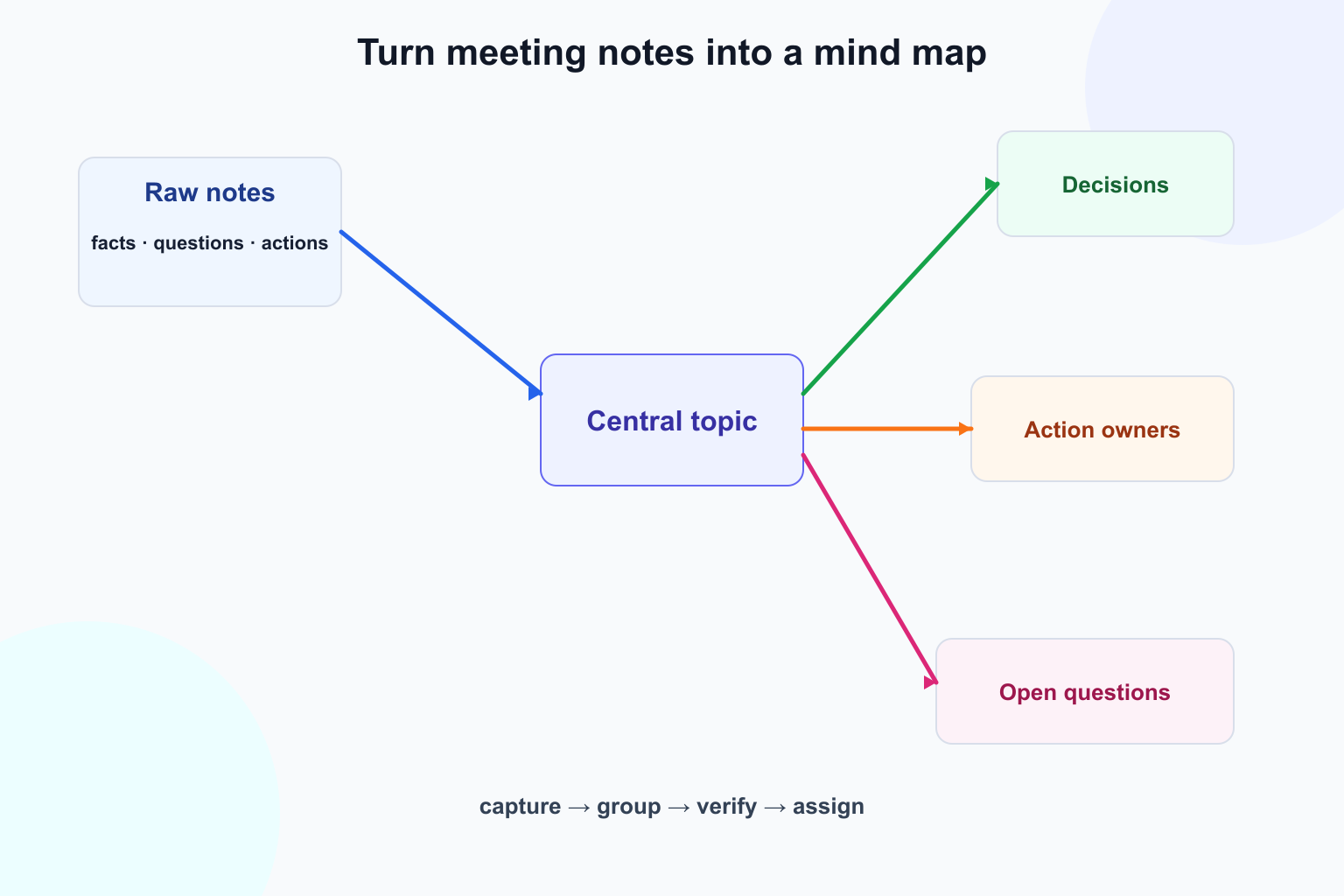
Before drawing, remove greetings, repeated comments and unresolved wording. Keep four types of information:
- Facts: observations, requirements, dates or links that someone can verify.
- Decisions: choices the group explicitly accepted, including the scope of the choice.
- Questions: unknowns that need evidence or another conversation.
- Actions: a verb, an owner and a due date or review point.
Mark an item as “unclear” when the notes do not show whether it was a decision or a suggestion. That small label prevents the map from turning an assumption into a commitment.
Build the central topic and first-level branches
Put the meeting purpose in the centre, such as “Q4 onboarding review” or “Checkout redesign”. Create first-level branches for the subjects actually discussed. Do not use a generic branch called “everything else”; move a note to a named topic or leave it in an open-questions branch until the next review.
Keep branch labels short, but preserve detail in the note attached to the node. A useful label is “mobile sign-in error” rather than “issue”. Link the original note, ticket or research clip to the node whenever the board supports links.
Group, verify and show relationships
Group notes that answer the same question, not merely notes that use the same word. Then verify each group against the source notes: does the summary preserve the condition, audience and time frame? Use a relationship line for dependency, and use a cross-link only when two branches need to be read together.
| Map element | Question to ask |
|---|---|
| Topic branch | What subject or user problem does this branch represent? |
| Decision node | What was accepted, and what was explicitly out of scope? |
| Evidence link | Where can another person verify this statement? |
| Action node | Who owns the next step and when will it be checked? |
Turn actions into an executable follow-up
Use a consistent action format: verb + deliverable + owner + date. “Draft the signup error copy — Priya — review Friday” is easier to track than “signup follow-up”. Keep actions near the branch they affect and add a separate “open questions” branch for work that is not ready to be assigned.
After the meeting, invite owners to confirm their nodes. If an owner changes the meaning of a decision, update the map and the original notes together rather than silently editing only one record.
Use Boardmix to review the map together
In Boardmix, start with a mind map canvas, place the meeting purpose in the centre, and attach links or comments to evidence and action nodes. A team can review the structure on the same board, then keep the map beside the related templates. Check the current pricing and sharing limits before moving sensitive notes.
Quality check before sharing
- Can every decision be distinguished from a proposal?
- Does each action have one owner and a check date?
- Are source notes or links attached to claims that need verification?
- Are unresolved questions visible instead of hidden in a summary?
- Can a person who missed the meeting understand the map without inventing context?
For more structured meeting records, compare this map with a meeting notes and minutes workflow. The goal is traceability: a useful map makes the next conversation easier without pretending to be the official record.