A project plan explains what the team will deliver, who will do the work, what resources and dependencies it needs, and how progress and quality will be checked. Start with those decisions, then put the work on a timeline. A schedule is one part of the plan; it does not replace scope, risks, or acceptance criteria.
This guide covers seven parts of a project plan and develops a fictional client-onboarding example you can adapt. Use Boardmix for visual project planning to keep the brief, milestones, and next week's tasks together.
Before choosing a template, write the plan as a small working brief: outcome, scope, deliverables, owner, dependencies, risks, and the checkpoint that will show whether the work is on track. For the example below, an approved onboarding workflow is the deliverable, the operations lead owns it, the data export is a dependency, and a trial account is the first operational check.

Part 1. What a Project Plan Covers
1.1 What is a project plan?
A project plan is basically a document that depicts how the project is going to be executed. It provides a basic overview of the project goals, scope, and objectives. Additionally, it outlines how the project is going to be monitored and how all the allocated resources and budget will be controlled—aligning with the project requirements.
1.2 Why is a project plan important?
A project plan can make or break the outcome of your project. Simply put, it is an imperative stage in your project management where you ensure the allocated resources are utilized within the budget, specified timeline, and other constraints involved.
Moreover, having a project plan helps to mitigate risks in a specific project. Thus, improving project execution and enabling you to take precautionary measures to improve your project workflow and avoid drawbacks.
A filled project brief: client onboarding pilot
This illustrative project is a four-week pilot, not a claim about a real customer or a guaranteed delivery time. Its purpose is to make one onboarding path ready for a limited trial.
- Outcome: By the end of week 4, three pilot accounts can complete account setup and the support handoff using an approved checklist.
- In scope: One onboarding workflow, a checklist, a welcome-email draft, and a trial with three accounts.
- Out of scope: Billing-system changes, migration of existing customers, and a company-wide rollout.
- Accountability: The operations lead owns the plan; the support lead approves the handoff checklist. IT supplies test accounts and the sample data export.
- Resources: Reserve two half-days each week for operations and one for support; book IT time before approving the schedule. No new software purchase is included.
- Acceptance: Each trial account completes setup, receives the intended welcome message, and reaches a named support contact. Record the result for all three accounts and resolve blocking failures before approval.
- Constraint and risk: The trial depends on IT access and an export. If either is late, revise the dependent dates before promising the pilot launch.
Copy these seven fields into a blank board and replace the example details. Check that the named people accept their responsibilities and resource commitments; putting a name in a plan does not confirm availability.
Part 2. What Are the 7 Parts of a Project Plan
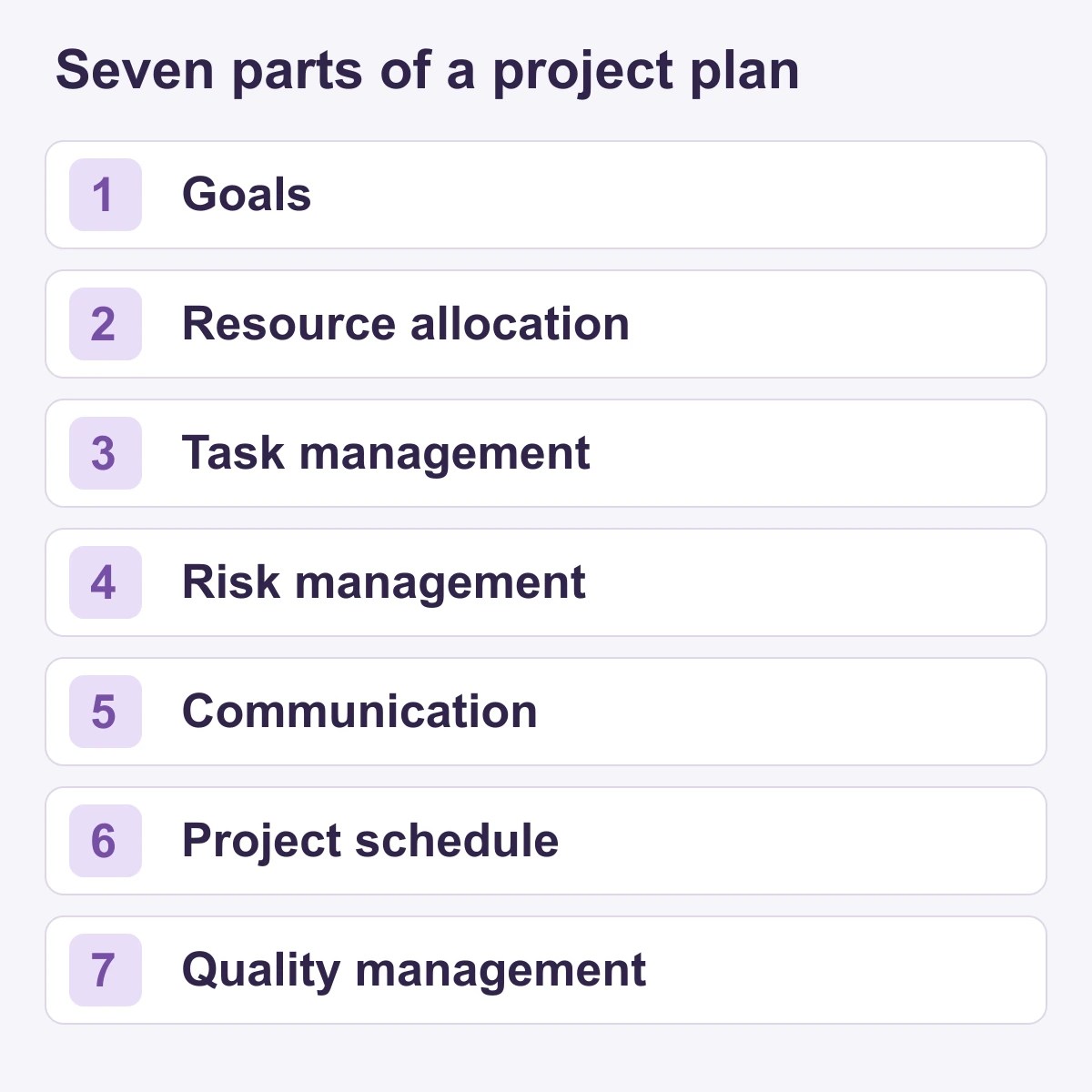
Here are seven areas to cover in a project plan so the team can understand the intended result, available resources, and constraints.
1. Goals
First and foremost, having a well-defined goal is crucial to any project plan. Setting out specific goals before beginning all the work helps you to have your team and other stakeholders on board with your ideas and head everyone in the desired direction. One way to make goals explicit is to use the SMART approach by listing goals that are Specific, Measurable, Attainable, Relevant, and Time-bound.
In the pilot: “Complete setup and handoff for three trial accounts by week 4” gives the team a testable result. Avoid substituting “improve onboarding,” which has no clear completion condition.
2. Resource allocation
In every project, you and your team will have scarce resources to work with. The next important part in a project plan is to plan how you are going to utilize those resources wisely. Resource gaps can force a change in scope or dates. Hence, a good resource allocation plan includes addressing how you will spend the budget, how much staff time each deliverable needs, how many suppliers are required to support the project, whether there are enough physical resources to fulfill the project, and how you are going to deal with obstacles on the way.
In the pilot: Confirm the weekly operations and support time before assigning work. If support cannot attend the week-3 trial, either reserve another slot or change the schedule; the same person cannot spend that time on two commitments.
3. Task management
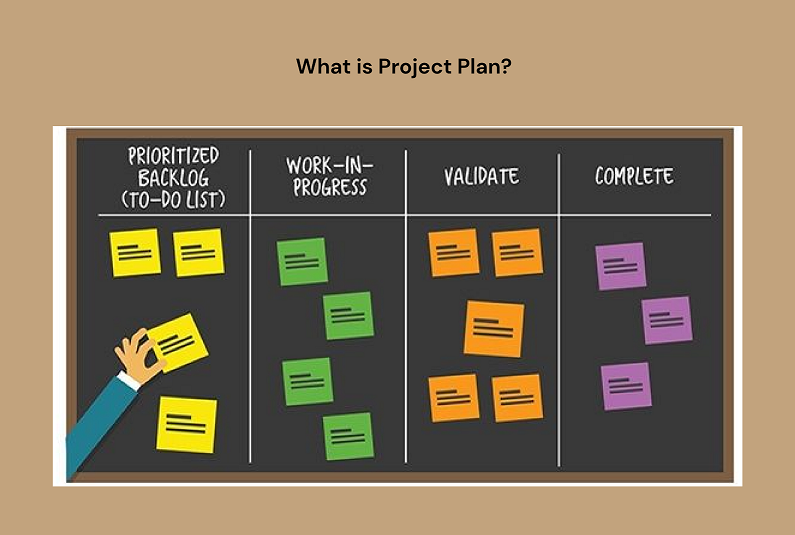
Planning how you will manage your tasks is another important area to look at. Each small task has a huge impact on the outcome of your project so they must be managed and executed properly. Having a good task management strategy like utilizing a Kanban board can help you execute large volumes of tasks efficiently.
In the pilot: Split “prepare onboarding” into draft workflow, review checklist, create test accounts, run trial, and resolve failures. Give each task one accountable owner and an observable result.
4. Risk management
Identifying the risks involved in the project is an important skill and part of project planning. It makes you prepared for potential risks that can affect your project and also plan ahead to mitigate and combat these risks. A useful way to identify potential risks is to check with your cross-functional teams and other stakeholders involved. Some risks are out of your control but it is best to list them to keep them at the back of your mind.
In the pilot: Record “export not available by week 2” as a risk, with IT as the dependency contact. Once the export is actually late, record it as an issue and update the affected milestones.
5. Communication
Communication is key when it comes to effective project management. Hence, planning how your team and other stakeholders will communicate during the project is important. Are they going to communicate using email, Slack, text messaging, or using project management software? Deciding on your communication tools helps to put everyone on the same page and boost effective collaboration.
In the pilot: Review the board every Tuesday with operations and support. Log scope or date decisions in the same place, and ask the operations lead to confirm changes before the team treats them as the new plan.
6. Project schedule
Having a project schedule helps you to keep track of the project's progress breaking a big project into milestones and taking it one step at a time. It helps you to decide on a timeline to complete each task and head closer to project completion. Using project scheduling tools and charts is a fine way to list specific tasks and deadlines within a project.
In the pilot: Checklist approval must precede the trial. A calendar containing both dates without that dependency can hide a blocked test.
7. Quality management
Quality management defines the acceptance criteria for each deliverable, how it will be checked, and who can approve it. For a client onboarding workflow, this might include testing account creation, confirming the required handoffs, and recording approval before launch.
Part 3. Build the Project Plan in Boardmix
Use the brief to populate the board before adding dates. The original screenshots below illustrate the template workflow; interface labels and available templates can change. Choose the equivalent controls in your current workspace.
Boardmix is an online tool that helps project managers to create a project plan quickly by using built-in templates and allows them to iterate the plan by adding elements and setting timelines.

Here’s how you can create a basic project plan using Boardmix:
Step 1 - Sign in and choose a workspace
Open Boardmix and sign in, or follow the registration options shown. Start in the workspace where the people responsible for the plan can review it.
Step 2 - Create or open a project board
Create or open a board for the project. Add the project brief near the top and give the board a clear name, such as “Client onboarding pilot.” The earlier interface shown below uses “New File.”

Step 3 - Browse through templates
Open the template library and look for a project timeline or weekly plan. The earlier screenshot shows a Templates entry and a Project Management category. Choose the structure that matches your planning horizon, then replace the sample content with your deliverables.

Step 4 - Insert the timeline template
Add a timeline for the major deliverables. The pictured template uses four quarters; for this four-week pilot, relabel the periods Week 1 through Week 4. Add the owner and approval condition to each milestone, and show which milestones depend on earlier work.

Step 5 - Plan a weekly schedule
Add a Weekly Plan for the next actionable tasks. In week 1, the operations lead drafts the workflow, the support lead reviews handoffs, and IT confirms access. Each task needs an owner and due date. Keep longer-term milestones in the timeline so the weekly view does not become a second, conflicting project schedule.

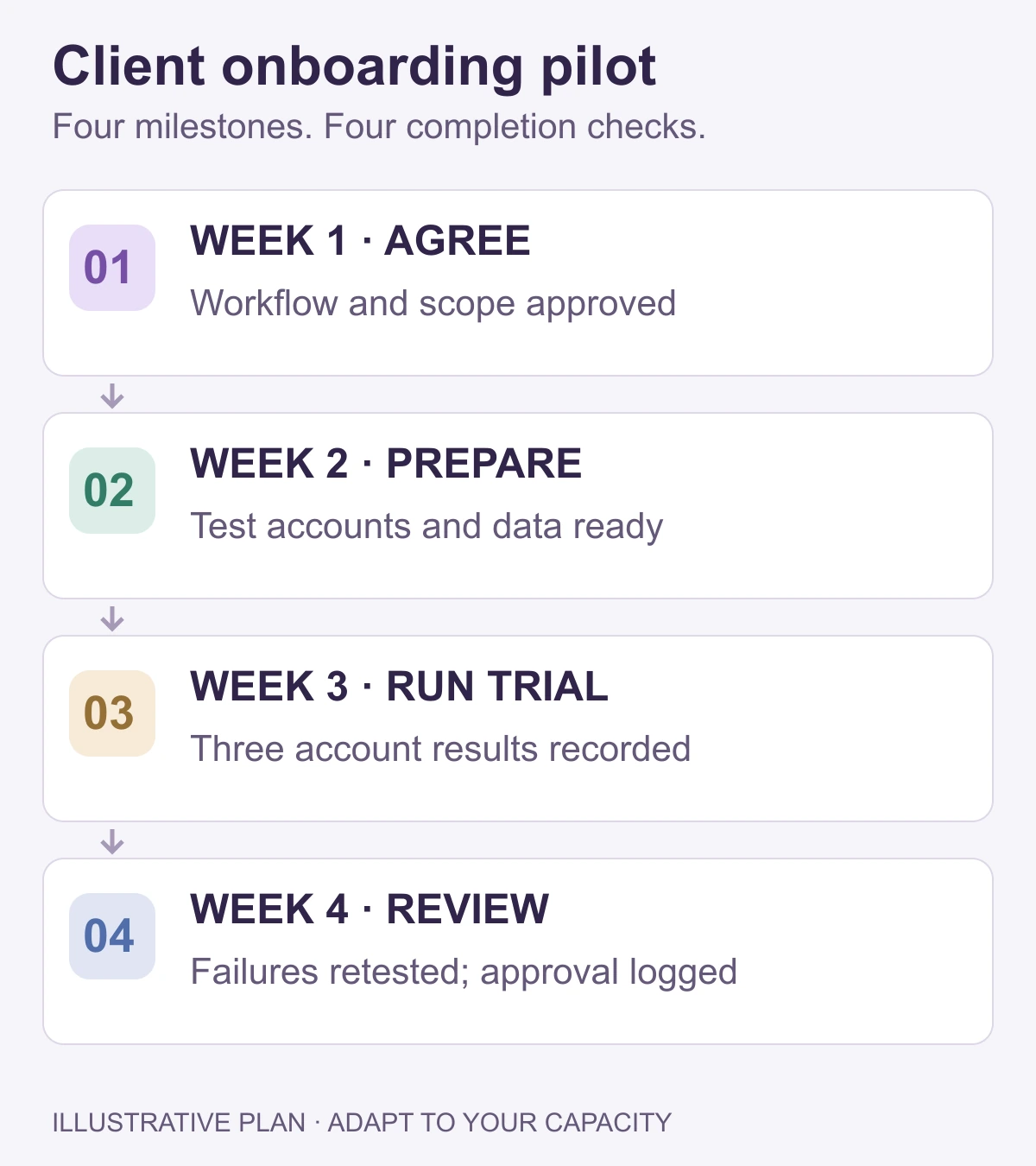
Connect four milestones to their acceptance checks
- Week 1 — Agree the workflow. Operations drafts it; support approves the handoff and out-of-scope items. Finish when both reviewers record agreement.
- Week 2 — Prepare the trial. IT provides test accounts and the export; operations checks the checklist against them. Finish when the trial can run with usable data and access.
- Week 3 — Run three trial accounts. Operations runs setup with support. Log each account's setup, welcome-message, and handoff results. This milestone depends on weeks 1 and 2.
- Week 4 — Resolve failures and review. Retest blocking failures. The support lead approves the checklist; the operations lead decides whether the evidence supports a wider rollout.
What to change when a dependency is late
Suppose the week-2 export is two working days late and there is no spare capacity in the trial slot. Keep the actual delay visible. Move the trial by two working days, then move the review if the team cannot preserve the planned retest time. Ask IT and support to confirm the revised dates before marking them agreed.
While access is pending, operations can review checklist wording and support can rehearse the handoff using a sample scenario. Those activities do not prove that live account setup works. Keep the operational test open until the required access and data are available.
Record the change as: “Export delayed two working days; trial and dependent review moved two working days; scope unchanged; operations lead confirmed revised dates.” If the deadline cannot move, raise a scope or capacity decision with the approver. Do not quietly remove a quality check to make the old deadline look achievable.
For a deeper look at sequencing work on the board, use the project plan and timeline guide.
Part 4. Choose a Template for the Plan You Need
Use the timeline template for major deliverables and dependencies, and a weekly plan for the tasks people will carry out next. For the onboarding example, place workflow approval, a trial account, and the launch review on the timeline; put each person’s preparation work in the weekly plan. Keep both views on the same board so the detailed tasks remain connected to the project milestones.

Check the Plan Before Work Begins
Before the kickoff, ask each owner to confirm the deliverable, available time, dependency, and acceptance check. Resolve contradictory dates between the timeline and weekly plan. Keep unresolved decisions visible instead of treating a populated template as approval.
Start with the filled brief above, adapt the seven parts to your project, and update the board when a decision changes. A useful project plan gives the team a shared basis for action and an explicit way to discuss trade-offs.