


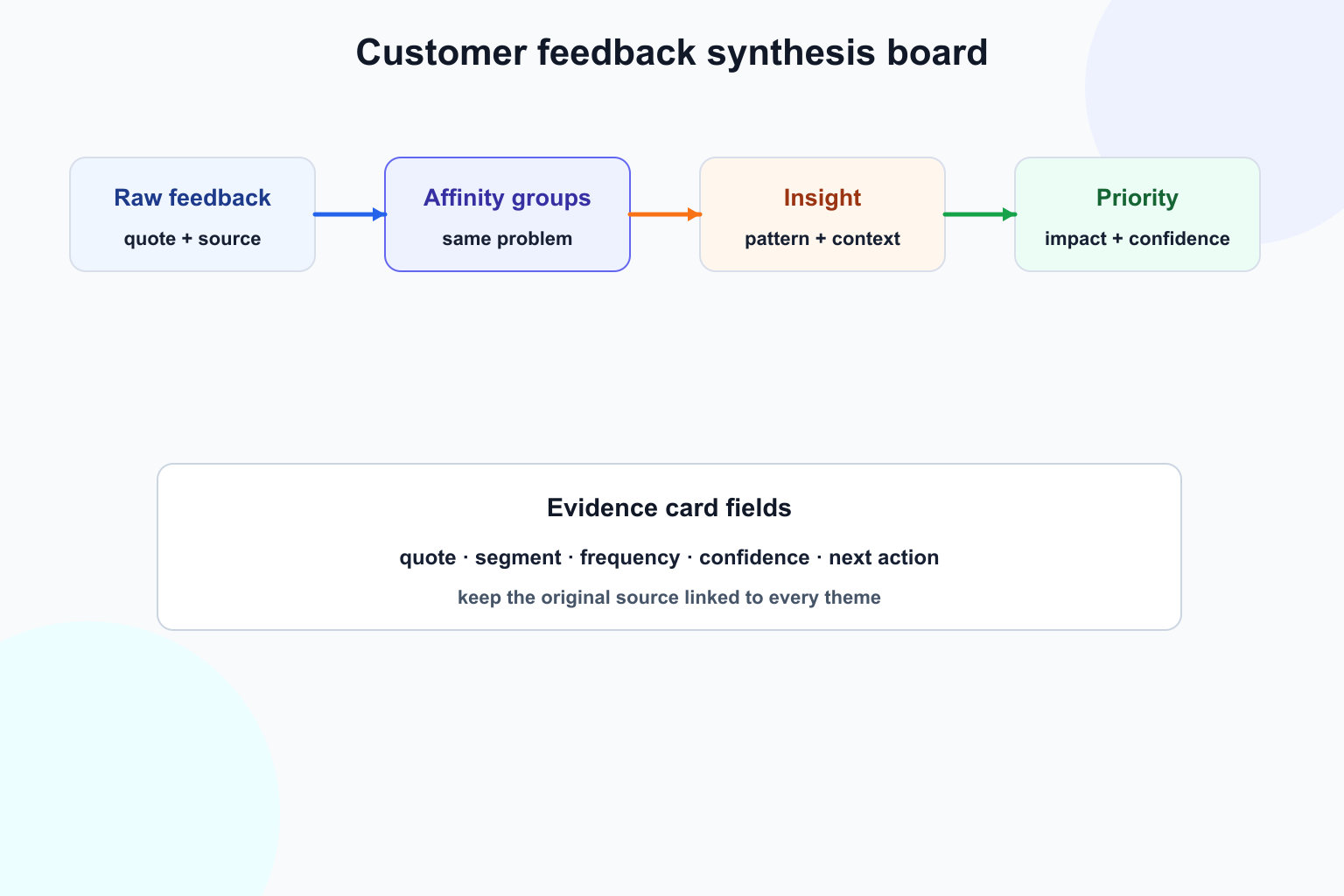
Customer feedback synthesis is the process of moving from individual quotes to evidence-backed themes and a prioritised next step. An online whiteboard is useful when it keeps the original source attached to every theme instead of turning a collection of opinions into an unsupported summary.
Collect feedback with source context
Bring together interviews, support conversations, survey comments and usability observations only when their context is recorded. A useful feedback card includes the quote or observation, customer segment, date, source link and any relevant task or product state. Remove personal information that the team does not need.
Separate quotes, interpretations and requests
Keep three card types distinct: quote records what a person said or did; interpretation explains a possible pattern; request names a desired change. A request is not proof that a feature is the root cause. Keeping the types visible makes later review more honest.
Use affinity mapping to form themes
Place related quotes together, then name the group with a sentence that describes the shared problem. “Confusing setup” is weaker than “New workspace owners cannot tell which step invites teammates”. Preserve outliers in a separate area instead of forcing them into the nearest cluster.
| Layer | Example | Evidence to keep |
|---|---|---|
| Quote | “I could not find the invite control.” | session link and task |
| Theme | Invite action is hard to discover | linked quotes and segment |
| Insight | Owners need an obvious next step after board creation | context and confidence |
| Action | Test two invite placements with new owners | owner, date and signal |
Add confidence and impact
Confidence describes how well the evidence supports the interpretation; impact describes what may change if it is true. Keep them separate. A frequently mentioned minor annoyance may be lower priority than a less frequent problem that blocks a critical task. State the basis of the judgement rather than assigning a decorative score.
Turn themes into a research or product action
Write the next action as a testable step: interview a defined segment, inspect a funnel event, prototype a change or reproduce a workflow. Add a success signal and an owner. If the team chooses not to act, record the reason and the evidence that would change the choice.
Review the synthesis with stakeholders
Invite people who can challenge the interpretation and people who will use the result. Ask them to trace each important insight back to source cards. If the group disagrees, preserve both interpretations until more evidence is available. That is more useful than forcing a single conclusion during the workshop.
Build the board in Boardmix
Use an affinity diagram template or a blank Boardmix board. Keep raw feedback, themes, insights and actions in separate areas, and attach sources to cards. Check your organisation’s sharing and retention rules before inviting external collaborators.
The resulting board is a research workspace, not a statistical report. Its value comes from traceability: another person can see what was observed, what was inferred and what the team will test next.