


Your team has plenty to discuss, but the recurring meeting keeps following the same agenda. A release question fills the first half, the manager's updates take the second, and the issues people brought never reach the table. Lean Coffee offers a different arrangement: participants choose the topics together, then discuss them one at a time.
The format suits communities of practice, team learning sessions, and open discussions where the useful agenda is not known in advance. It needs a clear purpose and a facilitator, but the facilitator does not arrive with every conversation already decided.

What makes a meeting Lean Coffee?
Lean Coffee's official guide describes a structured meeting whose agenda is generated by its participants. Jim Benson and Jeremy Lightsmith started the format in Seattle in 2009. Its basic board has three states: Ready, Doing, and Done. People propose topics, introduce them briefly, and vote on what interests them.
The guide gives each participant two votes, which can go to one topic or two different topics. That is a simple starting rule. Explain it before voting so people do not have to infer the rules from whoever goes first.
The cards represent conversations, not delivery tasks. Moving “How should we handle urgent requests?” to Done means the group has finished discussing it for now. It does not mean urgent requests are solved. Nor must every conversation create an action item: exchanging experience can be the intended result.
Choose a purpose with room for participants
A useful invitation gives people enough direction to bring relevant material. “What is making product work harder this month?” leaves more room than a preselected list of five status reports. “Discuss anything” may be appropriate for a social learning group, but it can be confusing inside a time-limited work meeting.
Consider a hypothetical product group with eight participants from design, engineering, support, and product management. They want to learn from recent delivery friction. They are not meeting to approve a release or assign next quarter's budget. Those decisions have separate owners and cannot be settled by a popularity vote.
Ask participants to bring a question, a situation they want help with, or an experience others might find useful. “Onboarding” is too broad for one card. “How do we notice when new administrators get stuck before inviting a teammate?” gives the group a conversation it can actually enter.
Use another meeting format when the agenda is fixed by an incident, a required approval, or a deadline that leaves no choice about what must be discussed. You can borrow a visible discussion board without calling every meeting Lean Coffee.
Prepare a board and a simple time agreement
Create the three columns and leave plenty of space in Ready. Add a small area for questions the group wants to return to later. Keep that area distinct from Done so an unfinished topic does not look resolved.
For the eight-person example, reserve 45 minutes. One possible agenda is five minutes to write topics, five to introduce and vote, about thirty for discussion, and five to close. These are planning choices for this session, not mandatory Lean Coffee timings.
Agree on how long the first discussion will run and what happens when time expires. For example, begin with five minutes, then ask whether people want another three minutes or want to move on. Decide in advance how that choice will be made. The facilitator can collect a quick show of hands or a spoken response; a simple meeting does not require an automated timer or voting system.
In a remote meeting, send the board and call links beforehand. Make sure participants can add a note and read the text at a comfortable zoom level. Give anyone who cannot edit the board a way to contribute through the facilitator.
Turn topic cards into an agenda
Let people write quietly before introducing their topics. This gives someone with an unfinished thought a chance to form it without competing with the first speaker. Use one question per card and ask its author for a short explanation.
Clarification is not discussion yet. If a card triggers a lively debate immediately, capture the question and bring the group back to hearing the remaining cards. Otherwise the meeting's agenda has already been chosen by the first interesting interruption.
Combine cards only when their authors agree they concern the same conversation. “Too many urgent requests” and “No clear owner for urgent requests” may overlap, but merging them can hide an important distinction between volume and responsibility.
| Proposed topic | Votes in the example | Discussion focus |
|---|---|---|
| How should support escalate urgent product requests? | 6 | Where the current handoff breaks down |
| How do we keep design feedback useful and specific? | 5 | Examples of feedback people can act on |
| What makes our release notes hard to write? | 3 | Missing information and unclear audiences |
| What have we learned from onboarding sessions? | 2 | Observations worth sharing across roles |
Eight participants with two votes each produce sixteen votes here. These counts are illustrative, not research findings. Sort the cards accordingly. For a tie, use a rule the group can understand, such as a quick choice between the tied topics. Avoid quietly giving the facilitator a deciding vote that was never agreed.
Facilitate one conversation at a time
Move the selected card to Doing and ask its author to provide just enough context to start. For the urgent-request topic, support might describe a recent case that moved between three teams without anyone accepting it. Other participants can explain how the request looked from their side.
Keep notes near the topic rather than building a verbatim transcript. “Urgency and ownership are being confused” captures a useful distinction. “Engineering ignored support” turns an interpretation into a verdict and is likely to derail the conversation.
At the agreed time, pause and ask whether the discussion should continue. In this example, the group chooses three more minutes to explore the ownership gap. A second extension would leave less time for design feedback, so the facilitator makes that trade-off visible before asking again.
If the discussion becomes a detailed solution session for two people, ask whether the rest of the group still needs to be involved. The participants may prefer to record a smaller follow-up conversation and move on. That is different from cutting off a difficult question simply because it is uncomfortable.
Build the discussion board in Boardmix
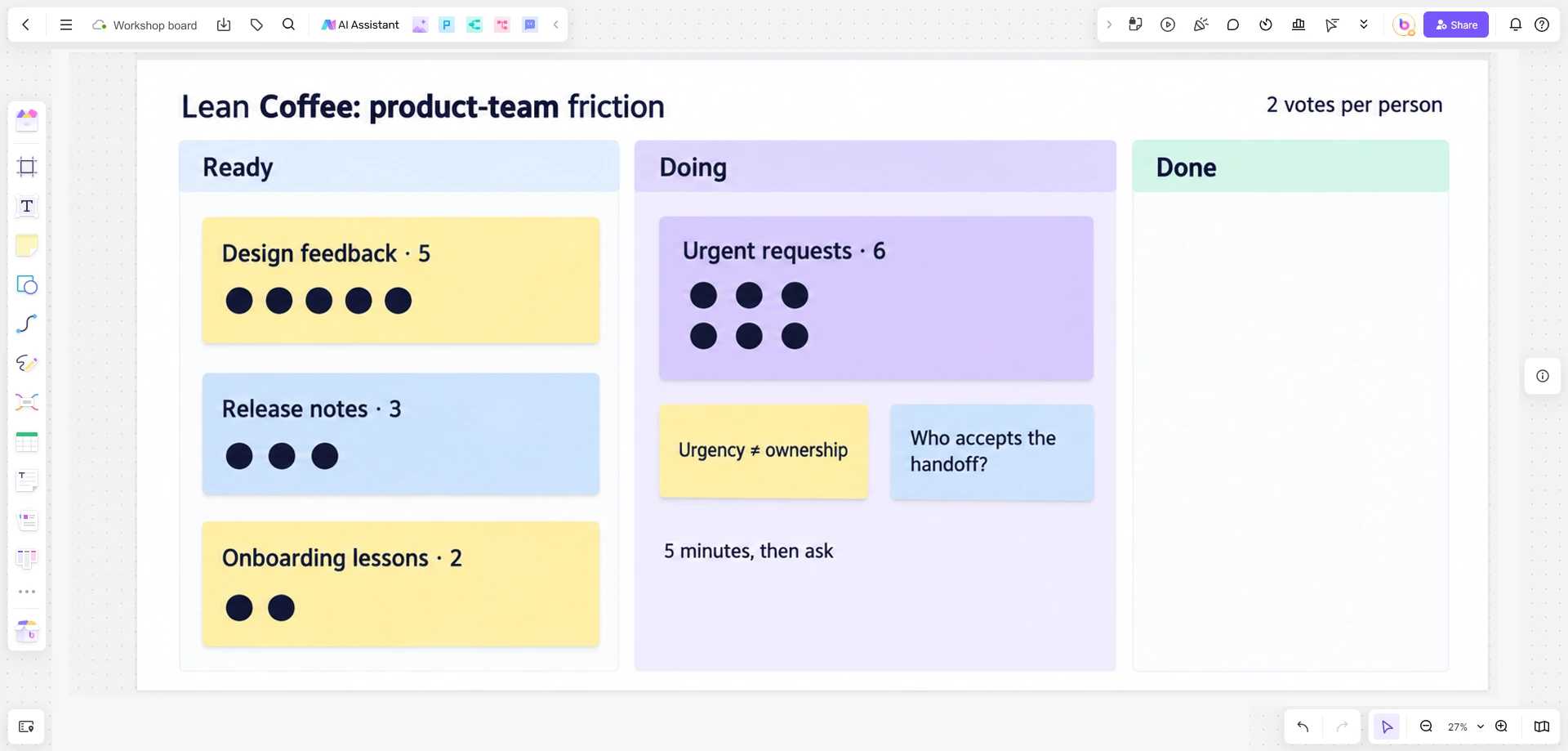
Open Boardmix and arrange three large rectangles labeled Ready, Doing, and Done. Use sticky notes for the four example topics, then add small circles beside each note to record the votes manually. Keep the voting rule visible above the board.
- Place the urgent-request card in Doing. Leave the other three topics in Ready, ordered by the agreed priority.
- Add two short notes beside the active card: “Urgency ≠ ownership” and “Who accepts the handoff?” These hold the discussion's useful detail.
- Write the current time agreement near Doing: “5 minutes, then ask whether to continue.” The facilitator manages the clock.
- When the group moves on, drag the topic and its notes to Done. Keep a separate note for any follow-up that somebody has actually accepted.
Use the board's sharing controls to give participants the access they need. The cards, dots, and time labels in this arrangement are ordinary board content, so the facilitator can adjust them as the conversation changes.
Handle topics that do not get discussed
A lower-voted topic may matter deeply to one person. Before closing, ask whether any untouched card concerns an obligation or immediate risk that needs a different route. Six votes do not make an issue more legally, technically, or operationally important than a two-vote issue.
For ordinary unfinished topics, let participants choose whether to carry them forward, discuss them asynchronously, or drop them. Do not automatically turn every leftover card into work. A learning group can finish with better questions rather than a larger task list.
If the urgent-request discussion produces an actual policy decision, record it separately in a decision log with the person authorized to make it. The Lean Coffee board can retain the reasoning and the questions that remain. At the next session, participants should still be free to bring the topics that matter then.