


A decision log records why a material choice was made, not just what was chosen. Use it beside meeting notes, a project plan or a product brief so that a new team member can reconstruct the context without reopening the entire conversation.
When to create a decision log
Create an entry when a choice changes scope, risk, cost, architecture, customer experience or ownership. Routine edits do not need a formal record. If the same question keeps returning, that is a signal to record the decision and the conditions under which it should be revisited.
Core fields in the template
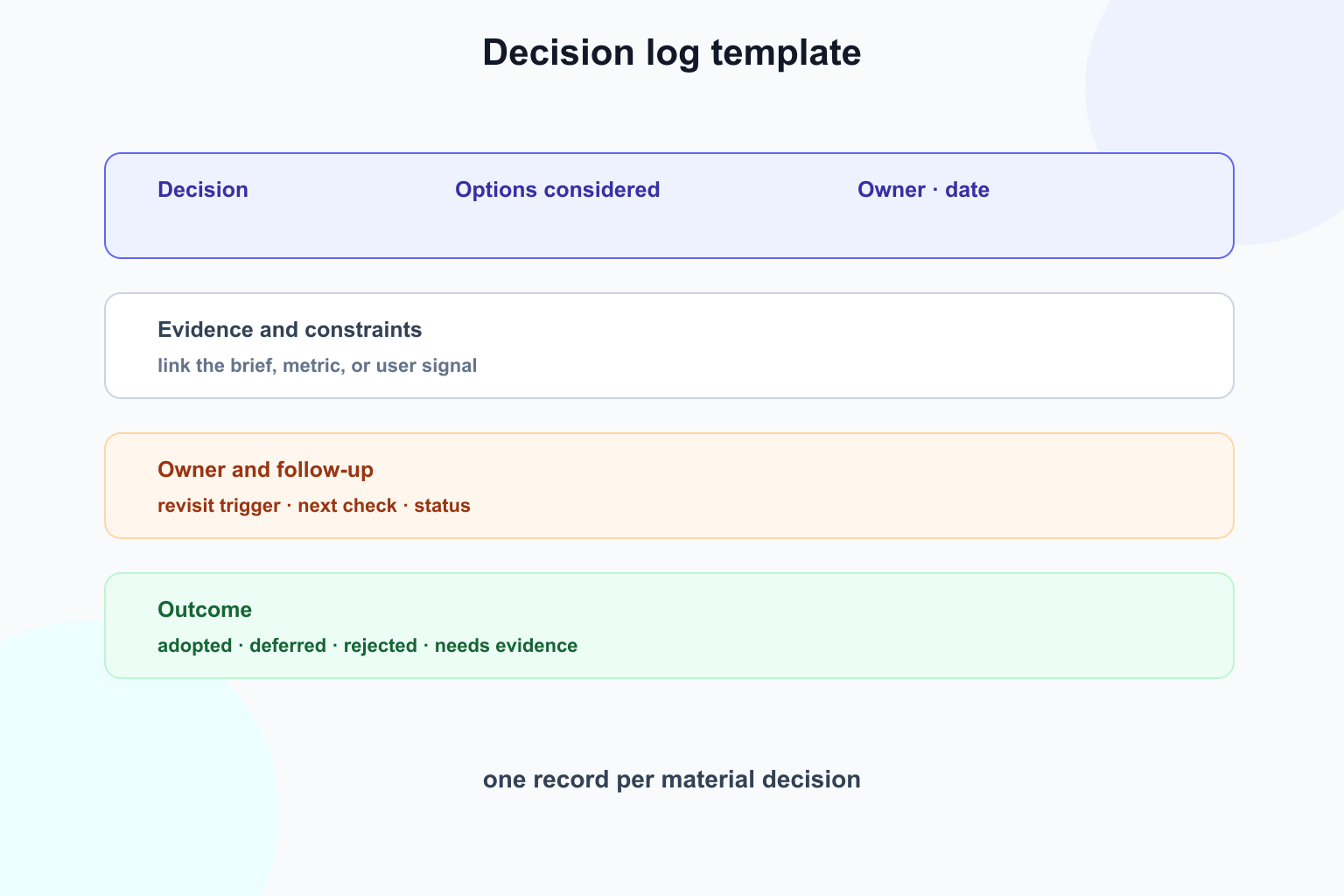
| Field | What to write |
|---|---|
| Decision | A single sentence that names the chosen option and scope |
| Context | The problem, goal and constraints at the time |
| Options | Options considered and why they were not selected |
| Evidence | Links to research, metrics, requirements or risks |
| Owner and date | The accountable person and decision date |
| Outcome | Adopted, deferred, rejected or awaiting evidence |
| Revisit trigger | The event or evidence that should reopen the choice |
Keep the decision field separate from the context. A paragraph that mixes both is hard to quote in a project update and easy to misread later.
Write a decision that can be tested
Prefer “Use a browser-based whiteboard for the pilot team; review access logs after the first research cycle” over “Boardmix is the best tool”. The first statement has a scope, a reason to review and a measurable follow-up. It does not turn one team’s choice into a universal ranking.
Capture disagreement without creating noise
List the serious alternatives and the constraint that ruled each one out. Do not transcribe every comment. If an objection remains unresolved, write it as a risk or open question with an owner. The record should make the trade-off visible without pretending that the meeting produced certainty where it did not.
Review and maintain the log
Link each entry to the related brief, board or meeting record. Review open revisit triggers at a regular project checkpoint. When a decision changes, keep the original entry, mark it superseded and link the new record. This preserves the history of the choice and avoids two current-looking versions.
Use the template in a collaborative board
A decision log works well as a table or a set of cards on an online whiteboard. Use one card per decision, a consistent set of labels and a link to evidence. Check the current sharing permissions and data-handling rules before adding customer or confidential material.
Decision-log quality check
- Can a reader identify the decision in one sentence?
- Are the relevant alternatives and constraints visible?
- Does each important claim link to evidence?
- Is one person accountable for the follow-up?
- Does the entry say when or why the decision should be revisited?