



Most teams that struggle with complex problems don’t lack intelligence or effort. They lack structure. Without a disciplined way to decompose a problem, smart people run in circles — generating heat instead of light, conflating symptoms with root causes, and building solutions for problems they haven’t fully defined yet.
The McKinsey logic tree is how the world’s top problem-solvers impose structure on chaos. Used by McKinsey & Company consultants for decades, adopted by strategy teams across every industry, and taught in MBA programs worldwide, the logic tree converts any ambiguous, sprawling business challenge into a set of discrete, testable, and actionable branches. No guesswork. No overlap. No missing pieces.
This guide covers everything: the foundational MECE principle, the three logic tree types and when to use each, a step-by-step build process, and worked business examples that show the framework applied to real problems. By the end, you’ll have a replicable method for structured problem solving you can use immediately.
What Is the McKinsey Logic Tree?
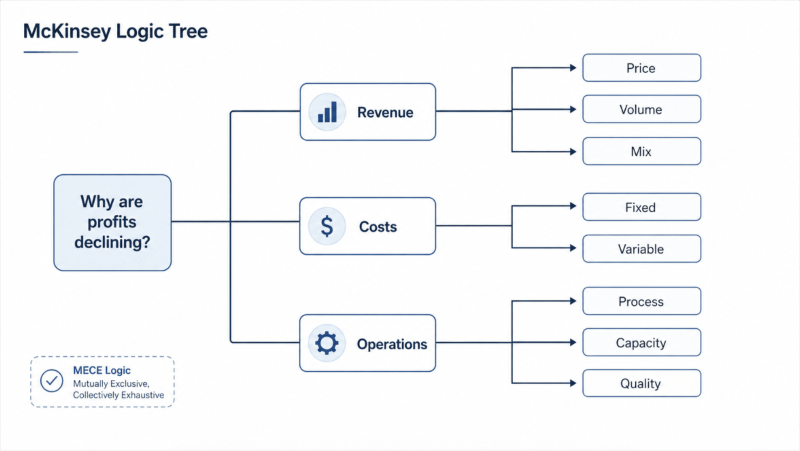
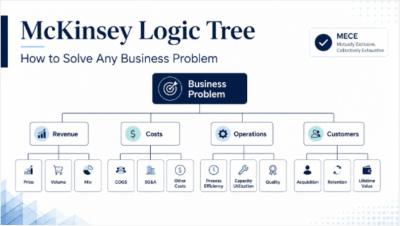
A McKinsey logic tree is a hierarchical problem-structuring framework that decomposes a central business question into discrete, mutually exclusive, and collectively exhaustive branches. Each branch represents a distinct dimension of the problem — a possible cause, a testable hypothesis, or a potential solution lever — which can be further subdivided until every component is specific enough to investigate independently.
The framework is a cornerstone of McKinsey’s problem-solving methodology and draws directly from Barbara Minto’s Pyramid Principle — the communications and thinking framework Minto developed during her tenure at McKinsey in the 1970s. Minto’s foundational argument, detailed in her widely used methodology, is that rigorous thinking must be structured top-down, grouped logically, and exhaustive in coverage. The logic tree is that argument made visual. It has since become standard practice across the global consulting industry, from McKinsey and BCG to in-house strategy functions at major corporations.
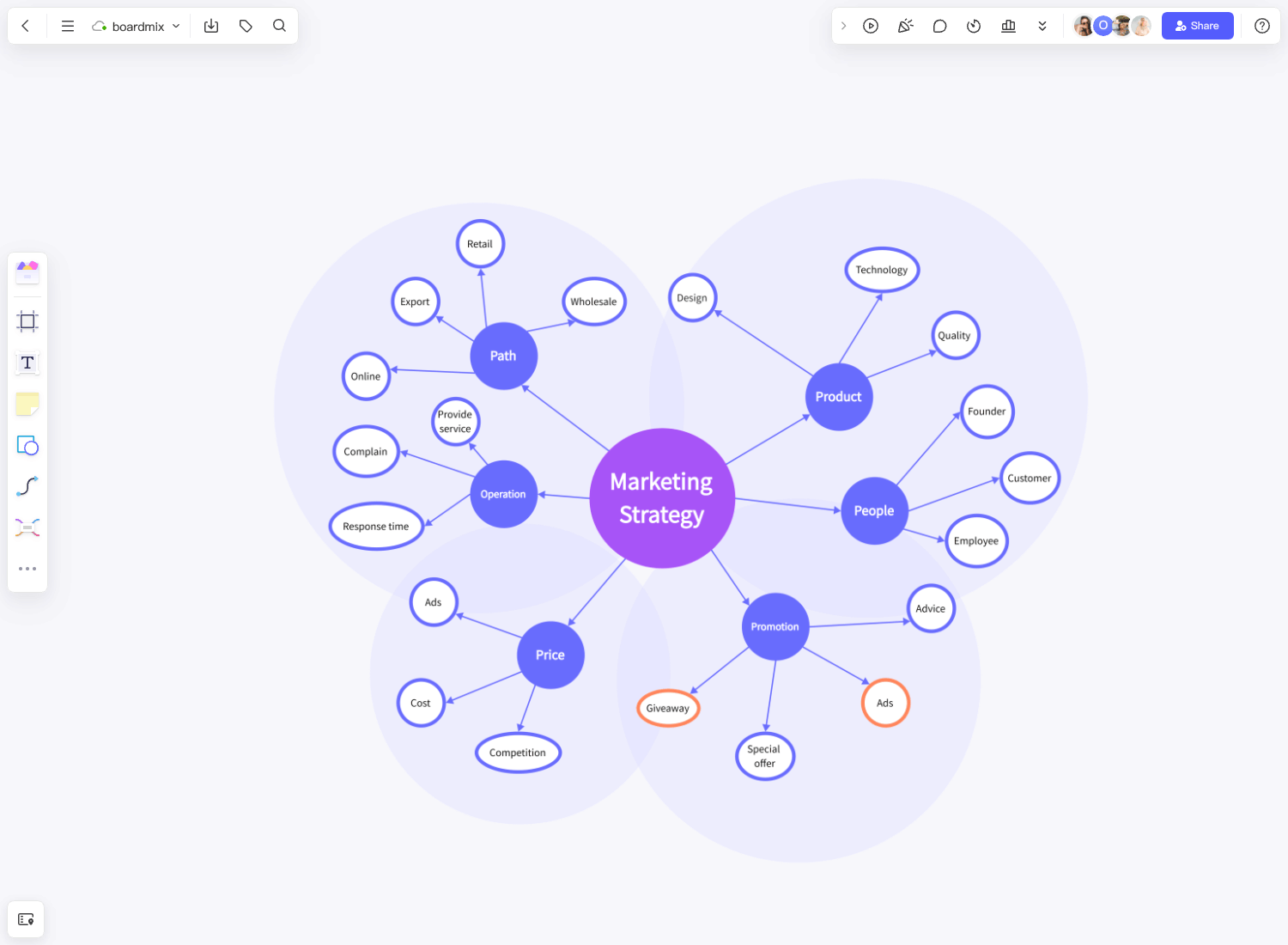
One clarification that comes up often: a logic tree is not a mind map. Mind maps radiate associatively — they capture connections between ideas without imposing structural rules. A logic tree is architecturally strict. At every level, branches must not overlap, and together they must account for the entire problem space. That constraint is precisely what makes the logic tree analytically powerful rather than merely visually organized.
The MECE Principle — The Foundation of Every Logic Tree
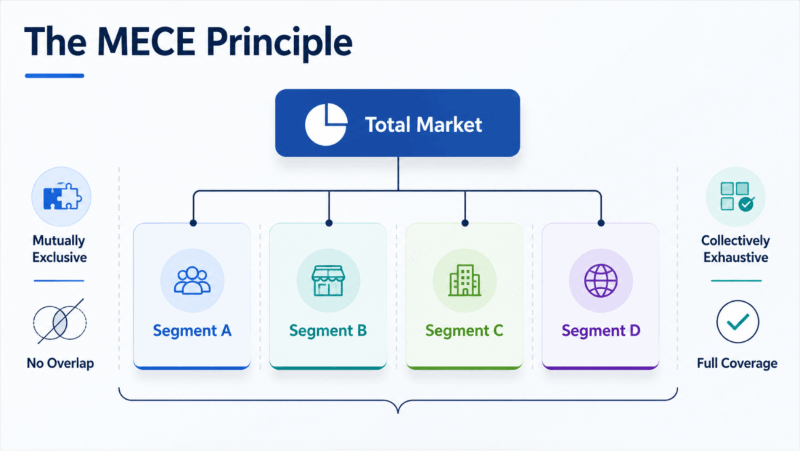
MECE (pronounced “mee-see”) stands for Mutually Exclusive, Collectively Exhaustive. It is the governing structural rule of every logic tree — the test that determines whether a decomposition is analytically sound or just a loosely organized list.
The MECE principle states that a valid set of logic tree branches must contain no overlaps between categories and no gaps in coverage. Every element of the problem must belong to exactly one branch, and the branches together must cover the entire problem without omission. Violate either condition and the tree misleads rather than clarifies.
Mutually Exclusive
Mutually exclusive means each branch covers a distinct, non-overlapping portion of the problem space. If a root cause, a customer segment, or a cost driver could legitimately belong to two different branches, those branches are not mutually exclusive — and any analysis built on them will produce double-counting and contradictory attribution.
The test is concrete: take any specific data point relevant to your problem and ask whether it can be placed cleanly in exactly one branch. If it sits in two simultaneously, the branches need to be redrawn before any analysis begins.
Collectively Exhaustive
Collectively exhaustive means the branches at any given level, taken together, account for the entire scope of the problem. If you can think of a cause, factor, or scenario that falls outside all current branches, the tree has a gap — and any solution built without accounting for that gap is structurally incomplete.
The test here is skepticism: after defining your branches, ask a knowledgeable colleague to find a scenario the tree doesn’t cover. If they can — and they usually can on a first draft — the decomposition is not yet collectively exhaustive.
How to Test Your Branches for MECE Compliance
Run these three checks at every level of your logic tree before proceeding to analysis:
- The overlap test. Pick five specific, concrete examples of the problem occurring in the real world. Can each one be placed in exactly one branch? If any example belongs to two branches simultaneously, you have a mutual exclusivity failure at that level.
- The completeness test. Can you think of any cause, scenario, or factor that falls outside all current branches? If yes, the tree has an exhaustiveness gap that needs to be closed before analysis proceeds.
- The summary sentence test. Restate your branches as a sentence: “The problem is caused by [A] or [B] or [C] — and these cover all possibilities.” Could you defend that sentence to a rigorous skeptic? If it feels incomplete or arbitrary, revisit the decomposition.
Common MECE violations — and how to correct them:
Violation 1 — Overlapping categories.
Revenue branches listed as: “Enterprise clients” / “SMB clients” / “Technology industry clients.”
The problem: Technology industry clients can be either enterprise or SMB — the third branch cuts across the first two.
The fix: Segment by a single dimension. Use “Enterprise” / “Mid-market” / “SMB” for size-based segmentation; create a separate branch for sector analysis if needed.
Violation 2 — Gaps in coverage.
Cost branches listed as: “Salaries” / “Marketing spend” / “Software licenses.”
The problem: Facilities, logistics, professional services, and capital expenditure are all unaccounted for.
The fix: Anchor the decomposition in a recognized cost framework — COGS / Sales & Marketing / Research & Development / General & Administrative — that systematically covers all operating cost categories.
Violation 3 — Mixed levels of abstraction.
Churn branches listed as: “Poor customer support” / “Competitive pressure” / “APAC customers leaving at high rates.”
The problem: The third branch is a specific observable symptom placed at the same level as two structural explanations. Symptoms and causes cannot coexist at the same hierarchical level.
The fix: Keep all branches at the same logical altitude. Move geographic observation into a sub-branch under a structural parent such as “Customer relationship factors” or “Regional delivery quality.”
The 3 Types of McKinsey Logic Trees
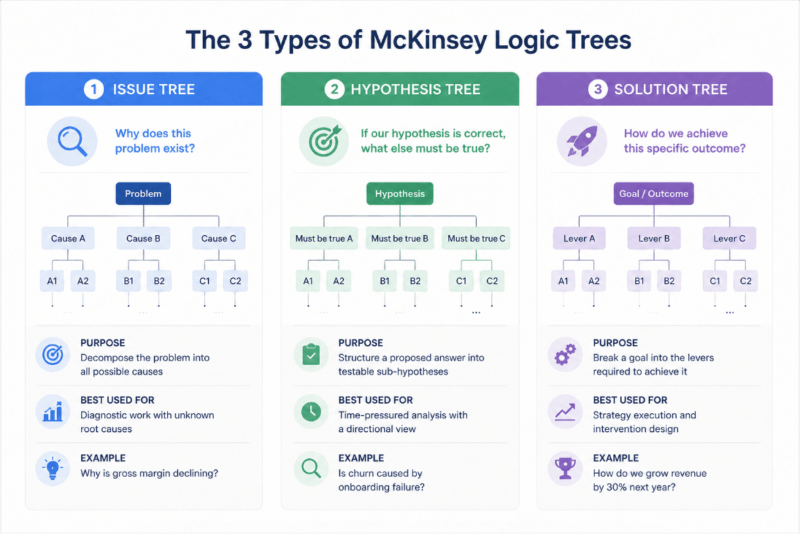
Not every business question calls for the same kind of decomposition. McKinsey problem analysis practice distinguishes three primary logic tree types, each suited to a different starting position and analytical objective. Choosing the wrong type for your situation wastes time and produces a tree that technically holds together but answers the wrong question.
1. Issue Tree (Problem Tree)
An issue tree — also called a problem tree — decomposes a problem by asking: why does this problem exist? It works backwards from a visible symptom toward its structural causes, breaking the central question into its possible explanations at each level.
When to use it: When you know a problem exists but haven’t yet identified its root cause. Issue trees are the right tool for diagnostic work — revenue shortfalls, declining customer satisfaction, rising costs, or operational failures where the symptoms are clear but the causes are not. This is the most frequently used logic tree type in consulting engagements.
Business example: A logistics company’s on-time delivery rate has fallen from 94% to 81% over six months. The issue tree branches at Level 1 into “Internal operational factors” and “External supply chain factors” — each of which decomposes further into specific, measurable drivers the team can investigate and quantify.
2. Hypothesis Tree
A hypothesis tree starts from a proposed answer rather than an open question. It asks: if our hypothesis is correct, what else must also be true? Each branch becomes a testable sub-hypothesis — a specific, verifiable claim that either supports or refutes the central argument.
When to use it: When your team already has a strong directional view and the primary task is to confirm or reject it efficiently. Hypothesis trees are especially powerful under time pressure — they align the team on precisely what to test, in what sequence, and what evidence would change the conclusion. McKinsey’s own published guidance on problem solving consistently emphasizes hypothesis-driven work as a core efficiency lever in complex engagements.
Business example: A SaaS company suspects that churn is driven primarily by onboarding failure rather than product-market fit issues. The hypothesis tree branches into three sub-hypotheses: “Onboarding completion rates fall below industry benchmarks” / “Users who complete onboarding churn at the same rate as those who do not” / “Support ticket volume peaks in the first 30 days of subscription” — each independently testable with available data.
3. Solution Tree (How Tree)
A solution tree — sometimes called a how tree — decomposes a desired outcome by asking: how can this goal be achieved? It works forward from a defined target, breaking it into the specific levers an organization can actually pull to deliver the result.
When to use it: When the problem is understood and the goal is clear, and the work is to identify, structure, and prioritize the interventions that will close the gap. Solution trees are most valuable in strategy execution, cost reduction programs, market entry planning, and growth initiatives where the question has shifted from “what’s wrong?” to “what do we do?”
Business example: A consumer goods manufacturer needs to reduce unit production cost by 20% within 18 months. The solution tree branches at Level 1 into “Reduce input material costs” / “Improve manufacturing yield” / “Optimize product portfolio mix” — giving the operations team a structured set of workstreams to design programs around and track in parallel.
Issue Tree vs. Hypothesis Tree vs. Solution Tree
| Dimension | Issue Tree | Hypothesis Tree | Solution Tree |
|---|---|---|---|
| Definition | Decomposes a problem into all possible causes | Structures a proposed answer into testable sub-hypotheses | Breaks a goal into the levers required to achieve it |
| Starting Question | Why does this problem exist? | If our hypothesis is correct, what else must be true? | How do we achieve this specific outcome? |
| Best Used For | Diagnostic work with unknown root causes | Time-pressured analysis with a directional view | Strategy execution and intervention design |
| Example Problem | Why is gross margin declining? | Is churn caused by onboarding failure? | How do we grow revenue by 30% next year? |
How to Build a McKinsey Logic Tree — Step by Step
The build process is itself structured. Skipping or rushing any step produces a tree that looks rigorous but misleads the analysis it is meant to guide. Follow these five steps in sequence.
Step 1: Define the problem as a single, precise question.
Before drawing a single branch, write the central problem as a specific, answerable question. “Our business performance is disappointing” is not a problem statement. “Why did net revenue retention fall from 112% to 94% in the past two quarters?” is. Precision here determines the analytical value of everything that follows. A vague question produces a vague tree — and a vague tree produces unfocused work.
Step 2: Select the right tree type and anchor Level 1 branches in an established framework.
Decide whether you need an issue tree, hypothesis tree, or solution tree based on what your team already knows. Then identify the highest-level structural breakdown using a recognized framework where one exists: Price × Volume for revenue problems, a standard P&L structure for cost work, or a People / Process / Technology split for organizational challenges. Established frameworks have been validated across thousands of engagements — they hold up under scrutiny in ways that ad hoc branch lists rarely do.
Step 3: Validate MECE compliance at Level 1 before proceeding.
Run the overlap test and the completeness test on your first-level branches before decomposing any of them further. A Level 1 tree that violates MECE will produce cascading structural errors in every branch beneath it. This is the step most teams skip — and the reason most logic trees eventually collapse when pressure-tested in a client or executive presentation.
Step 4: Decompose each branch to Level 2 and Level 3, maintaining MECE discipline throughout.
Work downward through the tree, applying the same structural rules at every level. Stop decomposing when branches become specific enough to assign to a single analytical owner and test with available or obtainable data. Most strategic problems are adequately structured at three levels; operational root cause analysis may require four or five. Depth should be determined by the granularity needed for action, not by a desire to appear thorough.
Step 5: Prioritize branches and convert the tree into a parallel work plan.
A completed logic tree is not the deliverable — it is the architecture of the work to come. Apply a prioritization lens to the finished structure: which branches are most likely to contain the root cause, or to represent the highest-impact lever? Assign each priority branch to a team member, define what data is needed to analyze it, set a synthesis deadline, and begin parallel workstreams. The logic tree’s greatest practical contribution is converting a single complex problem into a coordinated, simultaneous analytical effort that a team can execute far faster than sequential investigation would allow.
McKinsey Logic Tree in Action — 3 Business Examples
The following examples show the first two levels of decomposition for three common business problems. Each uses an issue tree structure for diagnostic purposes. The branches are MECE-validated and specific enough to drive direct analytical work.
Example 1: Revenue Decline
Problem question: Why has annual revenue declined 15% versus the prior year?
- Volume (units/transactions)
- New customer acquisition below plan
- Existing customer churn above historical baseline
- Reduced average purchase frequency among retained customers
- Price realization
- Increased discounting frequency and depth by sales team
- Unfavorable product mix shift toward lower average selling price SKUs
- Pricing architecture misaligned with updated competitive positioning
Example 2: Customer Retention
Problem question: Why has 12-month customer retention fallen below the 80% industry benchmark?
- Product and experience factors
- Core feature gaps relative to key competitive alternatives
- Low onboarding completion — users not reaching the activation milestone
- Platform reliability or performance issues during high-usage periods
- Relationship and service factors
- Insufficient proactive customer success coverage per account
- Slow support response times at critical moments in the customer journey
- Absence of structured business review cadence for mid-tier accounts
- Commercial and competitive factors
- Widening price-to-value perception gap over the contract term
- Aggressive competitive displacement offers timed to renewal windows
- Budget compression at customer organizations reducing renewal willingness
Example 3: Cost Reduction
Problem question: How can total operating cost be reduced by 18% within 12 months?
- Cost of goods sold (COGS)
- Direct materials procurement — supplier consolidation and renegotiation potential
- Manufacturing yield rate improvement and waste elimination
- Inbound logistics and inventory carrying cost reduction
- Operating expenses (OpEx)
- Headcount productivity and organizational layer efficiency
- Technology stack rationalization — redundant SaaS tools and infrastructure overlap
- Facilities footprint versus actual space utilization rate
- Sales and marketing spend
- Customer acquisition cost efficiency by channel and segment
- Marketing program spend relative to measurable pipeline contribution
- Field sales coverage model relative to revenue output per territory
How to Build a Logic Tree with Boardmix

Structuring a logic tree in a slide deck or document editor is slow, inflexible, and almost impossible to do collaboratively in real time. Branches need to move. The team needs to challenge the structure together as it forms. The finished tree needs to be shared, pressure-tested, and revised — ideally without rebuilding it from scratch every time a Level 1 branch changes.
Boardmix is built for exactly this kind of structured visual work. The infinite canvas gives your team the space to lay out a full multi-level logic tree without hitting the edges of a slide or compressing the structure into a fixed grid. Expand a branch, restructure Level 1 without starting over, zoom into a specific sub-tree while keeping the full architecture visible — the canvas adapts to your problem’s shape rather than forcing the problem into the canvas.
The logic tree template in Boardmix’s template library provides a pre-structured starting point with placeholder nodes at three levels, visual differentiation between tree types, and connectors that maintain alignment automatically as the structure evolves. Start from the template or build from a blank canvas; either way, iteration is fast and the team stays oriented.
Where Boardmix most dramatically accelerates the process is through Boardmix AI, the platform’s built-in AI Agent. Give a problem statement and it generates a diagram draft in the canvas. That draft is the starting point, not the answer. Your team challenges it, refines it, and owns the final structure. What Boardmix AI eliminates is the blank-canvas inertia that slows the opening thirty minutes of every problem-structuring session — freeing your team’s energy for the thinking that actually requires human judgment.
For enterprise teams where strategy work involves sensitive competitive or financial data, Boardmix’s private deployment option runs the full platform — canvas, templates, and AI capabilities — entirely within your organization’s own infrastructure. Your logic trees stay inside your firewall.
Frequently Asked Questions
What is the McKinsey logic tree?
A McKinsey logic tree is a structured problem-solving framework that decomposes a complex business question into discrete, non-overlapping branches governed by the MECE principle — mutually exclusive and collectively exhaustive. It is used by strategy consultants and business analysts to isolate root causes, organize hypotheses, and design solutions with precision before analysis begins.
What does MECE mean, and why does it matter?
MECE stands for Mutually Exclusive, Collectively Exhaustive. It means each branch of a logic tree covers a distinct, non-overlapping portion of the problem, and the branches together account for the entire problem space with no gaps. A tree that violates MECE produces double-counting, missed causes, and analytically unsound conclusions — making MECE compliance the single most important quality check in logic tree construction.
What are the three types of logic trees?
The three main types are the issue tree, which decomposes a problem into its possible causes; the hypothesis tree, which structures a proposed answer into testable sub-claims; and the solution tree, which breaks a goal into the specific levers needed to achieve it. The correct type depends on how much is already known when the problem-solving work begins and what kind of output the situation requires.
Is a logic tree the same as a decision tree?
No — they serve entirely different purposes. A logic tree is a problem-structuring tool that decomposes a question into exhaustive, non-overlapping branches for diagnostic or planning analysis. A decision tree is a probabilistic model that maps decision paths and assigns probabilities to different outcomes under uncertainty. They look superficially similar as diagrams but operate on different logic and are used at different stages of analytical work.
How do I know when my logic tree is complete?
A logic tree is complete when every branch at its lowest level is specific enough to assign to a single analytical owner, testable with available or obtainable data, and directly actionable if confirmed as a cause or lever. If a branch is still too broad to investigate with a clear methodology, it needs another level of decomposition. If every branch at the current level meets those three criteria, the tree is ready to become a work plan.
Conclusion
The McKinsey logic tree is not a complicated tool. It is a disciplined one. Its power comes entirely from the rigorous application of the MECE principle — no overlaps, no gaps, no mixing of abstraction levels — sustained consistently from the root question down to the deepest branch.
Master the three tree types. Build the habit of translating every messy problem into a precise central question. Your team will stop confusing effort with progress. Structured thinking, practiced consistently, compounds into a durable competitive advantage.
Ready to put it into practice? Try Boardmix free and use the logic tree template to structure your next strategic challenge — with the AI agent to accelerate your first draft and your whole team collaborating on the canvas together.