



A useful whiteboard integration specification is an acceptance contract, not a feature wish list. It should define the user journeys, collaboration behavior, identity and permission model, content lifecycle, integration interfaces, data boundaries, operating responsibilities, and evidence required from a proof of concept. Product, engineering, security, IT, procurement, and support should agree on those requirements before comparing vendors or approving a build.
This checklist shows how to turn a broad request for an "integrated whiteboard" into an RFP that vendors can answer consistently and a POC that produces a defensible go-or-no-go decision.

Start with the Outcome, Not the Tool
Begin by describing the business workflow in plain language. State who starts the session, where the canvas appears, who participates, what they create, what record or project the board belongs to, and what must happen after the session. This prevents a long list of attractive features from replacing the actual problem.
Requirement: a capability or constraint the solution must satisfy. Acceptance criterion: an observable condition that proves the requirement was met. Evidence: the artifact used to make that judgment, such as a test result, configuration record, screenshot, log, or documented response.
For example, "supports guest collaboration" is too vague. A testable version states which guest role is allowed, how the invitation is created, which actions are permitted, when access expires, and how revocation is verified.
Assign Requirement Owners Before Writing the RFP
No single stakeholder can define the whole integration. Assign an accountable owner to each requirement group and record who can approve an exception.
| Owner | Questions they should answer | Evidence expected |
|---|---|---|
| Product | Which user journeys and board actions are essential? | Prioritized scenarios and acceptance criteria |
| Engineering | How will the host application initialize, identify, and exchange data with the canvas? | Architecture sketch and interface test |
| Security and privacy | What data, access, logging, retention, and review controls apply? | Control mapping and open-risk register |
| IT or platform operations | Who runs, monitors, upgrades, backs up, and supports the service? | Operating model and support handoff |
| Procurement and legal | Which commercial, licensing, service, and contractual terms require review? | Completed RFP response and exception list |
1. Functional Whiteboard Requirements
List only the canvas capabilities required by the named workflows. For each item, specify the user role, input, action, expected output, and failure behavior.
- Board lifecycle: creation, naming, duplication, archiving, restoration, deletion, and ownership transfer.
- Visual objects: the required text, shapes, connectors, drawings, notes, media, diagrams, or structured objects.
- Navigation: zoom, pan, search, frames, pages, links, and presentation behavior where needed.
- Files: accepted upload and export formats, size rules, access behavior, and handling of failed conversions.
- Review: comments, mentions, approvals, activity history, or version comparison if the workflow requires them.
- Accessibility: keyboard access, focus behavior, labels, contrast, and any applicable organizational standard.
Avoid copying an entire vendor feature catalog into the requirement set. Mark each item as must-have, should-have, or out of scope, and explain the user consequence if a must-have is absent.
2. Collaboration and Session Requirements
Replace the phrase "real-time collaboration" with observable behavior. Define the participant range the POC will exercise, which edits must be visible to others, how presence is shown, and what happens during a temporary connection loss.
- Which roles may view, edit, comment, invite, export, or delete?
- How should simultaneous edits to the same or related objects behave?
- What must a disconnected user see, and how should reconnection be handled?
- Which activity must be attributable to a user and available for review?
- How are guests, external collaborators, and anonymous links governed?
- What should happen when access is revoked during an active session?
The POC should include at least one conflict, one revoked user, one failed operation, and one reconnect scenario. A smooth demonstration under ideal conditions does not test the behavior that creates support incidents.
3. Identity, Permissions, and Tenant Boundaries
Document the authoritative system for users, groups, roles, organizations, projects, and boards. Specify how identifiers map across systems and how changes propagate. Include new users, renamed users, role changes, account suspension, and tenant deletion.
Define permissions as actions rather than broad labels. "Editor" means little unless the RFP explains whether that role can share, export, copy, view history, restore versions, upload files, or delete a board. Where tenant isolation is required, include a negative test that attempts cross-tenant access and records the result.
4. Data, Security, and Deployment Requirements
Create a data inventory before selecting an architecture. Identify board objects, comments, user identifiers, uploaded files, previews, logs, backups, and exports. For each category, record its owner, location constraint, retention rule, deletion process, and access policy.
Security requirements should name the control and the evidence needed to assess it. Do not use deployment labels such as "cloud," "private," or "on-premise" as substitutes for a control review. Product teams can use this guide to online whiteboard data security as a prompt for the questions that need named owners and evidence.
Deployment questions for the RFP
- Which environments and network paths are in scope?
- Who provisions and rotates credentials, certificates, and secrets?
- Who owns backup, restore testing, monitoring, incident response, and upgrades?
- How are configuration changes reviewed and recorded?
- What dependencies require outbound connectivity or third-party services?
- How will capacity assumptions be tested and revisited?
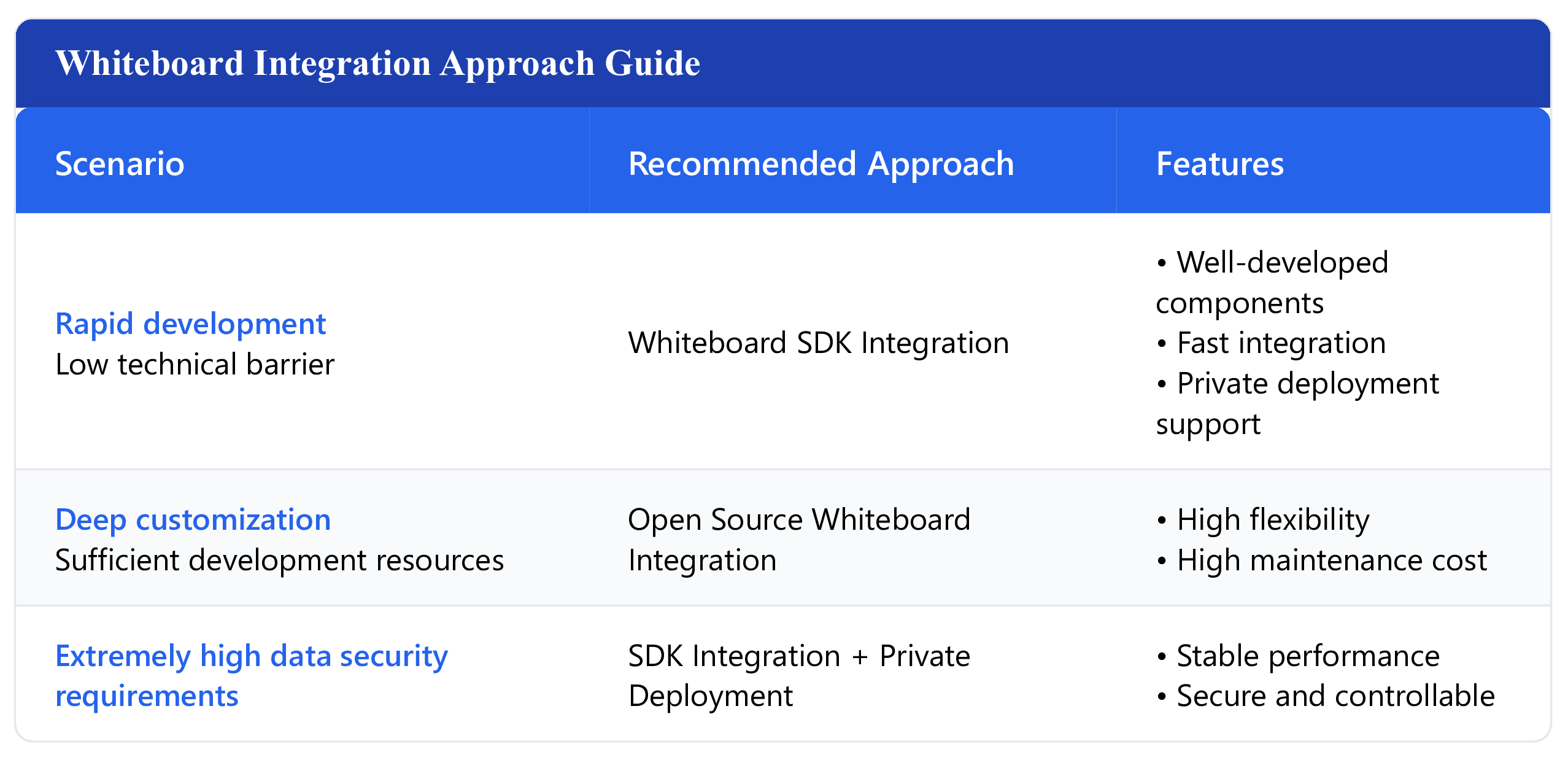
If the organization is comparing infrastructure models, review the distinct on-premise and private-cloud trade-offs instead of treating the terms as interchangeable.
5. Integration Interface Requirements
Describe the host-to-whiteboard contract in both directions. The RFP should cover initialization, user and tenant context, board identifiers, events, imports, exports, file handling, error responses, retries, and version compatibility. Add webhooks, APIs, or host callbacks only when the workflow requires them.
For every interface, provide a sample request or event, the expected response, error handling, authorization rule, and owner. Ask how changes are announced and how the integration can be tested before a production upgrade.
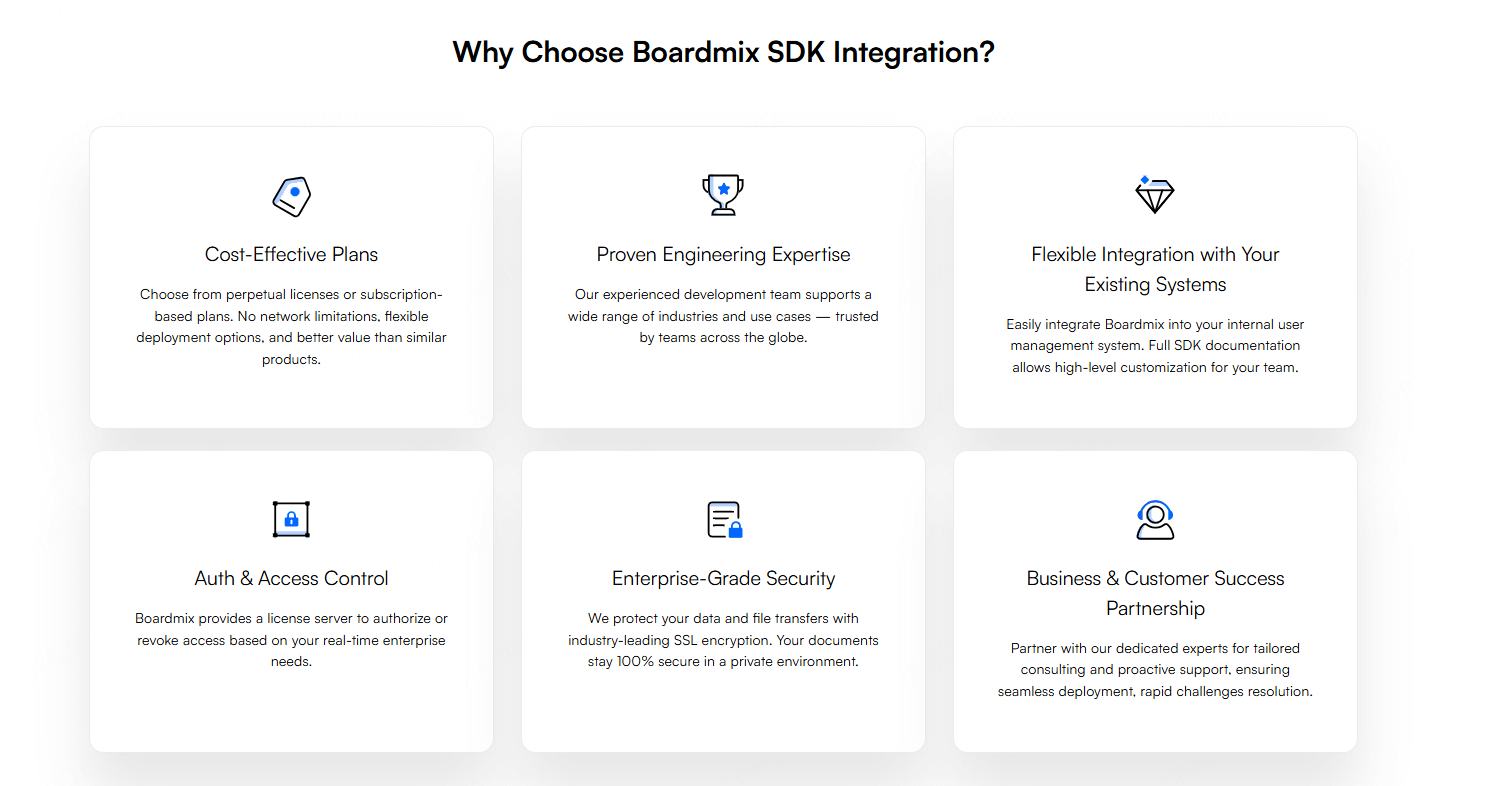
When Boardmix is under consideration, the published Boardmix SDK integration page can be included in the vendor-evidence set. The team should still map the published scope to its own requirements and verify each must-have in the POC.
6. Non-Functional and Operating Requirements
Non-functional requirements need a workload, measurement method, environment, and pass condition. A request for a "fast" canvas is not testable; a team-defined response target for a named action under a stated board size and participant scenario is.
- Performance: identify representative board sizes, operations, devices, networks, and participant scenarios.
- Reliability: define recovery behavior, data-loss tolerance, and the evidence expected after an interrupted operation.
- Observability: list the health signals, logs, audit events, and alerts required by support teams.
- Compatibility: name supported browsers, devices, input methods, host layouts, and embedded viewport sizes.
- Supportability: define incident ownership, escalation inputs, maintenance communications, and upgrade responsibilities.
Do not insert arbitrary industry numbers. The accountable team should set thresholds from its actual service objectives and user conditions.
Build an RFP Response Matrix
| Field | What to record |
|---|---|
| Requirement ID | A stable identifier used in the RFP, POC, and final decision |
| Priority | Must-have, should-have, or out of scope |
| Vendor response | Supported, configurable, requires custom work, planned, or unsupported |
| Evidence | Documentation, configuration, demonstration, test result, or contract term |
| POC test | Setup, action, expected outcome, and failure case |
| Owner | Person or team responsible for validation |
| Status | Passed, failed, exception requested, or not tested |
Require vendors to explain dependencies and custom work instead of answering with a simple yes. A capability that needs an additional service, license, or implementation should not be scored as equivalent to a capability available in the proposed configuration.
Run a POC That Tests the Real Workflow
- Freeze the test scope. Select one representative workflow and the highest-risk roles, integrations, and failure cases.
- Prepare realistic fixtures. Use approved sample boards, files, user roles, and host records that resemble the intended use without exposing sensitive production data.
- Record the environment. Note the product version, configuration, browser, device, network conditions, and connected services.
- Execute each acceptance criterion. Capture the expected result, actual result, evidence, tester, and date.
- Retest failures after a documented change. Do not silently change the test or requirement to create a pass.
- Close with an exception review. Assign an owner, impact, mitigation, and decision for every unresolved must-have.
Minimum POC acceptance set
| Area | Representative test | Pass evidence |
|---|---|---|
| Host entry | Open the correct board from the correct host record and user context | Recorded mapping and successful access |
| Permissions | Exercise allowed and denied actions for each critical role | Observed behavior matches the permission matrix |
| Collaboration | Edit concurrently, interrupt a connection, and reconnect | Observed result matches the agreed collaboration behavior |
| Data lifecycle | Create, export, restore, archive, and delete approved test content | Artifacts and records match the lifecycle requirement |
| Failure handling | Trigger a safe test failure and inspect the user message and operational evidence | Error and diagnostic evidence reach the named owners |
| Operations | Run the agreed health, backup, support, or upgrade exercise | Operating owner accepts the documented outcome |
Whiteboard Integration Requirements FAQ
How many requirements should an RFP contain?
There is no useful universal number. Include the requirements needed to distinguish acceptable solutions and manage material risk. Remove duplicate or non-testable items, and prioritize what must be proven during the POC.
Should a product team choose a vendor before the POC?
The team may create a shortlist, but it should avoid treating the POC as a formality. The pilot exists to test unresolved requirements and expose integration work before a final commitment.
What is the difference between a demo and a POC?
A demo shows a prepared product flow. A POC runs agreed acceptance tests in a recorded environment using representative identities, content, integrations, and failure cases. The latter produces evidence tied to the team's requirements.
What happens when a must-have requirement fails?
Record the failure and decide whether to reject the option, approve a documented exception, change the architecture, or require verified remediation. Do not relabel the requirement after the result merely to improve the score.
Final Review Before Approval
Approve a whiteboard integration only when every must-have requirement has evidence, every exception has an owner and accepted impact, and operational responsibility is explicit. The final decision record should preserve the RFP response, POC results, assumptions, unresolved risks, and the configuration that was evaluated. That record is more valuable than a generic claim that one solution "won."