



Your security team spends months hardening endpoints, auditing SaaS applications, and enforcing zero-trust network policies. Then someone shares a product roadmap on an online whiteboard — a tool most IT departments have never formally assessed, running on infrastructure your organization doesn’t control, storing data that could cause serious damage if it leaked.
This is the quiet risk hiding inside enterprise collaboration. Online whiteboard data security is routinely overlooked in security audits, yet the data that flows through these tools is often among the most sensitive your organization generates: product strategy, M&A timelines, financial models, customer journey maps, and competitive analysis — all living on a vendor-hosted canvas.
For IT managers, CISOs, and compliance officers, the question is no longer whether whiteboard security matters. It does. The question is whether your current tool’s architecture actually meets the standards your organization is required to maintain.
Why Online Whiteboard Data Security Matters More Than You Think
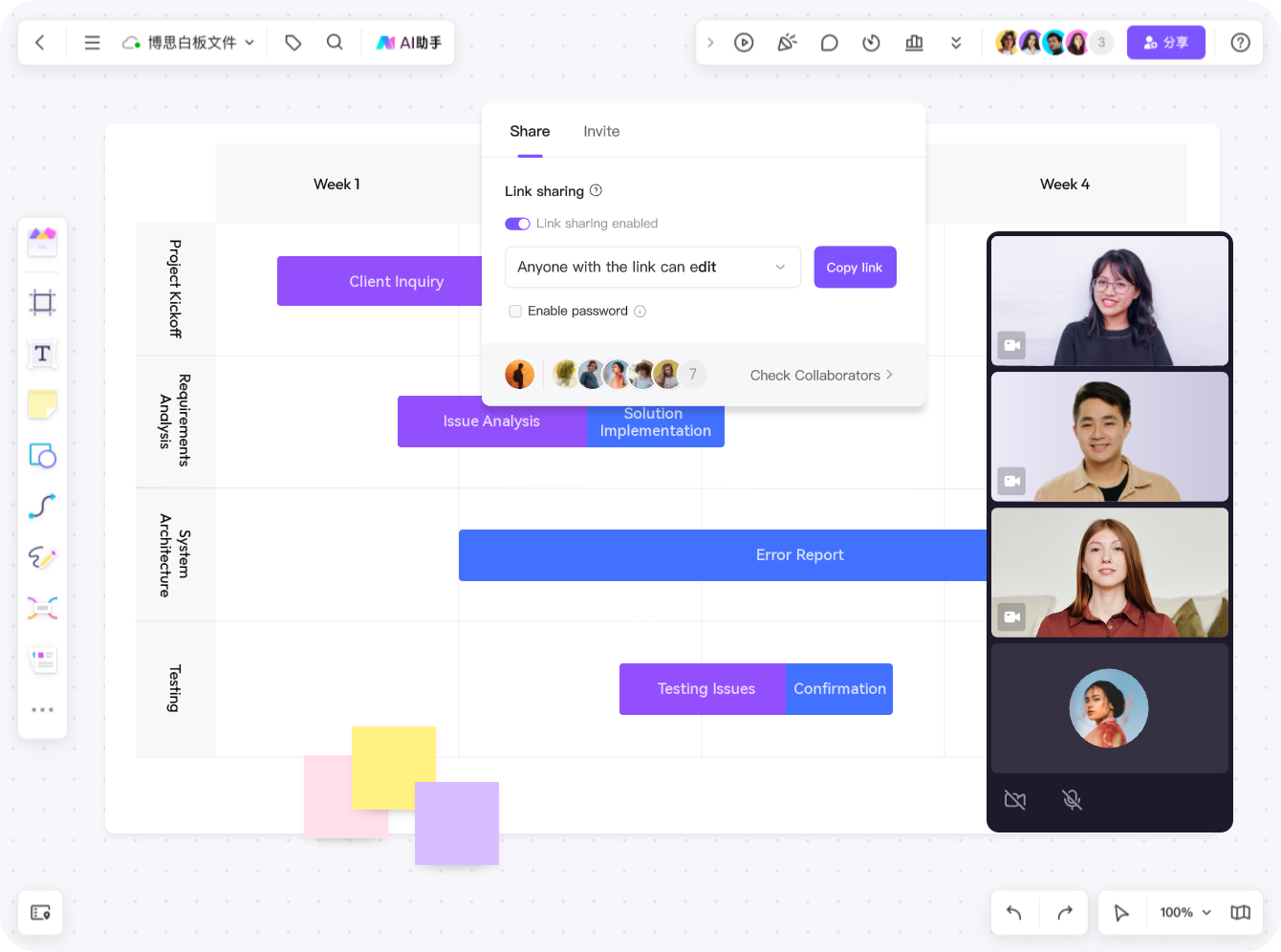
Online whiteboards have quietly evolved from digital sticky-note boards into the nerve centers of enterprise collaboration. Strategy planning, product development, board-level workshops, design sprints — these activities produce some of the most sensitive intellectual property your organization generates. And increasingly, they happen on shared SaaS canvases that nobody in security formally approved.
What Sensitive Data Lives on Whiteboards
Consider what a typical enterprise team commits to a whiteboard session in a single quarter. New product features awaiting public announcement. Organizational restructuring diagrams shared only with senior leadership. Merger and acquisition target analyses discussed by the executive team. Customer data mapped during journey workshops. Financial forecasts and headcount models reviewed before the board meeting.
None of this is trivial. In regulated industries — healthcare, financial services, legal, government — it may be subject to strict handling requirements under GDPR, HIPAA, or SOC 2 compliance frameworks. A single improperly secured collaboration session can expose data that triggers regulatory action, competitive damage, or reputational harm that takes years to repair.
The Risk Landscape: Breaches, Unauthorized Access, and Foreign Jurisdiction
According to the Verizon Data Breach Investigations Report, compromised credentials remain the dominant attack vector in data breaches — and a single compromised account on a shared SaaS whiteboard extends its blast radius to every board that account has ever accessed. Enterprise whiteboard platforms accumulate years of sensitive session content. That data does not expire when the session ends.
Foreign jurisdiction compounds the risk. When your whiteboard data lives on servers operated by a US-headquartered SaaS vendor, it may be subject to legal discovery processes, government data requests, or compliance obligations that directly conflict with your own data governance framework — particularly for organizations operating under EU, UK, or Australian data protection law.
Regulatory Pressure Is Intensifying
The European Union’s GDPR regulation mandates that organizations processing personal data maintain clear, demonstrable control over where data is stored and who can access it. HIPAA imposes strict requirements on organizations handling protected health information, including in collaboration contexts. SOC 2 Type II certification requires evidence that data in transit and at rest is encrypted, access is logged, and controls are consistently enforced across an audit period.
For enterprises subject to any of these frameworks, “we use a reputable SaaS provider” is no longer a sufficient answer. Auditors and regulators want documented controls, verifiable data residency, and evidence of continuous monitoring — none of which come standard with most cloud whiteboard tools.
The Two Security Models: SaaS Cloud vs. Private Deployment
Every whiteboard tool your team might adopt falls into one of two fundamental security architectures. Understanding the structural difference is the foundation of any informed procurement decision.
How SaaS Whiteboard Security Works
In a SaaS (Software as a Service) whiteboard model, the entire application — servers, storage, databases, and compute — is owned, operated, and maintained by the vendor. Your organization accesses the tool via a browser or desktop client. The vendor manages uptime, security patching, infrastructure scaling, and data backup.
The security controls you receive depend entirely on what the vendor has built and what your subscription tier unlocks. Enterprise plans from reputable vendors typically include SSO integration, role-based access control (RBAC), TLS encryption in transit, and AES-256 encryption at rest. Some offer compliance certifications and GDPR data processing agreements.
What they structurally cannot offer is data residency certainty. Your whiteboard data lives on multi-tenant infrastructure shared with thousands of other customers, in data centers whose location may shift without notice, subject to the vendor’s own security posture and the legal obligations of their operating jurisdiction.
How Private (Self-Hosted) Deployment Works
In a private deployment — also called on-premise or self-hosted whiteboard — your organization installs and runs the whiteboard application entirely within its own infrastructure: a physical on-premise server, a private cloud environment, or a dedicated VPC within a public cloud provider.
Your team controls the hardware, the network, the storage, the access policies, and the update schedule. The vendor provides the application software and deployment support. Data never traverses the public internet to a vendor-controlled server. It stays where you put it, behind your own firewall, subject only to your organization’s security controls.
This architecture is the foundation of genuine enterprise whiteboard data protection. It enables complete data residency control, the ability to enforce internal zero-trust policies, custom LDAP and SSO configurations, and audit log integration with existing SIEM infrastructure.
SaaS vs. Private Deployment — Online Whiteboard Data Security Comparison
| Security Dimension | SaaS Cloud | Private Deployment |
|---|---|---|
| Data Location | Vendor-controlled data centers; jurisdiction may vary without notice | Your own servers, private cloud, or VPC — fully under organizational control |
| Access Control | Vendor-defined tiers; SSO and RBAC available on enterprise plans only | Full control — custom LDAP, SSO, RBAC, IP allowlisting, custom policies |
| Compliance Flexibility | Constrained by vendor’s certifications and data processing terms | Configurable to any regulatory framework: GDPR, HIPAA, SOC 2, ISO 27001 |
| Breach Impact | Multi-tenant shared risk — a vendor-side breach affects all customers | Isolated entirely to your own infrastructure; no shared-tenant blast radius |
| Customization | Limited to vendor-provided configuration options and roadmap | Full control over network policies, encryption keys, audit log destinations |
| Setup Complexity | Minimal — account creation and SSO configuration | Requires IT resources: server provisioning, deployment config, and ongoing maintenance |
How Leading Whiteboard Tools Handle Data Security
Not all enterprise whiteboards are built with the same security posture. Here is a direct, comparable assessment of how the five most widely deployed tools approach online whiteboard data security — including the most consequential question of all: whether whiteboard on-premise deployment is even an option.
Boardmix
Boardmix is architected to support both cloud and full on-premise private deployment, making it the only major whiteboard platform where enterprises can genuinely choose their infrastructure. In the private configuration, all data — session content, file attachments, user activity — stays entirely within the organization’s own infrastructure. The enterprise tier includes LDAP/SSO integration, RBAC, audit logging, and support for custom encryption configurations. Boardmix’s AI Agent operates locally in private-deploy mode, meaning session content is never routed to external AI APIs.
Key security strengths:
- Full on-premise deployment supported — data never leaves your infrastructure
- SSO (SAML 2.0/LDAP), RBAC, and audit logs included at enterprise tier
- AI features run locally in private mode; no external data transmission for session content
- Designed to support GDPR, HIPAA, and SOC 2 compliance configurations out of the box
Limitations:
- Private deployment requires internal IT team involvement for provisioning and ongoing maintenance
- Global brand recognition still growing relative to legacy SaaS competitors
Bottom line: For enterprises where data sovereignty is non-negotiable, Boardmix’s whiteboard private deployment delivers structural control that cloud-only competitors cannot match by design.
Miro
Miro is a cloud-only platform with no self-hosted deployment option. Its enterprise security posture is strong within the SaaS model: Miro data security includes SOC 2 Type II certification, GDPR data processing agreements, AES-256 encryption at rest, TLS 1.2+ in transit, and SSO, SCIM provisioning, and RBAC on enterprise plans. EU data residency is available for eligible customers. However, the absence of any private deployment path is a firm architectural constraint for organizations that require data on internal infrastructure.
Key security strengths:
- SOC 2 Type II certified
- GDPR Data Processing Agreement available
- SSO, SCIM provisioning, and RBAC on enterprise tier
- EU data residency option on select plans
Limitations:
- Cloud only — no self-hosted or on-premise deployment option whatsoever
- Multi-tenant infrastructure means vendor breach risk is structurally shared
- Data residency limited to specific geographies and plan tiers
Bottom line: Miro is a credible choice for cloud-first enterprises that can accept vendor-controlled infrastructure. For organizations requiring data on private infrastructure, it is structurally not viable.
FigJam
FigJam inherits Figma’s enterprise security framework and carries SOC 2 Type II certification, SSO, RBAC, and GDPR data processing agreements. FigJam data security applies AES-256 encryption at rest and TLS in transit. The security posture is solid within its scope — but that scope is intentionally narrow, built around the design workflow rather than general enterprise collaboration. There is no private deployment option, and audit logging is less granular than purpose-built enterprise platforms.
Key security strengths:
- SOC 2 Type II certified via Figma’s security program
- SSO and RBAC available on organization plans
- GDPR-compliant data processing
Limitations:
- No self-hosted or private deployment option
- Audit logging less granular than enterprise-grade alternatives
- Security roadmap constrained by Figma’s product priorities
Bottom line: FigJam is adequate for design teams in cloud-first environments. Enterprises requiring deployment flexibility or deep audit capability will quickly reach its ceiling.
Microsoft Whiteboard
Microsoft Whiteboard’s security model extends directly from the Microsoft 365 compliance framework. For M365 enterprise subscribers, whiteboard data is stored within the organization’s own Microsoft 365 tenant, subject to all existing data retention, access control, and compliance tooling — including eDiscovery, DLP policies, and Microsoft Purview integration. This gives it a meaningful data governance advantage for M365-committed organizations: controls are already in place and managed internally, not by a separate vendor.
Key security strengths:
- Data stored in organization’s own M365 tenant — effectively organization-controlled
- Inherits Microsoft 365 compliance: eDiscovery, DLP, Purview, Conditional Access
- SOC 2, ISO 27001, and HIPAA BAA available through M365 compliance tiers
- MFA and Conditional Access enforced via Microsoft Entra ID
Limitations:
- Feature depth and template library significantly limited versus dedicated whiteboard platforms
- Requires active M365 enterprise licensing — not a standalone secure option
- Limited AI collaboration capabilities compared to newer platforms
Bottom line: Microsoft Whiteboard is a strong zero-additional-cost option for organizations fully committed to the Microsoft ecosystem. As a standalone enterprise collaboration platform, it falls well short on features.
Mural
Mural is a cloud-only platform that has invested in enterprise security documentation. It holds SOC 2 Type II certification, supports SSO and SCIM provisioning, and offers a GDPR data processing agreement with US and EU data residency options on enterprise contracts. Encryption is standard: AES-256 at rest, TLS in transit. There is no private or self-hosted deployment path — a firm constraint for organizations that require internal infrastructure control regardless of geographic region.
Key security strengths:
- SOC 2 Type II certified
- SSO, SCIM provisioning, and RBAC available
- EU and US data residency options on enterprise contracts
Limitations:
- Cloud only — no on-premise, private, or self-hosted deployment available
- Data residency limited to US and EU; no option for APAC, LATAM, or other regions
- Vendor breach risk shared across multi-tenant infrastructure
Bottom line: Mural’s enterprise security posture is credible within its SaaS architecture, but the structural absence of deployment flexibility disqualifies it for organizations with strict data sovereignty mandates.
Leading Whiteboard Tools — Online Whiteboard Data Security Comparison
| Security Feature | Boardmix | Miro | FigJam | Microsoft Whiteboard | Mural |
|---|---|---|---|---|---|
| Private Deployment | Yes — full on-premise | No | No | Partial (M365 tenant) | No |
| SOC 2 Type II | Yes | Yes | Yes (via Figma) | Yes (via M365) | Yes |
| GDPR Compliance | Yes | Yes | Yes | Yes | Yes |
| Data Residency Control | Full (self-hosted) | EU option (enterprise) | Limited | M365 tenant | US/EU only (enterprise) |
| Encryption | AES-256 / TLS 1.2+ | AES-256 / TLS 1.2+ | AES-256 / TLS | AES-256 / TLS | AES-256 / TLS |
| SSO / RBAC | SAML 2.0 / LDAP | Yes | Yes | Microsoft Entra ID | Yes |
What to Evaluate Before Choosing a Whiteboard Tool
Security specifications on vendor websites are written to reassure, not to inform. Here is what to actually scrutinize — and why each dimension carries weight in a genuine procurement assessment.
Data Residency and Jurisdiction
Data residency is the question of where, physically, your whiteboard data is stored — and whose laws govern it. A vendor’s SOC 2 certification describes their security controls. It says nothing about whether a government can issue a valid legal request for your data, or whether a data center migration will shift your data to a different jurisdiction without explicit notice. For EU-based organizations, transfers outside the EEA must comply with GDPR’s transfer mechanism requirements. Demand a Data Processing Agreement and an explicit written commitment on data location before signing.
Encryption Standards
The baseline is AES-256 encryption at rest and TLS 1.2 or higher in transit. These are table stakes — any enterprise-grade tool should meet them. The more consequential question is key management: who holds the encryption keys? In most SaaS models, the vendor does. In a private deployment, your organization does. For highly sensitive environments, customer-managed encryption keys (CMEK) provide an additional, contractually significant layer of assurance.
Access Controls: SSO, RBAC, and Audit Logs
Single Sign-On (SSO) via SAML 2.0 or LDAP integration ensures that whiteboard access is governed by your existing identity provider — joiners, movers, and leavers are handled automatically through the HR-to-IdP provisioning chain. RBAC limits what any user can view, edit, or export. And audit logs provide the forensic trail that compliance officers and incident responders require: who accessed which board, when, from which IP address, and precisely what actions they performed.
These three controls together form the operational backbone of secure online whiteboard management. Any tool that offers them exclusively on top-tier plans, or only in cloud configuration, is constraining your security posture by commercial design.
Compliance Certifications
SOC 2 Type II tells you a vendor’s security controls have been independently audited over an extended period — not just assessed in a point-in-time snapshot. Ask specifically for the Type II report, not the badge. ISO 27001 certification indicates a formal information security management system. HIPAA compliance requires a signed Business Associate Agreement. GDPR compliance requires a Data Processing Agreement. Collect the actual documents from every vendor under evaluation.
Deployment Flexibility
The final — and often decisive — criterion: can this tool run entirely within your own infrastructure? For organizations in regulated industries, cloud-only deployment is not a configuration preference. It is a structural disqualifier. Deployment flexibility separates tools that can genuinely serve enterprise data governance requirements from those that are architecturally incompatible with them, regardless of how strong their SaaS security posture appears on paper.
According to NIST’s guidelines on enterprise data security, organizations should maintain the capability to enforce security controls at the infrastructure level wherever sensitive data is processed — a standard that vendor-managed SaaS infrastructure cannot satisfy for many regulated use cases.
Frequently Asked Questions
What is the most secure type of online whiteboard for enterprise use?
The most secure whiteboard configuration is a private or self-hosted deployment, where the application runs entirely within your own infrastructure. This eliminates vendor-side data exposure, gives your organization full control over encryption keys and access policies, and allows the tool to be governed directly by your data governance and compliance frameworks — without depending on a third party’s security posture or contractual commitments.
Does GDPR apply to online whiteboard tools?
Yes. If your organization uses a cloud-based whiteboard and that usage involves processing personal data — including employee-identifiable session activity, comments, or user-linked content — GDPR applies. You must have a Data Processing Agreement with the vendor, ensure data transfers outside the EEA comply with valid transfer mechanisms, and be able to honor data subject rights requests for content stored on the platform.
What is the difference between SOC 2 Type I and SOC 2 Type II for whiteboard security?
SOC 2 Type I is a point-in-time assessment of whether a vendor’s controls are appropriately designed. SOC 2 Type II evaluates whether those controls operated effectively over an extended audit period — typically six to twelve months. For enterprise procurement decisions, Type II is the meaningful standard. It provides evidence of sustained, consistently enforced security discipline rather than a snapshot of documentation quality.
Can an online whiteboard tool be HIPAA-compliant?
Yes, but only if the vendor signs a Business Associate Agreement and the tool is configured with appropriate access controls, encryption, and audit logging. Using a whiteboard that handles protected health information without a BAA exposes the covered entity to direct HIPAA enforcement risk. Private deployment adds a further layer of assurance by keeping all PHI within the organization’s own controlled, auditable infrastructure.
What minimum security requirements should an enterprise whiteboard tool meet?
At minimum: AES-256 encryption at rest and TLS 1.2+ in transit; SSO via SAML 2.0 or LDAP; RBAC with granular permission levels; exportable audit logs covering user access and content modifications; a signed GDPR Data Processing Agreement; and SOC 2 Type II certification. Organizations in regulated industries should additionally require private deployment capability and, where applicable, customer-managed encryption key support.
Conclusion
Online whiteboard data security is no longer a peripheral IT concern. As collaboration shifts to the canvas, your most sensitive intellectual property moves with it — and the tool your organization chooses determines whether that data remains under your control or lives on infrastructure you do not own, cannot independently audit, and cannot fully govern.
For enterprises where data sovereignty is the standard — not the exception — Boardmix private deployment is the only whiteboard architecture that meets the bar completely