The World Café method brings people into small-group conversations, then moves them between tables so ideas travel beyond the group that first raised them. Each round builds on what came before, and the session ends with a shared “harvest” of insights, connections and unanswered questions.
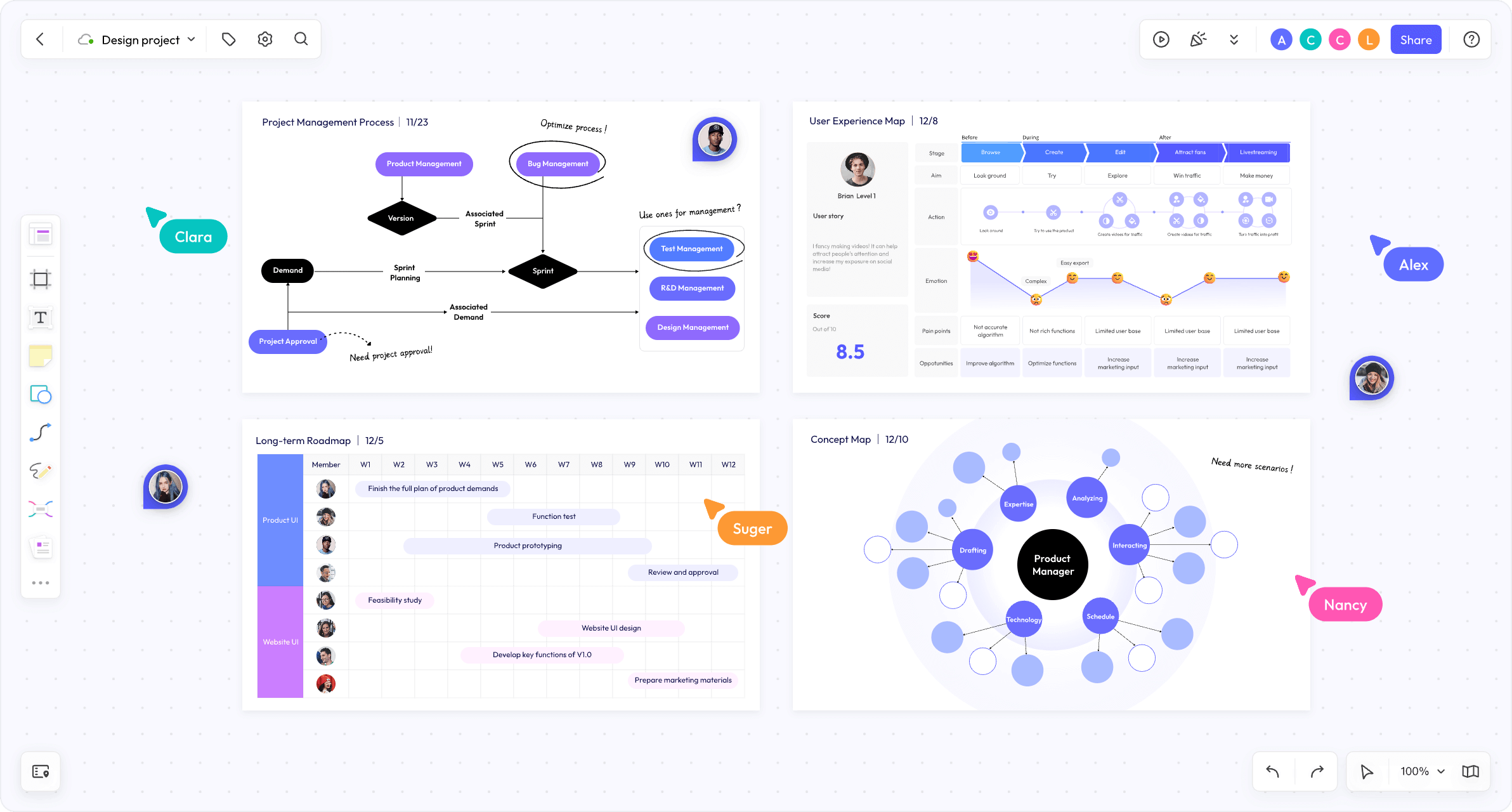
Use it when a group needs to understand a situation from several perspectives. It is less suitable when the purpose is simply to announce a decision or choose between fully specified options. A shared workshop whiteboard can hold the table notes and make the connections visible, whether the conversations happen in a room or through a separate online meeting.

How the World Café method works
The World Café Community Foundation's method guide describes five elements: a welcoming setting, an introduction, small-group rounds, purposeful questions and a collective harvest. Its basic model uses three or more rounds of about twenty minutes, with four people at a table ideally and no more than five.
Those details are a starting structure, not a promise that a particular agenda will fit every group. The context and purpose shape the questions and timing. A table host may remain to welcome the next group and explain earlier notes; keeping a host is an option, not a requirement of every World Café.
Unlike 1-2-4-All, which moves from individual reflection to pairs, quartets and the whole group, World Café develops ideas through repeated small-table conversations. The movement between groups matters. Three ordinary breakout discussions with no exchange of people or ideas would miss that mechanism.
Prepare a question people can discuss from experience
Our worked example brings together twelve people from customer support, warehouse operations and finance, with a facilitator guiding the session. They want to understand why customer returns lose context between teams.
The opening question is: “What makes a customer-return handoff difficult for the next person?” It invites experiences from different roles without assuming that the answer is a new form, a new system or a faster refund.
“How can we make everyone use the new return form?” would instead steer people toward a decision already made. “How can we improve everything?” gives the conversation too little focus. A useful question names the shared situation while leaving room for different explanations.
Explain who will use the insights and what the group can influence. Here, the session can propose improvements to handoff information, but it cannot change refund policy during the conversation. Keep personal customer details out of the shared notes; describe the situation rather than copying an identifiable case.
Set up the tables and a workable agenda
For this example, create three tables with four participants each. One person at each table agrees to stay as its host, while the other nine rotate. On the shared board, give each table its own labeled area with space for the question, notes from each round and connections worth bringing back to everyone.
The following ninety-minute plan includes introductions, three twenty-minute conversations, movement and a final harvest. It is an example schedule; adapt it when the group needs more time to read, interpret or change rooms.
| Time | Activity | Question or purpose |
|---|---|---|
| 0–10 minutes | Welcome and explain the format | Set the return-handoff context, show the board and explain how notes will travel. |
| 10–30 minutes | Round 1 | What makes a customer-return handoff difficult for the next person? |
| 30–33 minutes | Move and introduce previous ideas | Travelers join a new table; hosts explain the earlier discussion. |
| 33–53 minutes | Round 2 | What would the next person need to understand, and why? |
| 53–56 minutes | Move again | Bring a connection or question from the previous table. |
| 56–76 minutes | Round 3 | Which changes could make the handoffs work together, and what remains uncertain? |
| 76–90 minutes | Harvest with the whole group | Share the important connections, differences and questions to investigate. |
The host's job is to help newcomers enter the conversation, not to defend the first group's conclusions. Leave earlier notes visible and add later contributions beside them. Otherwise, every round becomes a fresh discussion and the group loses the benefit of rotation.
Use a clear rotation plan
A simple plan prevents people from spending the break deciding where to go. In this example, hosts A, B and C stay at their tables. Travelers are numbered 1–9. Each traveler visits all three tables once.
| Round | Table A, with host A | Table B, with host B | Table C, with host C |
|---|---|---|---|
| 1 | Travelers 1, 2, 3 | Travelers 4, 5, 6 | Travelers 7, 8, 9 |
| 2 | Travelers 4, 7, 8 | Travelers 1, 2, 9 | Travelers 3, 5, 6 |
| 3 | Travelers 5, 6, 9 | Travelers 3, 7, 8 | Travelers 1, 2, 4 |
This is one practical arrangement, not an official rotation rule. Use names in the actual session and choose starting groups that bring different perspectives together. A traveler should carry an idea or question, not deliver a long report of everything the previous table said.
Worked example: how a table's conversation develops
At Table A, the first group describes a familiar problem: support marks a return as approved, but the warehouse receives an item without enough information to match it to that approval. Their initial note is “Return reference missing from the handoff.”
In round two, a warehouse participant adds a useful difference. Sometimes the reference exists, but the item has arrived in a different condition than expected. A single “received” status does not explain whether inspection is complete. The table adds “Item received” and “Inspection complete” as distinct states instead of replacing the original reference problem.
In round three, a finance participant connects this to customer communication: a customer may hear that the item was received and assume the refund is already authorized. The group proposes showing the relevant state and the next team responsible, while keeping approval requirements separate.

| Round | New contribution at Table A | What stays visible |
|---|---|---|
| 1 | The next team cannot always match the item to its return approval. | The missing reference and where it was needed. |
| 2 | Receiving the item and completing inspection are different events. | The reference problem plus the two distinct states. |
| 3 | Customer updates should explain the current state without implying a refund is authorized. | The information needed at each handoff and the unresolved approval boundary. |
At another table, someone argues for one shared status; a colleague worries that this would conceal differences between receipt and inspection. Keep that disagreement. A polished note saying “Improve transparency” would erase the exact issue the group needs to resolve.
Harvest connections, not three long table summaries
Bring everyone back to the shared board and ask what became clearer after moving between groups. Invite insights that connect conversations, not a recital of every sticky note.
The return-handoff session might produce three linked findings: the return reference must travel with the item; the teams need distinct receipt and inspection states; and customer updates must not imply approval that has not happened. Beside them, preserve the open question: which system or person can provide each state reliably?
Those findings can inform a later process-mapping or implementation discussion. They are not automatically an approved process. If someone will take the work forward, name the next question they need to answer and keep the relevant notes attached.
Adapt World Café for online participation
Use a separate audio space for each conversation and a clearly labeled Boardmix area for each table. Test how participants will move between the meeting rooms and board areas before the session; the board itself does not establish how the audio groups are managed.
Keep the current question visible, make the notes large enough to read at the working zoom level and allow written contributions as well as speech. Ask a host to orient a newcomer to the previous notes rather than expecting them to read a crowded canvas while everyone talks.
Open a Boardmix board and arrange the three table areas, rotation plan and harvest space. After the session, leave the original table notes beside the combined insights so someone who was not there can understand how the conversation developed.