You ask a group for ideas and the same three people respond. Asking louder or waiting longer does not necessarily change who participates. The 1-2-4-All facilitation method changes the shape of the conversation: people think alone, compare ideas in pairs, develop them in groups of four, and then share with everyone.
That sequence gives an unfinished thought somewhere smaller to develop before it reaches the whole room. It is useful when you want contributions from across a group, especially when a presentation, planning question, or difficult discussion would otherwise turn into a conversation among the quickest speakers.

Understand the four configurations
1-2-4-All is a Liberating Structure developed by Henri Lipmanowicz and Keith McCandless. The numbers describe participation, not the number of ideas required: one person reflects, two people exchange ideas, two pairs form a quartet, and the full group hears selected contributions.
The current official guide allocates one minute for individual reflection, two for pairs, five for quartets, and seven for whole-group sharing, with an introduction beforehand. Treat those timings as a starting structure. Allow additional setup time when participants need interpretation, accessible materials, or help moving between remote groups.
Unlike brainwriting, the central mechanism is not passing written ideas around. The small-group conversations matter: people explain, question, and develop their thinking before speaking in the larger group. Notes help preserve what emerges, but a board filled with silent responses alone is not the same exercise.
If the group needs longer conversations across several table topics rather than a progression from individuals to quartets, consider the World Café method. Participants rotate between small groups while the table notes retain what earlier conversations contributed.
Write an invitation people can answer
Our worked example is a twelve-person team discussing how new colleagues ask for help. Its invitation is: “What could we change so a new colleague can ask a useful question during their first month without feeling they are interrupting?”
This question gives people a recognizable situation and leaves room for different answers. “How can we improve onboarding?” is broader and may produce unrelated suggestions about equipment, payroll, training, and team culture. “Should we create an onboarding chatbot?” has already chosen the solution.
Explain the practical boundary before starting. In this example, participants can suggest changes to their team's routines and materials, but they cannot promise changes to company-wide systems. Ask for observations and proposals in separate notes where that distinction matters. “I could not find the right person to ask” is an experience; “Assign a question buddy” is a possible response.
Do not seed the board with the manager's preferred ideas. If you need an example to explain the activity, use a neutral topic rather than placing the likely answer in front of everyone.
Run the individual and pair stages
One person: start with quiet reflection
Read the invitation aloud and leave it visible. Give everyone time to write independently. Ask participants to record a concrete thought rather than a polished presentation. Someone might write “Show who knows what,” “Let me ask privately first,” or “Explain which channel is for basic questions.”
Keep the room quiet during this stage. A running explanation from the facilitator competes with the reflection time. In a remote session, people can write privately before adding their notes to the shared board if seeing everyone else's ideas would distract them.
Two people: explain and build
Form six pairs. Ask each person to explain their thought before the pair develops it further. They do not have to choose a winner. “Question buddy” and “Expert directory” could address different needs: one offers reassurance, while the other helps someone locate relevant knowledge.
A useful prompt is “What would this look like for someone starting next Monday?” It encourages specifics. The pair might turn “Be welcoming” into “A named colleague checks whether the newcomer knows where to ask their first task-related question.”
If one participant immediately evaluates every suggestion, remind the pair to understand the ideas before eliminating them. The short timebox makes premature judgment particularly costly: the other person's thought may disappear before it has been explained.
Combine pairs without losing differences
Join the pairs into three quartets. Each pair brings its ideas and the reasoning behind them. Ask the quartet to look for connections, useful differences, and something the full group should hear.
One pair proposes a question buddy. Another wants a visible question channel. These can reinforce each other, but combining them into “Improve communication” loses the practical choices. Preserve both and ask when each would help.
| Contribution | What develops in the quartet | Detail worth preserving |
|---|---|---|
| A named question buddy | A newcomer has a first contact who helps route questions | The buddy does not need to know every answer |
| A visible place for basic questions | Useful answers can be found by later newcomers | Some questions should remain private |
| A directory of team knowledge | People can find a colleague with relevant experience | A name without availability information can still lead nowhere |
| Protected time for questions | The team makes asking easier to fit into daily work | One fixed time may exclude colleagues in other time zones |
The privacy point may come from only one participant. It should not disappear because three people prefer a public channel. A quartet is a setting for developing ideas, not a requirement to erase disagreement or claim unanimous support.
If the group gets stuck trying to present a perfect combined answer, ask it to share the unresolved choice instead. “We see a benefit in searchable answers, but need a private route too” is a useful contribution.
Bring the ideas back to everyone
Return to the full group and invite contributions that add something others should hear. For twelve participants, hearing from each quartet is manageable. Ask later speakers to build on what is already visible rather than repeat it with slightly different wording.
Capture ideas under concrete labels, such as “First contact,” “Findable answers,” and “Private route.” Keep the notes about time zones and availability beside the proposals they qualify. A tidy list that drops those conditions is less useful than the discussion that produced it.
Do not treat this sharing stage as an automatic decision. The team may need to compare feasibility, consult absent colleagues, or ask new starters which difficulty they actually experience. If a decision is required immediately, explain the decision rule separately instead of suggesting that the most frequently repeated idea has already won.
Prepare the Boardmix workspace
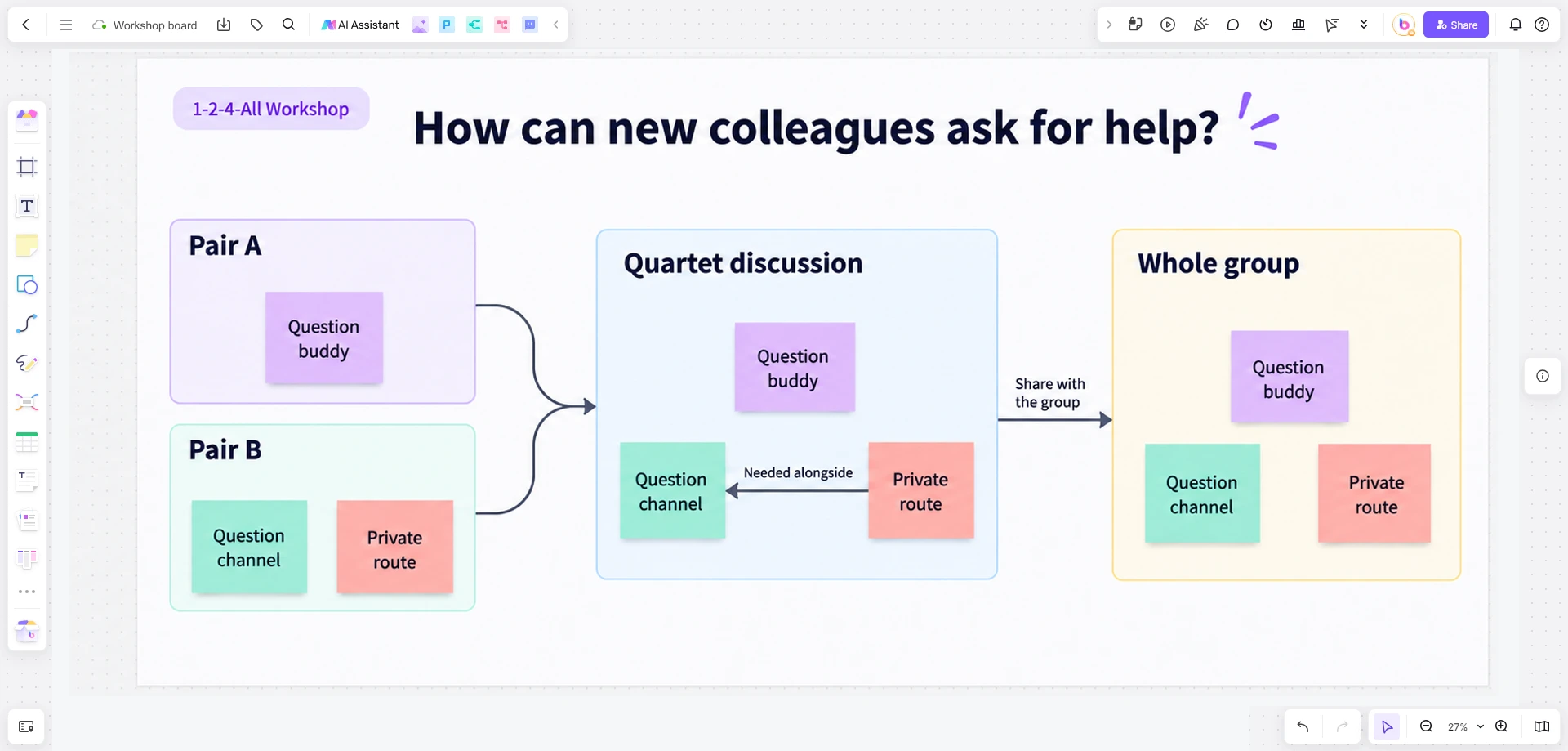
Open Boardmix and place the invitation at the top of a blank board. Beneath it, create working areas for the three quartets. Within each area, leave space for two pairs and a shared set of notes. Put a separate whole-group area to the right.
- Use simple text labels for Pair A, Pair B, and Quartet discussion. Participants can recognize where their small group belongs without learning a complicated layout.
- Add a sticky note for each idea. For the example quartet, retain “Question buddy,” “Question channel,” and “Private route” as separate notes.
- Use connectors or short annotations to show relationships. Connect “Private route” to the channel proposal with the label “Needed alongside.”
- When the quartet shares, copy the relevant notes into the whole-group area and keep the originals available. This preserves context if a short label needs explanation.
For remote participation, arrange the voice conversation in your meeting tool and use Boardmix for the shared material. Set up group membership before the exercise. Moving six pairs into three quartets is much smoother when people already know where to go. The board layout does not itself create audio breakout rooms.
Adjust the structure without promising equal influence
The format makes room for more contributions, but hierarchy and interpersonal risk do not disappear. Avoid placing a newcomer in a pair where they are unlikely to speak candidly. Offer a way to raise a sensitive concern without adding personal details to the shared board.
If remote group changes are impractical, the official guide suggests a 1-3-All variation. Explain that change to participants rather than pretending that pairs and quartets took place. With trios, be especially attentive to whether all three people have room to speak.
In the onboarding example, the discussion may end with a small experiment: pair the next new colleague with a first contact while leaving both public and private ways to ask questions. The important detail is the combination. It emerged because a concern voiced by one person remained visible as the group grew.