Revenue streams in a business model canvas explain what customers pay your business for. A useful entry names the customer, the offer, and how the charge works. “Camera rental charged per day” describes a stream. “Credit card” only describes how someone pays. “$40” is a price without enough context to explain the model.
Use a shared business model canvas to connect each revenue stream to the customers, activities, and resources that make it possible. This guide works through a fictional camera-rental business, including a completed revenue worksheet, one booking, and a membership alternative. The example explores a business design; it does not report market prices or business results.
Revenue stream, pricing, and payment method are different
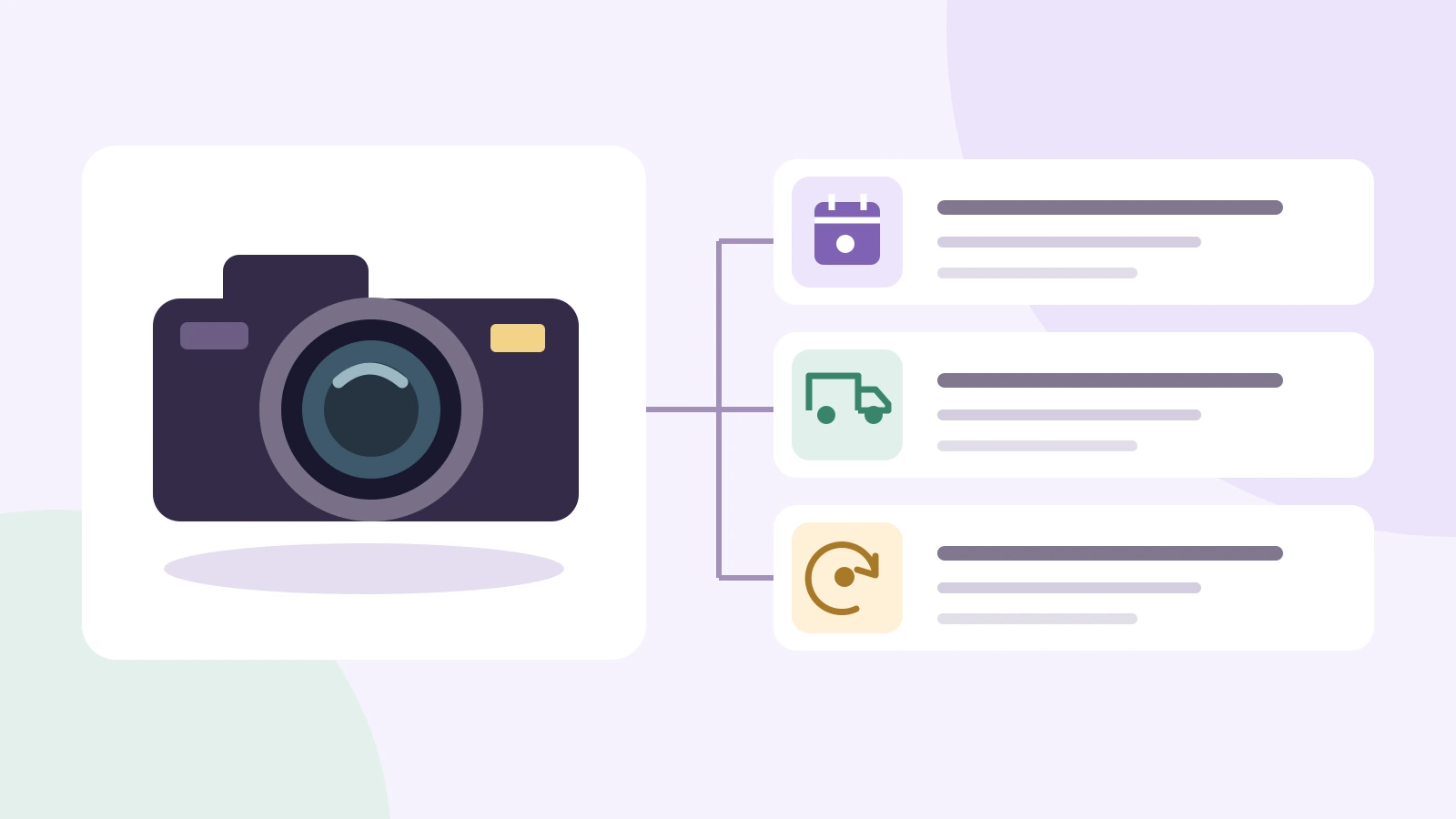
Three decisions often get mixed together in the bottom-right block of a canvas:
- Revenue stream: What does the customer buy? For the rental business, one stream is temporary use of camera equipment.
- Pricing mechanism: How is the amount determined? A rate per kit per rental day, with a defined pickup and return window, makes the charge understandable.
- Payment method: How does money move? A card payment or bank transfer does not become another stream simply because it uses a different channel.
Payment timing is another useful detail. The customer might pay when reserving equipment or receive an invoice under an agreed account arrangement. Neither choice changes what the business is selling, although it changes the booking and collection process.
The original Business Model Canvas connects nine building blocks rather than treating revenue as an isolated list. A proposed stream needs a customer who values the offer and an operation capable of delivering it. More streams are not automatically better: each additional offer can introduce work, costs, or confusion.
Worked example: a camera-rental revenue worksheet
Imagine a local rental service for freelance photographers and small production teams. It owns camera kits, checks equipment between bookings, and offers collection from its premises. Delivery is optional. The team is also considering membership for customers who rent regularly.
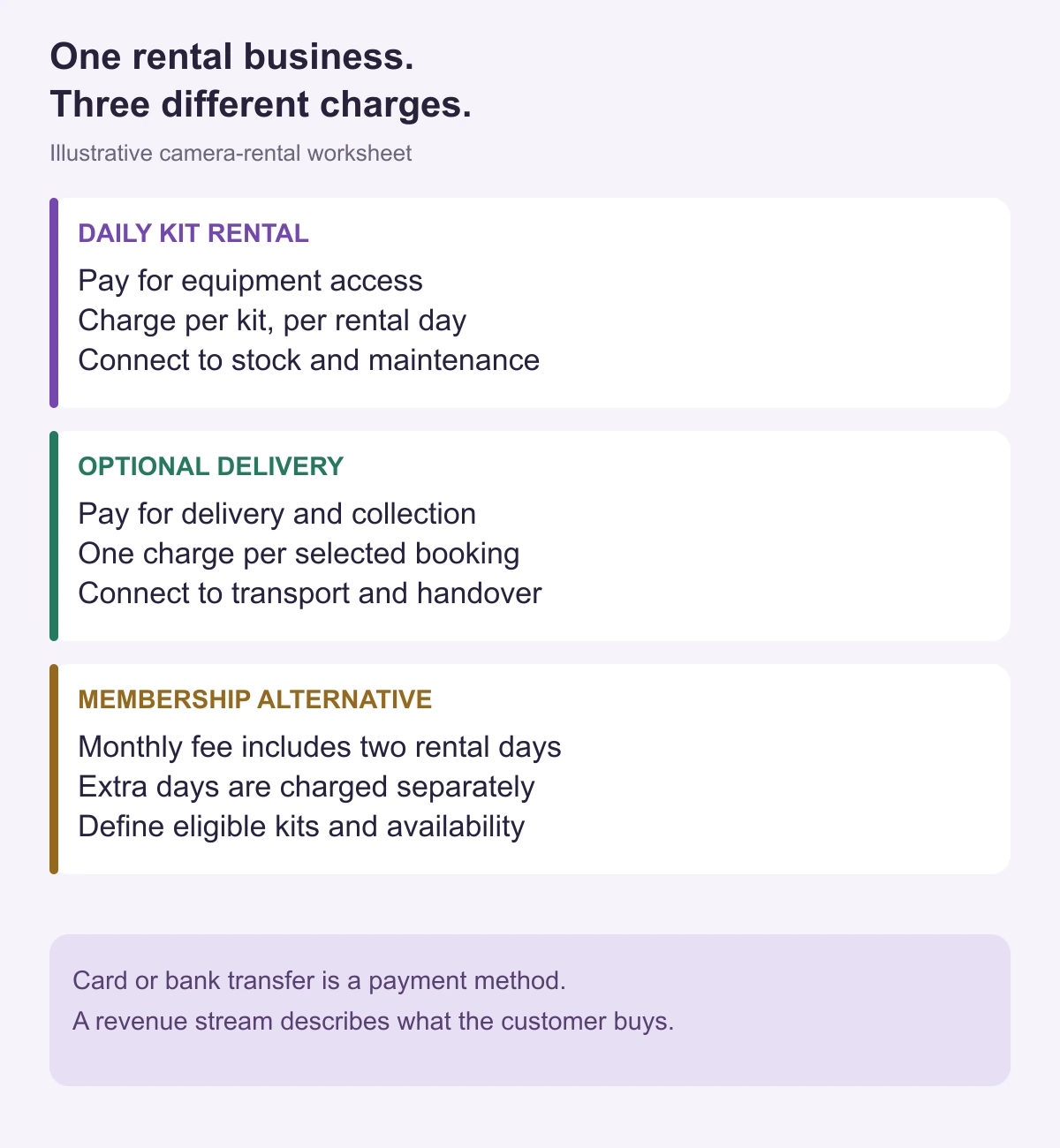
1. Equipment rental: access to a kit for an agreed period
- Customer and value: A photographer needs a suitable camera kit for a particular shoot without purchasing it.
- Charging unit: One kit for one rental day. Define when a rental day starts and ends.
- Price mechanism: A published rate for the selected kit and duration. Any longer-booking discount needs a clear rule.
- Payment timing: Payment when the reservation is confirmed in this illustrative model.
- Required operation: Availability management, handover, return inspection, cleaning, and maintenance.
A concise canvas entry could read: “Daily camera-kit rental fees from photographers and production teams; rate depends on kit and booked duration.” Keep the detailed rate list beside the canvas rather than squeezing every price into the block.
2. Optional delivery: bringing the booked kit to the customer
- Customer and value: A renter wants to avoid collecting and returning equipment in person.
- Charging unit: A delivery-and-collection service for one booking.
- Price mechanism: A flat charge within the defined service area; requests outside that area require a separate quote.
- Payment timing: Added to the reservation payment when the customer selects delivery.
- Required operation: Scheduling, transport, a handover contact, and a return-collection arrangement.
The stream is the delivery service, not the transport provider. If the renter collects the kit, there is no delivery charge. This distinction helps the team avoid counting optional revenue on every booking while overlooking the cost of the bookings that actually need it.
3. Membership: a different offer, not a new name for rental
For the alternative model, suppose a monthly membership includes two rental days for eligible kits. Extra days are charged separately, and delivery remains optional. This is a proposed package, not an existing customer entitlement.
The canvas entry becomes: “Monthly membership fees from frequent renters, plus charges for rental days beyond the included allowance.” The team must define eligible equipment, unused allowances, and how members reserve stock. A subscription creates an ongoing service obligation; it does not establish that customers will join or that equipment will always be available.
Follow one booking through the model
A freelance photographer reserves one kit for a three-day shoot and chooses delivery. Under the daily-rental model, the booking consists of three days of kit rental plus one delivery-and-collection charge. The card transaction settles that booking; it is not an additional revenue stream.
Now place the same booking in the proposed membership model. If the customer has both included days available, the booking uses those days and adds one separately charged rental day, plus delivery. The monthly membership fee is recorded as membership revenue; the included days should not also be counted as ordinary paid rental days.
This comparison exposes a practical question: does the membership offer encourage useful repeat bookings, or mainly discount rentals that would have happened anyway? A canvas cannot answer that by itself. Customer conversations, a clearly specified offer, and actual booking behavior provide different pieces of the answer.
Connect each stream to costs and capacity
Revenue is not profit. A busy calendar can still produce a weak model if pricing overlooks the work between bookings. Trace the service across the other canvas blocks:
- Key resources: The rentable kits, storage space, booking records, and people who handle equipment. The same kit cannot serve overlapping reservations.
- Key activities: Inspecting, cleaning, preparing, handing over, and maintaining equipment. Time between rentals affects usable capacity.
- Key partners: Repair specialists or delivery providers, where those services are outsourced.
- Cost structure: Equipment acquisition and replacement, premises, staff time, maintenance, payment processing, and delivery.
- Customer relationships: Support for choosing equipment, changing bookings, and resolving handover problems.
Keep delivery revenue next to delivery costs. For membership, consider the mix of equipment customers are likely to request, not just the number of members. An allowance that concentrates demand on a few popular kits may create a capacity problem even when other equipment sits idle.
The useful comparison is therefore not “subscription versus no subscription.” It is whether a defined package suits a particular customer group and can be delivered with the resources available.
Build the comparison on a shared canvas
Start with a business model canvas template. Keep the daily-rental model in one area and the proposed membership version beside it. Use the same customer scenario in both so a change in charging does not get confused with a change in audience.
- Write one note per stream. Use “Daily kit rental,” “Optional delivery,” and, in the proposal, “Monthly membership.” Place the customer and charging unit beneath each label.
- Keep the booking example visible. Add the three-day shoot beside both versions. Show which parts are included and which receive an extra charge.
- Connect changed blocks. Link membership to equipment availability and booking rules. Link delivery to transport activities and costs.
- Review with different roles. The person handling bookings can explain demand conflicts; operations can identify turnaround work; finance can check whether the charge and cost definitions are consistent.
Use comments beside the relevant note to discuss a change without losing its context. Keep customer interview notes or booking summaries nearby, with sensitive details removed. Boardmix provides the shared visual workspace; it does not calculate the profitability of the proposal from the canvas.
What should you have when you finish?
A useful revenue block lets someone explain who pays, what they receive, how the charge is calculated, and which costs or capacity constraints the offer creates. For the rental example, “card payments and subscriptions” becomes a concrete choice between daily hire with optional delivery and a defined membership package.
If the team is still debating a vague label, rewrite it around one customer transaction. If the transaction works on paper but depends on an untested behavior, such as frequent renters accepting a monthly commitment, make that the next question to investigate. Open a Boardmix workspace to compare the alternatives with the people who would sell, deliver, and support them.