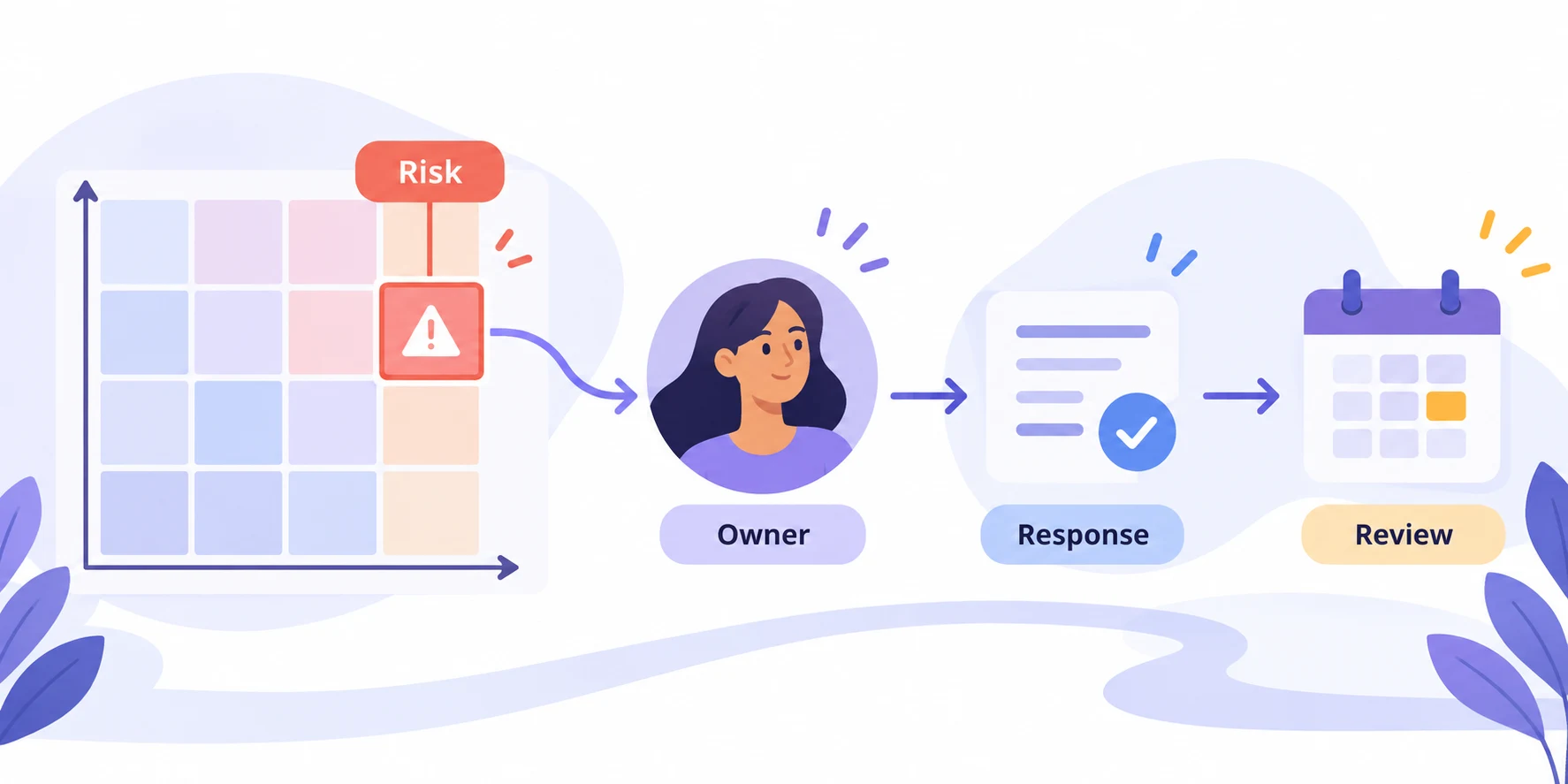
A risk matrix is useful when it changes what a team will do next. This worked example turns one release risk into a visible score, a response owner, a trigger, and a later residual-risk review. The numbers are illustrative; replace them with evidence from your release.
Teams often keep this work in a shared project-management workspace so that the reasoning and next action stay together. The example below is deliberately bounded; replace its illustrative details with your own evidence.
Define the risk before scoring it
Write the uncertain event, its cause, and the effect separately. “The launch will be late” is too broad to score consistently. A more useful statement is: “The payment-provider change may fail its certification window, which would block checkout release.” The event is uncertain, the effect is observable, and the boundary is one release.
Choose scales the team can explain
Use a small ordinal scale and define it before discussing a specific item. For example, likelihood 1 means the event is unlikely in this release context, while 5 means evidence makes it very likely. Impact 1 is a negligible effect on the release objective; 5 threatens the objective or requires a material plan change. These labels are team conventions, not measured probabilities.
| Risk statement | Likelihood | Impact | Score | Next response |
|---|---|---|---|---|
| Certification slot may miss the release window | 4 | 5 | 20 | Request slot; prepare fallback decision |
| Test merchant data may be incomplete | 3 | 3 | 9 | Confirm fixtures before integration review |
| Copy review may slip by one day | 2 | 2 | 4 | Book a short review slot |
Work one risk through the matrix
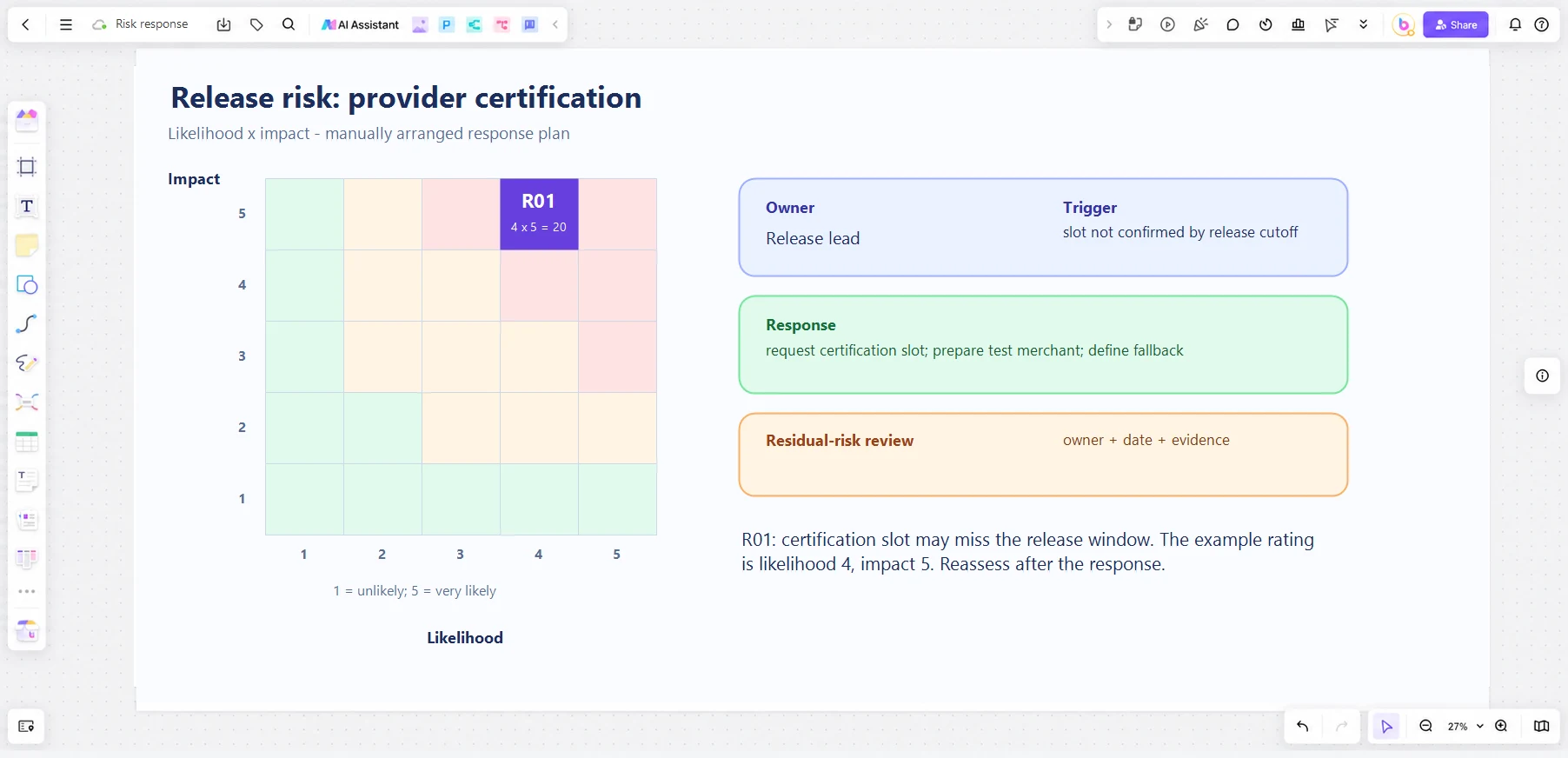
Suppose the payment certification risk is rated likelihood 4 and impact 5. The score of 20 is a prioritisation signal, not a prediction of loss. Record why the team chose 4 and 5: a certification slot is not yet confirmed, and the provider has changed an integration rule before. If the evidence changes, the rating should change too.
Turn a high score into an owned response
A colour does not mitigate a risk. Name the response, owner, due date, and trigger. In this case the response might be to request a certification slot, prepare a test merchant, and define a fallback release decision if the slot is not confirmed by a stated date. The owner coordinates the response; ownership does not mean that person can control every dependency.
Reassess residual risk after the response
After the response is complete, score the remaining exposure rather than leaving the original colour in place. A confirmed certification slot may lower likelihood, while a provider outage dependency may keep impact high. Keep the original rating, the evidence for the new rating, and the next review date. Do not call the risk closed merely because an action was assigned.
Build the risk conversation in Boardmix
Place the release objective and risk statement at the top of a Boardmix board. Put the likelihood-impact grid beside the risk register, then connect each high-priority item to its owner, response and trigger. Use comments or a meeting note for the evidence behind a score. Boardmix provides the shared canvas for this arrangement; it does not calculate a score, send a risk alert, or guarantee that an owner completed the response.
Open a Boardmix board and bring your own evidence into the same structure. Keep illustrative rows, estimates, and example decisions clearly separate from observations made by your team.