


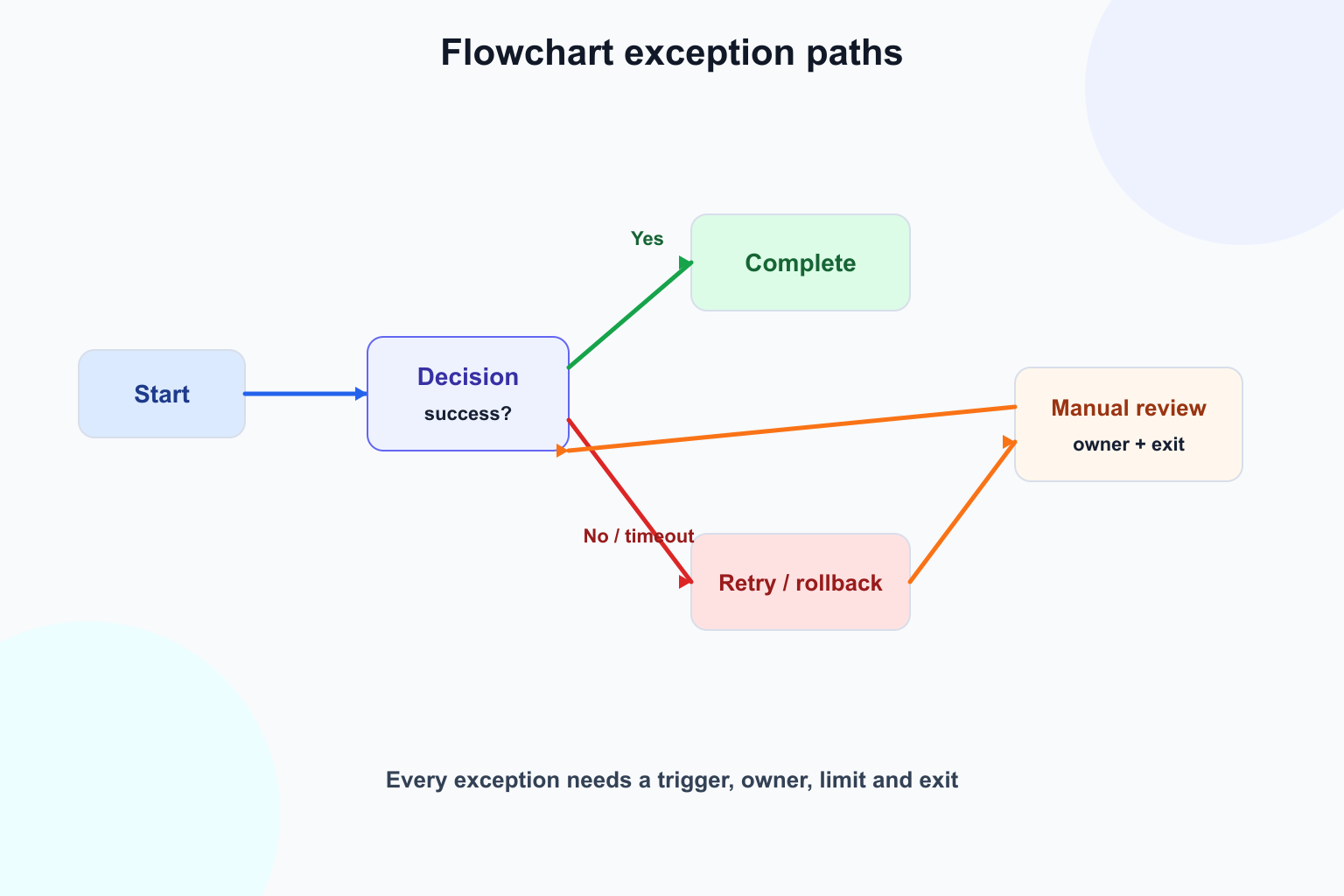
A flowchart is executable only when its failure paths are as clear as its happy path. Show what happens after a timeout, invalid input, rejected approval or unavailable dependency, and give each branch a bounded route back to work or to a deliberate stop.
Start with the exception contract
For every exception, write four pieces of information before choosing a symbol: the trigger, the response, the owner and the exit condition. “Payment failed” is incomplete. “Gateway timeout after the first attempt; retry twice; payment service owner; send to manual review if both retries fail” can be drawn and tested.
| Field | Example |
|---|---|
| Trigger | Gateway response exceeds the agreed timeout |
| Response | Retry with the same idempotency key |
| Owner | Payment service team |
| Exit | Success, manual review or explicit failure |
Choose the right branch type
Use a retry branch when the cause may clear and repeating the action is safe. Use rollback when a partial change must be undone. Use manual intervention when a person must inspect evidence or make a judgement. Use termination when continuing would create risk or duplicate work.
Label decision exits with a condition such as “valid / invalid” or “attempts remaining / limit reached”. Avoid unlabeled arrows that force readers to guess why the process changed direction.
Draw a bounded retry and rollback loop
Every retry loop needs a limit, a wait or backoff rule, and a different route after the limit. Put the attempt count near the decision node. If the action is not idempotent, show a verification step before retrying; otherwise the diagram may hide duplicate charges, records or messages.
Rollback is a process step, not an annotation. Show which state is restored, what happens if rollback fails, and who receives the incident. A rollback route that points back to the beginning without a condition can create an infinite loop.
Add human review without losing ownership
Place the manual-review node in the responsible swimlane and state the evidence the reviewer needs. Give the reviewer two or more explicit exits: approve, reject, request information or escalate. Record the service-level target only when the organisation has agreed one; do not invent a time promise for illustration.
Use one example to validate the diagram
For an order-refund process, test at least these paths: valid refund, missing order data, gateway timeout, duplicate request, policy rejection and manual approval. Walk each path from the start node to a terminal state. If a path reaches a node with no owner or exit, the flowchart is not ready for hand-off.
Review exception paths with a checklist
- Does every decision have labelled exits?
- Is each retry safe, bounded and observable?
- Can a partial change be rolled back or reconciled?
- Does manual review identify an owner and required evidence?
- Are duplicate, timeout and permission failures represented?
- Does every path end in a known state?
Create and review the flowchart online
Use a flowchart template to establish lanes and symbols, then review the exception paths with the people who operate them. Boardmix’s AI flowchart tool can help create a first draft from structured text, but a human should verify conditions, ownership, limits and exits before sharing it as a procedure.

![Strategic Group Map [Comprehensive Guide]](https://cms.boardmix.com/images/image/article-images/strategic-group-map.png)