Kano model analysis classifies a feature by how its presence or absence changes a person's satisfaction. A basic need is expected, a performance need changes satisfaction in proportion to delivery, a delighter is unexpectedly valuable, and an indifferent feature has little effect for the segment being studied. The categories help a team interpret feedback; they do not replace feasibility, evidence, or a product decision.
After classifying needs, use project priority management to compare the work against capacity, risk, and other commitments.

What the four common categories mean
| Category | If the feature is present | If the feature is absent | Useful question |
|---|---|---|---|
| Basic (must-be) | Satisfaction rises little because people expected it. | Satisfaction drops sharply. | Would its absence make the product unacceptable for this use? |
| Performance | More or better delivery generally improves satisfaction. | Less delivery generally reduces satisfaction. | Does improving this capability change the experience in a predictable direction? |
| Delighter | Satisfaction rises beyond expectations. | People may not miss it because they did not expect it. | Would this surprise matter to the target segment? |
| Indifferent | Little noticeable change. | Little noticeable change. | Would solving this change a real decision or outcome? |
Responses can also be reverse or questionable. Keep those cases visible rather than forcing every response into one of the four headline categories.
Write paired functional and dysfunctional questions
For each feature, ask two questions about the same situation. The functional question asks how someone feels if the feature is provided. The dysfunctional question asks how they feel if it is not provided. Use a consistent set of answer choices, such as “I like it,” “I expect it,” “I am neutral,” “I can accept it,” and “I dislike it.”
Example feature: exporting a shared board to PDF. The functional question is, “How would you feel if you could export this board to PDF for a review packet?” The dysfunctional question is, “How would you feel if you could not export this board to PDF for a review packet?” Keep the context and audience the same; changing the wording between respondents makes the classifications harder to compare.
Read the functional answer down the left and the dysfunctional answer across the top. Their intersection gives the category; the two answers are not numeric ratings to average.
| Present ↓ / Absent → | Like | Expected | Neutral | Tolerable | Dislike |
|---|---|---|---|---|---|
| Like | Q | A | A | A | O |
| Expected | R | I | I | I | M |
| Neutral | R | I | I | I | M |
| Tolerable | R | I | I | I | M |
| Dislike | R | R | R | R | Q |
A = Attractive (delighter); O = One-dimensional (performance); M = Must-be (basic); I = Indifferent; R = Reverse; Q = Questionable. Q calls for checking the wording or response, not assigning a feature priority. Kano evaluation table.
A worked classification example
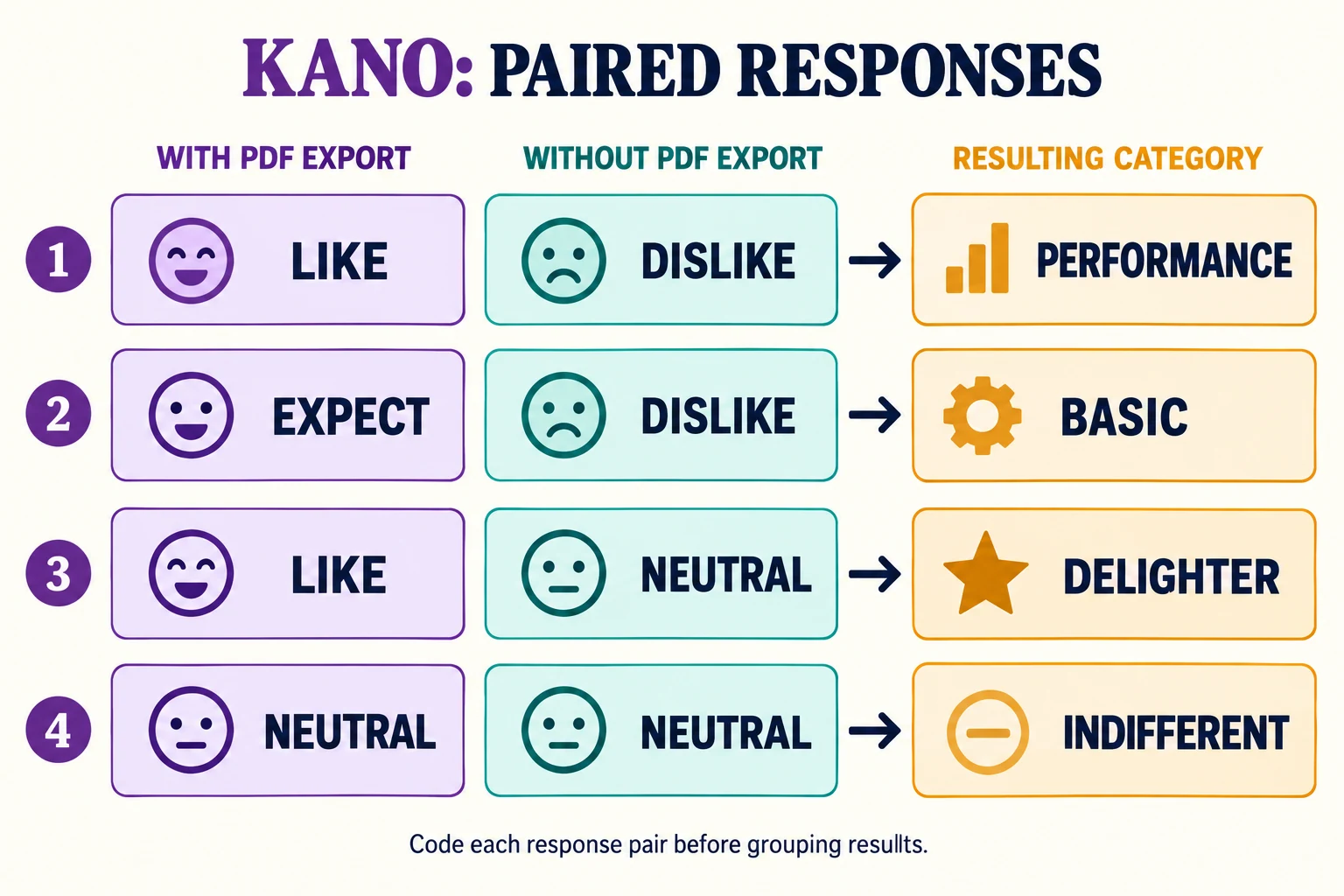
The following responses are illustrative. Four people from a documentation workflow answer the paired questions about PDF export. The category is a coding result for this small sample, not a claim about every customer.
| Response pair | Coded category | What the team can say | What remains unknown |
|---|---|---|---|
| Expect / dislike | Basic | Missing export may block this person's workflow. | Whether the need applies to other segments. |
| Like / neutral | Delighter | Export could add value for this person when it is easy to find. | Whether the surprise lasts after regular use. |
| Neutral / neutral | Indifferent | This respondent does not change the case for export. | Whether the wording or context was relevant. |
| Like / dislike | Performance | A usable export may improve the experience. | Which quality or format matters most. |
In this four-person example, the counts are M = 1, A = 1, I = 1, and O = 1: there is no leading category. Keep PDF export unclassified at the sample level, review the respondents’ contexts, and decide which group the next round should study.
Use categories with other product evidence
A basic need can be a release requirement even when it does not create excitement. A delighter can lose its novelty or fail to matter to a different segment. Combine the category with observed behavior, support themes, feasibility, access needs, and the cost of delaying other work. Keep the category as one input to the decision, not as an automatic roadmap order.
When respondents disagree, preserve the disagreement. It may indicate two segments, two use contexts, or an ambiguous question. Count the responses in each category for each segment; do not average the category labels. A single blended category can hide the exact group whose need the feature is meant to solve.
Copyable Kano research table
| Feature and segment | Functional question | Dysfunctional question | Response evidence | Category / uncertainty |
|---|---|---|---|---|
| Feature A | — | — | — | — |
| Feature B | — | — | — | — |
| Feature C | — | — | — | — |
Organize the analysis on a shared board
Place the question set, response evidence, category notes, and open decisions in separate areas of a Boardmix board. Keep the segment and collection context beside each group of responses so a later reviewer can understand the boundary. Link the category summary to the prioritization discussion, but keep raw responses separate from the conclusion.
Open a Boardmix board to organize the next Kano study. The useful outcome is a clearer statement of which need was observed, for whom, and what evidence should change the decision.