A concept map can have the right ideas and still say very little. Put “library,” “member,” and “loan” in three boxes, connect them with “related to,” and the reader still has to guess the relationship. Specific statements such as “Members borrow copies” and “Loans record due dates” explain what each connection means.
Use a concept map template as a starting structure, then examine the sentence formed by each pair of concepts and its connecting phrase. The goal is not to find a more impressive verb. It is to make a specific relationship readable without someone standing beside the diagram to explain it.

Read one connection as a sentence
The Institute for Human and Machine Cognition describes linking words as the phrases that join concepts into propositions. In everyday terms, a connection should make a meaningful statement: “Members borrow copies” or “A loan records a due date.” The concepts supply the nouns; the linking phrase explains the relationship.
Read in the direction of the arrow. “Members borrow copies” makes sense; “Copies borrow members” does not. You can keep the second direction if you change the phrase to “are borrowed by.” What matters is that the label and direction agree.
Start with a focus question. For our example, it is “How does this library keep track of borrowed items?” That question gives “member,” “copy,” and “loan” a specific meaning. A map about how people choose books would need different concepts and links.
Six connection repairs in a library map
The following example describes a fictional library's lending records. It is not a claim that every library uses the same rules. Each correction addresses a different problem, so you can apply the same reasoning to a study map, a business model, or a technical explanation.
| Unclear connection | Clearer connection | What changed |
|---|---|---|
| Member → is related to → Loan | Loan → records borrowing by → Member | The phrase names the relationship instead of merely announcing that one exists. |
| Copy → is a → Collection | Copy → is part of → Collection | A copy belongs to the collection; it is not a kind of collection. |
| Copy → borrows → Member | Member → borrows → Copy | The arrow now follows the action from the borrower to the item. |
| Loan → has it → Due date | Loan → records → Due date | The phrase no longer depends on an unexplained pronoun. |
| Reminder → guarantees → Return | Reminder → asks the member to arrange → Return | The map describes the message's purpose without claiming a guaranteed result. |
| Loan → records borrower, item and date → Member | Loan → records borrowing by → Member; Loan → identifies → Copy; Loan → records → Due date | Three different relationships become three readable links. |
Notice that fixing a link sometimes requires changing a node or splitting a connection, not just replacing one word. If “Loan details” contains a borrower, a copy, and a due date, a single arrow labeled “includes” may be enough for an overview. If the task is to explain the records, those details deserve separate nodes.
Choose the relationship before the phrase
“Is a,” “is part of,” and “causes” do different jobs. Substituting them for one another can make a polished diagram factually wrong.
- Category: use “is a type of” when the first concept belongs to a broader class. A reference book is a type of book.
- Part and whole: use “is part of” or “contains” when discussing composition. A chapter is part of a book.
- Action: use a verb that identifies who does what. A member borrows a copy.
- Record or description: use phrases such as “records,” “identifies,” or “describes.” A loan record identifies a borrowed copy.
- Condition: name the relevant rule. In a particular lending policy, renewal may require that no other member has reserved the copy.
- Cause or association: use only the relationship your evidence supports. “Is associated with” does not mean “causes,” and “may contribute to” still needs a reason.
A phrase bank can help you start, but it cannot decide which relationship is true. If you cannot complete the sentence confidently, put the question beside the link and check the source. Do not conceal uncertainty behind “impacts,” “involves,” or “affects.”
Build the corrected library map
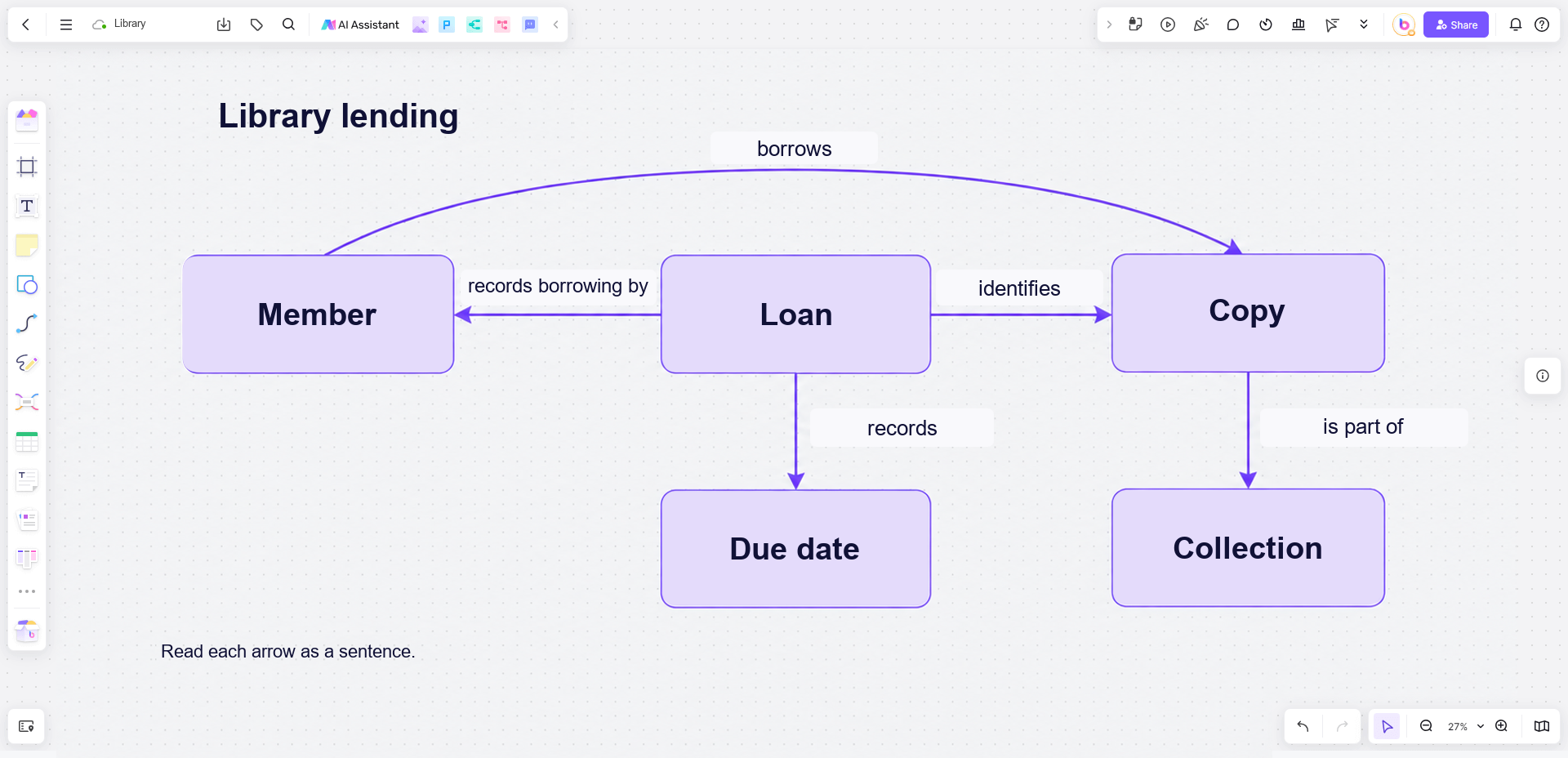
Place Loan near the center of this example because the focus is the borrowing record. Connect it to Member, Copy, and Due date. Add Collection beside Copy, then connect Copy to Collection with “is part of.” Finally, connect Member to Copy with “borrows.”
The resulting connections answer different questions: Who borrowed it? Which physical item was borrowed? When is it due? Where does that item belong? The link between Member and Copy crosses the record-based branches, but it adds a useful relationship rather than decoration.
Read each statement on its own before reading the whole network. Then look for contradictions. A copy may belong to a collection whether or not it is currently on loan. Drawing “Loan creates Collection” would confuse a borrowing event with the library's inventory structure.
Edit the connections in Boardmix
On your Boardmix canvas, create a shape for each concept and place connecting lines between related shapes. Add the short linking phrase on or beside each line. Keep the phrase close enough that it cannot be mistaken for the label of a neighboring connector. Where lines cross, adjust the spacing before reducing the text size.
Use one visual treatment for the relationships you have confirmed and a distinct note for unresolved questions. For example, put “Check renewal condition” beside the renewal link rather than presenting an unverified rule as part of the finished map. Color can help locate that question, but the words should carry the meaning.
Ask another person to read a path aloud without your explanation. If they need to supply a missing verb or reverse an arrow mentally, repair that connection. If they understand the sentence but disagree with it, the next task is checking the underlying claim, not adjusting the layout.
Open a Boardmix board and begin with one unclear pair from your own map. Write the relationship as a sentence first, then put that sentence back into the diagram.