


A business continuity checklist for visual collaboration platforms should verify more than uptime. Before procurement or renewal, confirm six gates: business criticality, service commitments, recoverability, identity and audit, data governance, and a tested fallback when the platform or a dependency is unavailable.
Bring IT, security, procurement, compliance, and workspace owners into the review. Agree on the critical work the platform supports and the evidence each team needs before approving it.
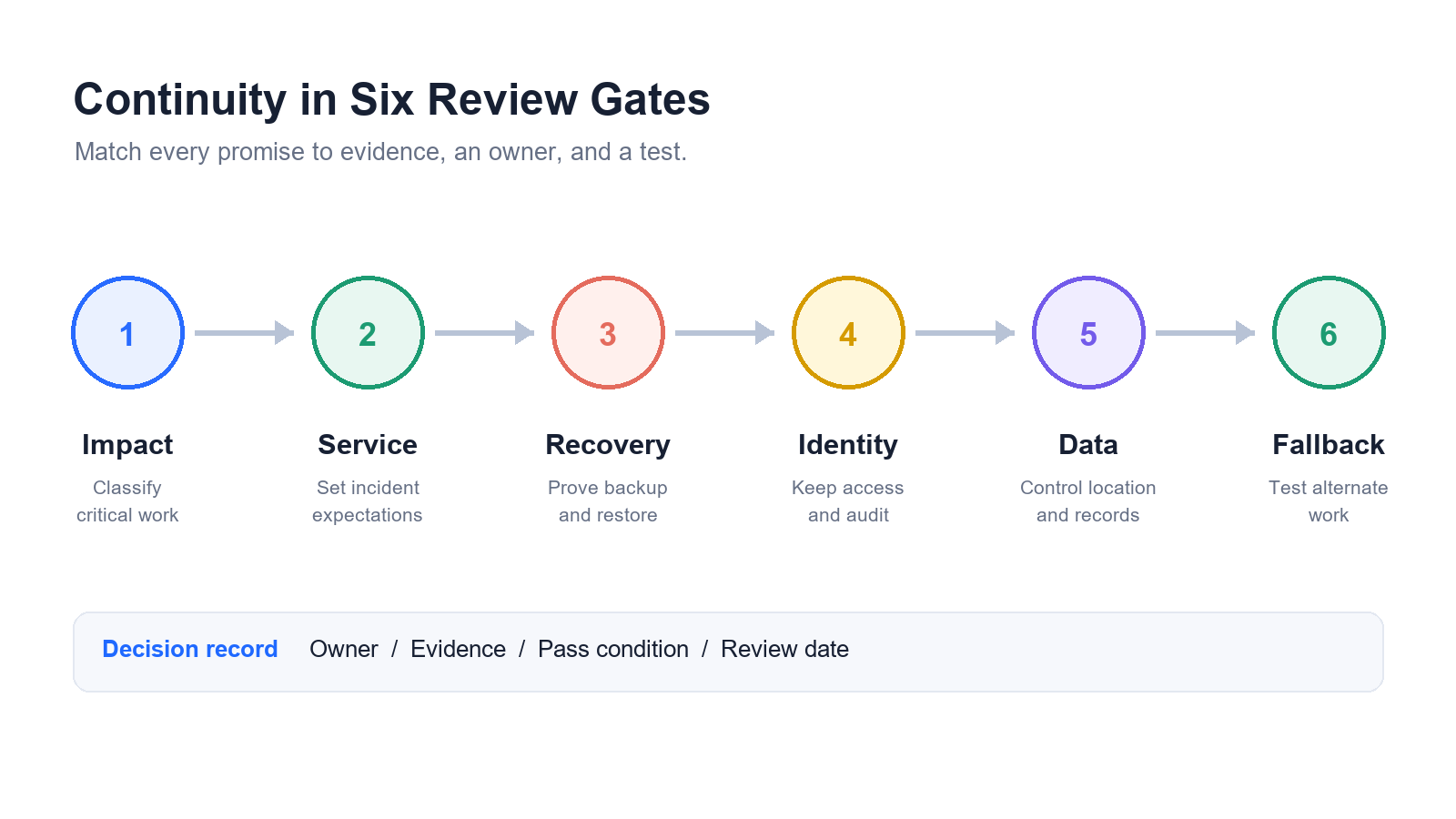
Start with Business Impact, Not Features
A whiteboard becomes a continuity dependency when work, decisions, or evidence exist there and cannot be recreated quickly elsewhere. Classify the platform by the business process it supports, not by the product category on an invoice.
| Question | What to inventory | Evidence to keep |
|---|---|---|
| What work happens there? | Workshops, product decisions, service maps, research, planning, customer or regulated data | Process owner, board list, downstream deliverable |
| What is the impact of loss? | Missed deadline, lost decision context, disclosure, compliance breach, or blocked customer work | Business impact analysis and criticality tier |
| What must be restored? | Objects, text, images, comments, links, attachments, permissions, templates, history, and exports | Representative-board inventory and restore acceptance criteria |
| Who can approve recovery? | Business owner, IT/SaaS owner, security, legal, communications, and vendor contacts | Named primary and alternate owners |
Use a higher review tier for boards that contain regulated data, executive decisions, active customer work, or the only record of a project decision. A finished workshop that has been exported and stored in the system of record may need a different continuity control than a live board that a distributed team uses every day.
Set MTD, RTO, and RPO for the Actual Workflow
Recovery objectives should come from business impact, not from a vendor's marketing page. NIST describes contingency planning as coordinated plans, procedures, and technical measures for recovering systems, operations, and data, including alternate equipment and short-term manual processing when appropriate. See the NIST contingency planning overview for the framework.
| Term | Plain-language meaning | Visual collaboration example |
|---|---|---|
| Maximum tolerable downtime (MTD) | Longest disruption the business process can absorb before the impact becomes unacceptable | A launch workshop must resume within one business day because the decision blocks a release |
| Recovery time objective (RTO) | Target time to restore an acceptable service or workaround | Users can access a usable board or read-only export within four hours |
| Recovery point objective (RPO) | Maximum acceptable period of data that could be lost | No more than 30 minutes of board edits may be lost for an active planning board |
| Recovery service level | What the vendor and customer each promise to do, and how success is measured | Restore, validate permissions, notify owners, and record the incident within defined windows |
Separate the platform objective from the process objective. A vendor may restore the service in two hours, but your team may still be unable to work if the identity provider, integration, or board export is unavailable. Record dependencies and test the full user journey.
Review the SLA and Incident Process
An uptime percentage is only one part of continuity. Ask what the SLA covers, how downtime is measured, which components are excluded, and whether service credits are the only remedy. A strong review connects the contract to an operational response.
- Does the SLA cover the workspace, APIs, file storage, embeds, integrations, and authentication dependencies?
- Are scheduled maintenance, regional events, force majeure, and customer-caused incidents defined?
- What severity levels trigger customer notification, and through which out-of-band channels?
- How quickly will the vendor provide status updates, an incident report, and a root-cause analysis?
- Are RTO/RPO targets contractual, documented service objectives, or only internal vendor goals?
- Can the customer escalate a business-critical incident to a named support or account team?
- Are planned changes, API deprecations, region moves, and material subprocessor changes announced early enough to test?
Store the status-page URL, incident contact route, escalation matrix, maintenance calendar, and latest postmortem in the continuity record. A vendor's public trust page is useful evidence, but it should not replace contract language for a critical process.
Prove Backup and Restore Under the Shared Responsibility Model
Do not assume that a vendor's infrastructure backup is a customer-controlled backup. The Cloud Security Alliance shared-responsibility guidance warns that SaaS providers may protect their own equipment without providing a complete, tenant-restorable copy of customer data. Clarify the boundary between the provider, your SaaS administrator, your backup service, and the business owner in writing.
| Control | Ask the vendor | Test or evidence | Customer owner |
|---|---|---|---|
| Backup scope | Are board objects, comments, attachments, links, permissions, templates, and history included? | Data map, export sample, backup documentation | SaaS owner |
| Backup cadence | How often are backups or snapshots taken, and what is the actual RPO? | Dated policy or contract statement | IT / vendor manager |
| Isolation | Can a compromised admin account delete production and backups together? | Separate role, account, region, or immutable-copy evidence | Security |
| Restore granularity | Can the team restore one board, one workspace, or only the entire tenant? | Restore demonstration in a non-production space | Workspace admin |
| Restore fidelity | Are layout, connectors, comments, links, history, and permissions usable after restore? | Representative-board acceptance test | Business owner |
| Retention and deletion | How long are deleted boards and backups retained, and how do legal holds change deletion? | Retention schedule, DPA, and legal response | Legal / compliance |
The restore test should use a simple board, a dense workshop board, and a board with the team's most important integrations. Record elapsed time, missing objects, visual changes, permission repair, comments, links, and the person who accepted the result. A successful API response is not proof of a usable recovery.
Check Identity, Access, and Auditability
Continuity fails when users cannot authenticate, administrators cannot recover access, or nobody can prove what happened. Include the identity provider and emergency access path in the test scope.
- SSO: Confirm the supported protocol, domain verification, login behavior, and what happens when the identity provider is unavailable.
- SCIM or lifecycle automation: Test joiner, mover, and leaver flows, including ownership transfer for boards owned by a departing employee.
- MFA and break-glass access: Maintain a protected emergency administrator path with a rotation and approval procedure.
- RBAC: Test view, edit, comment, share, export, duplicate, restore, and delete separately. Labels such as “editor” are not enough.
- External collaboration: Test guests, public links, domain restrictions, link expiration, and the ability to revoke access during an incident.
- Audit logs: Confirm coverage, retention, export format, timestamps, actor identity, and delivery to the monitoring or SIEM process.
The existing whiteboard integration requirements checklist is a useful companion for turning these controls into named owners, evidence, and POC tests.
Validate Data Residency, Retention, and Legal Hold
Data residency is not the same as data sovereignty, and a primary storage location is not necessarily the location of backups, logs, support access, analytics, or subprocessors. Ask for the complete data-flow scope before approving a platform.
| Area | Questions for procurement and legal | Evidence |
|---|---|---|
| Data categories | Where are boards, comments, files, thumbnails, logs, metadata, exports, and backups processed? | Data-flow diagram and DPA |
| Region and transfer | Can the customer select a region? Can support or subprocessors access data from another jurisdiction? | Region terms, subprocessor list, transfer mechanism |
| Retention | What are the default and configurable retention periods for active, deleted, and archived boards? | Retention policy and admin settings |
| Legal hold | Can the organization preserve a board and related records without freezing the entire tenant? | Legal-hold procedure and export test |
| Deletion | What does deletion mean for replicas, backups, caches, and support copies? | Deletion statement, certificate, or contractual answer |
| Access requests | Who responds to data-subject, regulator, discovery, or law-enforcement requests? | Response process and contact owner |
Miro's security and compliance FAQ and data-residency guide show why scope matters: EU data residency is available on all plans, while US, Australia, and Japan residency is limited to Enterprise. The documentation also identifies third-party integration data and some processing paths that may sit outside a selected region. Verify the current terms against your workspace configuration and contract, then preserve the source and date in the review record.
Map Integrations and Design a Degraded Mode
A visual collaboration platform rarely operates alone. Map identity, storage, meetings, messaging, project management, document systems, APIs, embeds, webhooks, and analytics. For each dependency, record whether the board remains readable, editable, exportable, or inaccessible when that dependency fails.
| Failure scenario | Minimum fallback | Owner and test |
|---|---|---|
| Whiteboard service outage | Cached export or read-only reference plus an approved alternate workshop format | Workspace owner runs a tabletop exercise |
| Identity provider outage | Protected break-glass account and an out-of-band communications route | Security tests access without normal SSO |
| Integration or API failure | Manual export/import or documented handoff to the system of record | Integration owner runs the task script |
| Regional network disruption | Approved alternate network, region, or offline reference process | IT validates the path and legal constraints |
| Vendor security incident | Incident contact, evidence preservation, access review, and communication plan | Security and legal run a tabletop |
Define one source of truth during a degraded mode. If people update a screenshot, a PDF, and a restored board at the same time, recovery creates conflicting decisions. The fallback should preserve the decision record and make the handoff back to the platform explicit.
Review Supplier and Product-Change Risk
Business continuity includes changes that are not outages. An acquisition, pricing change, new subprocessor, region migration, API deprecation, AI-provider change, or plan retirement can make an existing control or workflow unsuitable.
- Require notice for ownership changes, material service changes, region moves, and new subprocessors.
- Record renewal dates, notice periods, data-return terms, deletion timelines, and assistance available at termination.
- Keep a current export and a tested path to interpret the export outside the vendor editor.
- Review whether the contract allows audits, evidence requests, incident reports, and legally required retention.
- Track product changes that affect permissions, authentication, integrations, exports, or board history.
- Assign a decision owner for stay, remediate, pilot, split, or exit when the vendor posture changes.
Use the online whiteboard vendor lock-in checklist for the portability and exit portion of this review. Continuity and exit readiness are connected: a platform that cannot be exported or interpreted cannot be recovered independently during a prolonged vendor event.
Run a 30-Day Continuity Review
A document-only review can miss the failure modes that matter. Use four weeks to turn claims into evidence without disrupting active work.
| Week | Activity | Output | Exit condition |
|---|---|---|---|
| Week 1: Inventory | Classify boards, data, users, integrations, owners, and critical workflows | Criticality tiers, dependency map, RTO/RPO/MTD worksheet | Business and technical owners approve scope |
| Week 2: Evidence | Request SLA, DR, backup, residency, identity, audit, DPA, subprocessor, and contract evidence | Vendor evidence matrix with source dates and exceptions | Every must-have has evidence or an open risk |
| Week 3: Test | Restore representative boards, test access and exports, simulate an outage and an IdP failure | Test log, repair list, elapsed times, screenshots, and acceptance decision | Recovery meets the business-defined pass conditions |
| Week 4: Exercise | Run a tabletop with business, IT, security, legal, communications, and vendor contacts | Runbook, fallback instructions, escalation tree, remediation owners | Sponsor accepts residual risk and review cadence |
Retest after a material product, contract, identity, integration, region, or ownership change. A continuity plan that has never been exercised is an assumption, not evidence.
Copyable Business Continuity Checklist
Use this compact checklist in procurement or renewal reviews. Mark each item Pass, Fail, Exception, or Not tested; do not treat Not tested as Pass.
| Control | Pass condition | Evidence / source | Owner | Review date |
|---|---|---|---|---|
| Criticality | Business process, impact, MTD, and board scope are documented | BIA and board inventory | Business owner | Enter |
| RTO / RPO | Targets match the workflow and are supported by a test or contract | Objective worksheet and test log | IT / SaaS owner | Enter |
| SLA | Coverage, exclusions, notification, escalation, and remedies are understood | SLA, support plan, status history | Procurement | Enter |
| Backup | Scope, cadence, isolation, retention, and customer responsibility are explicit | Backup policy and responsibility matrix | Security | Enter |
| Restore | Representative boards restore with acceptable fidelity and access | Restore report and acceptance record | Workspace owner | Enter |
| Identity | SSO, lifecycle, MFA, break-glass, guests, and revocation are tested | Configuration and access test | IAM owner | Enter |
| Audit | Required events are retained, exportable, and monitored | Log sample and SIEM route | Security operations | Enter |
| Residency | Storage, backups, support access, and subprocessors meet obligations | DPA, data-flow map, subprocessor list | Privacy / legal | Enter |
| Legal hold | Required boards and records can be preserved and produced | Hold procedure and export test | Legal | Enter |
| Fallback | People know how to continue critical work during outage or IdP failure | Runbook and tabletop result | BCM owner | Enter |
| Supplier change | Notice, renewal, exit, portability, and change review triggers exist | Contract and exit checklist | Vendor manager | Enter |
| Exercise | Continuity is retested after material changes and at the chosen cadence | Exercise report and remediation log | Executive sponsor | Enter |
How Boardmix Fits the Evaluation
When Boardmix is one of the platforms under review, evaluate it with the same evidence standard as every other candidate: define the critical workflow, map data and dependencies, test access and export, restore a representative board, and record unresolved risks. The existing online whiteboard data-security guide covers architecture and security questions; the integration requirements checklist provides an RFP and POC structure; the private-deployment guide covers infrastructure and governance questions.
Do not approve any vendor because a checklist is complete on paper. Approve the configuration and workflow that passed the team's own recovery, access, governance, and fallback tests.
Business Continuity Checklist FAQs
Is a whiteboard platform really part of business continuity?
It is when a business process depends on the boards, decisions, attachments, or collaboration access stored there. Tier the platform by impact and recoverability rather than by the word “whiteboard” in the product name.
Does a SaaS vendor's backup protect my boards?
Not necessarily. Confirm what is backed up, how it is isolated, whether you can request a tenant-level restore, how much data can be lost, and whether the restored board remains usable. Keep customer-controlled exports when the process requires independent recovery.
What RTO and RPO should an online whiteboard have?
There is no universal number. Set the targets from the business process, the maximum tolerable downtime, the amount of work that can be recreated, and the cost of a workaround. A live launch board may need tighter targets than an archived workshop.
Should legal hold be part of a continuity checklist?
Yes, when boards contain decisions, regulated data, or records that may be discoverable. Confirm how a hold preserves content, comments, attachments, and metadata while respecting deletion and privacy requirements.
How often should the checklist be tested?
Review it at least at renewal and after a material change. Exercise the recovery and fallback path at the cadence required by the business process, and close the remediation items from every exercise.