The AI Knowledge Platform for Enterprise: A Complete Guide
Mackenzie Carter
Published on
Jun 08, 2026, updated on Sep 16, 2026
As AI transforms enterprise workplaces, organizational efficiency now depends not on "having AI tools," but on owning a complete AI knowledge platform.
For most companies, chatbots, writing assistants, and document systems fail to solve knowledge silos, information gaps, or collaboration inefficiencies. Future-ready organizations integrate knowledge bases, AI capabilities, teamwork, and workflows into one unified platform—enabling continuous knowledge flow and intelligent collaboration.
A mature AI knowledge platform for enterprise connects corporate knowledge, AI understanding, and team processes into a shared space where knowledge is stored, understood, reused, and continuously circulated.
This article systematically explores how to build such a platform—covering architecture, implementation steps, tool selection, and future trends.
What is an AI knowledge platform?
An AI knowledge platform is the next-generation knowledge infrastructure built for the AI era. It is not a document storage system with a search bar bolted on, nor simply an upgraded version of a traditional wiki or intranet. Rather, it is an integrated environment that connects three things enterprise organizations have historically kept separate: knowledge accumulation, AI semantic understanding, and real-time team collaboration — unified into a single, living system.
In most organizations today, knowledge is not missing — it is invisible. It lives in closed Slack threads, in the heads of employees who have since left, in slide decks buried three folders deep, and in meeting recordings no one has time to watch. The core promise of an AI knowledge platform is to make that knowledge findable, usable, and continuously compounding.
A working definition: An AI knowledge platform for enterprise is a collaborative system that allows organizations to capture, structure, and retrieve institutional knowledge using AI-powered semantic understanding — while keeping the entire workflow within a shared, real-time collaborative space accessible to the whole team.
AI knowledge platform vs. traditional knowledge base
Many enterprises have already deployed a knowledge base of some kind. But as AI adoption deepens, the limitations of traditional systems are becoming impossible to ignore. The distinction is fundamental:
Dimension
Traditional Knowledge Base
AI Knowledge Platform
Primary function
Store and retrieve documents
Understand, surface, and activate knowledge
Search capability
Keyword matching
Semantic understanding, contextual retrieval
Collaboration model
Sequential editing, version files
Real-time multi-user co-creation on shared canvas
AI integration
None, or surface-level chatbot
Native AI agents, auto-summarization, workflow automation
The shift from "storing information" to "flowing knowledge" is the defining difference — and it is why enterprises that simply upgrade their wiki software find themselves facing the same problems six months later.
Why enterprises are prioritizing AI knowledge platforms now
The volume of information generated inside organizations has accelerated dramatically with the adoption of AI tools. Paradoxically, many teams report feeling less informed and more overwhelmed than before. The problem is not a shortage of content — it is a structural failure to connect content to work.
Several compounding pressures are driving the shift toward a unified AI knowledge platform for collaboration:
Fragmented tool stacks. The average enterprise knowledge worker switches between 10+ applications daily. Each tool holds a fragment of the organizational picture. No single person or system sees the whole.
Non-replicable expertise. When experienced employees leave, their tacit knowledge — how decisions were made, why certain approaches failed, who to call for what — disappears with them. Knowledge platforms are increasingly seen as institutional memory insurance.
Cross-functional coordination overhead. As teams become more distributed and projects more cross-departmental, the cost of alignment meetings, status updates, and repeated briefings is now measurable in lost engineering and design hours.
AI tools without connective tissue. Deploying ChatGPT, Copilot, or standalone AI writing tools creates point-solution value but no cumulative organizational intelligence. Each conversation starts from zero. An AI knowledge platform changes that by giving AI a persistent, curated organizational memory to draw from.
The core value proposition: An AI knowledge platform for collaboration doesn't just reduce search time. It changes the compounding rate of organizational learning — so that teams that collaborate inside the platform get smarter together faster than teams that use siloed tools.
The four-layer architecture of an enterprise AI knowledge platform
A well-designed AI knowledge platform for enterprise is built on four interconnected layers. Each layer is necessary; none is sufficient on its own. Here is how they stack:
📚Layer 1: Knowledge Layer
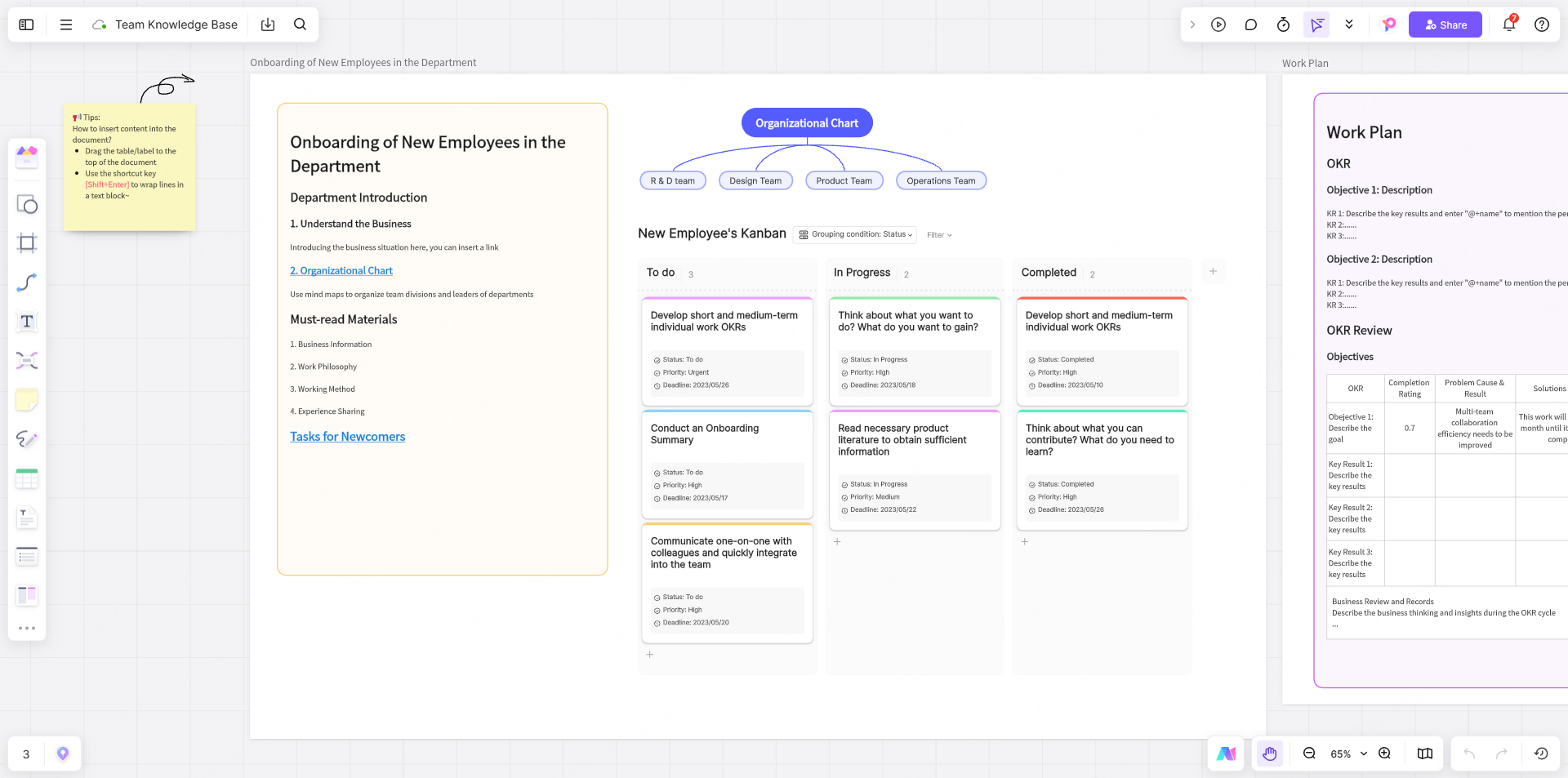
The foundation. All organizational content — documents, SOPs, project records, meeting notes, process diagrams — is consolidated into a single, structured repository. The goal is eliminating knowledge silos, not simply copying files to a new location. Critically, this layer should support visual knowledge organization: mind maps, relationship diagrams, and project canvases — not just text files. Complex knowledge has structure that linear documents cannot represent.
🧠Layer 2: AI Layer
The intelligence engine. Traditional keyword search fails when employees cannot recall the exact title of a document. Semantic AI search allows users to ask questions in natural language and retrieve contextually relevant content — even when no exact terminology matches. Beyond search, the AI layer handles auto-summarization of meetings, content generation assistance, and the early-stage capabilities of an AI agent that can answer queries grounded in your organization's actual knowledge.
🤝Layer 3: Collaboration Layer
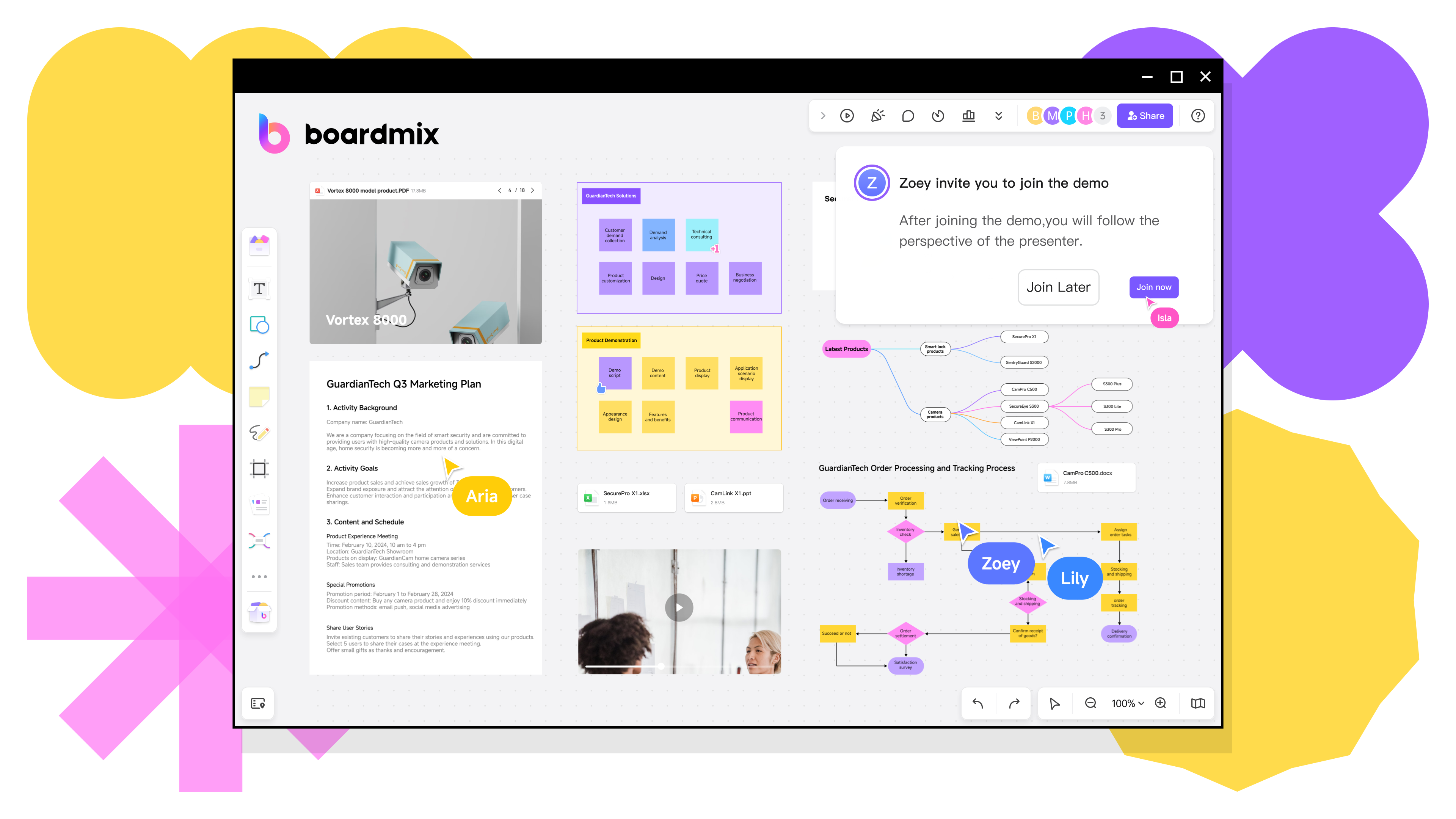
Knowledge that cannot be collaborated on in real time quickly becomes stale. The collaboration layer enables teams to work simultaneously on the same knowledge assets — brainstorming, planning, updating process flows, and integrating AI-generated content without switching tools. Online visual whiteboards like Boardmix excel here: they provide an infinite canvas where flowcharts, project maps, knowledge graphs, and structured documents coexist in the same shared space, visible and editable by the whole team simultaneously.
⚡Layer 4: Workflow Layer
The most forward-looking layer. An AI knowledge platform for enterprise becomes most powerful when knowledge feeds directly into business execution. This means AI-generated task breakdowns from meeting summaries, automated project status updates pulled from knowledge artifacts, and multi-agent workflows where AI orchestrates steps across teams. As this layer matures, the platform evolves from a knowledge container into an intelligent operational backbone for the organization.
The interdependence matters: a sophisticated AI layer with no structured knowledge base to draw from produces hallucinations. A rich knowledge base with no collaboration layer produces an archive nobody visits. All four layers must develop in concert.
How to build an AI knowledge platform: 5 implementation steps
Building an AI knowledge platform for enterprise does not require rebuilding every system at once. The most successful implementations follow an incremental path — establishing each capability layer before advancing to the next. Here is the five-step framework:
Step 1. Unify your knowledge entry point
Begin by auditing where organizational knowledge currently lives — project management tools, email threads, chat platforms, shared drives, and individual local files. Consolidate documents, meeting records, SOPs, and project artifacts into a single structured repository with clear taxonomy. The primary objective at this stage is not comprehensiveness but eliminating islands of information that no one else can find or access.
Outcome: Single source of truth established
Step 2. Build a visual knowledge structure
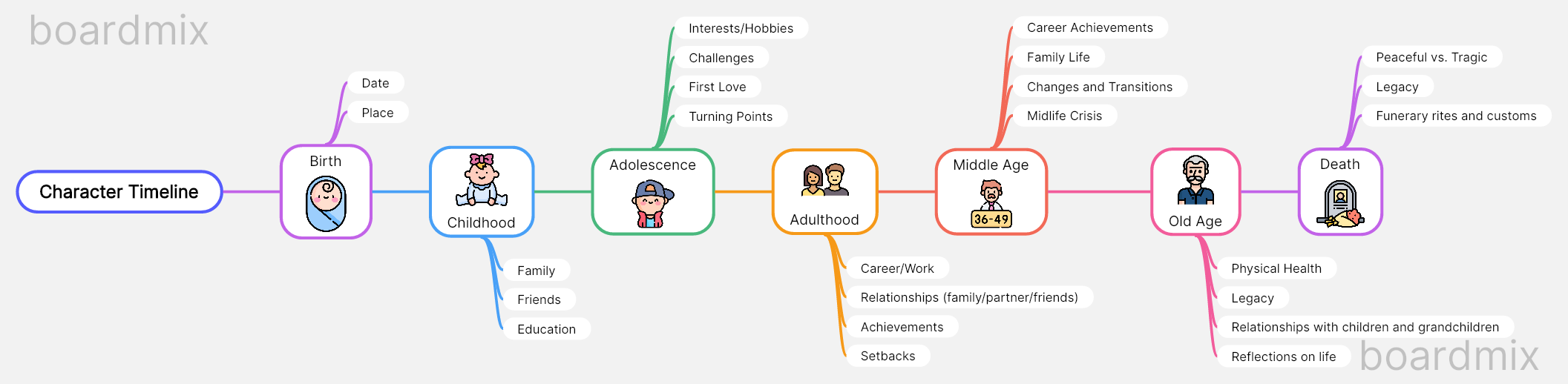
Plain text documents struggle to represent the relationships between ideas, processes, and team responsibilities. At this stage, convert key knowledge assets into visual formats: process flowcharts, organizational mind maps, project relationship diagrams, and strategic canvases. Tools like Boardmix allow teams to use AI to generate these visual structures from text descriptions — dramatically accelerating the time from raw notes to navigable knowledge. Visual structures are also inherently more AI-readable, which pays dividends in the next step.
With a structured knowledge base in place, introduce AI capabilities progressively. Start with semantic search and AI Q&A — these deliver immediate ROI by reducing time spent hunting for information. Add AI auto-summarization for meeting notes and project updates. Then expand to AI-assisted content generation, where the AI drafts process documentation, project briefs, or training materials grounded in your organization's existing knowledge. The goal is not replacing human judgment — it is eliminating the low-value cognitive work that prevents humans from applying their judgment where it matters.
Outcome: AI-accelerated knowledge retrieval and creation
Step 4. Connect AI workflows to live business processes
This is where the platform transitions from a knowledge resource to a collaboration operating system. Integrate your knowledge layer with actual project execution: AI that automatically generates task breakdowns from meeting summaries, project status that updates from knowledge artifacts, and AI agents that coordinate handoffs between teams. This step requires cross-functional alignment — IT, operations, and team leads must agree on which workflows to automate first and how to validate AI-generated outputs before they become part of the execution record.
Outcome: Knowledge flows into execution without manual transfer
Step 5. Build a continuous knowledge accumulation loop
The most common failure mode in enterprise knowledge initiatives is treating them as one-time projects. A mature AI knowledge platform is never "finished" — it compounds value through consistent contribution habits, regular retrospectives, and structured knowledge update cycles. Establish clear ownership for key knowledge domains, set quarterly review cadences for high-priority content areas, and create lightweight contribution rituals so that lessons learned from every project find their way back into the organizational knowledge base.
Outcome: Self-reinforcing organizational intelligence system
Implementation insight: Organizations that try to build all four layers simultaneously typically stall after six months. Start with Layer 1 (knowledge unification) and Layer 3 (real-time collaboration) — they deliver the fastest visible returns and create the momentum needed to justify the AI and workflow investments that follow.
Which tools are right for your AI knowledge platform?
The enterprise market offers a wide range of tools positioned as AI knowledge solutions. The relevant categories are:
AI knowledge bases (e.g., Notion AI, Confluence with AI extensions) — strong for structured document management and Q&A retrieval
AI-powered visual whiteboards (e.g., Boardmix, Miro with AI plugins) — strong for visual knowledge organization, real-time collaboration, and complex workflow mapping
Project collaboration platforms (e.g., Asana, Linear, Jira) — strong for task and execution management, weaker on knowledge accumulation
AI workflow tools (e.g., Make, Zapier with AI, n8n) — strong for process automation, require integration with other systems to access organizational knowledge
The market trend is moving clearly from specialized point solutions toward unified collaborative platforms that combine multiple layers. For knowledge-intensive organizations, the evaluation criteria that matter most are:
Does it support multi-user real-time collaboration with low latency?
Does the AI layer understand the organization's own content — not just general knowledge?
Can visual and structured knowledge formats (diagrams, maps, frameworks) coexist with documents?
Does it support complex workflow connections or AI agent integrations?
What are the enterprise data security and deployment options?
Why visual whiteboards are becoming the collaboration layer of choice: Linear documents are optimized for reading, not for thinking or relating. An infinite visual canvas allows teams to show how ideas connect — which is how knowledge actually lives in organizations — making it a far more natural home for an AI knowledge platform for collaboration than a document editor.
Boardmix is designed specifically for this convergence: it brings together unlimited canvas collaboration, AI-generated diagrams and content, knowledge structuring tools, and enterprise workflow capabilities in a single platform — making it one of the most natural choices for teams building an AI knowledge platform from the ground up.
Typical use cases across enterprise teams
An AI knowledge platform for enterprise delivers value differently across functions. Here are the most common high-impact applications:
🛠️Product & Engineering Teams
Centralize requirements documentation, user research findings, and system architecture diagrams in a shared visual space. AI assists with summarizing user interviews, generating PRD drafts, and surfacing relevant prior decisions when new requirements arrive — reducing the "I thought we already figured this out" problem endemic to fast-moving product teams.
📣Marketing & Operations Teams
Connect content strategy, campaign planning, and performance retrospectives into a living operational playbook. AI automatically synthesizes campaign retrospective notes into best-practice updates, ensuring that what was learned in Q2 actually informs Q3 planning rather than being forgotten in a slide deck nobody revisits.
🎓HR, L&D & Onboarding
Build a dynamic SOP library and structured onboarding curriculum that AI can personalize by role and department. When processes change, AI surfaces outdated training content for review. New hires can ask natural language questions and receive answers grounded in the actual organizational knowledge base — not just generic AI responses.
🌐Distributed & Remote Teams
For organizations spanning multiple time zones, an AI knowledge platform eliminates the "you had to be in the meeting" problem. AI-generated meeting summaries, automatically updated project canvases, and asynchronous annotation allow distributed team members to stay in context without attending every synchronous session — preserving both flexibility and alignment.
How AI knowledge platforms will evolve
The current generation of AI knowledge platforms represents the first chapter of a longer architectural shift. Several developments are likely to reshape the category over the next two to three years:
Multi-agent knowledge orchestration. Rather than a single AI assistant answering queries, future platforms will deploy specialized AI agents — one focused on financial records, another on engineering documentation, another on customer interaction history — that collaborate on complex cross-domain queries in real time.
Knowledge graphs replacing flat document stores. AI understanding improves dramatically when knowledge is represented as a network of relationships rather than isolated documents. Platforms that support rich relationship mapping between concepts, people, projects, and decisions will produce far more useful AI outputs than those built on keyword indexes.
Proactive knowledge surfacing. Current systems retrieve knowledge when asked. Future platforms will proactively surface relevant prior knowledge at the moment it becomes relevant — suggesting the outcome of a similar project before a team reinvents an approach that has already been tried and failed.
The blurring boundary between knowledge and execution. The distinction between "knowing" and "doing" will erode as AI agents that have access to organizational knowledge begin taking actions — scheduling, drafting, routing, escalating — rather than merely advising. The AI knowledge platform becomes the intelligent coordination layer of the enterprise.
For organizations investing in AI knowledge infrastructure today, the strategic priority is not to optimize for current AI capabilities but to build the knowledge layer — structured, visual, and continuously maintained — that will make future AI capabilities immediately useful when they arrive.
Frequently asked questions
What is the difference between an AI knowledge platform and a traditional knowledge base?
A traditional knowledge base is primarily a document archive with keyword search. An AI knowledge platform adds semantic understanding, real-time multi-user collaboration, and AI workflow integration — transforming static content into a dynamic, searchable, and actionable organizational intelligence system. The knowledge doesn't just sit; it flows through work.
What tools does an enterprise need to build an AI knowledge platform?
The typical stack combines an AI knowledge repository for structured content, an online visual whiteboard for real-time
collaborative knowledge organization, and an AI workflow tool for process automation. Many enterprises find the highest ROI in an "AI whiteboard + knowledge base" combination, as the visual canvas naturally handles both the collaboration and knowledge structuring layers simultaneously.
What types of organizations benefit most from an AI knowledge platform for collaboration?
The strongest candidates are mid-to-large enterprises, distributed teams across time zones, and knowledge-intensive functions — product, R&D, legal, consulting, and customer success. Any organization where critical knowledge currently lives in individuals' heads, closed email chains, or tools no longer accessible to the team will see immediate structural improvements from a centralized AI knowledge platform.
How does an AI knowledge platform protect sensitive enterprise data?
Enterprise-grade platforms apply role-based access controls at the document, folder, and workspace level — ensuring that sensitive financial or personnel information is visible only to authorized users. For organizations with strict data residency requirements, platforms like Boardmix offer private on-premise deployment options, ensuring that organizational knowledge never leaves the enterprise's own infrastructure.
Why is a visual whiteboard better than a document system for AI knowledge collaboration?
Knowledge rarely lives in isolation — it exists in relationship to other knowledge. A visual whiteboard makes those relationships spatially explicit: how a product requirement connects to a user research finding, how a process step depends on a prior decision. This relational representation is not just more intuitive for human collaborators; it also provides far richer context for AI systems to draw on when answering questions or generating content grounded in organizational knowledge.
The bottom line
The competitive advantage in the AI era will not go to the organization with the most AI tools — it will go to the organization with the best-connected organizational intelligence. An AI knowledge platform for enterprise is the infrastructure that makes that intelligence compounding rather than ephemeral. Start with knowledge unification. Add AI capabilities. Connect to workflows. The organizations building this foundation today will move faster at every level two years from now.