



There is a very specific moment when Lucidchart stops being the right tool for an enterprise. It is not when the price scales up. It is not when a competitor launches a shinier feature set. It happens when your security team, your compliance officer, or your legal department asks a single question: can we deploy this inside our own infrastructure?
The answer from Lucidchart is no. It has always been no. And for a growing segment of regulated enterprises — financial institutions, healthcare systems, government contractors, defense organizations — that answer ends the evaluation before it ever reaches a feature comparison.
This guide is written for the teams who have reached that point. It explains exactly what Lucidchart’s enterprise offering does and does not provide, why on-premise deployment has become a procurement requirement rather than a preference, and why Boardmix has emerged as the leading Lucidchart on-premise alternative for enterprises that refuse to compromise on data control.
What Lucidchart Enterprise Offers — and Where It Stops
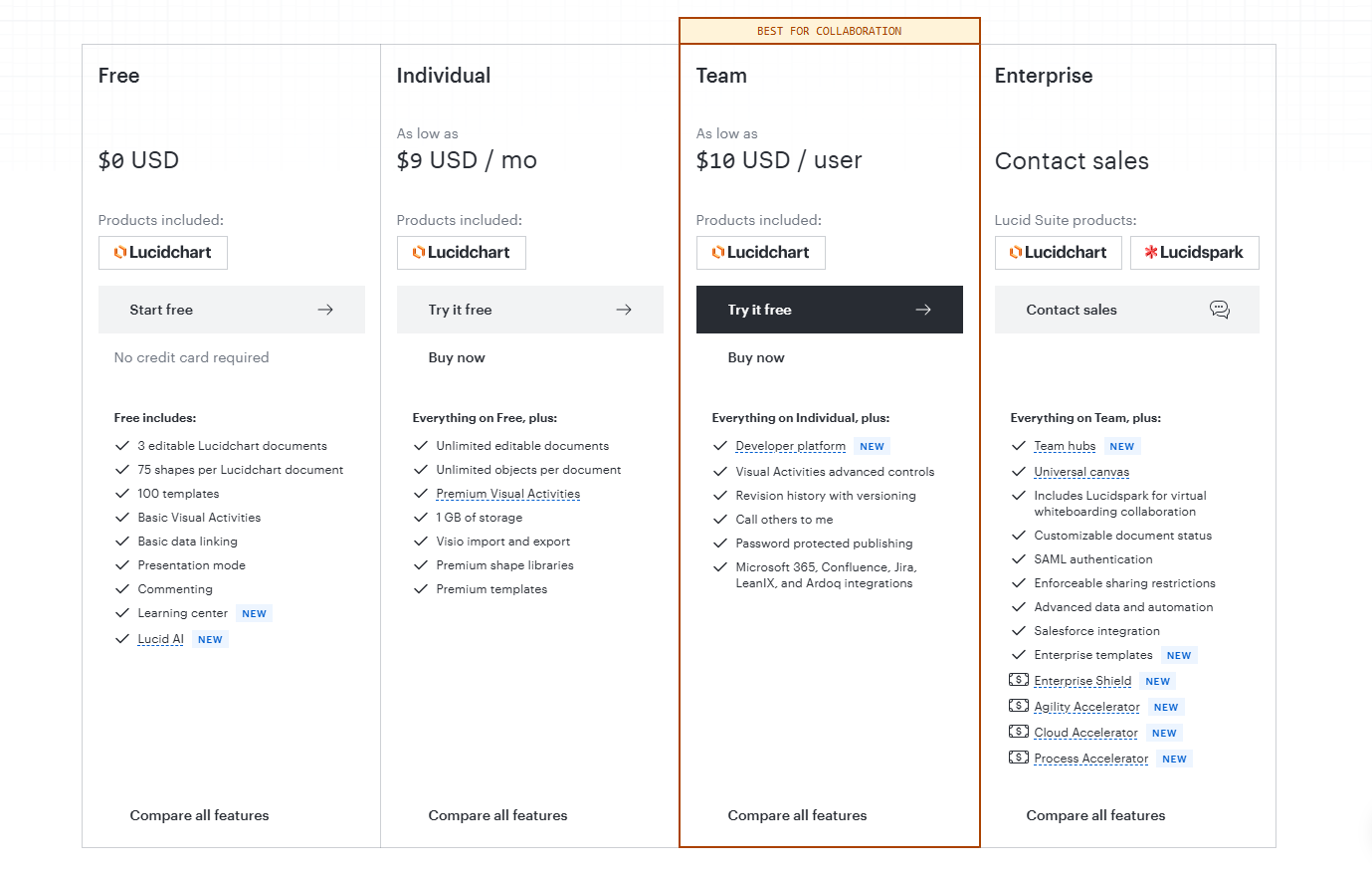
Lucidchart built its reputation on diagramming done well. Flowcharts, org charts, network topology maps, UML diagrams, swimlane processes — the tool handles all of it cleanly. Its enterprise tier adds SSO via SAML 2.0, admin controls, team management, advanced sharing permissions, and audit logging. For organizations without strict data residency requirements, it is a capable, well-polished product.
But Lucidchart's primary offering is cloud-based, with no standard on-premises deployment option. Every diagram, every collaboration session, every export, every audit log lives on Lucid’s infrastructure. That is a fixed architectural constraint — not a feature gap scheduled for a future release. It applies at every tier, including enterprise.
What Lucidchart enterprise does not offer:
- On-premise deployment on your organization’s own servers or data center hardware
- Private cloud deployment within your own AWS, Azure, or GCP tenancy, isolated from Lucid’s infrastructure
- Air-gapped or network-isolated operation with zero external internet dependency
- SDK integration that embeds diagramming capabilities inside your own platforms under your own data governance
- Organization-controlled encryption where your team holds the keys
For enterprises in industries where any one of these items sits on the procurement checklist, Lucidchart is structurally disqualified — regardless of how strong the rest of the feature set is.
Why Enterprises Require a Lucidchart Self-Hosted Alternative
IT managers do not chase on-premise deployment because they enjoy maintaining additional infrastructure. The requirement arrives from outside the IT team — from legal, compliance, security governance, or a regulatory framework that draws a hard line around where sensitive data can travel.
Data localization laws are tightening globally. GDPR in the EU, PDPA across Southeast Asia, LGPD in Brazil, and sector-specific frameworks in the Middle East and China all impose varying degrees of data residency obligation. A SaaS vendor’s choice of data center region does not satisfy these requirements the way an organization deploying within its own controlled infrastructure does. Regulators and auditors understand the distinction clearly.
HIPAA, FINRA, FedRAMP, and ITAR impose explicit infrastructure controls. Healthcare organizations, financial services firms, and defense contractors operate under compliance frameworks that require demonstrated control over how sensitive data is stored, transmitted, and accessed. Using a third-party SaaS tool for diagramming workflows that touch protected data creates exposure. The only architecture that eliminates that exposure is one where the tool runs entirely within the covered organization’s own environment.
Internal security policy at large enterprises has hardened considerably. Following a decade of high-profile breaches and the acceleration of supply-chain attacks, many organizations now operate under blanket prohibitions on routing any classified, strategic, or IP-sensitive collaboration data through external services — regardless of vendor security certifications. Architecture diagrams, network topology maps, system design documents: these are exactly the assets that flow through diagramming tools like Lucidchart. For organizations where those assets are sensitive, SaaS deployment is not an option.
According to Mordor Intelligence, the collaborative whiteboard and diagramming software market is projected to grow from $3.81 billion in 2026 to $9.59 billion by 2031, with on-premises deployment among the fastest-growing segments — driven precisely by regulated industries where cloud-only tools cannot pass procurement review.
Gartner’s digital workplace research consistently identifies data governance and sovereignty as top-tier criteria in enterprise software selection — a ranking that has strengthened, not softened, as regulatory environments have tightened.
What a Genuine Lucidchart On-Premise Alternative Must Deliver
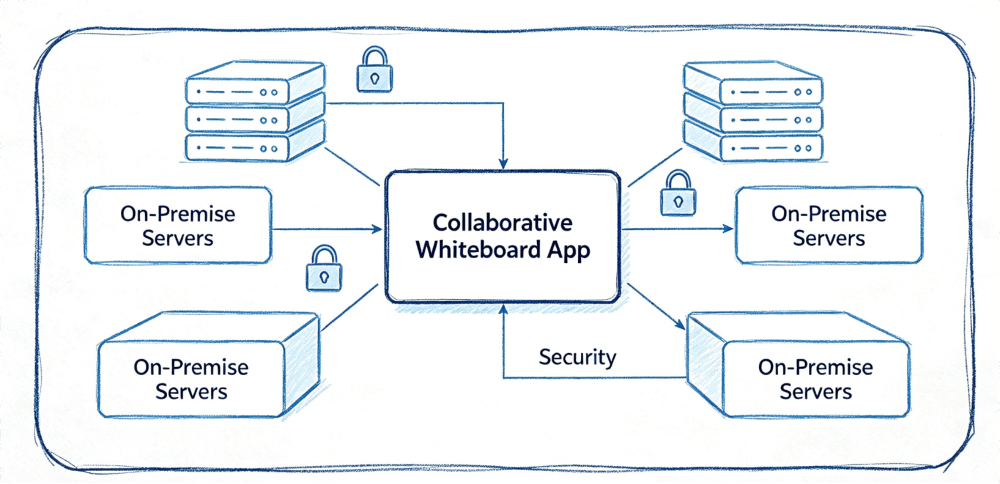
Not every tool that claims on-premise capability deserves the label. Enterprises evaluating a Lucidchart private deployment replacement should demand the following before advancing any candidate through procurement:
Diagramming depth that matches Lucidchart’s feature set. The replacement must handle flowcharts, process maps, org charts, network diagrams, UML diagrams, swimlanes, mind maps, and entity-relationship diagrams — with a shape library and template collection that scales to enterprise use. A simplified drawing canvas is not a diagramming platform.
Real-time multi-user collaboration. Multiple team members must be able to edit, comment on, and review diagrams simultaneously. This is no longer a differentiating feature — it is baseline. Any on-premise solution that cannot support live concurrent editing is not a viable Lucidchart replacement.
Full feature parity between cloud and on-premise versions. Many vendors ship stripped-down on-premise packages. The on-premise deployment must deliver every capability available in the SaaS version: AI-powered generation, templates, export formats, presentation mode, and collaboration tools. Any capability gap between the two versions is a red flag.
Native enterprise identity integration. SSO via SAML 2.0, LDAP, and Active Directory must be built in — not a paid add-on, not a configuration workaround. Users authenticate through your existing identity provider from day one.
Granular, enforceable access controls. Role-based access control at workspace, board, and content level. Administrators must be able to define exactly who can view, edit, export, and share — with those controls enforced in the infrastructure, not just the interface.
Audit logging your team can access directly. Tamper-evident logs of every user action — board access, edits, exports, permission changes — stored within your own infrastructure and queryable by your security operations team without involving the vendor.
SDK integration for embedded deployment. The most architecturally sophisticated enterprises do not want another standalone application. They want diagramming capabilities embedded directly inside existing platforms — internal portals, engineering tools, OA systems, project management software. A genuine enterprise alternative should offer a production-grade SDK that operates fully within private deployment environments.
Boardmix: The Lucidchart On-Premise Alternative Built for Enterprise
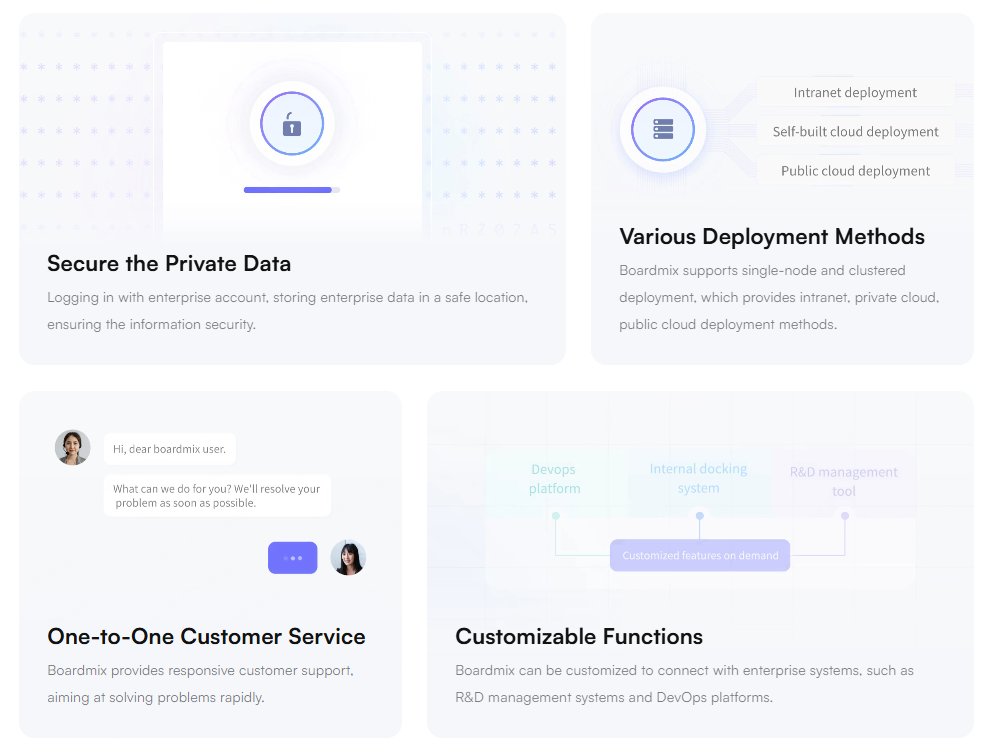
Boardmix is a full-featured enterprise visual collaboration and diagramming platform designed from the ground up to support private deployment. Not as a premium tier. Not as a late-addition compliance feature. As a foundational architectural requirement.
Where Lucidchart’s enterprise offering stops at the boundary of Lucid’s own cloud, Boardmix extends into your infrastructure — on-premises, in your private cloud, or embedded directly inside platforms your teams already operate.
On-Premises Deployment
Boardmix’s on-premises deployment installs the complete application stack — backend services, database, real-time collaboration engine, file storage — directly on your organization’s servers or data center hardware. Nothing crosses your network boundary. No external API calls reach Boardmix’s cloud infrastructure. No dependency on vendor uptime, vendor policy decisions, or vendor infrastructure choices.
Your IT team manages access controls, encryption configuration, version updates, and audit log retention using your existing processes and tooling. The deployment package includes full Docker and Kubernetes support, comprehensive setup documentation, and dedicated onboarding from Boardmix’s enterprise deployment engineers.
This is the architecture that satisfies financial regulators, healthcare compliance teams, government security reviews, and defense contractor information security policies — environments where the question is not “what does the vendor certify?” but “what does our infrastructure control?”
Private Cloud Deployment
For organizations that want cloud-native scalability without shared-infrastructure exposure, Boardmix deploys within your own dedicated cloud tenancy — AWS, Azure, Google Cloud, or other major providers.
Your account. Your IAM configurations. Your VPC. Your encryption keys. Boardmix’s infrastructure never processes your data. You retain complete Lucidchart private deployment-equivalent sovereignty while operating with the flexibility and resilience of cloud-native architecture — without sharing any infrastructure layer with Boardmix’s other customers.
Whiteboard and Diagramming SDK Integration
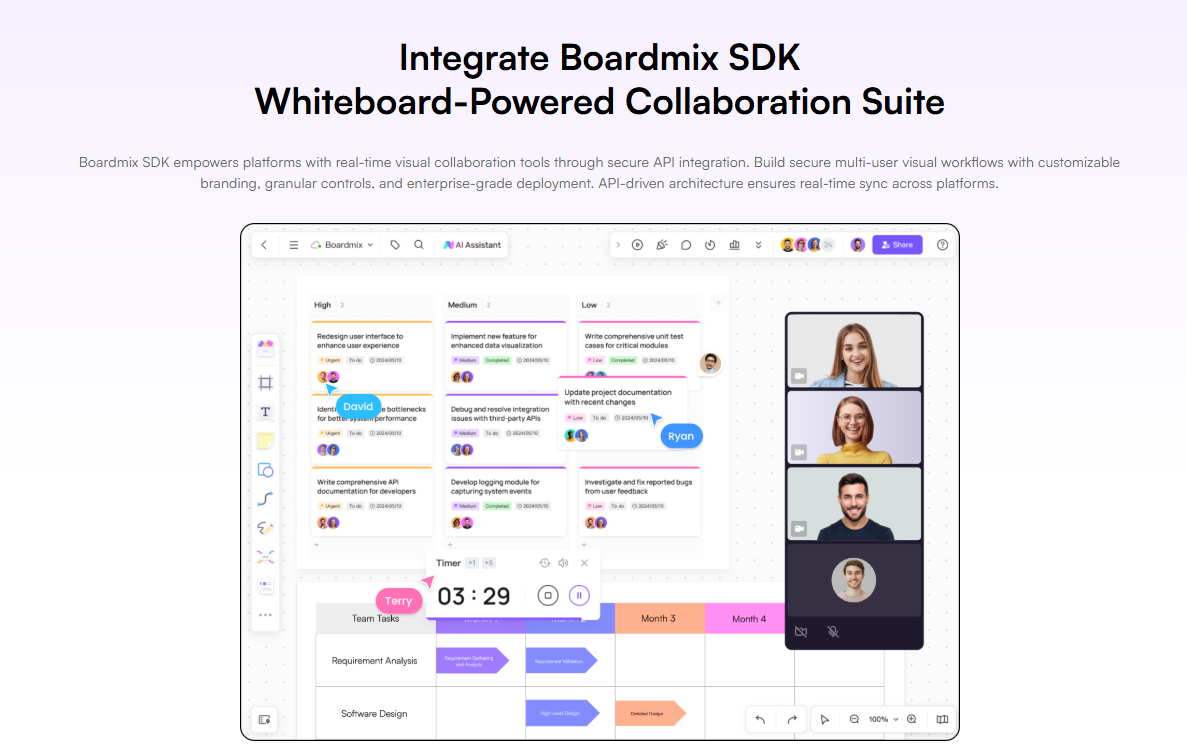
The Boardmix SDK opens a third path that many enterprises evaluating Lucidchart replacements do not initially anticipate — and then find indispensable once they understand it.
Rather than deploying Boardmix as a standalone application, your development team embeds the complete Boardmix canvas directly inside platforms your organization already owns and operates. The diagramming environment lives inside your internal tools. Authentication flows through your existing identity layer. All data stays entirely within your infrastructure.
SDK integrations support on-premises data centers and private cloud environments natively. Teams embed Boardmix into:
- Internal engineering portals and architecture review platforms
- OA systems and intranet collaboration hubs
- Product management and project tracking tools
- Document management and knowledge base systems
- Customer-facing SaaS products requiring co-creation or annotation features
Boardmix vs. Lucidchart: Feature and Deployment Comparison
| Capability | Lucidchart Enterprise | Boardmix Enterprise |
|---|---|---|
| On-premises / self-hosted deployment | Not available | Full support |
| Private cloud deployment | Not available | AWS, Azure, GCP, and others |
| Data residency control | Lucid-managed cloud only | 100% within your infrastructure |
| Air-gapped / network-isolated operation | Not possible | Fully supported |
| SDK for embedding into internal platforms | Not available | Full SDK with private deployment support |
| Flowcharts, org charts, UML, swimlanes | Available | Available |
| Real-time multi-user collaboration | Available | Available |
| AI-powered diagram generation | Available | Available |
| SSO (SAML 2.0, LDAP, Active Directory) | Available | Available |
| Role-based access control | Available | Available — workspace, board, and content level |
| Audit logging | Available | Available — directly accessible within your infrastructure |
| Organization-controlled encryption | Not available | Available |
| Dedicated deployment engineering support | Standard enterprise tier | Dedicated deployment engineers |
| Licensing model at scale | Per-seat SaaS subscription | Flexible enterprise licensing |
The deployment column is where the evaluation ends for regulated industries. Beyond deployment flexibility, both platforms offer comprehensive diagramming capabilities — though private deployment versions may include feature optimizations and exclusive enterprise features designed specifically for self-hosted environments.
Industries Already Running Boardmix as Their Lucidchart Enterprise Alternative
Financial services. Investment banks, asset managers, and insurance firms use Boardmix on-premises to run process mapping, system architecture documentation, and operational workflow design — entirely within their security perimeter, satisfying both internal information security policy and external regulatory requirements.
Healthcare and life sciences. Hospital IT teams, clinical operations groups, and pharmaceutical research organizations use Boardmix private cloud deployment to diagram clinical workflows, system integrations, and data architecture — without routing any content through external infrastructure that could create HIPAA exposure.
Government and defense. Government agencies and defense contractors operating under FedRAMP, ITAR, or classified network requirements deploy Boardmix on-premises in fully air-gapped environments. No public internet dependency. No external API calls. Complete network isolation.
Large technology organizations. Engineering teams building proprietary systems, designing unreleased product architectures, or documenting sensitive technical infrastructure use Boardmix SDK integration to embed diagramming directly inside internal engineering portals — keeping every diagram invisible outside the corporate network.
How to Migrate from Lucidchart to Boardmix On-Premises
Step 1: Select your deployment model. On-premises on your own servers, private cloud in your own tenancy, or SDK integration into an existing internal platform. Boardmix’s enterprise team helps scope the right architecture for your environment and compliance obligations.
Step 2: Technical scoping. Boardmix’s deployment engineers assess your existing infrastructure — server topology, SSO configuration, network architecture, existing tool integrations — and build a deployment plan around your specifics.
Step 3: Private trial environment. A trial instance is deployed inside your infrastructure before any production commitment. Your engineering and IT teams validate performance, feature parity, identity integration, and workflow compatibility on real projects.
Step 4: Security and compliance review. Boardmix provides architecture diagrams, data flow documentation, and security certifications to support your internal procurement, legal, and IT security review processes.
Step 5: Production rollout. Boardmix’s enterprise deployment team supports the full go-live, including user onboarding, administrator training, and post-deployment stability monitoring.
The Lucidchart Gap Is an Architecture Decision, Not a Feature Hunt
Teams searching for a Lucidchart on-premise alternative often begin by comparing shape libraries and template counts. That is a reasonable starting point — and Boardmix holds up well against Lucidchart on every feature dimension.
But the real decision is architectural. The question is not which tool draws better swimlane diagrams. It is which platform can operate compliantly and reliably, entirely within your own infrastructure — today and as your organization’s regulatory environment evolves.
Boardmix addresses that question with comprehensive deployment options, maintaining strong feature consistency while offering private-deployment-specific capabilities. On-premises deployment. Private cloud deployment. SDK embedding into your existing systems. Enterprise-grade security architecture. Active product development. Dedicated deployment engineering support. Everything Lucidchart’s enterprise tier provides in terms of diagramming capability, and everything it structurally cannot deliver on deployment.
Ready to evaluate Boardmix as your Lucidchart on-premise replacement? Contact the Boardmix enterprise team to schedule a technical consultation and request a private deployment trial configured for your environment.