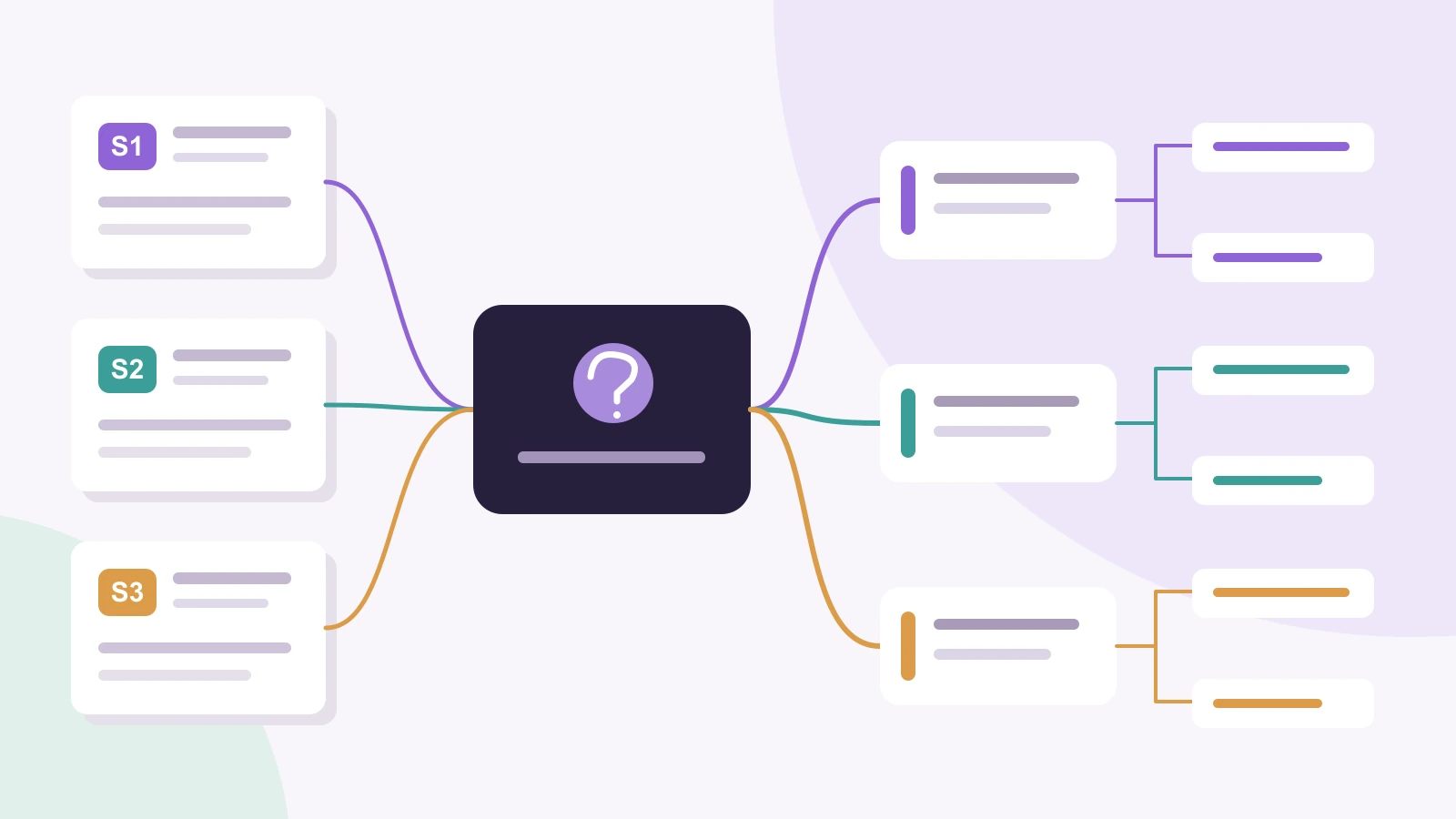
A literature review mind map connects a research question to themes, findings, and the sources behind them. Start with the question in the center, group related findings on branches, and keep a source ID beside each finding. Then compare what the sources actually support before turning a branch into a paragraph.
The useful result is a thematic outline you can explain and trace back to your reading. You can build it with Boardmix's online mind map maker, keeping the map, reading notes, and questions for collaborators on one board.
What belongs in a literature review mind map?
Use the center for a bounded question, the main branches for emerging themes, and the smaller branches for findings with source references. Keep detailed reading notes nearby. A heading such as “Online learning” is too broad to decide what belongs; “What shapes participation in asynchronous online seminar discussions?” gives you a practical inclusion test.
The UNC Writing Center's literature review guide distinguishes synthesis from a sequence of source summaries. A map helps you make that shift: related observations sit together, even when they come from different publications. A single source can appear on more than one branch.
- Question: the population, setting, and issue your review addresses.
- Themes: ideas that recur across the material, rather than one branch per author.
- Findings: short, specific statements with a stable source ID.
- Context: method, sample or setting, and limitations that affect the comparison.
- Working interpretations: what you think the relationship means, visibly separated from reported findings.
A mind map is useful while the organization is still changing. A synthesis matrix is often easier when you need the same fields for many sources: one row per source and columns for methods, themes, and findings. Use the matrix for detailed comparison and the map for the argument's shape. Neither replaces your reference manager, full texts, or the search record required for a systematic review.
Prepare source notes you can return to
Give each source a short ID such as S1, S2, or S3. Keep that ID unchanged even when you move a finding. Beside the map, record the full citation, DOI or stable URL, study context, method, relevant finding, and exact page, table, or section. If you copy wording, mark it as a quotation immediately; otherwise a compact note can accidentally become an unattributed quote in your draft.
Write a finding at the level the source supports. “Participants said the flexible response window helped them contribute” is different from “Flexible deadlines improve learning.” The latter adds a causal claim and an outcome that the first statement does not establish.
The following three source notes are fictional teaching materials, used throughout this example. They are not published studies or evidence about online education.
- S1 — Student interviews. Part-time postgraduate students described fitting forum contributions around work. The relevant passage is in the interview findings. The note concerns reported experience, not measured learning performance.
- S2 — Forum activity observations. In an undergraduate course, replies clustered near submission deadlines. The activity results count replies but do not assess the quality of the reasoning in them.
- S3 — Instructor reflection. An instructor described exchanges in which students compared different examples after a prompt. The discussion section concerns one course and offers no controlled comparison.
These notes already show why “three sources agree that online discussions work” would be an inaccurate summary. They concern different participants, methods, and outcomes.
A worked map: participation in online seminars
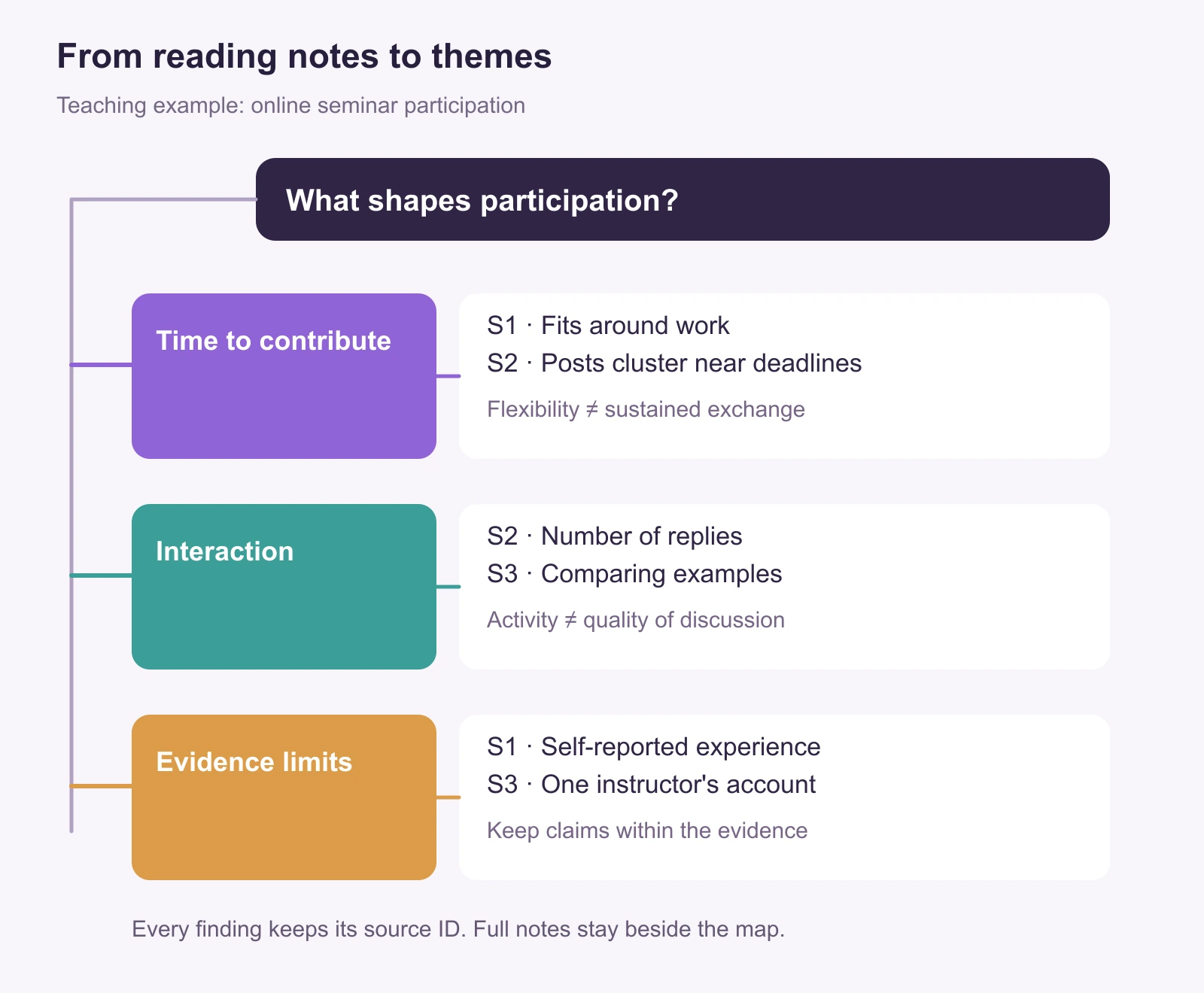
Place the question in the center. For this small teaching set, create three branches: Time to contribute, Interaction, and Evidence limits. These branches organize the current notes; a larger reading set may require different themes.
Time to contribute
Put S1's work-schedule observation and S2's deadline clustering on this branch. They are related, but they are not opposite answers to the same measurement. One describes how students experience flexibility; the other describes when replies occur. Your working interpretation can be: “Having time to contribute and sustaining an exchange are separate questions.”
Interaction
Place S2's reply counts beside S3's account of comparing examples. Label the difference in outcomes: participation volume versus the content of the exchange. Do not draw a causal arrow from a prompt to better learning, because these notes do not establish that claim.
Evidence limits
Keep S1's self-reported experience and S3's single-course account visible. Attach each limitation to the finding it qualifies. A separate limitations branch is a useful overview, but it should not let a simplified finding elsewhere on the map lose its context.
One unanswered question now becomes clear: “How does prompt design relate to the quality of discussion across different course settings?” Record it as a question to investigate. A gap in these three notes is not proof that the research field has never addressed it.
Build and revise the map in Boardmix
- Set the question. Open a board and create a central mind-map topic. Add the population and setting if they define your review. Keep your assignment requirements in a separate note so they do not become research findings.
- Create tentative theme branches. Start with labels drawn from your reading. If you need a starting structure, browse the mind map templates and adapt the branches to the question.
- Add one finding per small branch. Write a short statement followed by its source ID. Keep the full citation and locator in the reading-note area. Split a node that contains two different claims.
- Move related findings together. A paper can contribute to both a methods discussion and a substantive theme. Reuse its ID rather than treating the second appearance as another independent study.
- Label relationships in words. Use “similar result,” “different population,” “different measure,” or “unresolved” where appropriate. Color can help navigation, but should not be the only way a reader understands a relationship.
- Review the argument with a collaborator. Ask them to follow one claim back to its note and identify where you have moved from a reported finding to an interpretation. Discuss those points on the shared board before drafting.
Keep the board focused on organizing your reading. Adding a citation to a map does not confirm that the source exists or supports the claim; open the original and check it when you use the finding.
A reusable branch structure
Copy this structure into your working notes and replace the bracketed fields. Expand it only where your material needs more detail.
- [Research question and scope]
- [Theme]
- [Finding] — [source ID + page/table/section]
- [Related finding] — [source ID + locator]
- [Method or context that affects comparison]
- [Relationship between the findings]
- [Working paragraph claim]
- [Unanswered question or next search]
- [Theme]
For the time branch above, the working claim is “Time flexibility and sustained participation need separate treatment.” The source notes remain S1 and S2; the different populations and outcomes remain attached. The next search asks about the relationship between response windows and interaction patterns, rather than searching for a paper that merely repeats the claim you already prefer.
Turn one branch into a synthesis paragraph
Begin with a point that compares the sources. Follow it with the relevant findings, explain their differences, and end with the implication that your evidence can support. A teaching paragraph from the fictional notes could read:
Time flexibility and sustained interaction describe different aspects of online seminar participation. In S1, part-time postgraduate students described fitting contributions around work. S2's activity observations instead showed replies clustering near deadlines in an undergraduate course. Because the notes concern different populations and measure different things, they do not establish whether flexible response windows produce more sustained exchange. A review of timing therefore needs to distinguish access to participation from patterns of interaction.
For your actual review, replace the IDs with the required citation style and include the real bibliographic entries. The map gives you the paragraph's logic; the sources provide its evidence. If a branch produces only one source summary after another, return to the relationship between them before adding more prose.
When the map becomes difficult to use
- Every branch is an author. Keep those as source notes, then create a second view organized around the questions those authors address.
- Nodes contain entire abstracts. Shorten the visible node to one finding. Leave the full note and locator nearby.
- One source dominates several branches. That may reflect its relevance, but repeated appearances are not independent support. Count sources, not nodes, when describing the evidence.
- Different results look contradictory. Compare the population, method, setting, and outcome first. Label a disagreement only after checking that the studies address a comparable question.
- The map is too crowded. Keep a high-level theme map and separate detailed source notes. Move to a matrix when repeated comparisons are easier in rows and columns.
If your task concerns a single text rather than a body of research, use a book-summary mind map instead. For a literature review, keep asking which relationship each branch will explain in the written argument.
Open Boardmix to organize your own question, sources, and themes on a shared board.