Bending Spoons agreed to acquire Miro for an enterprise value of $1.355 billion in a deal announced on September 10, 2026. The Miro acquisition is expected to close in the fourth quarter of 2026 subject to regulatory approvals, and until it does, both companies say they will continue to operate independently. No change to Miro's pricing, packaging, or product commitments has been announced.
Deal status as of September 17, 2026
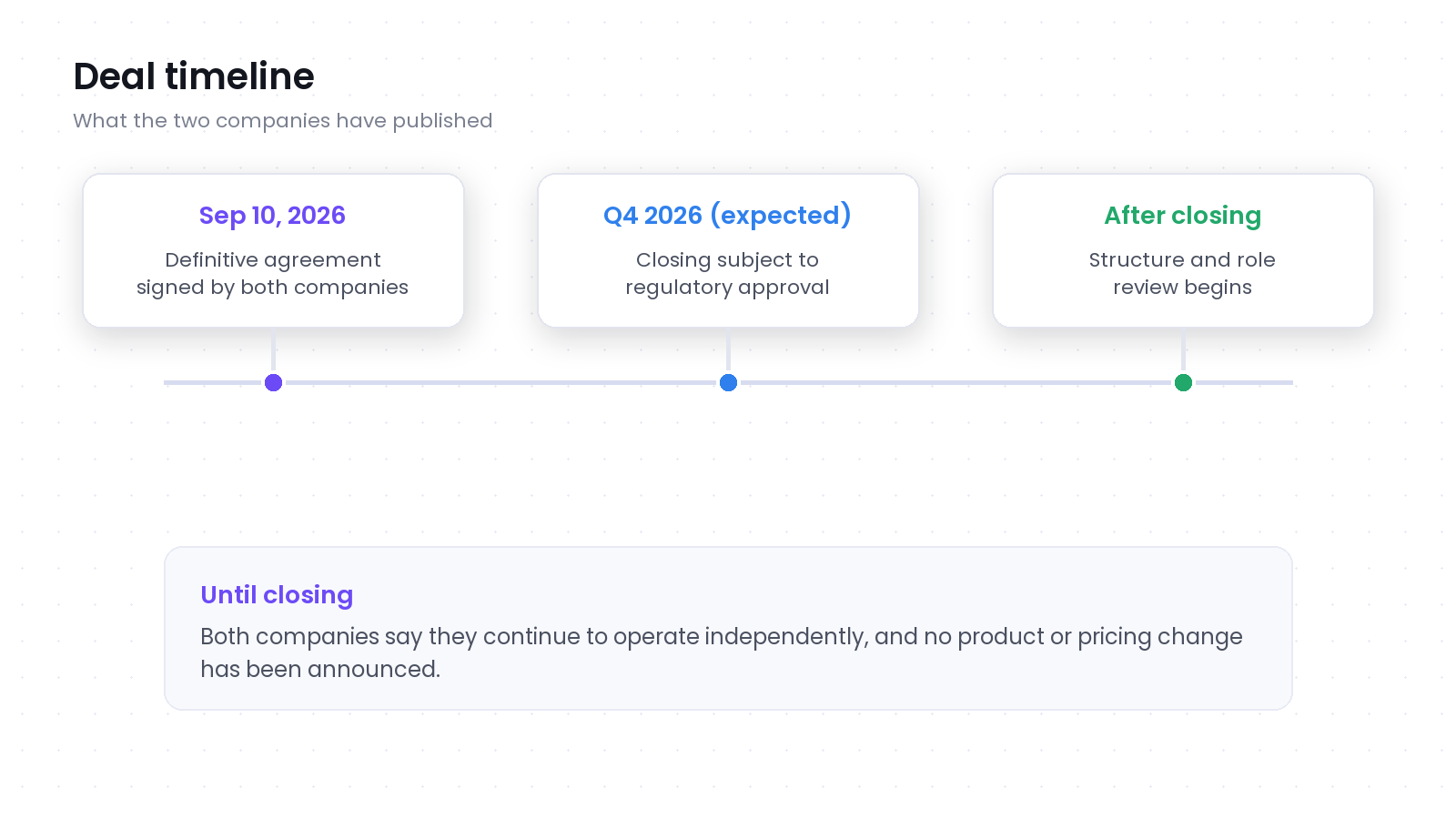
- Signed on September 10, 2026: definitive agreement between Bending Spoons and Miro.
- Not yet closed. Closing is expected in the fourth quarter of 2026, subject to regulatory approvals and other customary closing conditions.
- Operations before closing: unchanged, according to both companies' public statements.
This explainer sticks to what the two companies have published: the terms, the timeline, what each side has said it intends to do, and the questions that are genuinely still open. It is written for the teams and administrators who plan around Miro, not for investors.
What Was Announced
On September 10, 2026, Bending Spoons S.p.A. and Miro signed a definitive agreement for Bending Spoons to acquire Miro. The news came from the Bending Spoons investor newsroom and from a public note from Miro's founder and CEO, Andrey Khusid published the same day.
The agreement was unanimously approved by both boards of directors. Under its terms, Bending Spoons will acquire 100% of Miro's issued and outstanding shares in an all-cash transaction.
A definitive agreement is a signed contract, not a completed deal. The transaction still has to clear regulatory approvals and other customary closing conditions before it can close.
Deal Timeline
- Week before September 10, 2026: Bending Spoons completes its acquisition of Airtable, its most recent addition before Miro.
- September 10, 2026: Miro's CEO shares the news with employees and publishes a public note; Bending Spoons publishes the acquisition announcement.
- Fourth quarter of 2026 (expected): the transaction is expected to close, subject to regulatory approvals and customary closing conditions.
- After closing: Bending Spoons has said it will study how Miro operates before making decisions about structure and roles.
Deal Facts at a Glance
| Item | What the public record shows |
|---|---|
| Announcement date | September 10, 2026 |
| Acquirer | Bending Spoons S.p.A. (NASDAQ: BSP), headquartered in Milan |
| Enterprise value | $1.355 billion |
| Implied equity value | Approximately $1.79 billion, once Miro's net cash is added to the enterprise value |
| Consideration | All cash |
| Shares acquired | 100% of Miro's issued and outstanding shares |
| Shareholder investment | Certain Miro shareholders agreed to invest $295 million of their proceeds into newly issued Bending Spoons equity |
| Board approval | Unanimous approval from both boards of directors |
| Expected close | Fourth quarter of 2026, subject to regulatory approvals and other customary closing conditions |
| Operating status before close | Both companies continue to operate independently |
What Bending Spoons Has Said About Its Plans
Bending Spoons is a technology company headquartered in Milan that recently completed an IPO and now trades on NASDAQ under the ticker BSP. Its portfolio includes Airtable, AOL, Brightcove, Eventbrite, Evernote, Tractive, Vimeo, and WeTransfer, and the company says it has never sold a material business it acquired.
Luca Ferrari, Bending Spoons' CEO and co-founder, framed the deal around long-term ownership and product fundamentals rather than cost cutting. After closing, he said, the company plans to invest substantially in performance, reliability, and the functionality that supports critical collaborative work. He added that Bending Spoons acquires businesses with the intention of owning and operating them for the long term.
Two numbers from the same announcement give useful context for buyers. Miro has grown to around $600 million in annual recurring revenue, nearly 90% of which comes from business and enterprise customers. More than 250,000 organizations have integrated Miro into their workflows.
The announcement also describes the general model Bending Spoons has applied to acquired businesses. That model typically involves reorganizing teams, overhauling technology, redesigning user interfaces, accelerating product development, and changing how products are marketed and monetized.
Read that passage carefully. It describes the acquirer's standard approach across its portfolio, not a plan published for Miro. Miro has not announced any of those changes.
What Miro Says Changes Before Closing
Miro's message to customers has been narrow and specific: until the deal closes, nothing changes in how the company operates.
Miro's CEO also described the three criteria the company used when weighing the offer.
- The best long-term outcome for users and customers, which meant an owner willing to keep investing in Miro for years.
- The best outcome for employees.
- The best outcome for the investors who backed the company.
On employee equity, Miro's board approved crediting eligible employees for a portion of unvested equity based on tenure, paid as a one-time cash bonus at closing, and waived the standard one-year cliff.
Miro also described how the transition is expected to begin. In Miro's account, Bending Spoons' approach is to spend time understanding the business first, and decisions about structure and roles are expected to follow that review, subject to local legal requirements.
Known, Unknown, and Watch Items
The table below separates what the two companies have actually published from the questions that remain open. Treat anything in the third column as unresolved rather than as a likely outcome.
| Topic | Documented today | Still open |
|---|---|---|
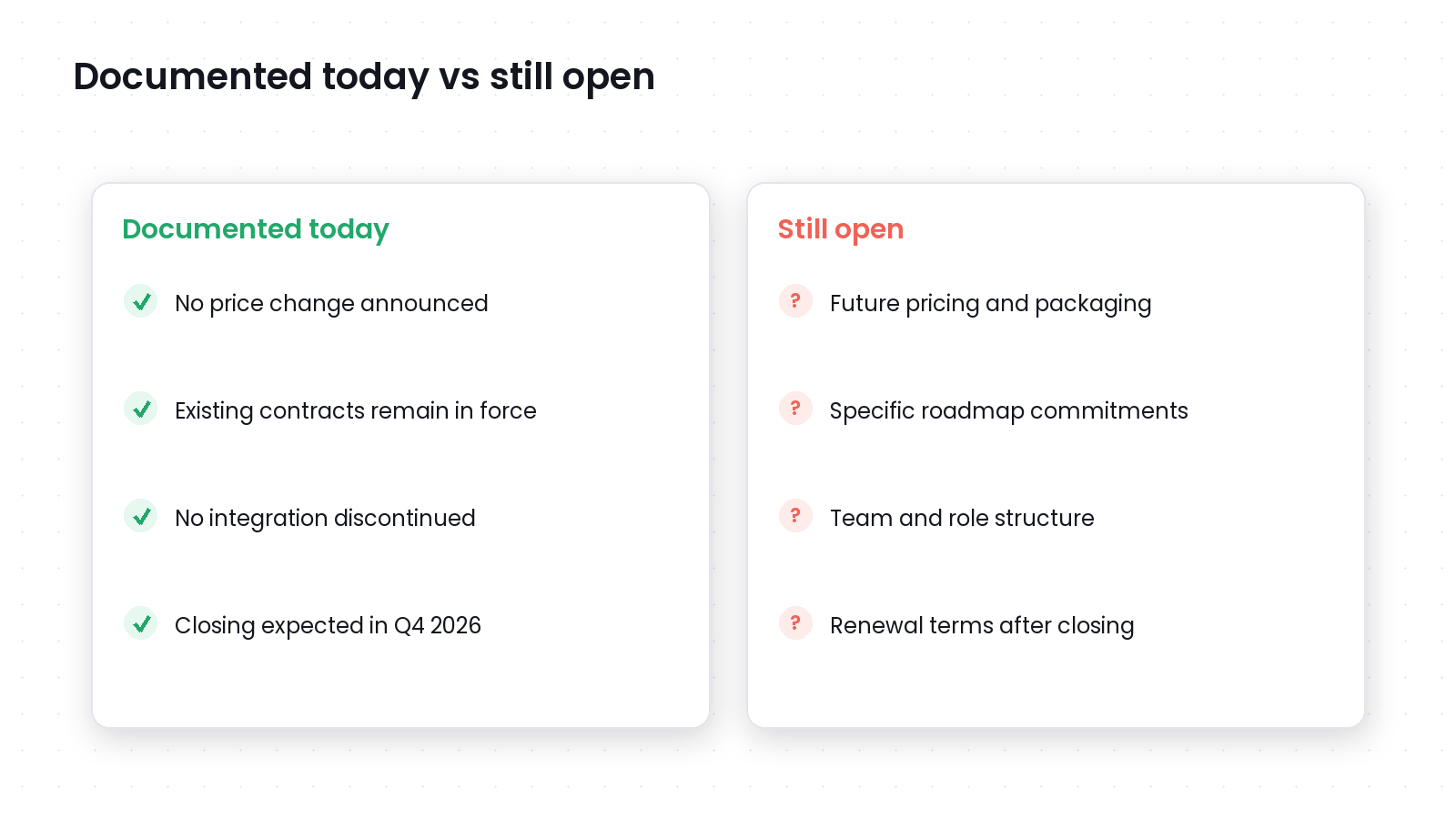
| Pricing and packaging | No price change has been announced | Whether list prices, seat rules, or plan packaging change after closing |
| Product roadmap | Bending Spoons says it plans to invest in performance, reliability, and functionality | Specific roadmap commitments, features, and delivery dates |
| Organization | Bending Spoons says it will study how Miro operates before deciding on structure and roles | How teams and roles are organized once that review is complete |
| Customer contracts | Existing agreements remain in force on their current terms | Whether renewal terms or enterprise packaging change later |
| Data and security | No change to data handling or residency has been announced | Whether infrastructure, subprocessors, or regional options are adjusted |
| Integrations | No integration has been discontinued | Long-term support for the integrations your workflows depend on |
| Timeline | Closing is expected in the fourth quarter of 2026 | Whether the regulatory review moves that date |
What the Deal Does Not Change Today
- Miro is still operating. No shutdown, wind-down, or service discontinuation has been announced.
- Published prices still apply. No increase or repackaging has been announced.
- Existing contracts still govern. Your current terms remain the reference point until a change is agreed or announced.
- Roadmap statements are unchanged. Nothing in the announcement removes previously committed work.
That does not mean nothing will change. It means the change has not been announced, and planning around an unannounced outcome is guessing rather than forecasting.
How to Track the Deal Without Overreacting
The practical response for a team that runs on Miro is documentation, not a rushed migration. Record five things for every agreement and platform dependency you rely on.
- The renewal date and notice period.
- What your plan allows you to export, and when.
- The integrations that would be hardest to replace.
- Any data-residency or retention obligations.
- The boards that would be expensive to rebuild.
Review the same questions for the other collaboration platforms you depend on. Vendor concentration is a portfolio question, and the answer is usually a documented exit path rather than an immediate switch. If you are comparing options, the Miro alternatives comparison sorts products by workflow, and the Boardmix and Miro comparison covers feature, pricing, and migration differences side by side.
Teams that keep this review on a shared canvas find it easier to maintain. A board that holds the contract dates, integration dependencies, and open questions can be reviewed in a short meeting and updated as the deal progresses.
Last verified: September 17, 2026. Deal terms and timelines reflect the two companies' public statements on that date. Miro and Bending Spoons are trademarks of their respective owners; Boardmix is not affiliated with or endorsed by either company.