


Miro is a powerful visual collaboration tool. Thousands of product teams, designers, and strategists use it daily — and for good reason. The infinite canvas, the template library, the real-time cursors: it all works.
But there is one thing Miro does not offer, and for a growing segment of enterprise IT and security teams, it is the one thing that matters most. Miro has no self-hosted deployment option. Your data lives on Miro’s cloud infrastructure. Full stop. You cannot change that.
For organizations operating under GDPR, HIPAA, SOC 2, or strict internal data governance policies, this is not a minor inconvenience. It is a disqualifying constraint. And it is exactly why searches for a Miro self-hosted alternative have surged among enterprise procurement teams in regulated industries.
This article breaks down why self-hosted whiteboard deployment has become a hard requirement, what separates a genuine enterprise-grade alternative from a basic workaround, and why Boardmix has emerged as the leading choice for organizations that refuse to compromise on either features or data control.
Why Enterprises Are Walking Away from Miro’s SaaS-Only Model
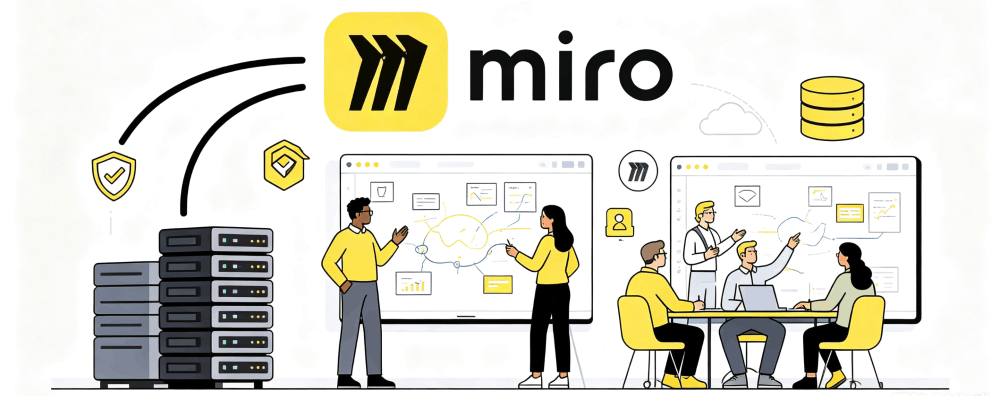
Miro’s enterprise tier offers enhanced security controls — SSO, audit logs, advanced permissions. But all of it runs on Miro’s own cloud. That architecture works until it doesn’t.
Here is what enterprise IT teams consistently flag during procurement reviews:
Data residency uncertainty. Miro stores data on its cloud infrastructure, with data centers in specific regions. For organizations subject to strict data localization requirements — certain EU member states, government agencies, defense contractors — this creates compliance exposure that legal teams refuse to accept.
No network isolation. Even with Miro’s enterprise plan, your whiteboard sessions route through external infrastructure. Internal collaboration on sensitive projects, unreleased product designs, or confidential strategic planning cannot be fully isolated from public internet exposure.
Third-party audit dependency. Security teams cannot inspect Miro’s infrastructure directly. They rely on Miro’s own compliance certifications. For organizations that require full-stack visibility into their collaboration environment, that dependency is a fundamental architectural problem.
Escalating per-seat costs at scale. Miro’s pricing scales linearly with users. For large enterprises deploying collaboration tools to hundreds or thousands of employees, the cost structure becomes difficult to justify — especially when self-hosted alternatives can be deployed at a fixed cost model.
According to Mordor Intelligence, the collaborative whiteboard software market is projected to reach $9.59 billion by 2031, with on-premises deployment emerging as one of the fastest-growing segments — driven specifically by regulated industries and data-sovereignty mandates.
What to Actually Look for in a Miro Self-Hosted Alternative
Not every tool that claims “self-hosted” delivers what enterprise teams actually need. A Docker container with basic drawing tools is not a viable Miro replacement. Here is the evaluation framework that separates real enterprise alternatives from lightweight experiments.
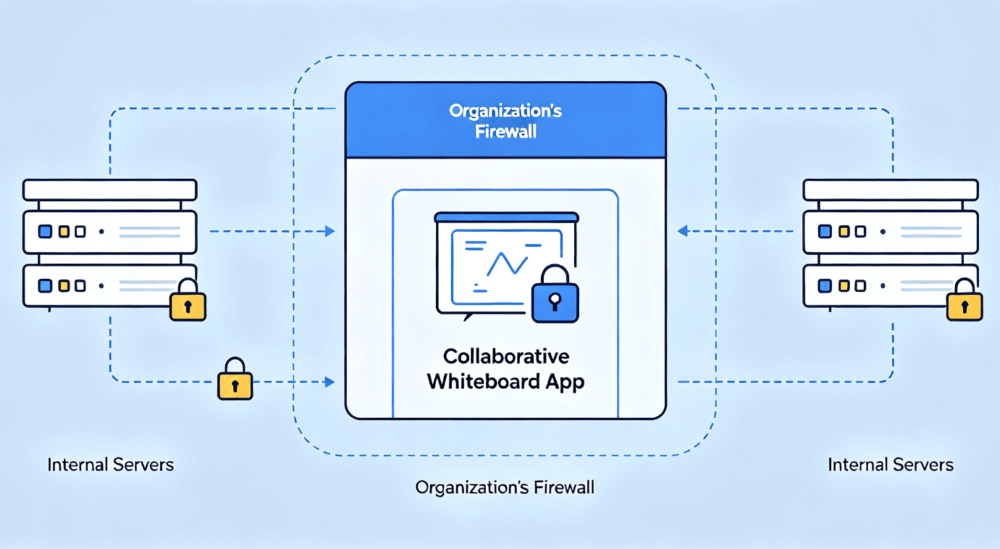
Full feature parity with the SaaS version. Many vendors offer stripped-down on-premises versions. The on-premises deployment must support real-time multi-user collaboration, a complete template library, flowcharts, mind maps, presentations, and AI-powered tools — not a reduced feature subset.
Flexible deployment architecture. True enterprise needs vary. Some organizations want pure on-premises deployment on their own servers. Others want private cloud deployment within their own AWS or Azure tenancy. The best alternatives support both, plus SDK-based embedding into existing internal platforms.
Security-first design — not security as a bolt-on. SSO integration (LDAP, SAML, Active Directory), role-based access control, end-to-end encryption, and audit logging need to be native architecture features. Not optional add-ons that require custom development work.
SDK and API integration capability. The most forward-thinking enterprises do not want a separate whiteboard application at all. They want visual collaboration embedded directly into their OA systems, project management platforms, or internal portals. A genuine Miro alternative should offer an enterprise-grade SDK that supports private deployment environments.
Dedicated deployment and ongoing support. Private deployment is a long-term infrastructure commitment. The vendor needs to provide deployment engineers, containerized setup documentation (Docker/Kubernetes), version management, and responsive enterprise support channels.
Boardmix: The Enterprise-Grade Miro Self-Hosted Alternative
Boardmix was built with enterprise deployment as a first-class requirement — not an afterthought. While other whiteboard tools are designed primarily as consumer SaaS products with enterprise features grafted on, Boardmix’s architecture was designed from the ground up to support private deployment at any scale.
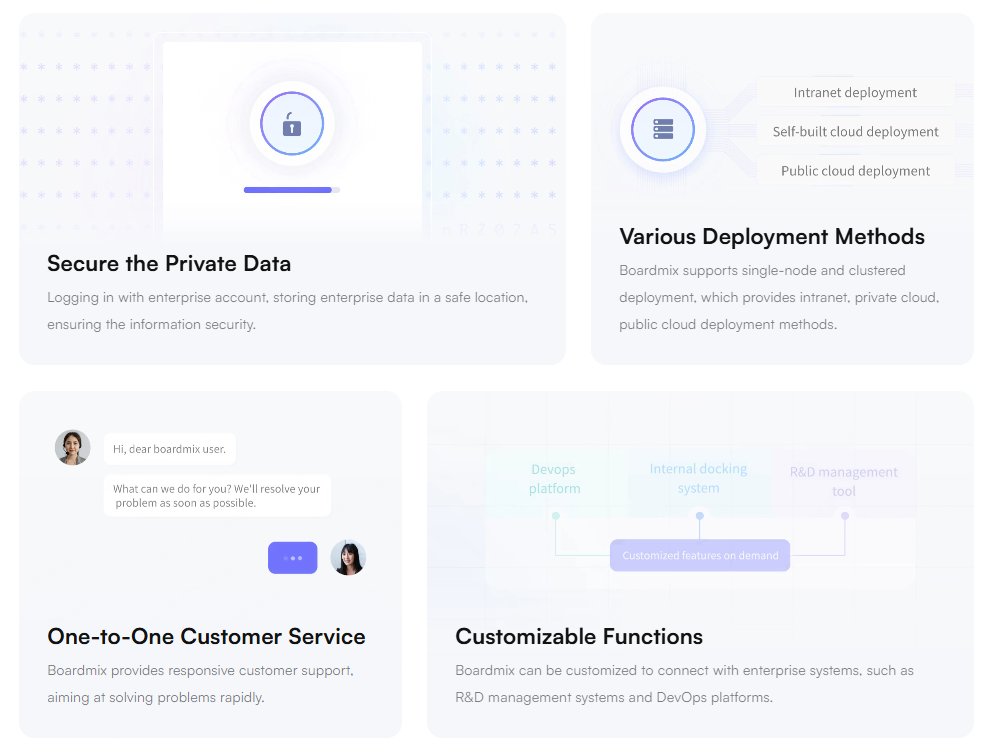
On-Premises Deployment
Boardmix’s on-premises option installs the complete application stack — backend services, database, file storage, real-time collaboration engine — directly on your organization’s own servers or data center hardware.
Nothing leaves your network. Your IT team controls access management, encryption standards, and audit logging. The deployment supports containerized environments via Docker and Kubernetes, making integration with existing infrastructure straightforward. Boardmix’s enterprise team provides dedicated deployment support, including go-live assistance and ongoing version management.
This is the right path for financial institutions, healthcare systems, government agencies, and defense contractors where any external data routing is either prohibited or subject to stringent approval processes.
Private Cloud Deployment
For organizations that prefer cloud-native operational flexibility without SaaS exposure, Boardmix supports private cloud deployment within your own cloud tenancy on AWS, Azure, Google Cloud, and other major providers.
Your account. Your IAM policies. Your data. Boardmix’s infrastructure does not touch it. You get the scalability and operational simplicity of cloud architecture while maintaining complete data sovereignty.
Whiteboard SDK Integration
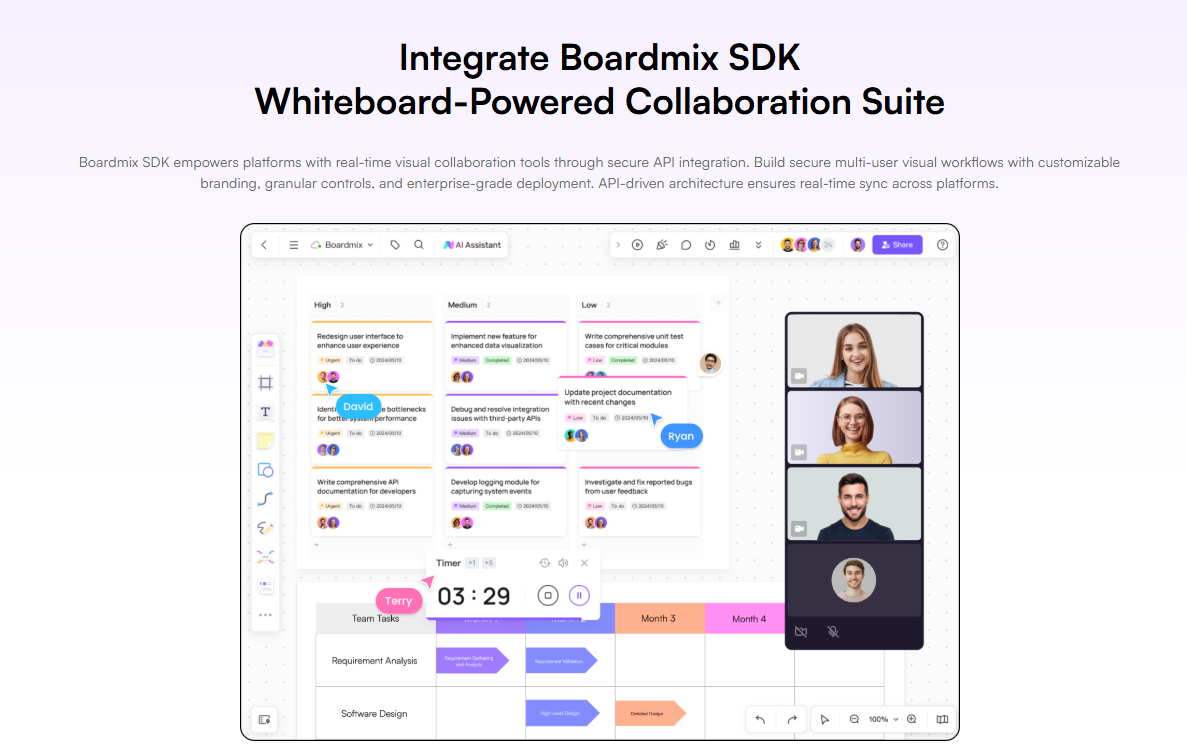
Beyond standalone deployment, Boardmix’s SDK enables enterprise development teams to embed full whiteboard functionality directly inside existing platforms — OA systems, internal portals, document management tools, project management platforms, and customer-facing SaaS products.
The SDK supports on-premises and private cloud environments, meaning the security model carries through to every embedded whiteboard instance. Open APIs and a plugin architecture give development teams complete control over UI, permissions, and data flows.
Boardmix vs. Miro: Enterprise Deployment Comparison
| Criteria | Miro Enterprise | Boardmix Enterprise |
|---|---|---|
| Self-hosted / On-premises deployment | Not available | On-premises support |
| Private cloud deployment | Not available | AWS, Azure, GCP, and more |
| Data residency control | Miro-managed cloud only | 100% within your infrastructure |
| SDK / API for platform embedding | Limited API integrations | SDK with private deployment support |
| SSO integration (LDAP, SAML, AD) | Available | Available |
| Role-based access control | Available | Available |
| Audit logging | Available | Available |
| End-to-end encryption | Vendor-managed | Organization-controlled |
| AI-powered collaboration tools | Available | Available |
| Real-time multi-user canvas | Available | Available |
| Deployment support | Standard enterprise support | Dedicated deployment engineers |
| Pricing model at scale | Per-seat SaaS subscription | Flexible enterprise licensing |
*Note: The Boardmix private deployment versions may have certain feature differences compared to the public SaaS version. Some features are exclusive to private deployment, while others are in active development for on-premises environments.
The table above clarifies what is actually at stake. On every dimension that matters to enterprise IT and security teams — deployment flexibility, data control, SDK capability. Boardmix delivers deployment options that Miro fundamentally cannot offer while maintaining feature consistency with the core platform, with certain optimizations and exclusive capabilities designed specifically for private deployment environments.
Real-World Scenarios Where Boardmix Wins the Evaluation
Financial services and banking. A regional bank deploying whiteboard tooling across its strategy and product teams cannot route session data through any external cloud service under its internal information security policy. Boardmix on-premises deployment passes the security review.
Healthcare and life sciences. Hospitals and pharmaceutical companies working with patient data context or clinical development documentation need collaboration infrastructure that can satisfy HIPAA requirements. Private deployment keeps the entire collaboration environment within the covered entity’s own infrastructure.
Government and public sector. Government agencies operating under data localization mandates or classified information handling requirements need tools that run entirely within government-controlled networks. Boardmix’s on-premises deployment supports network-isolated environments with no public internet dependency.
Large enterprise product teams. A global technology company with thousands of engineers wants to embed whiteboard collaboration directly into its internal engineering portal rather than manage a separate SaaS subscription. Boardmix’s SDK embeds the full whiteboard experience into the existing platform, under existing SSO, without routing data externally.
How the Migration from Miro to Boardmix Works
Switching from a SaaS whiteboard tool to a self-hosted alternative sounds operationally complex. In practice, the process is structured and well-supported.
Step 1. Define your deployment model. Decide between on-premises, private cloud, or SDK integration. This shapes infrastructure requirements and timeline.
Step 2. Technical scoping. Boardmix’s enterprise team conducts a scoping session to assess your existing infrastructure, security requirements, SSO configuration, and integration points with other internal tools.
Step 3. Trial deployment. A private deployment trial environment is provisioned for your team to validate performance, feature parity, and integration compatibility before committing to full rollout.
Step 4. Security review. Boardmix provides comprehensive compliance documentation — architecture diagrams, data flow maps, security certifications — to support your internal security and procurement review process.
Step 5. Production deployment and training. Boardmix’s enterprise deployment team supports the production go-live, including staff onboarding and training to ensure adoption is immediate rather than incremental.
The Self-Hosted Whiteboard Market Is Growing Fast — and Enterprises Are Leading It
The demand driving this market shift is structural, not cyclical. Gartner research on digital workplace strategy consistently finds that data governance concerns are now among the top three factors influencing enterprise software procurement decisions. Cross-border data regulation, increasingly enforced by regulators in the EU, APAC, and North America, has transformed data residency from a preference into a procurement gate.
Miro built an exceptional product for cloud-native teams with minimal compliance constraints. That product continues to serve those teams well. But the enterprise market has moved. Organizations managing genuinely sensitive workflows — proprietary IP, patient records, financial models, government data — need collaboration infrastructure they own and control.
That is precisely the problem Boardmix solves.
The Bottom Line
Miro has had years to build a self-hosted deployment option. It has not, and based on its current product roadmap and business model, it is unlikely to. The architecture that makes Miro’s SaaS product work is the same architecture that prevents it from offering private deployment.
If your organization has reached the point where Miro’s data model is the blocker — where legal, compliance, or IT security teams have flagged the deployment architecture as a risk — waiting is not a strategy.
Boardmix is the enterprise-grade Miro self-hosted alternative your teams can adopt without sacrificing the visual collaboration experience they rely on. Same infinite canvas. Same real-time multi-user collaboration. Same AI-powered tools. Entirely within your own infrastructure.
Ready to see it in your environment? Contact the Boardmix enterprise team to schedule a technical consultation and request a customized private deployment trial.