


AI can help you explore an essay topic, organize notes, and revise a draft. The argument, source checking, and final wording remain your responsibility. This guide explains a practical workflow: map a question, connect claims to evidence, write a draft, and review it in your own voice. Check your institution’s AI policy before using assistance on assessed work.
Essential Guide: How to Write an AI Essay with Maximum Impact
Start with a research question and a provisional thesis. List the claims you need to support, then collect sources and note what each source actually says. A visual outline can help you find gaps or repeated points; a linear outline also works. Use the structure that helps you reason clearly, and revise it when the evidence changes.
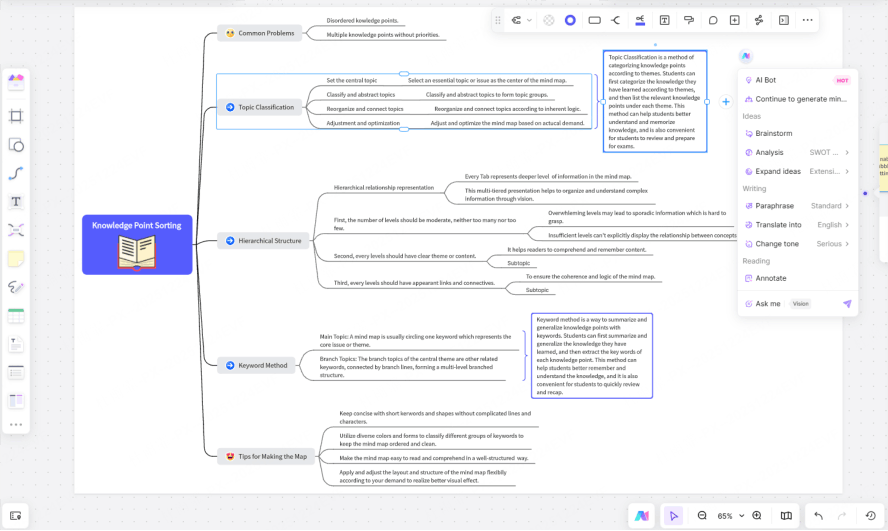
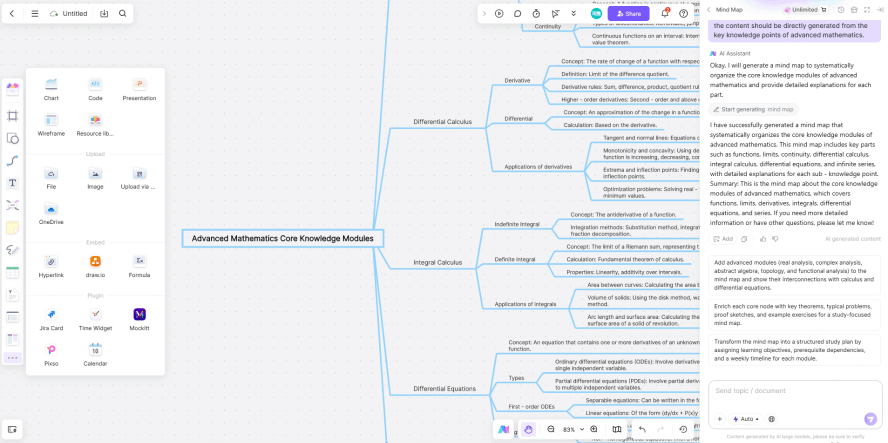
On a Boardmix board, place your thesis in the center and add branches for supporting claims, counterarguments, and open questions. If you use AI mind mapping, treat the output as a starting outline. Check each branch yourself before drafting; a neat map does not prove an argument is sound.
Top 7 AI Essay Writing Tools for 2026
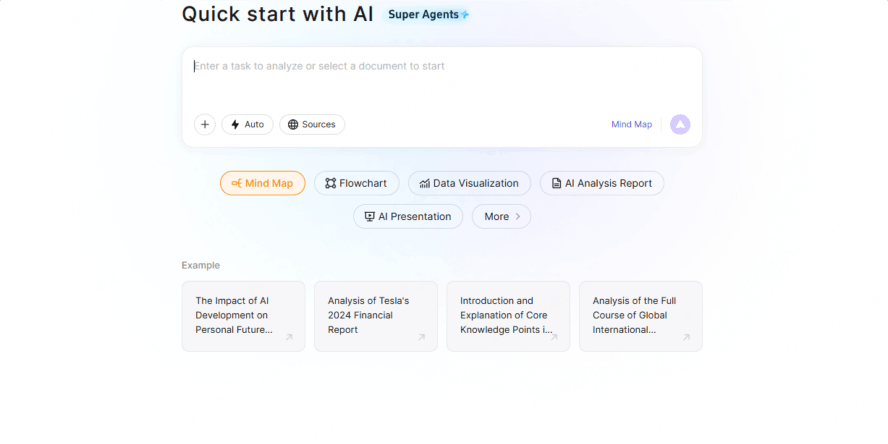
- Boardmix AI: Use a collaborative whiteboard to arrange research notes, outline branches, and feedback. Review generated suggestions before adding them to your argument.
- Elicit/Perplexity: Consider research-oriented tools for discovering sources. Open the original paper, check its methods and publication details, and confirm that it supports the claim you intend to make. A generated citation alone is not evidence.
- Claude: Consider a writing assistant for discussing an outline or revising a passage. Compare suggestions with your source material and assignment requirements; model availability and limits depend on the current plan.
- QuillBot: Use rewriting suggestions to explore clearer wording. Preserve meaning, cite borrowed ideas, and reject changes that misrepresent your sources. Rephrasing does not establish originality.
- Grammarly: Review grammar and style suggestions while retaining control of the final wording. Check which features are included in the plan you use.
- Jasper: A content-writing workflow may help with brainstorming and draft variations. For academic work, assess its fit against your institution’s rules and verify references independently.
- Originality.ai: Detection results should not be treated as proof of authorship or as a compliance certificate. Keep your research notes and drafts, disclose assistance where required, and follow the relevant academic policy.
Deep Dive: Why Boardmix AI is the Hub of Your Writing Workflow
Keep research notes, your outline, and feedback together on a board so you can compare them while revising. Write the final document in the format required by your course or publisher. The whiteboard is a planning workspace, not a substitute for checking sources or meeting submission requirements.
Step-by-Step Operations in Boardmix:
- Step 1: Map the question. Create a mind map for your essay question. For example, list the benefits, risks, and governance questions involved in gene editing. If AI suggests branches, review them and remove anything irrelevant.
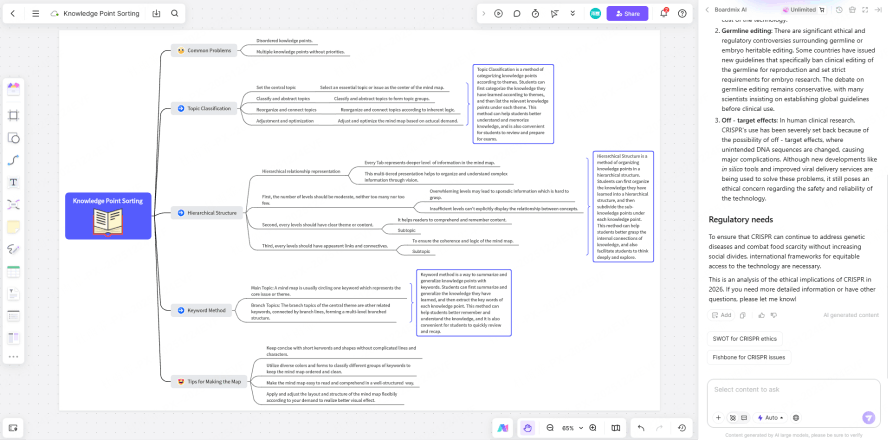
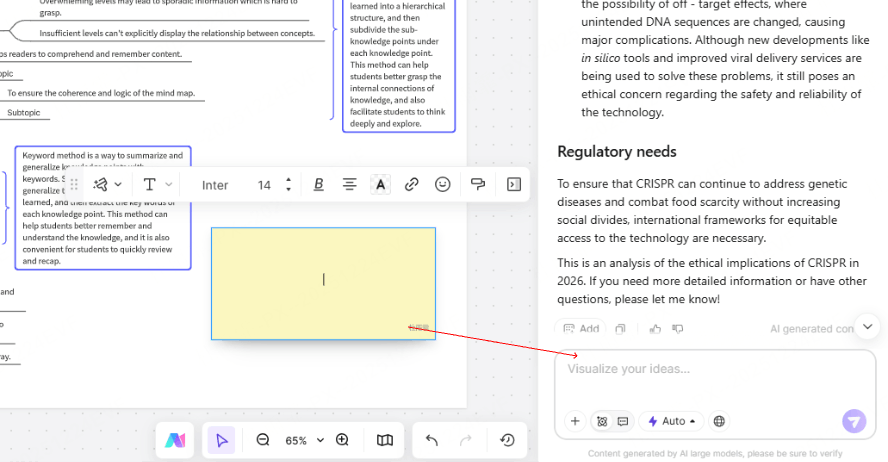
- Step 2: Expand a claim. Add subpoints for evidence, assumptions, and a possible counterargument. A prompt such as “What evidence would be needed to support this claim?” can help you identify research tasks; it is a prompt example, not a dedicated product command.
- Step 3: Draft from checked notes. Choose one claim and its verified source notes. Write a paragraph that explains the claim, cites the evidence, and acknowledges limitations. If you ask AI for a draft, compare every factual statement with the original material.
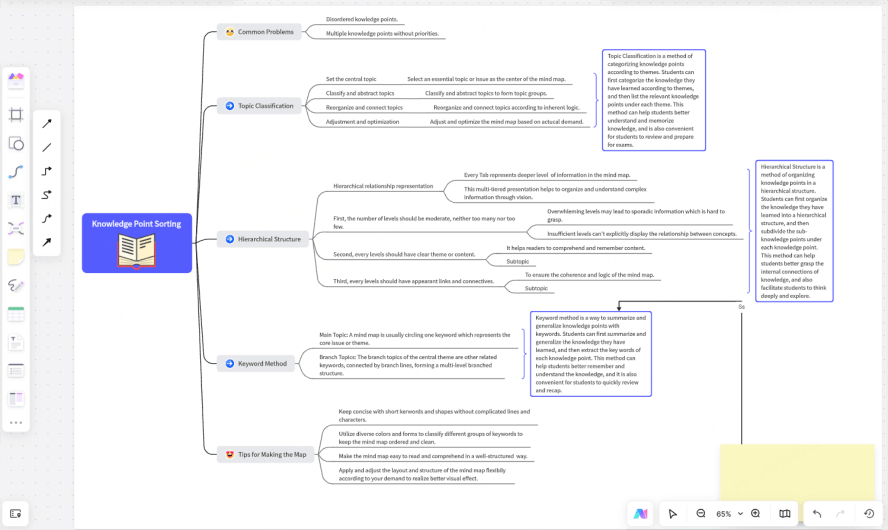
- Step 4: Check the argument. Connect each claim to its supporting source. Mark unsupported claims as research tasks. Read the draft in order to check whether each paragraph advances the thesis and whether a counterargument deserves more space.
Advanced Techniques: How to Make AI Writing Sound More Human
Clear writing reflects your reasoning and the needs of your reader. Read the draft aloud, remove formulaic transitions, and replace vague statements with specific evidence. Vary sentence length when it improves readability; changing a statistical writing pattern is not a way to prove authorship.
- Use the board to try different argument sequences before committing to a draft. Add a personal example only when it is true and relevant to the assignment. Do not invent experience or evidence to make a passage sound more personal.
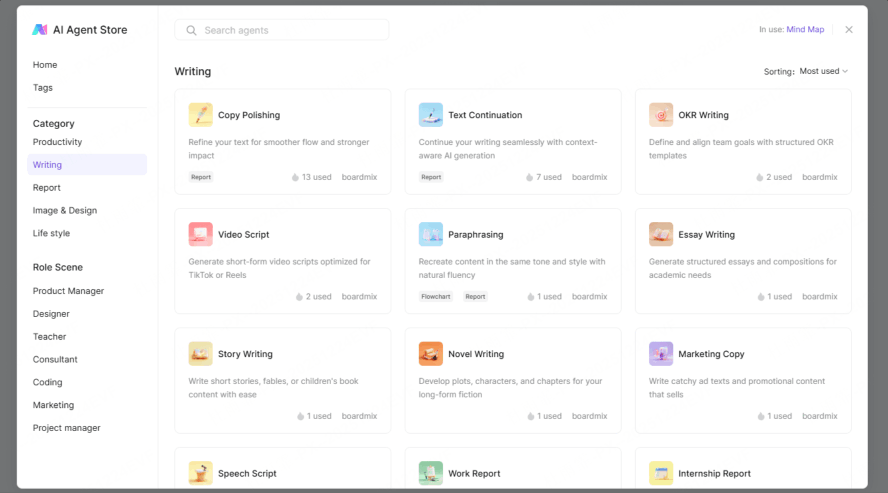
- Write a brief style instruction, such as “Use clear academic language and explain specialist terms.” This is an example prompt rather than a claim about a named voice-cloning feature. Edit the result yourself so the meaning and tone fit your work.
- For a difficult paragraph, ask for a clarity review: “Identify vague claims, long sentences, and missing evidence without adding facts.” Compare the suggestions, rewrite the passage yourself, and retain any required citations.
Solving the Ultimate Academic & Professional Pain Points
Before submitting an AI-assisted essay, review these five areas. They concern the quality of your work and the evidence behind it; no writing tool can guarantee acceptance, accurate citations, or a particular detector result.
- Authorship and policy: Follow your institution’s rules for AI assistance. Retain notes and draft history, and disclose assistance where required. Do not use detector scores as proof that work is original or acceptable.
- Source verification: Keep links and notes next to each claim. Open every cited source, confirm its author and publication details, and check the relevant passage. Uploading a document does not guarantee that an AI response accurately cites or interprets it.
- Argument review: Ask a peer or an AI assistant to identify unstated assumptions and possible counterarguments. Evaluate the suggestions against your sources and revise the argument where the criticism is justified.
- Your own voice: Compare the draft with writing you are comfortable with. Replace generic wording with precise explanations and remove claims you cannot defend. Give a short style instruction when needed; this workflow does not depend on a voice-cloning feature.
- A manageable revision process: Keep a checklist for sources, structure, citations, and final proofreading. Assign each unresolved question an action. Organizing this work can reduce repeated searching, but completion time depends on the research and revision required.
Conclusion
A useful AI-assisted essay workflow begins with a question and ends with your own checked argument. Start a Boardmix board to organize claims and sources, then revise the draft against your assignment criteria. Boardmix Free includes three editable boards, up to 100 objects per board, and 1 GB of storage. AI access and usage allowances vary by plan; see Boardmix pricing.
![[Detailed Guide] Software Engineer Roadmap](https://cms.boardmix.com/images/articles/software-engineer-roadmap.png)