


You finish a book. You feel good about it. Two weeks later, someone asks what it was about — and you’re drawing a blank.
Sound familiar? You’re not alone. Research by Hermann Ebbinghaus on the forgetting curve shows that without active reinforcement, people forget up to 70% of new information within 24 hours. Reading without a structured note-taking strategy is essentially reading to forget.
The good news: knowing how to take reading notes properly changes everything. The right system transforms passive reading into active learning — and turns scattered highlights into a connected knowledge base you actually use.
In this guide, you’ll get five battle-tested reading note methods, a head-to-head comparison table, and a practical workflow using boardmix to visually organize everything.
Why Most Reading Notes Don’t Work
Most people take notes the same way they did in school: copy sentences, highlight passages, scribble margins. Then they close the book and never look at those notes again.
The problem isn’t effort — it’s method.
Passive note-taking creates an illusion of learning. You feel productive while reading, but the information never gets properly encoded. There’s no structure, no connection to what you already know, and no reason to revisit the material.
Effective reading notes share three traits:
- They force you to process, not just copy. Summarizing in your own words activates deeper cognitive engagement.
- They create connections. Ideas linked to other ideas are far easier to recall — and far more useful.
- They’re designed to be revisited. A note nobody reads again is just visual noise.
The five methods below address all three. Each one has a different strength, and the best choice depends on what you’re reading and what you want to do with the knowledge.
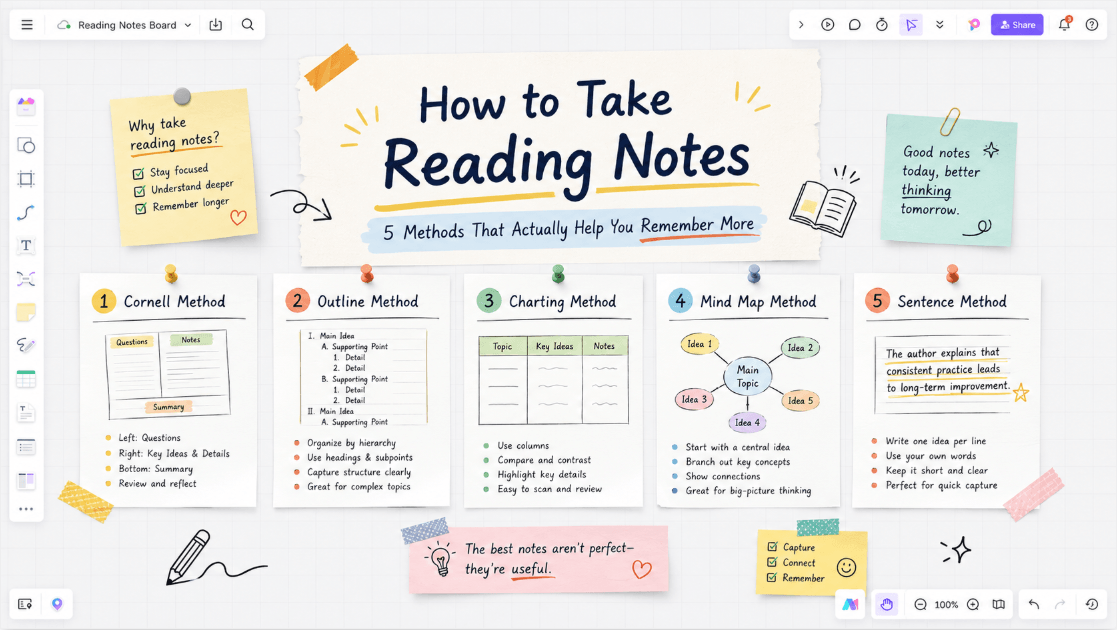
5 Reading Notes Methods That Actually Stick
1. Cornell Note-Taking Method
What it is: Developed at Cornell University, the Cornell method divides each page into three zones — a narrow left column for cues/questions, a wide right column for main notes, and a summary section at the bottom. It’s one of the most research-backed note-taking strategies for retention and review.
When to use it: Non-fiction books, academic texts, anything you’ll need to study or reference repeatedly. It’s especially powerful for dense material where you want to identify key concepts fast.
How to do it — 4 action steps:
- Divide your page. Draw a vertical line about 2.5 inches from the left edge and a horizontal line about 2 inches from the bottom.
- Take notes in the right column during reading. Use bullet points, short phrases, and your own words — not verbatim quotes.
- Fill in the left column after reading. Write questions, keywords, or prompts that correspond to the notes on the right. These become your self-test triggers.
- Write a 3–5 sentence summary at the bottom. Synthesize the main idea of the section without looking at your notes. This is where real encoding happens.
2. Zettelkasten Method (Slip-Box / Card Notes)
What it is: The Zettelkasten method — German for “slip-box” — was famously used by sociologist Niklas Luhmann to produce over 70 books and 400 academic articles. Each idea gets its own atomic note (a “zettel”), written in your own words and linked to related notes. Over time, these interconnected cards become a personal knowledge network rather than a static archive.
When to use it: Long-term knowledge building. If you read across topics — philosophy, business, psychology, history — and want ideas to cross-pollinate, Zettelkasten is unmatched. It’s the go-to method for writers, researchers, and lifelong learners.
How to do it — 4 action steps:
- Capture a single idea per note. One concept, one card. Avoid stuffing multiple ideas into one note — atomicity is the whole point.
- Write it entirely in your own words. No copy-paste. Paraphrasing forces comprehension and makes the note genuinely yours.
- Assign a unique ID and tags. This lets you retrieve and cross-reference notes later, even years down the line.
- Link related notes explicitly. Add references at the bottom of each note: “See also: [Note on cognitive load].” These links are what transform your notes from a list into a living system.
3. Mind Map Notes
What it is: Mind mapping is a visual note-taking strategy that radiates from a central topic outward, with branches representing subtopics and leaves representing supporting details. It mirrors how the brain actually processes information — through association rather than linear sequence. Studies suggest visual organization can improve recall by up to 32% compared to linear notes.
When to use it: Ideal for books with layered structures — self-help, business strategy, creative nonfiction. Also powerful for chapter summaries, book overviews, and brainstorming how ideas connect across chapters.
How to do it — 4 action steps:
- Place the book title or core concept in the center. This is your anchor.
- Draw main branches for each chapter or major theme. Keep labels short — 2 to 4 words maximum per branch.
- Add sub-branches for key ideas, examples, and arguments. Use color-coding to differentiate concept types (e.g., blue for definitions, orange for examples).
- Review and connect. After finishing the book, look for cross-connections between branches. Draw linking arrows where ideas from different chapters reinforce each other.
With boardmix’s AI mind map tool, you can build and expand mind maps in seconds — paste in your highlights and let the AI structure them automatically.
4. SQ3R Method
What it is: SQ3R stands for Survey, Question, Read, Recite, Review — a structured active reading framework developed by education psychologist Francis Robinson in 1946. It’s not just a note format; it’s a complete reading protocol. By engaging with the material before, during, and after reading, SQ3R dramatically improves comprehension and long-term retention.
When to use it: Textbooks, instructional guides, research papers, or any book where deep understanding matters more than speed. It’s particularly effective when you need to apply what you’ve read — not just remember it abstractly.
How to do it — 4 action steps:
- Survey first. Skim the chapter: read headings, subheadings, bold text, the intro, and the summary. Build a mental map before you start reading word-for-word.
- Turn each heading into a question. “Types of learning” becomes “What are the types of learning and how do they differ?” This primes your brain to read with purpose.
- Read to answer your questions. Don’t just absorb — actively hunt for answers. Take brief notes as you go.
- Recite and review. After each section, close the book and explain the key points out loud or in writing. At the end of the chapter, review all your questions and answers to reinforce connections.
5. Feynman Technique
What it is: Named after Nobel Prize-winning physicist Richard Feynman, this method is built on a deceptively simple premise: if you can’t explain it simply, you don’t understand it yet. You take notes by writing out concepts as if you’re teaching them to someone who has never encountered the subject before.
When to use it: Perfect for complex, technical, or abstract material — philosophy, science, economics, dense theory. It’s also excellent as a post-reading audit: after finishing a chapter, use the Feynman Technique to identify exactly where your understanding breaks down.
How to do it — 4 action steps:
- Write the concept name at the top of a blank page. Be specific — not “quantum mechanics” but “why electrons don’t fall into the nucleus.”
- Explain it in plain language, as if teaching a curious 12-year-old. No jargon. No hedging. If you reach for technical terms, that’s a flag.
- Identify the gaps. Wherever your explanation gets vague, repetitive, or circular — that’s exactly what you don’t understand yet. Go back to the source material and dig deeper.
- Simplify and use analogies. Rewrite your explanation using a real-world comparison. The ability to generate a good analogy is the clearest signal of genuine understanding.
Comparison Table: Which Reading Note Method Is Right for You?
| Method | Best For | Effort Level | Ideal Format | Key Strength |
|---|---|---|---|---|
| Cornell Notes | Academic/structured texts | Medium | Paper or digital template | Fast review and self-testing |
| Zettelkasten | Long-term knowledge building | High | Digital cards with links | Idea connection across topics |
| Mind Map | Visual thinkers, overviews | Low–Medium | Visual canvas | Shows relationships at a glance |
| SQ3R | Deep comprehension | Medium–High | Any reading format | Active engagement before/during/after |
| Feynman Technique | Complex or abstract concepts | Medium | Free-writing format | Exposes and fixes knowledge gaps |
How to Organize Reading Notes Visually with boardmix
Taking great notes is only half the job. The other half is organizing them so you can actually find, use, and build on them later. That’s where visual organization pays dividends — and where boardmix’s online whiteboard genuinely changes the game.
Here’s how readers use boardmix to elevate their note-taking workflow:
Build a book knowledge map. Create a dedicated boardmix canvas for each book. Drop in your Cornell notes, mind map branches, Feynman write-ups, and Zettelkasten-style cards — all in one visual space. Use color-coded sticky notes to tag ideas by theme, then connect related concepts with arrows.
Use ready-made templates. boardmix’s template library includes Cornell note templates, mind map layouts, SQ3R reading frameworks, and more. You don’t have to build from scratch — just open a template and start filling it in.
Link notes across books. Unlike paper notebooks, boardmix lets you embed links, reference other canvases, and create a visual “knowledge graph” across everything you’ve read. Your Zettelkasten, but make it visual.
Collaborate on shared reading. Book club? Study group? Team learning initiative? Share your boardmix canvas and let others add their own annotations, questions, and connections in real time.
Build a Personal Note-Taking Workflow with AI
The most powerful shift in modern reading note-taking isn’t a method — it’s the integration of AI into the workflow. boardmix’s built-in AI Assistant lets you streamline the entire process from raw highlights to structured knowledge.
Here’s a practical AI-powered reading workflow:
Step 1 — Capture raw notes during reading. Don’t overthink it. Highlight key passages, jot quick reactions, and copy memorable quotes into your boardmix canvas as you go.
Step 2 — Use AI to generate a mind map. Paste your raw highlights into boardmix’s AI mind map tool. In seconds, the AI organizes your notes into a structured visual map — identifying themes, grouping related ideas, and suggesting connections you might have missed.
Step 3 — Apply the Feynman filter. Ask boardmix’s AI Assistant: “Explain this concept in simple terms” or “What’s the gap in this reasoning?” Use its response as a benchmark against your own explanation.
Step 4 — Create a summary card. Use boardmix to generate a one-page visual summary — the book’s core argument, three key takeaways, and two actionable next steps. This becomes your permanent reference card.
Step 5 — Review and connect. Once a week, revisit your boardmix library. Look for new connections between books. Let the visual overview surface ideas that reinforce, contradict, or extend each other.
This isn’t just faster. It’s a fundamentally different relationship with the material — one where knowledge compounds rather than evaporates.
Conclusion
Knowing how to take reading notes is one of the highest-leverage skills a reader can develop. The difference between a book that changes how you think and one that disappears from memory within a month often comes down to a single thing: whether you had a system.
The five methods in this guide — Cornell Notes, Zettelkasten, Mind Map, SQ3R, and the Feynman Technique — each offer a different angle on the same goal: helping knowledge stick, connect, and grow. You don’t need to use all five. Start with one that matches your reading style, commit to it for a month, and see what changes.
And when you’re ready to turn those notes into a visual, searchable, AI-powered knowledge base — boardmix is built exactly for that.
Try boardmix free today and bring your reading notes to life on an intelligent, visual canvas — no credit card required.